30 Days Rebuilding Our AI Content Strategy

A 30-day rebuild of an AI content strategy should focus less on publishing volume and more on usefulness, originality, evidence, and search visibility. Without first-party NewsBolts Search Console data, it would be misleading to claim specific traffic gains from a 30-day experiment. Instead, this article presents a practical 30-day methodology for rebuilding an AI-assisted content operation around Google's current guidance for people-first and generative search content.

Why We Decided to Rebuild the Strategy
AI makes it possible to produce articles much faster.
That is useful for a publisher.
But speed creates a difficult question:
What happens when producing content becomes easier than producing genuinely valuable content?
A newsroom or publishing team can generate dozens of drafts quickly.
The harder part is deciding which topics deserve coverage, what original value the article provides, which sources support the claims, and whether the finished page actually helps readers.
Google's current guidance emphasizes helpful, reliable, people-first content and specifically warns against creating large amounts of content primarily to attract search traffic.
That changes how an AI content strategy should be designed.
The objective should not be:
"How can we publish more AI content?"
It should be:
"How can AI help us produce better content while preserving editorial judgment?"
What Changed in the Strategy
The rebuild can be summarized in five changes.
Before: Topic volume was the primary production goal.
After: Topic relevance became the first filter.
Before: AI generated much of the initial structure.
After: Evidence and editorial intent came first.
Before: Optimization was treated mainly as an SEO task.
After: Search optimization became part of the publishing workflow.
Before: Articles were evaluated individually.
After: Content was evaluated as part of a broader topical and editorial system.
Before: AI was primarily viewed as a writing tool.
After: AI became a workflow assistant operating under human editorial control.
This distinction matters because Google's guidance says SEO can be useful when applied to people-first content rather than content created primarily for search engines.
Day 1–5: Audit What Already Exists
The first stage of a 30-day rebuild should not involve creating new articles.
It should involve understanding the existing content.
Start by reviewing:
Published articles
Search impressions
Clicks
Search queries
Top-performing pages
Pages receiving little or no traffic
Older articles
Duplicate topics
Thin articles
Articles without clear sources
Articles that no longer match search intent
Google recommends reviewing which pages and types of searches are affected when analyzing search performance changes.
The purpose of the audit is to find patterns.
For example, perhaps some articles receive impressions but few clicks.
Perhaps certain topics consistently perform better.
Perhaps several articles target almost identical questions.
Perhaps some pages contain useful information but lack clear structure.
These observations should guide the rebuild.
Create a Content Classification System
A simple classification system makes the audit easier.
Every article can be placed into one of four groups.
Keep
The article is useful, accurate, relevant, and worth maintaining.
Improve
The topic is valuable, but the article needs better evidence, structure, originality, or updating.
Consolidate
Several articles cover substantially similar topics and may be better handled through a stronger primary resource.
Remove or Retire
The content has little continuing value and does not justify continued maintenance.
The important point is that an AI content strategy should not assume every existing article needs to be preserved.
Day 6–10: Rebuild Topic Selection
The next change is to stop treating keywords as the complete content strategy.
Keywords remain useful.
But a keyword does not explain everything about a topic.
For every proposed article, ask:
Who is searching for this?
What problem are they trying to solve?
What information do existing results provide?
What information is missing?
What can our publication contribute?
What evidence can we provide?
What would make the article worth bookmarking or sharing?
Google's people-first guidance asks whether content provides original information, reporting, research, or analysis and whether it offers substantial value compared with other pages.
That gives publishers a better content-selection framework.
The NewsBolts Content Value Test
Before approving a topic, use five questions.
Audience
Does our target reader actually need this information?
Evidence
Can we support the important claims?
Expertise
Do we have knowledge or experience that adds value?
Originality
What will this article provide that a generic summary will not?
Utility
Will the reader be able to do something useful after reading it?
If the answer to most of these questions is no, the topic may not deserve production.
Day 11–15: Change How AI Is Used
The biggest strategic change should be moving AI away from being treated as an automatic article generator.
Instead, AI can support multiple stages.
For example:
Research organization
↓
Source comparison
↓
Question identification
↓
Content structure
↓
Draft assistance
↓
Editing assistance
↓
SEO suggestions
↓
Content repurposing
The human editorial team remains responsible for the important decisions.
This creates a human-governed workflow rather than an autonomous publishing system.
AI Should Start With Evidence
One of the strongest improvements is to provide evidence before drafting.
Instead of:
Topic → AI article
Use:
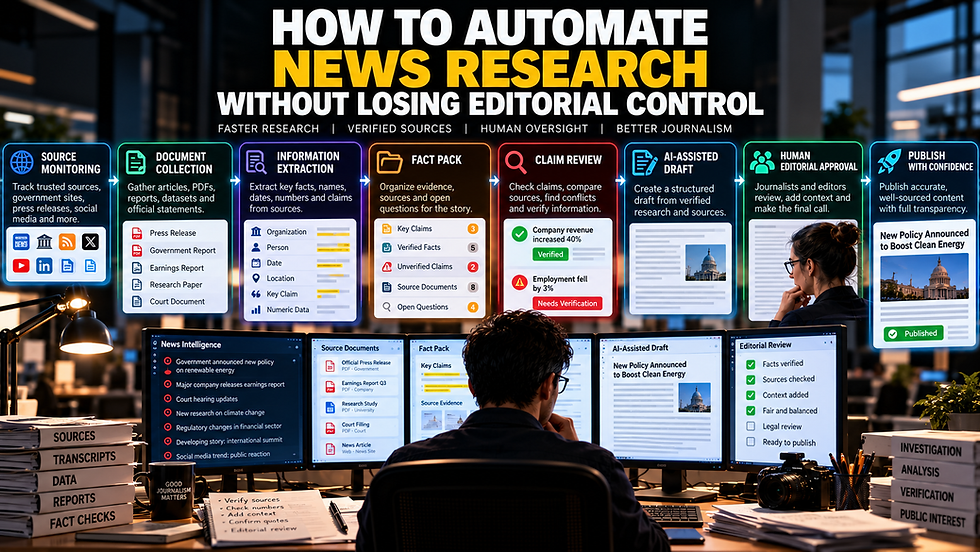
Topic → Sources → Evidence → Structure → AI assistance → Human review → Article
This small change can significantly improve editorial discipline.
A Fact Pack can be useful here.
A Fact Pack can contain:
Verified facts
Source links
Important dates
Names
Numbers
Quotes
Supporting documents
Unverified claims
Open questions
Editorial notes
The AI can then work from the evidence rather than generating an article from a vague topic.
Day 16–20: Rebuild Article Structure
The next stage is to improve how articles answer questions.
A strong article should make the main answer easy to find.
Start with a concise explanation of the topic.
Then answer the most important questions.
Then provide supporting detail.
Then address limitations, examples, comparisons, or practical steps.
This structure is particularly useful for AI search experiences because users increasingly ask longer and more specific questions and may ask follow-up questions. Google recommends providing useful, unique content and ensuring that important information is accessible and understandable.
The goal is not to write for an AI system instead of people.
The goal is to make the article clear enough for both.
Build Articles Around Questions
Instead of building an article around a list of keywords, build it around the reader's information journey.
For example:
What is the topic?
Why does it matter?
How does it work?
What are the main options?
What are the risks?
What should a publisher do?
What mistakes should be avoided?
What should happen next?
This creates a more complete resource than repeating the primary keyword throughout the article.
Day 21–25: Improve Originality
This is where many AI content strategies fail.
AI can summarize existing information extremely well.
But summarization alone does not necessarily give readers a reason to choose one article over another.
The rebuilt strategy should therefore add original-value elements.
Examples include:
Publisher-focused frameworks
Decision matrices
Editorial workflows
Original checklists
Practical examples
Comparisons
Technical diagrams
First-party observations
Original calculations
Methodologies
If first-party data is available, publish it responsibly.
If it is not available, do not manufacture a case study.
Instead, create a research opportunity.
NewsBolts Research Opportunity
A future NewsBolts study could analyze a defined sample of articles before and after an AI content workflow change.
The study could measure:
Production time
Editorial review time
Corrections
Search impressions
Clicks
Query coverage
Content updates
Reader engagement
The methodology, sample size, dates, and limitations should be documented before making any performance claim.
Day 26–28: Connect SEO With Editorial Quality
SEO should not be treated as a separate final-stage activity.
It should be connected to the article from the beginning.
Review:
Search intent
Page title
Main heading
Supporting headings
Internal links
Image alt text
Metadata
Structured data
Author information
Source quality
Content freshness where relevant
Google's Search Essentials continues to emphasize helpful, reliable, people-first content while also recommending that publishers use words people search for in prominent and descriptive locations.
The important distinction is that SEO should help search engines understand useful content.
It should not determine what the content says.
Search Optimization for AI Experiences
Google's current guidance says its generative AI search experiences are built on core Search systems and can use retrieved web pages to ground AI responses. Google also emphasizes unique, valuable, non-commodity content.
That means publishers should focus on fundamentals rather than trying to discover a secret "AI ranking trick."
A stronger approach is:
Clear answers
Strong evidence
Useful structure
Original information
Good page experience
Accessible content
Consistent publishing quality
Day 29: Review Technical Discoverability
A content strategy cannot succeed if search engines cannot properly access the pages.
Review:
Indexability
Crawl accessibility
Canonical URLs
Internal linking
XML sitemap
Robots directives
Page rendering
Mobile usability
Structured data
Page experience
Google explains that websites need to meet technical requirements so Google can find, crawl, index, and consider pages for Search.
This is particularly important for publishers because a strong article is not useful in search if technical problems prevent proper discovery or indexing.
Day 30: Measure the Rebuild
The final day should be about measurement.
Do not ask only:
"Did traffic increase?"
Ask a broader set of questions.
Visibility
Are important pages receiving impressions?
Query Relevance
Are pages appearing for queries related to their actual purpose?
Clicks
Are searchers clicking when the page appears?
Content Quality
Are editors seeing fewer major problems during review?
Production Efficiency
Is the newsroom spending less time on repetitive work?
Original Value
Are articles adding information that competitors or generic AI summaries do not provide?
Editorial Quality
Are corrections and unsupported claims decreasing?
The measurement period should be long enough to produce meaningful evidence.
A 30-day rebuild can establish a process and create early signals.
It should not automatically be treated as proof of long-term ranking performance.
Before and After: The Strategic Difference
Old Approach | Rebuilt Approach |
Publish more | Publish with purpose |
Keyword first | Audience first |
AI drafts first | Evidence first |
Generic summaries | Original value |
SEO at the end | SEO throughout |
Volume as a KPI | Quality and efficiency |
AI as writer | AI as assistant |
Human proofreading | Human editorial governance |
Individual articles | Connected content system |
What Actually Changed?
The biggest change was not the AI tool.
It was the workflow.
AI itself does not automatically create a better content strategy.
The surrounding system determines whether AI becomes useful infrastructure or simply a faster way to produce more average content.
A stronger system creates boundaries.
AI can organize.
AI can summarize.
AI can suggest.
AI can draft.
AI can repurpose.
Humans verify.
Humans edit.
Humans decide.
Humans publish.
Common Mistakes During an AI Content Rebuild
Publishing More Because AI Makes It Easier
Lower production cost does not automatically create higher reader value.
Removing Human Review
AI-assisted content still requires appropriate editorial oversight.
Creating Dozens of Similar Pages
Google's current guidance warns against producing large amounts of content primarily to manipulate search results, including using extensive automation for search-engine-first content.
Writing About Every Trending Topic
A publisher should have a clear audience and purpose instead of chasing every available search opportunity.
Rewriting Competitor Content
Changing wording without adding meaningful value creates another version of the same information.
Measuring Only Traffic
Traffic can increase or decrease for many reasons.
A serious content strategy should examine visibility, relevance, quality, efficiency, and business outcomes together.
Treating AI Visibility as a Separate SEO Trick
Google's current guidance says traditional SEO remains relevant to generative AI search experiences.
The fundamentals still matter.
The NewsBolts 30-Day Framework
The complete framework can be summarized in four phases.
Phase 1: Diagnose
Audit existing content, search performance, technical accessibility, and editorial quality.
Phase 2: Rebuild
Change topic selection, evidence collection, AI usage, and article structure.
Phase 3: Strengthen
Add original value, improve internal connections, improve technical discoverability, and strengthen editorial review.
Phase 4: Measure
Track search visibility, query relevance, production efficiency, corrections, engagement, and business outcomes.
This framework turns AI content strategy into an operating process rather than a collection of prompts.
How NewsBolts Fits Into the Model
NewsBolts is positioned as a Human-Governed AI Newsroom Operating System.
Its role in this type of strategy is not to replace journalists.
The useful model is to connect newsroom stages that are often separated.
News intelligence can feed research.
Source verification can support evidence collection.
Fact Packs can organize important information.
AI-assisted drafting can support production.
Human editorial approval can control publication.
SEO, GEO, and AEO workflows can support discovery.
Analytics can provide feedback.
Content repurposing can extend approved journalism into other formats.
The principle remains the same:
AI supports the newsroom.
Humans govern the newsroom.
What Publishers Should Do Next
Publishers considering an AI content rebuild should start with their existing content rather than immediately buying more tools.
Review the last several months of published work.
Identify which topics attracted meaningful attention.
Identify which articles provided original value.
Find pages that overlap.
Find articles that need stronger sourcing.
Find repetitive production tasks.
Then choose one workflow to improve.
Document the process before changing it.
Measure the process after changing it.
Keep what works.
Remove what does not.
Then expand.
This approach produces better evidence than assuming an AI tool will automatically improve search performance.
The Bigger Lesson
The biggest lesson from rebuilding an AI content strategy is that the difficult part is not generating text.
Text generation is increasingly easy.
The difficult part is deciding what deserves to be published, what evidence supports it, what makes it useful, and how the newsroom can maintain quality at scale.
Google's guidance increasingly emphasizes the same fundamental direction: create content that is useful, reliable, unique, and designed primarily for people.
That means the future of AI content strategy is unlikely to be about simply producing more pages.
It is about building better systems for producing valuable pages.
FAQs
Did Google stop rewarding AI-generated content?
No. Google has stated that its focus is on the quality and purpose of content rather than simply whether AI was used to produce it. However, using automation primarily to manipulate search rankings can violate Google's spam policies.
What should publishers change first when rebuilding an AI content strategy?
Start with an audit of existing content. Review search performance, content quality, overlapping topics, source quality, and technical accessibility before increasing production.
Does AI content need human review?
For publishers using AI in editorial workflows, human review is important for verifying facts, context, sources, quotations, and editorial decisions.
How can AI content become more original?
Add information that a generic AI system cannot simply reproduce from existing web pages. This can include first-party research, original analysis, publisher frameworks, documented processes, practical examples, and proprietary data when legitimately available.
Does traditional SEO still matter for AI search?
Yes. Google's current guidance says SEO best practices remain relevant because generative AI search experiences are connected to Google's core Search systems.
Should publishers create separate pages for every related search query?
Not simply to capture more searches. Google warns against creating large amounts of content primarily to manipulate search rankings or AI responses. Publishers should create pages when they genuinely serve a user need.
Can a 30-day experiment prove that a new AI content strategy works?
A 30-day period can help establish a workflow and identify early signals, but it is not enough by itself to prove long-term organic performance. Publishers should document methodology, account for limitations, and continue measuring after the initial period.
What is the most important change in an AI content strategy?
The most important change is moving from an AI-first production model to an evidence-first, people-first workflow in which AI assists production while humans remain responsible for editorial quality.
Conclusion
Rebuilding an AI content strategy is not primarily about choosing a better AI model.
It is about changing the system around the technology.
The stronger model is:
Audience
↓
Topic
↓
Evidence
↓
AI assistance
↓
Human editorial review
↓
Original value
↓
SEO and technical optimization
↓
Publication
↓
Measurement
The purpose of the 30-day framework is to make that process repeatable.
For NewsBolts, the long-term opportunity is to connect these stages through a Human-Governed AI Newsroom Operating System that supports publishers without removing editorial authority from the people responsible for the journalism.
The lesson is simple.
Use AI to make the newsroom more capable, not simply more prolific.


Comments