AI Editorial Workflow: From Research To Draft To Human Approval

An AI editorial workflow uses AI to assist with research, organization, drafting, metadata, and other repeatable newsroom tasks while keeping verification, editorial judgment, and final publication decisions under human control. The strongest workflow is not AI → Publish. It is Research → Evidence → Draft → Human Review → Approval → Publish → Learn.
Newsrooms are under constant pressure to work quickly.
A breaking story can change within minutes. Editors may need to review several sources, organize facts, produce a draft, prepare headlines and metadata, publish the article, and then update it as new information arrives.
AI can assist with parts of that process.
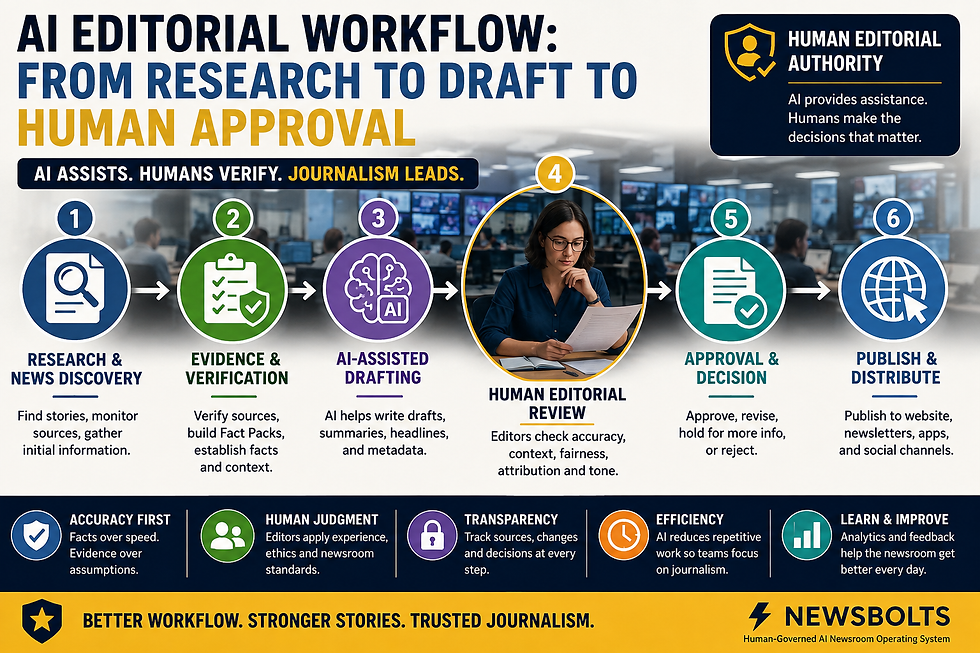
But speed creates a problem when every stage becomes automated without clear controls.
A generated draft can sound authoritative while containing unsupported details. A summary can omit an important qualification. A headline can exaggerate what the evidence actually establishes. A translation can alter meaning. A system can also make it difficult to determine who approved a claim if the workflow has no audit trail.
The solution is not necessarily to avoid AI.
The better approach is to design the workflow so that AI has a defined role and humans have defined decision rights.
That is the foundation of a responsible AI editorial workflow.
What Is An AI Editorial Workflow?
An AI editorial workflow is a structured newsroom process in which artificial intelligence assists specific editorial or production tasks while people remain responsible for appropriate decisions.
The workflow can include:
News discovery
Research organization
Source comparison
Summarization
Fact Pack preparation
Draft generation
Headline suggestions
SEO metadata
Translation
Content repurposing
Editorial review
Publishing
Performance analysis
The important distinction is between assistance and authority.
AI can help prepare information.
A journalist or editor decides whether that information is sufficiently reliable for publication.
The Associated Press provides a useful real-world example of this principle. Its July 2026 newsroom standards state that AI can assist journalists with specific tasks, while editorial judgment, verification, and accountability remain the responsibility of AP journalists. AP also says AI-generated output is reviewed and edited before publication.
That principle can be applied more broadly:
AI can participate in the editorial workflow without becoming the editorial authority.
Why The Workflow Matters
The biggest mistake is to think about AI as a writer that sits at the end of the newsroom process.
In practice, writing is only one stage.
A news story begins with information.
That information needs to be evaluated.
Claims need evidence.
Sources need context.
The story needs an editorial angle.
The draft needs review.
The final version needs publication.
The published article may then need updates and corrections.
An AI system inserted into only the drafting stage can therefore solve one part of a larger problem.
A properly designed workflow looks at the entire chain.
Google's current guidance similarly emphasizes accuracy, quality, relevance, originality, and people-first content when AI is used to assist with web content. Google warns against using generative AI to produce large quantities of pages without adding value.
For publishers, this means AI should be used to improve the quality and efficiency of the editorial process, not simply increase the number of articles produced.
The Core AI Editorial Workflow
The complete process can be represented simply:
Research → Evidence → AI Draft → Human Review → Editorial Decision → Publish → Analytics → Learning
Each stage answers a different question.
Research: What is happening?
Evidence: What can we establish?
AI Draft: How can the verified material be organized efficiently?
Human Review: Is the draft accurate, fair, clear, and appropriate?
Editorial Decision: Should this be published, changed, held, or rejected?
Publish: Where and when should it appear?
Analytics: How did the published content perform?
Learning: What should the newsroom improve?
This structure is more useful than simply describing an AI writing tool because it defines the responsibility of every stage.
Stage 1: Research And News Discovery
Every editorial workflow begins with information gathering.
Depending on the newsroom, research can involve:
News feeds
Official statements
Public records
Government websites
Company announcements
Social platforms
Interviews
Documents
Previous reporting
Search trends
Internal newsroom databases
AI can help organize this information.
For example, it can assist with:
Grouping related documents
Summarizing long documents
Identifying repeated themes
Extracting dates and names
Comparing multiple documents
Highlighting potentially relevant passages
Creating research notes
But discovery is not verification.
A system finding a claim does not make the claim true.
That distinction should be built into the workflow from the beginning.
Stage 2: Evidence And Verification
This is where an AI editorial workflow becomes significantly different from a generic AI content workflow.
Before drafting, the newsroom should know what evidence supports the important claims.
A Fact Pack can provide a structured editorial evidence layer containing information such as:
Source
Claim
Supporting evidence
Date
Context
Verification status
Uncertainty
Notes for the editor
The Fact Pack does not need to become another long document.
Its purpose is to make the evidence behind the story easier to inspect.
The workflow becomes:
Research → Source Review → Fact Pack → Draft
This gives the AI a more controlled information environment.
The AI should not be treated as the source of truth.
The underlying evidence should remain the source of truth.
The Associated Press similarly states that generative AI output should be treated as unvetted source material and that journalists must apply editorial judgment and sourcing standards before publication.
That is an important principle for any AI-assisted newsroom.
Stage 3: AI-Assisted Drafting
Once the evidence has been organized, AI can become useful as a production assistant.
It can help with:
Creating an initial draft
Organizing information
Turning notes into coherent sections
Suggesting headlines
Creating summaries
Suggesting SEO metadata
Producing alternate versions
Preparing social copy
Translating approved material
Repurposing an article into other formats
But the prompt should not simply be:
“Write a news article about this topic.”
A better workflow provides controlled editorial inputs.
The AI can be instructed to work from:
Approved facts
Verified sources
Defined audience
Editorial angle
Required terminology
Known uncertainties
Publication format
House style
This reduces the chance that the AI will fill gaps with unsupported information.
It does not eliminate that risk.
The resulting draft still needs human review.
Stage 4: Human Editorial Review
Human review is not a final spelling check.
It is the stage where the newsroom decides whether the AI-assisted output is acceptable.
An editor should examine at least five dimensions.
Accuracy
Are the factual claims supported?
Attribution
Does the article clearly identify who said or established something?
Context
Has important context been omitted?
Framing
Does the headline or wording overstate the evidence?
Editorial judgment
Should the story be published in this form at all?
The editor should also look for things that sound plausible but cannot be supported.
These are particularly dangerous because fluent writing can make weak claims appear credible.
The purpose of human review is therefore not to “approve the AI.”
It is to evaluate the journalism.
Stage 5: Editorial Approval And Publishing
After review, the editor makes a decision.
Possible outcomes include:
Approve → Publish
Revise → Review Again
Hold → Gather More Evidence
Reject → Do Not Publish
This is an important design improvement.
A newsroom should not treat review as a binary button that says “AI looks good.”
The editorial decision can have multiple outcomes.
This also creates a more useful audit trail.
If a story was held because a source could not be independently verified, that reason can remain part of the workflow record.
If the story was revised because an AI-generated claim lacked evidence, the workflow can record that as well.
The CMS should receive the content only when it reaches the appropriate publishing state.
The NewsBolts Editorial Control Framework
NewsBolts can frame the workflow around six control questions.
1. Source Control
Where did the information come from?
The newsroom should know the origin of important claims.
2. Evidence Control
What supports the claim?
Evidence should be accessible to the journalist or editor.
3. AI Control
What task is AI performing?
AI should have a defined function rather than unrestricted editorial authority.
4. Review Control
Who reviewed the output?
The workflow should make human responsibility visible.
5. Publishing Control
Who can authorize publication?
Technical publishing permissions should reflect editorial permissions.
6. Learning Control
What happened after publication?
Performance, corrections, reader feedback, and editorial observations should inform future workflows.
Together, these create:
Source → Evidence → AI Assistance → Human Review → Approval → Publishing → Learning
That is the NewsBolts perspective: the workflow governs the AI, rather than the AI governing the workflow.
What AI Should And Should Not Do
Not every newsroom task has the same risk.
Task | AI Role | Human Control |
Document summarization | Strong assistance | Review source context |
Research organization | Strong assistance | Verify important claims |
Headline suggestions | Assistance | Editor selects final headline |
SEO metadata | Assistance | Editor reviews accuracy and relevance |
Translation | Assistance | Human review for important content |
Article drafting | Assistance | Full editorial review |
Source credibility decision | Limited assistance | Human decision |
Sensitive allegation | Limited assistance | Human verification and judgment |
Final publication | Automation may execute | Human authorization |
Corrections | Assistance with identification | Human editorial decision |
The exact risk classification will vary by newsroom.
The principle is more important than the specific table:
The higher the editorial consequence, the stronger the human control should be.
Why Human Approval Does Not Have To Mean Slow Approval
One objection is that human review defeats the purpose of AI.
That is only true if the review process itself is poorly designed.
A good editorial workflow can make review faster by presenting editors with the information they actually need.
Instead of giving an editor a long AI-generated draft and asking:
“Is this correct?”
the system can surface:
Key claims
Supporting sources
Unverified statements
AI-generated sections
Changes from source material
Missing attribution
Sensitive terms
Publication status
The editor can then concentrate on decisions rather than reconstructing the entire research process.
This is where workflow design matters more than raw model speed.
Reuters Institute research published in 2025 found that public comfort with AI-assisted news rises when humans remain meaningfully involved, while also identifying concerns around transparency and trust.
Human oversight therefore needs to be more than a label.
It needs to be an operational function.
Common Mistakes
Treating AI output as evidence
AI-generated text is an output, not independent verification.
Reviewing only grammar
A grammatically perfect article can still contain unsupported claims.
Giving AI unrestricted source access
Not every document or database should automatically be available to every AI system.
Allowing AI to decide publication
The system should not confuse content generation with editorial authorization.
Reviewing every article identically
A routine evergreen article and a developing breaking-news story do not carry the same risk.
Hiding uncertainty
If the evidence is incomplete, the workflow should preserve that uncertainty rather than encouraging the AI to produce a definitive statement.
Creating too much automation
More automation can create more failure points if no one understands where responsibility sits.
Failing to record editorial decisions
If the newsroom cannot determine why an article was approved, changed, or held, improving the process becomes harder.
A Risk-Based Review Model
A useful approach is to classify stories by editorial risk.
Risk Level | Example | AI Assistance | Human Review |
Low | Routine background article | Broad | Standard review |
Medium | Time-sensitive industry development | Moderate | Detailed fact review |
High | Allegation involving a person or organization | Limited | Deep verification |
Critical | Major breaking event or potentially harmful claim | Highly restricted | Senior editorial oversight |
This is a framework rather than a universal newsroom policy.
The value is that it prevents the newsroom from applying exactly the same review process to every story.
A low-risk task may need a quick editorial check.
A high-risk story may require source-by-source verification and senior approval.
NIST's AI Risk Management Framework emphasizes defining human oversight and documenting AI risks and controls according to the system's context and intended use.
That principle translates naturally into editorial workflows.
Editorial Review Checklist
Before publishing an AI-assisted article, editors can ask:
Are the important claims supported by reliable sources?
Did the AI introduce any unsupported facts?
Are names, dates, locations, and numbers correct?
Is attribution clear?
Does the article distinguish facts from claims and opinions?
Has important context been removed?
Does the headline accurately represent the evidence?
Are quotes authentic and correctly attributed?
Are sensitive claims independently verified?
Has uncertainty been preserved where necessary?
Is the article original rather than a superficial rewrite?
Is the tone appropriate?
Are SEO elements accurate?
Has a human editor approved the final version?
Is the publishing status correctly recorded?
This checklist is intentionally simple.
The purpose is to support editorial judgment, not replace it.
Risks And Limitations
AI editorial workflows have real limitations.
AI can introduce factual errors
A model can produce information that sounds plausible but is unsupported.
Human review can become superficial
If editors are overloaded, “human-in-the-loop” can become a checkbox rather than meaningful oversight.
Automation can create hidden dependencies
A workflow may depend on multiple AI models, APIs, databases, and publishing systems.
A failure in one component can affect the final output.
Source quality remains critical
AI cannot compensate for weak underlying evidence.
AI can amplify framing problems
If the source material is incomplete or biased, an AI system may reproduce the underlying framing rather than challenge it.
Disclosure may be appropriate
Google recommends considering how to give users context about how content was created when automation or AI plays a substantial role.
The appropriate disclosure approach depends on the publisher, jurisdiction, editorial policy, and nature of the AI use.
How Publishers Should Implement The Workflow
Publishers do not need to automate the entire newsroom at once.
Start with one repeatable workflow.
Step 1: Identify the bottleneck
Find the stage consuming disproportionate staff time.
It might be:
Research organization
Transcription
Summarization
Draft preparation
Metadata
Repurposing
Step 2: Define the AI task
Do not say:
“AI will handle the article.”
Say:
“AI will summarize approved source documents.”
Or:
“AI will generate headline options from the approved article.”
The second approach creates a measurable boundary.
Step 3: Define the evidence layer
Determine what source material AI can use.
Step 4: Define the human decision
Specify exactly where the editor must intervene.
Step 5: Connect the publishing system
Only after the editorial workflow is clear should automation connect to the CMS.
Step 6: Add monitoring
Track failures, revisions, corrections, and manual interventions.
Step 7: Review the workflow itself
The newsroom should periodically ask:
Is AI actually reducing repetitive work?
Are editors spending more time checking AI output than they previously spent doing the task?
Are errors increasing or decreasing?
Are important editorial decisions still clearly owned by humans?
That last question should never be removed from the process.
A Practical NewsBolts Architecture
For a publisher building a Human-Governed AI Newsroom Operating System, the workflow can be represented as:
News Intelligence → Source Verification → Fact Pack → AI Assistance → Human Editorial Review → CMS → Publishing → Analytics → Editorial Learning
The important control point is not the AI model.
It is the editorial decision layer.
The AI can assist before review.
The CMS can execute publication after approval.
Analytics can provide feedback afterward.
But the human editorial layer connects evidence to accountability.
That architecture also makes it easier to replace individual AI tools without redesigning the entire newsroom.
If one model changes, the editorial process can remain.
What Publishers Should Measure
A publisher should measure more than the number of AI-generated drafts.
Useful metrics include:
Workflow efficiency
Time from research to draft
Time spent on repetitive tasks
Review time
Approval time
Manual interventions
Editorial quality
Corrections
Factual errors caught during review
Unsupported claims
Attribution problems
Headline revisions
Governance
Percentage of AI-assisted stories receiving human approval
Stories escalated for additional verification
High-risk stories receiving senior review
AI workflow exceptions
Publishing performance
Publication speed
Update frequency
Search performance
Audience engagement
Distribution performance
The most useful measurement question is not:
“How much content did AI produce?”
It is:
“Did the workflow help the newsroom produce reliable journalism more efficiently?”
What Publishers Should Do
Publishers implementing AI should begin with workflow design rather than tool selection.
First define the editorial process.
Then identify where AI can reduce repetitive work.
Then create evidence and verification controls.
Then define human approval.
Only afterward should the publisher automate publishing and distribution.
The practical sequence is:
Map Workflow → Identify Bottleneck → Define Evidence → Assign AI Task → Set Risk Level → Human Review → Approval → Publish → Measure
This approach makes AI a component of newsroom infrastructure rather than an uncontrolled content generator.
NewsBolts Research Opportunity
NewsBolts could conduct first-party research into the effectiveness of different AI editorial workflows.
A useful study could compare several newsroom processes before and after AI assistance.
Potential workflows could include:
Research summarization
Fact Pack preparation
First-draft creation
Headline generation
SEO metadata
Content repurposing
Methodology
Measure the workflow before and after implementation using consistent tasks and clearly defined quality criteria.
Potential measurements:
Time to first draft
Editorial review time
Number of factual issues detected
Number of revisions
Number of escalations
Correction frequency
Manual interventions
Data Requirements
The study would need actual newsroom workflow data rather than assumptions about productivity.
Limitations
Results could vary according to:
Story type
Editor experience
AI model
Source quality
CMS
Workflow design
Review standards
Publication speed requirements
Until NewsBolts has actual first-party results, no specific efficiency or accuracy improvement should be claimed.
Conclusion
An effective AI editorial workflow is not a pipeline that starts with a prompt and ends with a published article.
It is a controlled newsroom process:
Research → Evidence → AI Assistance → Human Review → Editorial Decision → Publish → Analytics → Learning
AI can make specific stages faster.
It can organize research, summarize documents, prepare drafts, suggest headlines, generate metadata, and repurpose approved content.
But those capabilities do not remove the need for journalism.
They make workflow design more important.
The strongest model is therefore not AI replaces the editor.
It is:
AI assists → Evidence supports → Editor evaluates → Human approves → Systems publish
This distinction is central to NewsBolts as a Human-Governed AI Newsroom Operating System.
The goal is not to maximize the amount of AI-generated content.
The goal is to build a newsroom where AI handles appropriate repetitive work while journalists and editors retain responsibility for evidence, context, accuracy, judgment, and accountability.
That is what turns AI from a content generator into useful newsroom infrastructure.
FAQs
What Is An AI Editorial Workflow?
An AI editorial workflow is a newsroom process in which AI assists with defined tasks such as research organization, drafting, summarization, metadata, or repurposing while humans retain responsibility for verification, editorial judgment, and publication.
Should AI Write The Entire News Article?
AI can assist with drafting, but a newsroom should not automatically equate AI-generated text with publishable journalism. Important claims need evidence and editorial review. The appropriate level of AI assistance depends on the story's risk and the publisher's editorial standards.
Where Should Human Review Happen?
Human review should occur before publication and should cover factual accuracy, sourcing, context, attribution, framing, and editorial suitability. Higher-risk stories may require additional or more senior review.
How Can Human Review Be Made Faster?
Give editors the information needed to make decisions efficiently: source evidence, key claims, uncertainty indicators, AI-generated sections, and workflow status. The objective is to reduce the amount of reconstruction an editor has to perform.
What Tasks Are Best Suited To AI In A Newsroom?
AI is generally well suited to defined assistance tasks such as summarization, transcription, translation, headline suggestions, research organization, metadata assistance, and content repurposing. The newsroom should determine appropriate use based on risk and editorial policy.
Can AI Be Used For Breaking News?
It can assist with certain parts of a breaking-news workflow, but rapidly changing information creates higher verification requirements. AI output should not be treated as evidence, and publication decisions should remain subject to appropriate editorial review.
Does Human Oversight Mean AI Cannot Be Automated?
No. Automation can handle repeatable tasks and move information between systems while a human remains responsible for defined decisions. The distinction is between automating workflow operations and automating editorial authority.
Does Using AI Automatically Hurt SEO?
No. Google's guidance focuses on the quality, usefulness, originality, accuracy, and people-first nature of content rather than treating AI use itself as the determining factor. Google does warn against using generative AI to produce large amounts of low-value content primarily to manipulate Search rankings.



Comments