AI Media: The New Era of Real-Time Language Translation

Updated: Aug 5
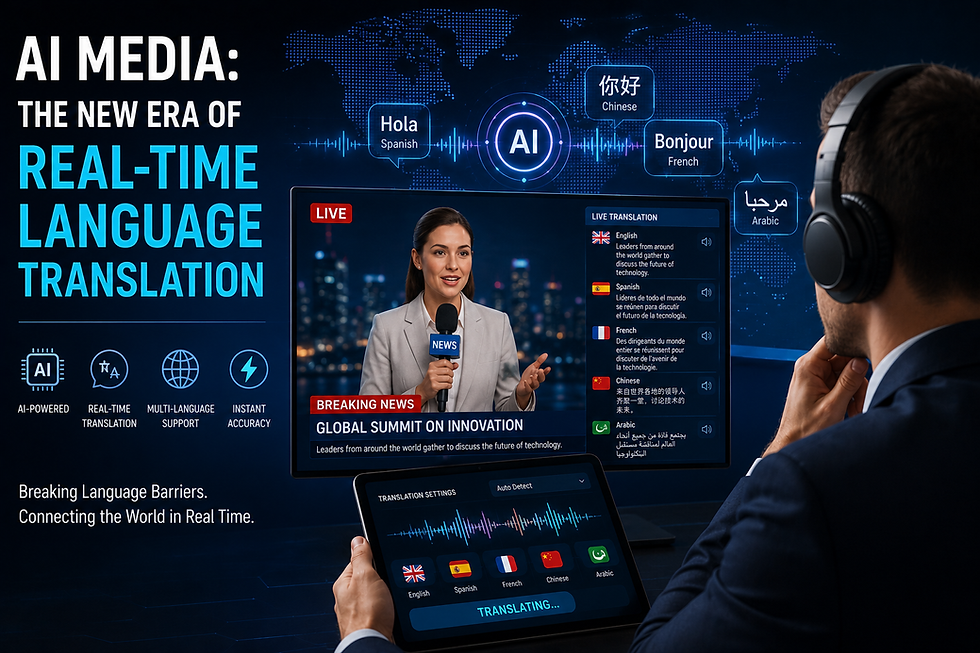
The world is rapidly becoming digital, and at the very heart of this transformation lies Artificial Intelligence or AI. Today, AI is no longer confined merely to data analysis or chatbots; rather, it is revolutionizing the fields of media and communication as well. In particular, "real-time language translation" technology has made global communication easier than ever before.
One no longer has to wait for extended periods to understand a foreign language. AI-based systems can translate speech, videos, or text within a matter of seconds. This is precisely why the demand for these technologies is surging across sectors such as education, media, business, and social networking.
The Growing Power of AI Media
AI media platforms are now providing real-time translation services for live videos, podcasts, and online meetings. Imagine a scenario where a person is speaking in Japanese, and an Indian listener sitting across from them can simultaneously hear the translation in Hindi. This technology is charting a new course for international communication.
Multinational companies are utilizing AI translation systems for their employees, enabling individuals from different countries to collaborate without language barriers. Meanwhile, within the media industry, broadcasting live interviews and international events in multiple languages has become easier than ever before.
Major Changes in Education and Healthcare
The most significant impact of real-time language translation is being observed in the education and healthcare sectors. Online education platforms are now making content available in various languages with the aid of AI. This enables students in villages and small towns to access global knowledge.
This technology is also proving to be extremely useful in healthcare services. Even when doctors and patients speak different languages, AI-based translation systems facilitate their communication. This ensures accurate treatment and improved understanding.
The Challenges Are Not Few Either
Although AI-based language translation systems are evolving rapidly, they also present several challenges. Language is not merely a collection of words; it also encompasses culture, emotions, and local context. AI systems often struggle to accurately interpret idioms, sarcasm, or emotional nuances.
Furthermore, data privacy and cybersecurity constitute major concerns. Systems that translate live conversations collect vast amounts of data. If this data is misused, personal information could be compromised.
A Golden Opportunity for India
For a multilingual country like India, AI translation systems are nothing short of a boon. Hundreds of languages and dialects are spoken across the nation. In this context, AI technology can make government services, digital platforms, and education more inclusive.
If information regarding government schemes were instantly available in every regional language, the 'Digital India' campaign would be further strengthened. Moreover, this could also present a significant opportunity for Indian startups. Many tech companies are currently developing AI models for Indian languages, which will, in turn, give a boost to the local content industry.
A Glimpse of the Future
Experts believe that in the coming years, AI-driven media and real-time language translation technologies will become even more accurate and human-like. In the future, smart glasses, mobile apps, and virtual assistants will be able to directly comprehend our language and provide instant translations.
However, as rapidly as technology advances, it is equally crucial to ensure that ethics and transparency are maintained in its application. AI should not be viewed as a technology intended to replace humans, but rather as a medium that serves to strengthen communication.
Digital platforms such as NewsBolts are also continuously focusing on AI-based media solutions, a trend that indicates the future will be defined entirely by smart communication.
Conclusion
Real-time language translation technology has made the world more connected than ever before. AI media systems are not only facilitating communication but are also unlocking new possibilities in fields such as education, healthcare, business, and entertainment. Despite the challenges, this technology has the potential to serve as a strong foundation for a future global society, one where language will never again stand as a barrier to dialogue.


Comments