Can AI Now Predict Which Company Will Beat Earnings Estimates?

A New World of Earnings Forecasting
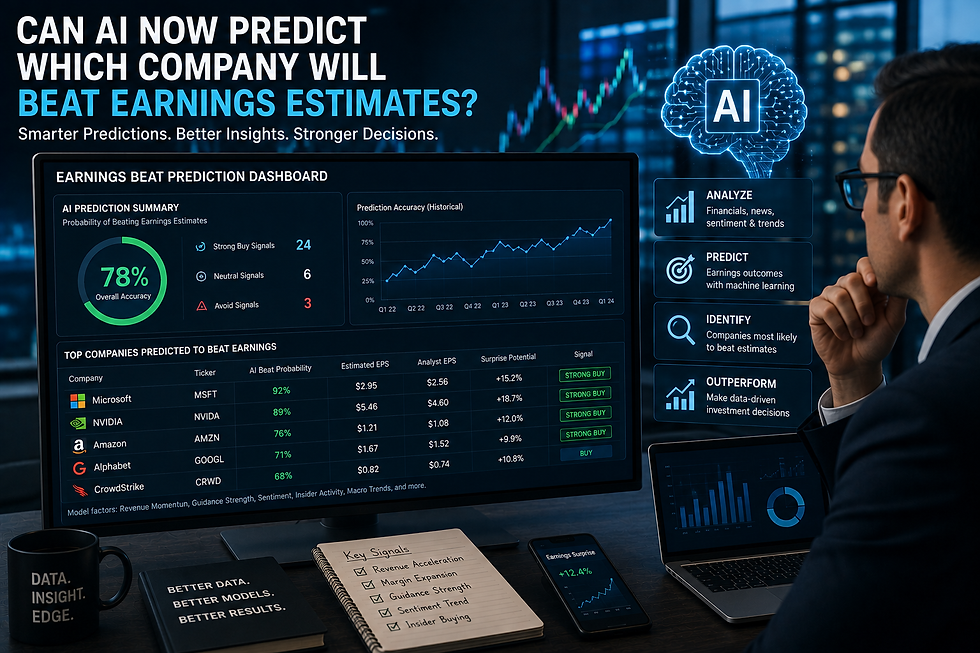
In the stock market, a company's quarterly earnings are among the most critical indicators for investors. When a company outperforms analysts' estimates, it is referred to as an "earnings beat." For a long time, assessing this possibility relied on financial experts and research firms, but Artificial Intelligence (AI) is rapidly transforming this process. Advanced AI models analyze millions of data points to predict which companies might outperform expectations.
From Data to Prediction
AI is not limited to just balance sheets or income-expenditure figures. It analyzes a company's past quarterly performance, supply chain dynamics, consumer demand, industry trends, management commentary, news reports, and even social media signals. Machine learning algorithms establish connections between these diverse pieces of information to identify patterns that human analysts might overlook. This is why AI-driven research is gaining rapid popularity in financial markets.
Why Is This Important for Investors?
AI-based earnings beat predictions can help investors identify potential opportunities. Anticipating a company's strong results in advance allows for more informed investment decisions. However, this does not mean every AI prediction will be accurate. Markets are also influenced by external factors such as global economic conditions, policy changes, and unforeseen events. Therefore, AI should be viewed as a powerful analytical tool rather than the final decision-maker.
In this vein, digital platforms like NewsBolts are exploring ways to make AI-driven financial research and data-based analysis more accessible, enabling investors to receive complex financial information in a simplified format.
Growing Acceptance of AI Research
In recent years, global investment institutions have begun integrating AI into their research models. Several reports indicate that a combined AI analysis of corporate earnings estimates, conference call transcripts, and market signals can offer a more comprehensive perspective than traditional methods. Consequently, major investors are increasingly relying not just on financial data but also on intelligent insights generated by AI.
Challenges Alongside Opportunities
While AI's potential is impressive, understanding its limitations is equally crucial. If a model is fed incorrect, incomplete, or biased data, its conclusions can be compromised. Furthermore, sudden geopolitical events, regulatory changes, or natural disasters can alter the predictions of any AI model. Therefore, experts emphasize a balanced approach that combines AI with human expertise.
The Way Forward
In the future, predicting earnings beats will not be limited to historical data alone. The integration of generative AI, Natural Language Processing (NLP), and real-time data analytics could lead to even more accurate assessments of corporate performance. As AI models become more sophisticated, decision-making processes for investors, fund managers, and research institutions will become increasingly data-driven. Yet, the fundamental principle of successful investing remains unchanged: superior results are best achieved by combining AI-generated insights with prudent analysis and risk management.



Comments