Deploying AI Journalism Newsroom AI Tools in 2026

Updated: Jul 25
The year 2026 is becoming an important period for digital journalism. News organizations are adopting Artificial Intelligence at a faster pace to improve reporting, content creation, publishing, and audience engagement. AI tools are no longer experimental technologies. They are becoming a regular part of daily newsroom operations. As media companies look for greater efficiency and faster workflows, deploying AI newsroom tools has become a major priority.
Why Newsrooms Are Adopting AI
Modern newsrooms handle large amounts of information every day. Journalists must research stories, verify facts, write articles, publish content, and track audience engagement. AI tools help reduce the time spent on repetitive tasks and allow teams to focus on high-value journalism.
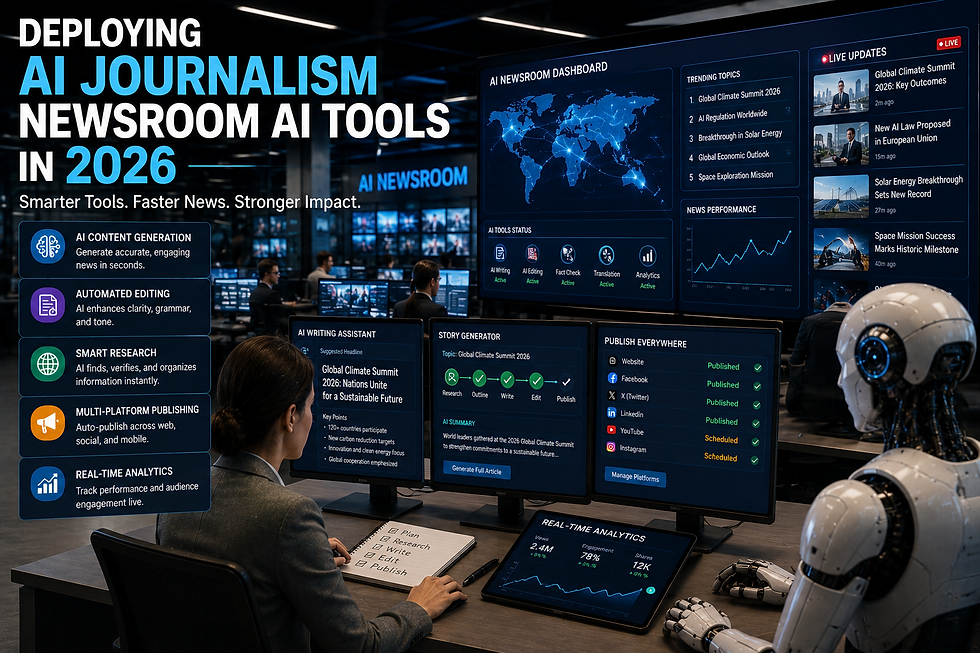
Many media organizations are using AI to assist with content summaries, headline suggestions, translation, transcription, analytics, and publishing automation. These capabilities help improve productivity while maintaining consistent workflows.
In some digital publishing environments, platforms similar to NewsBolt are being used to support AI-driven newsroom operations and content management processes.
Key Steps in AI Deployment
Successful AI deployment starts with identifying newsroom needs. Different organizations require different solutions depending on their size, audience, and publishing goals.
Newsrooms often begin by introducing AI tools for simple tasks such as article categorization, metadata generation, and content scheduling. Once teams become familiar with the technology, more advanced tools can be added for research, analytics, and workflow automation.
Training is also an important part of deployment. Journalists and editors need to understand how AI tools work and how to use them effectively within their daily routines.
Benefits of AI Newsroom Tools
AI systems can improve newsroom efficiency in many ways. They help process large amounts of information quickly, automate repetitive tasks, and provide useful insights from audience data.
These tools also support faster publishing and better content organization. As a result, newsrooms can produce more content while reducing manual workload.
Another advantage is scalability. AI systems can support growing content operations without requiring a proportional increase in staff resources.
Challenges and Considerations
Although AI provides many benefits, implementation is not always simple. Newsrooms must ensure that AI-generated content is accurate and properly reviewed before publication.
Data security, privacy, and ethical concerns must also be addressed during deployment. Organizations should create clear guidelines for how AI is used within editorial workflows.
Human oversight remains essential because AI cannot fully replace editorial judgment, creativity, or investigative reporting.
Conclusion
Deploying AI journalism tools in 2026 is helping news organizations become faster, more efficient, and more adaptable. From content creation to workflow automation, AI is transforming newsroom operations in meaningful ways. However, the most successful implementations combine advanced technology with human expertise, ensuring that journalism remains accurate, responsible, and trustworthy in the digital age.



Comments