How AI Automation Changes Newsroom Economics

AI automation can change newsroom economics by reducing the time required for repetitive work, increasing the amount of work a team can handle, and shifting spending toward technology, data, verification, and new editorial roles. But automation does not automatically mean lower costs or higher profits. The financial value depends on what is automated, what quality controls remain, and whether saved capacity creates measurable business value.

Why the Economics of Newsrooms Are Changing
Running a digital newsroom involves more than journalist salaries.
Publishers also spend money on:
Editorial staff
Editors and fact-checkers
Technology
CMS and hosting
Research tools
SEO
Analytics
Images and video
Distribution
Marketing
Sales and advertising
Subscriptions and membership operations
Historically, increasing output often meant increasing staff or asking existing teams to handle more work.
AI introduces another option.
A publisher can use software to handle some repetitive tasks while allowing the same editorial team to spend more time on reporting, verification, analysis, and original work.
But the economics are more complicated than:
AI → fewer employees → lower costs
A better model is:
AI → lower time per task → more editorial capacity → potential business value
Whether that value becomes profit depends on what the publisher does with the additional capacity.
The Basic Economics of AI Automation
The simplest way to understand AI newsroom economics is to separate cost per task from value per output.
Suppose a newsroom spends significant time manually:
Monitoring sources
Transcribing interviews
Summarizing documents
Creating article metadata
Formatting content
Producing social versions
If AI reduces the time required for these tasks, the newsroom's cost per completed workflow can potentially fall.
But that does not necessarily mean the publisher should reduce staff.
The saved capacity could instead be used for:
More original reporting
More investigations
Faster breaking-news coverage
Better fact-checking
More newsletters
Video production
Audience development
Subscription products
This creates two different economic strategies.
Cost reduction
Same output + fewer resources
Capacity expansion
More output or better quality + similar resources
For many publishers, the second model may be more strategically useful.
AI Does Not Make a Newsroom Free
AI systems introduce their own costs.
A publisher may need to pay for:
AI model usage
Software subscriptions
API usage
Data services
Cloud infrastructure
Integration
Security
Monitoring
Staff training
Technical support
Editorial governance
There can also be less obvious costs.
For example, if AI-generated material requires extensive human correction, the expected productivity gain may be much smaller than the headline automation claim suggests.
The correct question is therefore not:
"How much does the AI tool cost?"
It is:
"How does the total cost of the workflow change after introducing AI?"
The Total Cost of an AI-Assisted Editorial Workflow
Publishers should calculate the economics of the entire workflow.
A simplified model is:
Total workflow cost = Human labor + AI/software cost + infrastructure + verification + correction + management
This is more useful than comparing an AI subscription with a journalist's salary.
For example, imagine a workflow currently requires:
Research → Draft → Edit → Publish
After automation it becomes:
AI research → Fact Pack → AI draft → Human verification → Edit → Publish
The AI may reduce research and drafting time.
But it may also create additional verification work.
The economic result depends on the net time saved.
The Most Important Metric: Cost per Verified Output
For news publishers, measuring the cost of an AI-generated article can be misleading.
A better metric is:
Cost per verified and publishable article
This includes the human work required to make the article safe and useful for publication.
A workflow that produces 100 AI drafts but requires heavy rewriting may be less efficient than a workflow producing 60 drafts that require minimal correction.
Publishers should therefore track:
Time to research
Time to verify
Time to draft
Time to edit
Time to publish
Correction time
AI/software cost
Then calculate the total cost of the completed workflow.
AI Can Change the Economics of Editorial Capacity
One of the biggest potential advantages of AI is not direct cost reduction.
It is capacity creation.
Imagine a journalist normally spends part of the day performing repetitive tasks.
If AI reduces that workload, the journalist may have more time for higher-value work.
For example:
Before automation
Research → Formatting → Transcription → Drafting → Editing
After automation
AI-assisted research → Verification → Reporting → Analysis → Editing
The newsroom has not necessarily reduced its headcount.
Instead, it has changed how expensive human time is allocated.
That distinction matters because journalism depends heavily on skilled human judgment.
Where AI Can Create the Most Economic Value
Not every newsroom task has the same automation potential.
Workflow | Automation potential | Human importance | Economic opportunity |
Transcription | High | Medium | Time savings |
Document summarization | High | High | Faster research |
Metadata creation | High | Medium | Production efficiency |
Content formatting | High | Low | Workflow efficiency |
News monitoring | High | High | Faster discovery |
Source verification | Partial | Very high | Faster review |
Article drafting | Partial | High | Increased capacity |
Investigative reporting | Limited | Very high | Human-led value |
Editorial judgment | Low | Very high | Should remain human |
Final approval | Low | Very high | Governance |
The highest-value automation opportunities are usually tasks that are:
Repetitive
Time-consuming
Structured
Easy to review
Low-risk when automated
The Economics of "More Content" Are Not Always Attractive
One of the biggest mistakes publishers can make is using AI simply to increase article volume.
More articles mean:
More pages to maintain
More editorial review
More competition between your own stories
More distribution requirements
More opportunities for errors
Potentially more low-value content
The market may not reward additional volume if the content does not provide meaningful value.
The Reuters Institute's 2026 research shows publishers are increasingly concerned about AI-driven content abundance and are putting greater emphasis on distinctive journalism, original reporting, context, explanation, and human stories.
That suggests an important economic principle:
The objective should be more valuable editorial output, not simply more output.
AI Can Shift Spending Toward Higher-Value Journalism
If routine work becomes cheaper or faster, publishers have a choice.
They can reduce spending.
Or they can reinvest the capacity.
For example:
Routine automation
↓
Time saved
↓
More journalist capacity
↓
Original reporting
↓
More differentiated content
↓
Potential audience and revenue value
This is where AI can affect newsroom economics beyond simple cost cutting.
A publisher may decide that one hour saved from repetitive production work is more valuable when used for original reporting than when converted directly into a staffing reduction.
Why Original Journalism May Become More Economically Important
As AI makes generic content easier to produce, basic information becomes easier to replicate.
This can put pressure on content that provides little differentiation.
At the same time, original reporting can become more valuable because it gives publishers information that competitors cannot easily reproduce.
Reuters Institute's 2026 survey found that publishers planned to place greater emphasis on original investigations, on-the-ground reporting, contextual analysis, explanation, and human stories.
This creates an important strategic shift:
AI may make commodity content cheaper while increasing the relative importance of distinctive journalism.
The Economics of Human-Governed AI
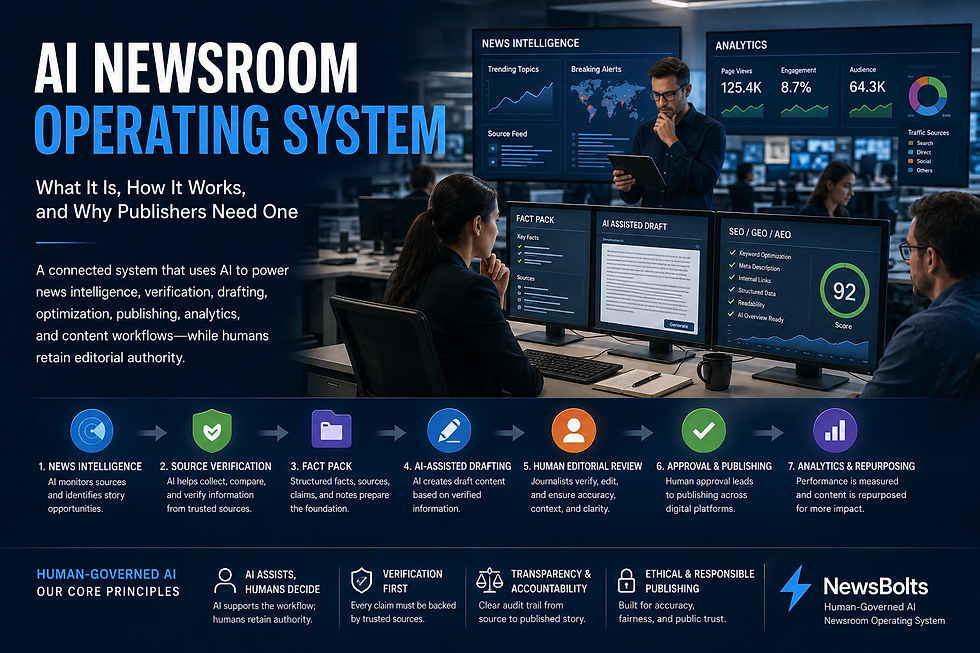
A human-governed AI newsroom does not attempt to remove humans from every stage.
Instead, it assigns tasks according to their economic and editorial value.
AI handles
Monitoring
Classification
Summarization
Transcription
Draft assistance
Metadata
Formatting
Repurposing
Humans handle
Source judgment
Reporting
Verification
Editorial framing
Sensitive decisions
Ethical decisions
Final approval
This approach can produce a better economic balance.
AI handles work where automation can create efficiency.
Humans focus on work where judgment creates value.
Why Verification Has an Economic Value
Verification is sometimes treated as a cost.
It is better understood as part of the value proposition of journalism.
An inaccurate article can create costs through:
Corrections
Editorial rework
Reputation damage
Audience distrust
Legal exposure
Lost subscriptions
Lost advertiser confidence
Not every consequence can be assigned a precise financial value.
But publishers should recognize that accuracy is an economic asset as well as an editorial requirement.
This is one reason AI automation should not remove verification stages simply to reduce production time.
A Simple AI Newsroom ROI Model
Publishers can evaluate an automation project using a simple framework.
Step 1: Measure current workflow cost
Record:
Staff time
Software cost
Production volume
Correction time
Step 2: Measure post-automation workflow cost
Record the same metrics after implementation.
Step 3: Calculate capacity created
Measure how much time the team has recovered.
Step 4: Determine where the capacity goes
Does it create:
More reporting?
Faster publishing?
Better verification?
More formats?
More revenue opportunities?
Step 5: Compare the value created with total automation cost
The goal is not simply to show that AI is cheaper.
The goal is to determine whether the overall newsroom becomes more economically productive.
An Illustrative Example
Consider a hypothetical newsroom workflow.
A team spends substantial time each week collecting documents, summarizing them, formatting articles, and preparing social versions.
An AI system reduces the time required for these tasks.
The publisher now has two choices.
Option A: Cost reduction
The newsroom produces roughly the same amount of content with fewer labor hours.
Option B: Capacity reinvestment
The newsroom uses the recovered time for:
Additional reporting
Investigations
Newsletters
Video
Audience development
Neither strategy is automatically better.
The correct decision depends on the publisher's revenue model, audience, competitive position, and editorial priorities.
This example is intentionally illustrative, not a claim about NewsBolts or any particular publisher.
The Hidden Cost of AI Automation
AI automation can also create costs that are easy to overlook.
Integration costs
Existing CMS, analytics, research, and publishing systems may need to be connected.
Training costs
Editors and journalists need to understand how to use the system correctly.
Governance costs
Someone needs to define:
What AI can do
What AI cannot do
What requires review
What data can be processed
Quality-control costs
AI output needs appropriate checking.
Maintenance costs
Models, APIs, integrations, prompts, workflows, and policies may need ongoing maintenance.
Vendor dependency
A newsroom may become dependent on external AI providers.
These costs should be included in any serious business case.
AI Automation and the Newsroom Cost Curve
A useful way to think about automation is through the relationship between volume and marginal cost.
Without automation, producing additional content may require substantial additional human labor.
With automation, some repetitive tasks can become cheaper per additional output.
But editorial review still creates a human cost.
So the real model may look like:
AI reduces production cost
Human verification remains
Editorial complexity increases with sensitive stories
Therefore, the cost curve does not simply fall to zero.
The newsroom still needs people.
The economic opportunity is to use those people more effectively.
Why Headcount Reduction Is Not the Only Measure of AI Success
A publisher might introduce AI and see no reduction in employee numbers.
That does not mean the project failed.
The newsroom may instead be:
Publishing faster
Covering more topics
Producing more original work
Improving research
Creating more formats
Increasing newsletter output
Improving audience engagement
The Reuters Institute's 2026 research illustrates this distinction: 67% of surveyed publishers said they had not saved jobs as a result of AI efficiencies, while 16% reported slight staff reductions and 9% reported adding new roles or costs.
This is a useful warning against measuring AI economics only through headcount reduction.
AI Can Also Change Revenue Economics
Automation affects the revenue side as well as costs.
A publisher may use AI to support:
Personalized content
Newsletters
Recommendations
Translation
Audio
Video
Subscription experiences
Content licensing
Audience segmentation
The Reuters Institute's 2026 research reports that subscription and membership remained the biggest revenue focus among surveyed publishers, followed by display and native advertising, while some publishers also expect revenue from AI-platform relationships.
However, publishers should not assume that AI-generated efficiency automatically creates revenue.
The business model still determines how efficiency becomes financial value.
The NewsBolts Economics Framework
For NewsBolts, a useful framework is:
AUTOMATE → VERIFY → REINVEST → MEASURE
Automate
Identify repetitive newsroom work that AI can assist with.
Verify
Keep human review around claims, sources, and important editorial decisions.
Reinvest
Use recovered capacity for higher-value journalism or audience work.
Measure
Track whether the change improves cost, speed, quality, output, audience value, or revenue.
This positions NewsBolts as a Human-Governed AI Newsroom Operating System rather than simply a content-generation tool.
The economic goal is not:
"Replace journalists with AI."
It is:
"Use AI to increase the value produced by human newsroom capacity."
A Decision Matrix for Publishers
Before automating a newsroom task, score it against five questions.
Question | Low score | High score |
How repetitive is the task? | Unique | Repetitive |
How structured is the input? | Unstructured | Structured |
How easy is human review? | Difficult | Easy |
What is the risk of an error? | High | Low |
How much time can automation save? | Very little | Significant |
Tasks with high repetition, structured inputs, easy review, low risk, and meaningful time savings are strong candidates.
Tasks involving sensitive editorial judgment should generally receive much stronger human control.
What Publishers Should Measure
A publisher should establish a baseline before introducing automation.
Track:
Cost
Cost per published article
Staff time per article
AI/software cost
Verification cost
Correction cost
Productivity
Articles completed
Stories researched
Time to publication
Formats produced
Quality
Corrections
Editorial revisions
Verification completion
Source quality
Audience
Page views
Engagement
Returning visitors
Newsletter activity
Revenue
Subscription conversions
Advertising value
Revenue per article
Revenue per newsroom employee
The exact metrics should reflect the publisher's business model.
Common Mistakes
Mistake 1: Treating AI cost as the total cost
The AI subscription is only one part of the economics.
Mistake 2: Measuring drafts instead of publishable content
A hundred drafts are not equivalent to a hundred verified articles.
Mistake 3: Assuming automation means layoffs
AI can also create capacity for higher-value work.
Mistake 4: Automating high-risk decisions
The cost of an error can outweigh the time saved.
Mistake 5: Increasing volume without increasing value
More content does not necessarily mean more revenue.
Mistake 6: Ignoring integration costs
Connecting AI to CMS, analytics, source systems, and publishing workflows requires resources.
Mistake 7: Measuring only short-term savings
A newsroom should also consider audience value, editorial quality, differentiation, and long-term revenue.
What Publishers Should Do
Start with one workflow.
For example:
Document monitoring → Summarization → Fact Pack → Journalist review
Measure the baseline.
Then introduce automation.
Measure again.
Compare:
Time saved + quality maintained + capacity created
against:
AI cost + integration cost + verification cost + management cost
If the economics are positive, expand the workflow.
Then move to another process.
This is more reliable than automating the entire newsroom based on a general assumption that AI will reduce costs.
The Future Economics of Digital Newsrooms
The economic question around AI is becoming broader than labor savings.
Publishers are increasingly operating in an environment where AI can affect:
Production costs
Search traffic
Audience behavior
Content distribution
Subscription strategies
Advertising
Licensing
Product development
Editorial workflows
The Reuters Institute's 2026 report describes this as a major business-model challenge: publishers are dealing with AI-driven changes to search and distribution while also experimenting with AI to improve efficiency and create new products.
This means publishers should avoid evaluating AI as a single software purchase.
It is a business-model and operating-model decision.
Conclusion
AI automation can change the economics of running a digital newsroom, but the biggest opportunity is not necessarily reducing the number of journalists.
The stronger opportunity is to reduce the amount of time journalists spend on repetitive work and redirect that capacity toward activities that create greater editorial and business value.
The economic model is therefore:
Automate repetitive work → protect verification → free human capacity → reinvest in valuable journalism → measure the outcome.
For NewsBolts, this is the foundation of a Human-Governed AI Newsroom Operating System.
AI can help publishers operate more efficiently.
Humans remain responsible for deciding what the newsroom stands for, what is trustworthy, and what deserves to be published.
FAQs
Does AI automation actually reduce newsroom costs?
It can reduce the time and resources required for some tasks, but total savings depend on AI costs, integration, verification, training, and how the publisher uses the additional capacity.
Does AI automation mean fewer journalists?
Not necessarily. AI can reduce repetitive work while allowing journalists to spend more time on reporting, investigation, analysis, and audience work.
What is the biggest economic benefit of AI in a newsroom?
One major benefit is increased editorial capacity. AI can help teams complete repetitive tasks faster, allowing skilled employees to focus on higher-value work.
How should publishers calculate AI ROI?
Compare the total cost of the existing workflow with the total cost after automation, including software, human review, integration, corrections, and management. Then measure the value of additional capacity.
Should publishers use AI to increase article volume?
Not automatically. Increasing volume without increasing quality or audience value can create more work without improving the business.
Which newsroom tasks are best suited to automation?
Repetitive, structured, reviewable tasks such as transcription, summarization, classification, formatting, monitoring, metadata creation, and content repurposing are generally better candidates.
What should remain under human control?
Source judgment, verification, sensitive reporting, ethical decisions, editorial framing, and final publication decisions should retain appropriate human authority.


Comments