How AI Can Help Publishers Create YouTube Shorts From News Articles

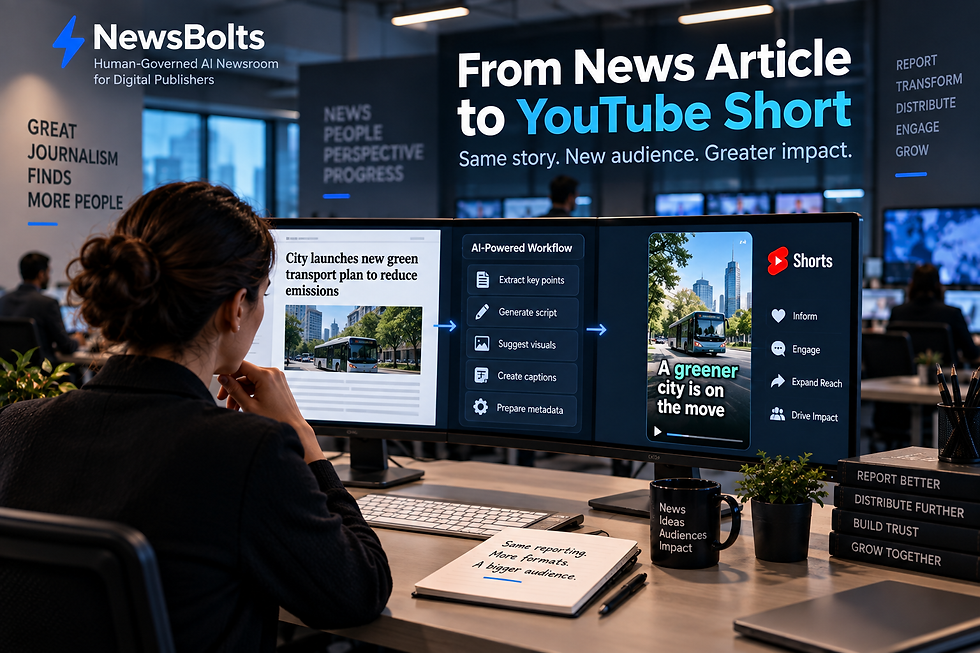
AI can help publishers turn existing news articles into YouTube Shorts by identifying the strongest angle, extracting verified facts, drafting a short script, suggesting visuals, creating captions, and preparing metadata. The newsroom should still verify every factual claim and approve the final video. The most effective workflow treats AI as a production assistant not as an autonomous journalist.
Why Publishers Are Turning Articles Into Short-Form Video
A news article and a YouTube Short serve different audience needs.
An article can provide context, documents, quotes, chronology, background, and detailed reporting. A Short has to communicate a focused idea quickly enough for someone to understand it while scrolling through a video feed.
That difference creates an opportunity for publishers.
Instead of creating every video story from scratch, a newsroom can identify articles that already contain strong material for short-form video and transform selected reporting into another format.
This matters because video is becoming a more important part of news distribution. The Reuters Institute's 2026 Digital News Report found that 77% of people across its 48 markets consume online news video each week. Its 2026 trends report also found that 79% of surveyed publishers considered investing more in video important, while YouTube was the leading off-platform priority among the publishers surveyed.
That does not mean every article should become a Short.
It means publishers should build a system for identifying which articles deserve a video version and why.
The biggest opportunity is not simply producing more videos.
It is getting more distribution value from reporting the newsroom has already produced.
What Can AI Do With A News Article?
AI can support several stages of the article-to-Short workflow.
A newsroom can use AI to help:
Identify possible video angles.
Extract important facts from an approved article.
Turn a broad story into one focused question.
Draft a short-form script.
Suggest a visual sequence.
Create caption and title drafts.
Adapt the script for different presentation styles.
Prepare publishing metadata.
Identify related newsroom content.
Analyze performance data after publication.
The important word is help.
The Associated Press's updated newsroom AI standards provide a useful example of this distinction. AP permits AI assistance for tasks including early-stage research, document summarization, transcription, translation, headlines, story summaries, shotlists, grammar, and search optimization, while stating that AI output is reviewed and edited by journalists and that AI does not replace reporting, sourcing, editorial judgment, or verification.
For publishers, that is a useful operating principle:
AI can accelerate production. Humans remain responsible for journalism.
The Article Should Be The Source, Not The Script
One of the biggest mistakes is asking AI to turn an article directly into a video script.
That approach often produces a shortened version of the article.
The result may be technically accurate but editorially weak.
A better process is:
Article → Editorial Angle → Verified Facts → Video Question → Script → Visuals → Human Review → Short
The article contains the reporting.
The video contains a selected interpretation of that reporting.
For example, an article might explain a new government regulation across 1,500 words.
The Short could focus on:
“Who is affected by the new rule?”
Or:
“What actually changes under the new policy?”
Or:
“Why did the government introduce this change?”
The video does not need to reproduce every paragraph.
Its job is to answer one useful question.
A NewsBolts Framework: Article To Short
For NewsBolts, a practical framework is:
Story → Angle → Evidence → Script → Visuals → Verification → Publish → Measure
Each stage has a specific editorial purpose.
Story
Start with an existing article or approved story.
Angle
Identify the one idea most suitable for short-form video.
Evidence
Extract the facts, figures, quotes, documents, and context supporting that angle.
Script
Turn the evidence into a concise explanation.
Visuals
Determine what the viewer needs to see.
Verification
Check every claim against the underlying reporting and sources.
Publish
Release the approved version to YouTube Shorts.
Measure
Evaluate whether viewers watched, engaged, subscribed, or continued to related content.
This framework prevents the AI system from jumping directly from article to publication.
Step 1: Find Articles That Actually Deserve A Short
A newsroom should not automatically generate a Short for every article.
Instead, create selection criteria.
Strong candidates often have at least one of these characteristics:
a clear public question
a significant development
a surprising finding
useful visual material
a strong data point
an important explanation
a clear before-and-after comparison
a compelling timeline
a notable official announcement
a topic with continuing audience interest
Weak candidates may include:
routine updates with no clear visual angle
articles requiring extensive context
stories where the central claim is still uncertain
highly technical material that cannot be responsibly compressed
opinion pieces where a short format could blur fact and commentary
The question should be:
“Can we explain one important part of this reporting clearly without misleading the audience?”
If not, the article may not be a good Short candidate.
Step 2: Ask AI To Identify Video Angles
Once an article has been selected, AI can generate potential angles.
For example, an article about a court ruling could produce possible angles such as:
What did the court decide?
Who is affected?
What happens next?
Why was the case important?
What does the decision change?
The editor should choose the angle.
That decision requires editorial judgment because the most clickable angle is not necessarily the most useful or accurate one.
A newsroom should prioritize:
clarity + relevance + evidence
over:
curiosity + exaggeration + emotional language
Step 3: Build A Verified Fact Set
Before generating the final script, create a compact fact set.
A useful internal Fact Pack can include:
Field | Example |
Main event | What happened |
Date | When it happened |
Location | Where it happened |
Key entities | People, organizations, places |
Main claim | What the video needs to establish |
Supporting evidence | Source-backed facts |
Important context | Information needed to avoid misunderstanding |
Uncertainty | What remains unconfirmed |
Attribution | Who made each important claim |
Article | Original newsroom report |
This step is particularly important when AI is involved.
The model should not be asked to determine what is true simply because the article contains a sentence.
The newsroom should establish the approved factual basis first.
Step 4: Turn The Fact Pack Into One Question
Short videos work better when their scope is controlled.
Instead of:
“Explain this entire story.”
Use:
“What changed?”
Or:
“Why does this matter?”
Or:
“Who is affected?”
Or:
“What happens next?”
The question determines what information belongs in the video.
This also gives the editor a simple test.
If the script tries to answer five major questions, the scope is probably too broad.
Step 5: Let AI Draft The First Script
AI can then create a first draft from the approved facts.
A useful structure is:
Hook
Introduce the specific question or development.
Answer
Give the main information immediately.
Evidence
Add the most important supporting fact or source.
Context
Explain the minimum context necessary for understanding.
Next Step
Tell the viewer what is happening next or where to find deeper coverage.
The first draft should be treated as production material, not finished journalism.
The editor can remove unnecessary wording, restore missing context, correct emphasis, and make sure the video sounds like the publisher rather than a generic AI narrator.
How Long Should A News Short Be?
YouTube currently allows square or vertical Shorts up to three minutes long.
That does not mean every news Short should be three minutes.
A short should be as long as necessary to explain its chosen idea clearly and no longer.
A simple breaking-news update may need very little time.
An explainer may require more.
The editorial question should determine the length, not an arbitrary target.
A 30-second video that removes essential context can be worse than a carefully structured longer Short.
Step 6: Use AI To Suggest Visuals
AI can also convert a script into a visual plan.
For example:
Narration: The regulator announced a new rule.
Visual: Official announcement document or verified newsroom graphic.
Narration: The rule affects three categories of businesses.
Visual: Simple three-part graphic.
Narration: The changes take effect next year.
Visual: Timeline.
The principle is simple:
Every visual should help the viewer understand the reporting.
Publishers should avoid using generic AI-generated imagery to represent real events when doing so could imply that the image is actual news footage.
For sensitive stories, use verified photographs, licensed footage, original graphics, documents, maps, charts, or other appropriate editorial material.
AI-Generated Visuals Require Extra Care
News publishers need a stricter standard than entertainment creators when using synthetic imagery.
A generated image of an actual political event, disaster, conflict, crime scene, or public figure can easily be mistaken for authentic documentation.
AP's current AI standards explicitly address AI-generated and manipulated content and require appropriate identification and context when such material is included in AP journalism. AP also states that generative AI is not used to create, alter, or enhance news photography.
For a publisher, the safest workflow is to separate:
illustration
from
evidence.
A clearly labeled conceptual illustration is different from an image presented as evidence of something that actually happened.
Step 7: Create Captions And On-Screen Text
AI can draft captions and on-screen text, but the newsroom should edit them.
Short-form video text should generally reinforce the spoken message.
It should not become a second article pasted onto the screen.
A useful rule is:
One idea per visual moment.
For example:
WHAT CHANGED?
followed by:
New eligibility rules
is usually more useful than putting a six-sentence paragraph on screen.
Text should remain readable on mobile devices.
Step 8: Create A YouTube Title
The title should describe the actual video.
Avoid titles that promise more than the Short delivers.
For example:
What The New Policy Actually Changes
is more defensible than:
This Policy Will Change Everything
The second title may attract attention, but it makes a much stronger claim.
AI can generate title variations, but editors should select the final title.
The same principle applies to descriptions and captions.
Step 9: Connect The Short To Deeper Content
The Short should not be treated as the entire publishing ecosystem.
The original article can provide:
full context
source links
documents
chronology
related reporting
expert interviews
corrections
additional evidence
YouTube provides a related-video feature that lets creators connect a Short to another video on their channel. Viewers see a clickable link below the channel handle.
Publishers should also understand an important limitation: URLs placed in YouTube Shorts descriptions and comments are non-clickable, while related-video links are clickable.
This means a publisher should not assume that every Short can send viewers directly to the original website article.
The distribution path has to be designed around the platform's actual capabilities.
Article And Short: Different Jobs, One Editorial Source
A strong multi-format newsroom treats the article and Short as connected but different products.
Element | News Article | YouTube Short |
Primary purpose | Depth and reporting | Discovery and explanation |
Information volume | High | Focused |
Context | Extensive | Essential context only |
Sources | Detailed | Selected attribution |
Format | Text, images, embeds | Vertical video |
Audience behavior | Reading | Watching/swiping |
Main editorial task | Explain comprehensively | Explain one idea clearly |
Best connection | Related coverage | Deeper video or article ecosystem |
This distinction prevents a common content-repurposing mistake: forcing one format to behave like another.
How YouTube Evaluates Shorts Performance
Publishers should understand that YouTube recommendations are not simply based on whether a publisher uploads frequently.
YouTube says its systems consider whether viewers choose to watch a recommended Short, whether they continue watching, and signals including the percentage who chose to view, average view duration, average percentage viewed, likes, and post-watch survey results.
YouTube also provides Shorts analytics including Shown in feed and How many chose to view.
That gives publishers a useful diagnostic model.
If a Short is shown frequently but relatively few viewers choose to watch, the problem may involve the opening, framing, topic, or presentation.
If viewers choose to watch but leave quickly, the problem may be the script, pacing, mismatch between promise and content, or lack of clarity.
The data should inform editorial decisions rather than encourage blind optimization.
What Publishers Should Measure
A publisher should measure the Short at three levels.
Level 1: Distribution
Measure:
impressions or feed exposure
views
traffic sources
audience reach
Level 2: Viewing Behavior
Measure:
chose-to-view behavior
average view duration
percentage viewed
retention
engagement
Level 3: Publisher Outcomes
Measure where possible:
subscribers
related video views
website referrals
newsletter actions
returning visitors
registrations
memberships
other defined business outcomes
YouTube's analytics environment allows publishers to examine how viewers find Shorts and how they interact with them.
Do not use views as the only measure of success.
A Short can generate significant reach while producing little measurable downstream value.
Another Short might reach fewer people but attract highly relevant subscribers.
The correct metric depends on the publisher's objective.
AI Can Help With Performance Analysis Too
After publication, AI can help newsroom teams analyze patterns across their Shorts.
For example, a publisher could categorize videos by:
story type
topic
presenter
video length
opening style
visual format
publication time
article category
audience outcome
The goal is not to ask:
“What makes a viral video?”
That question is too broad.
A better question is:
“Which video structures work for our audience and our journalism?”
That creates a more useful feedback loop.
For example, a newsroom might discover through its own data that explainers perform differently from breaking-news updates.
That would be a first-party observation.
It should not be presented as a universal industry rule.
NewsBolts Workflow For AI-Assisted YouTube Shorts
A NewsBolts implementation can connect the entire process:
Published Article → Story Selection → Angle Recommendation → Fact Pack → Script Draft → Visual Plan → Human Verification → Editor Approval → YouTube Short → Analytics
The value of this workflow is that the AI does not operate in isolation.
The article provides the editorial source.
The Fact Pack establishes the approved evidence.
The script is generated from that evidence.
The editor reviews the final result.
Analytics then informs future production.
This is a more defensible model than asking a generic AI tool to read an article and automatically publish a video.
AI Assistance Vs Autonomous Video Publishing
There is a meaningful difference between using AI to help produce a Short and allowing AI to publish news without human review.
Model | AI Role | Human Role | Newsroom Risk |
AI Assistance | Drafts, summarizes, suggests | Full editorial control | Lower |
Workflow Automation | Moves approved content through systems | Defines rules and approvals | Moderate |
AI-Directed Production | Handles multiple production stages | Reviews important outputs | Higher |
Autonomous Publishing | Generates and publishes | Limited or post-publication review | High |
For news publishers, the first two models are easier to govern.
The third requires stronger controls.
The fourth creates the greatest risk because a factual error can move from source material into a published video without a meaningful editorial checkpoint.
A Human-Governed AI Newsroom should therefore make approval boundaries explicit.
Risks And Limitations
AI-assisted news video has several important limitations.
Hallucinated Facts
AI can generate claims that are not supported by the source article.
Every factual statement needs verification.
Context Loss
An article may contain qualifications that disappear when compressed into a Short.
Editors must identify which context is essential.
Misleading Visuals
Generated or unrelated visuals can make an audience believe something happened when the footage is illustrative.
Quote Distortion
AI-generated scripts can shorten or rephrase quotations in ways that change meaning.
Use original wording and attribution where a quote matters.
Source Confusion
A model may mix information from the article with information from other material.
The approved Fact Pack should define what belongs in the video.
Brand Homogenization
If every publisher uses the same AI script patterns, news video can become repetitive.
Human editorial voice still matters.
Copyright And Licensing
Publishers need the right to use footage, music, photographs, graphics, and other media.
YouTube warns that externally created Shorts containing copyright-protected material must have appropriate rights; valid copyright claims can result in restrictions or removal. YouTube also states that Shorts over one minute with an active Content ID claim are blocked globally.
Platform Dependency
YouTube is a distribution platform, not the publisher's entire audience relationship.
Algorithmic distribution can change.
The publisher should retain the underlying reporting on its own site and other owned channels.
Common Mistakes Publishers Should Avoid
Turning Every Article Into A Short
Automation makes production easier, but not every story deserves another format.
Asking AI To “Make It Viral”
This encourages attention optimization rather than editorial usefulness.
Give AI a specific editorial task instead.
Letting AI Choose The Final Angle
AI can suggest angles.
Editors should decide which angle best serves the audience and reporting.
Reading The Article Word For Word
A Short should be written for video.
Removing Necessary Context
Shorter does not automatically mean better.
Using AI Images As News Evidence
Clearly distinguish illustrations from authentic reporting material.
Measuring Only Views
Reach is useful, but publishers need to understand viewing quality and business outcomes too.
Forgetting The Original Article
The article often contains the evidence and depth that the Short cannot include.
Publishing Without A Human Check
A final editorial review should be part of the workflow.
What Publishers Should Do
Publishers interested in AI-assisted YouTube Shorts should begin with a small controlled workflow.
Start with existing articles.
Choose stories with strong explanatory or visual potential.
Then establish a standard production template:
1. Select the story.
2. Identify one editorial question.
3. Build a verified Fact Pack.
4. Ask AI for several possible angles.
5. Select the angle as an editor.
6. Generate a first script.
7. Create a visual plan.
8. Verify every factual statement.
9. Edit the script for clarity and voice.
10. Approve the final video.
11. Publish the Short.
12. Measure performance.
13. Record the learning for future videos.
The important change is that video creation becomes a newsroom workflow rather than an isolated social-media activity.
A Practical Editorial Decision Matrix
Before creating a Short, score the story against five questions.
Question | Yes | No |
Is there one clear question the video can answer? | Strong candidate | Reconsider |
Are the key facts verified? | Proceed | Stop |
Can the story be explained without misleading compression? | Proceed | Reconsider |
Are useful visuals available or safely creatable? | Strong candidate | Consider another format |
Does the video serve a defined audience or distribution goal? | Proceed | Reconsider |
This simple gate can prevent the newsroom from creating hundreds of unnecessary videos merely because AI makes production inexpensive.
GEO, AEO And The Role Of The Original Article
The video should complement the article rather than replace the text.
Google's current guidance for AI Overviews and AI Mode says there are no additional technical requirements or special AI markup required for a site to appear in these experiences. Google continues to emphasize foundational SEO, helpful content, crawlability, internal links, textual content, and accurate structured data.
For publishers, that means the written article still needs to stand on its own.
A video can strengthen the overall content ecosystem, but it should not be treated as a shortcut around strong reporting and searchable text.
The article should contain the detailed explanation.
The video should provide another way to discover and understand it.
NewsBolts Research Opportunity
NewsBolts could test whether AI-assisted article-to-Short production actually improves newsroom economics and audience outcomes.
No first-party findings should be claimed until the data exists.
Suggested Methodology
Select a defined sample of published articles across several categories.
Divide them into:
articles that receive no Short
articles that receive an AI-assisted Short
articles that receive a fully human-produced Short
The comparison should use consistent editorial standards.
Data To Collect
Track:
production time
editing time
verification time
video completion
chose-to-view behavior
subscriber growth
related-content consumption
article referrals where measurable
production cost
corrections
editorial rejection rate
Research Question
The strongest question is not:
“Does AI make videos faster?”
It is:
“Can AI reduce the production burden of news Shorts while maintaining editorial accuracy and producing useful audience outcomes?”
That question can produce evidence that is actually relevant to publishers.
YouTube Shorts Checklist For News Publishers
Before publishing an AI-assisted Short, confirm:
The original article has been reviewed.
One clear video question has been selected.
The central claim is supported.
All numbers have been checked.
Quotes have been checked against the source.
Attribution is accurate.
Necessary context has been preserved.
The script does not introduce unsupported information.
Visuals accurately represent the story.
Illustrative visuals are not presented as real evidence.
Copyright and licensing have been checked.
The title accurately describes the video.
Captions have been reviewed.
A human editor has approved publication.
Performance metrics have been defined.
The Short has a useful relationship with deeper publisher content.
Conclusion
AI can make it easier for publishers to turn existing news articles into YouTube Shorts, but the best workflow is not article in, automatic video out.
The newsroom should first decide whether the story deserves a Short.
Then it should identify one useful question, establish the verified facts, let AI assist with script and production work, create appropriate visuals, and require human review before publication.
YouTube provides a substantial short-form distribution environment, and publishers are placing greater strategic emphasis on video. But distribution alone is not the objective.
The objective is to make existing reporting more useful across formats without weakening accuracy, context, or editorial standards.
For NewsBolts, that means treating article-to-Short production as a connected newsroom workflow:
Story → Fact Pack → Angle → Script → Visuals → Verification → Human Approval → Distribution → Measurement
AI handles appropriate production work.
Journalists handle reporting and verification.
Editors retain authority.
The result is not automated journalism. It is a newsroom that can adapt strong reporting into more formats without losing control of the journalism itself.
Frequently Asked Questions
Can AI Turn A News Article Into A YouTube Short?
Yes. AI can help extract key facts, identify possible angles, draft a short script, suggest visuals, and prepare captions or metadata. The newsroom should review and verify the output before publication.
Should AI Generate The Entire News Short Automatically?
For professional newsrooms, fully autonomous publication creates unnecessary editorial risk. A better approach is to use AI for specific production tasks while keeping human responsibility for reporting, verification, editorial judgment, and final approval.
How Long Can A YouTube Short Be?
YouTube currently categorizes eligible square or vertical videos up to three minutes as Shorts. The appropriate length for a news video depends on the complexity of the story and the amount of context required.
Can A YouTube Short Link Directly To A News Article?
YouTube currently supports clickable related-video links in Shorts. However, URLs placed in Shorts comments and descriptions are non-clickable. Publishers should therefore design their traffic strategy around the platform's actual linking options.
Does Publishing More Shorts Guarantee More YouTube Reach?
No. YouTube says Shorts recommendations use viewer and performance signals, including whether viewers choose to watch, how long they watch, average percentage viewed, and other signals. There is no universal publishing volume that guarantees results.
Can AI Write The Script From The Article Word For Word?
It can, but that is usually a poor editorial workflow. A better process is to identify one question or angle and build a new video script from the article's verified facts.
Can Publishers Use AI-Generated Images In News Shorts?
They can use synthetic visuals in appropriate circumstances, but publishers should clearly distinguish illustrations from documentary evidence. AI-generated imagery should not create a false impression that an event was photographed or recorded when it was not.
How Should Publishers Measure AI-Assisted Shorts?
Measure both video performance and newsroom efficiency. Useful metrics include production time, verification time, views, chose-to-view behavior, retention, subscribers, related-content consumption, referrals where measurable, corrections, and cost per produced video.
What Is The Best Role For NewsBolts In A YouTube Shorts Workflow?
NewsBolts can serve as the workflow layer connecting approved news reporting with story intelligence, Fact Packs, AI-assisted scripts, visual planning, human verification, editorial approval, publishing, and analytics. The purpose is to make multi-format production more organized while keeping editorial authority with humans.

Comments