How Human Editors Can Review AI-Generated News Without Slowing Down the Newsroom

Human editors can review AI-generated news without becoming a bottleneck by using risk-based editorial review rather than checking every sentence with equal intensity. The most efficient safe workflow verifies the story premise, material claims, sources, attribution, context, and AI-specific failure points first. AI can assist with identifying possible problems, but human editors retain final authority over accuracy, fairness, framing, and publication.

AI has changed the production equation for publishers.
A journalist can use AI to summarize documents. An editor can use it to generate headline options. A newsroom can use automated systems to prepare drafts, metadata, translations, social copy, or updates.
The difficult question is what happens next.
Who checks the output?
If the answer is “the editor,” another question immediately follows:
How can the editor do that without becoming the new bottleneck?
That is not a reason to remove human review. It is a reason to design the review process more carefully.
The Associated Press's updated newsroom standards, published July 23, 2026, provide a useful example. AP permits AI assistance for specific tasks including early-stage research, document summarization, transcription, translation, headlines, summaries, grammar and search optimization, while stating that AI output is reviewed and edited by AP journalists and that AI does not replace reporting, sourcing, editorial judgment or verification.
The practical lesson is simple:
Human oversight works best when the workflow is designed around it.
The Real Problem Is Review Design, Not Review Speed
The conventional assumption is:
AI writes faster → editors review faster → newsroom publishes faster
The weak point is the middle.
AI can produce fluent text containing:
Accurate facts
Unsupported claims
Outdated information
Incorrect names or titles
Misleading context
Incorrect figures
Misattributed statements
Invented details
Overconfident conclusions
Distorted quotations
The problem is not that every AI draft contains all of these errors.
The problem is that an editor cannot know which sentences require the most attention simply from the quality of the prose.
A polished paragraph can contain a serious factual error.
A rough paragraph can contain completely accurate reporting.
That means editorial review should be organized around risk and evidence, not writing quality alone.
Recent Reuters Institute research on AI governance in newsrooms makes a related point: human oversight remains a central safeguard, but the workload created by that oversight is becoming a concern for editors and newsroom managers. The report describes newsrooms reconsidering how governance is built into workflows and systems rather than relying solely on additional manual scrutiny.
The answer is therefore not:
“Make editors work faster.”
It is:
“Give editors better signals about where their attention is needed.”
What Should Human Editors Actually Review?
An editor should focus first on the parts of an article where an error could materially change what the reader understands.
Those areas usually include:
Story premise
Material claims
Sources
Attribution
Dates and figures
Quotations
Context
Headline and framing
AI-specific errors
Final editorial judgment
Not every sentence deserves equal scrutiny.
For example, an editor does not need to spend the same amount of time checking:
“The announcement was made Tuesday.”
and:
“The new policy will eliminate 20% of the company's workforce.”
The second claim has greater potential consequences if it is wrong.
That does not mean the first statement can never be wrong. It means the review system should help editors allocate attention intelligently.
The Risk-First Editorial Review Framework
NewsBolts can structure AI review around a simple hierarchy:
Review area | Core question | Priority |
Story premise | Did the underlying event actually happen? | Critical |
Material claims | Are the important facts supported? | Critical |
Sources | Can claims be traced to evidence? | Critical |
Attribution | Is it clear who is making each claim? | High |
Context | Could the article mislead without more context? | High |
Headline | Does the headline accurately reflect the story? | High |
AI failure points | Did AI introduce unsupported information? | High |
Style | Is the writing clear and readable? | Medium |
Formatting | Is the article technically ready? | Lower |
This is not intended to create a universal numerical score.
It is a review-order framework.
The editor starts with the areas where errors could cause the greatest harm.
That is more useful than asking an editor to proofread an AI-generated article from the first word to the last with identical attention.
The AI News Review Workflow
A practical workflow for a publisher can look like this:
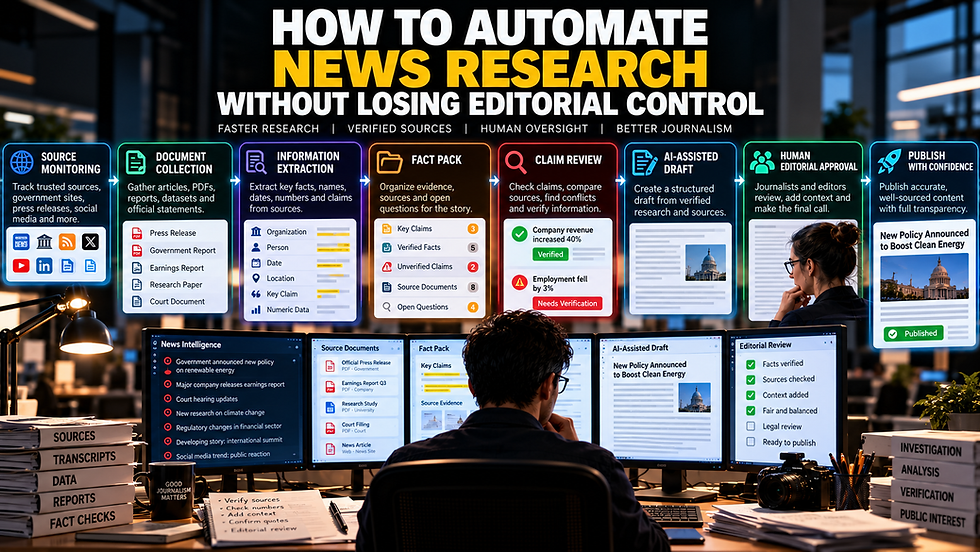
AI-Assisted Draft → Automated Pre-Check → Story Premise Review → Material Claim Verification → Source & Attribution Check → Context & Framing Review → AI-Specific Error Check → Headline / Metadata Review → Human Editorial Approval → Publishing
The sequence matters.
Automated checks happen before or alongside human review.
Evidence is connected to the draft.
Risk determines where the editor spends time.
The final decision remains human.
This is the difference between automation supporting editorial control and automation becoming the editorial control.
Check the Story Before Checking the Writing
The first question should not be:
“Is this article well written?”
It should be:
“Is the underlying story correct?”
Suppose an AI draft says:
“The regulator banned Company X's product after safety concerns.”
Before editing the sentence, the editor should verify:
Did the regulator actually issue a ban?
What date was the action taken?
What did the official document say?
Was it a ban, investigation, warning, recall, or proposal?
What exactly was affected?
What evidence supports the safety claim?
If the underlying event was an investigation rather than a ban, polishing the paragraph is wasted work.
The story premise needs correction first.
A useful editorial test
Ask:
“If this central claim were wrong, would the meaning of the story materially change?”
If the answer is yes, verify it before spending time on style.
Verify Material Claims
A material claim is a factual statement that substantially affects the meaning of the story.
Common examples include:
Names
Dates
Locations
Numbers
Financial figures
Legal allegations
Scientific findings
Government actions
Company announcements
Causal claims
Predictions
Quotes
Claims about harm or responsibility
Editors should identify these claims early.
A useful review method is:
Claim → Source → Evidence → Attribution → Status
For example:
Claim: Company X announced layoffs.
Source: Company filing.
Evidence: Filing states that workforce reductions are planned.
Attribution: Company statement.
Status: Verified for publication.
This is much more useful than simply asking an AI system:
“Is this article accurate?”
The latter produces an answer.
The former creates an evidence trail.
Check Sources, Attribution and Context
AI-generated writing can make source relationships difficult to see.
An editor should be able to answer:
Where did this information come from?
Is the source primary or secondary?
Does it directly support the claim?
Is the source current?
Is the claim attributed correctly?
Are apparently different reports actually repeating the same information?
Is important context missing?
This is where a Fact Pack becomes valuable.
A Fact Pack can connect:
Claim → Source → Evidence → Attribution → Verification Status
Instead of searching through documents while reading the article, the editor reviews the evidence alongside the draft.
That can make the review process more structured and auditable.
Context Can Be More Important Than Grammar
A sentence can be factually accurate but still misleading.
For example:
“The company reported record growth.”
That may be technically correct.
But an editor may need to ask:
Record compared with what?
Over what period?
Is the figure based on revenue, users, profit, or another metric?
Was the statement made by the company?
Is there independent evidence?
Are there relevant qualifications?
The issue is not grammar.
It is context.
Human editorial judgment is particularly important here because the editor must determine what readers need to understand the claim fairly.
The Society of Professional Journalists' ethics guidance emphasizes verification, original sources where possible, clear identification of sources, context, and correction of information when necessary.
Check AI-Specific Failure Points
AI-assisted news requires editors to look for several failure modes that may be less obvious in conventional copy.
Fabricated details
AI can generate names, events, statistics, citations, or other details that sound plausible but cannot be traced to evidence.
Source blending
Information from several documents can become one sentence that no individual source actually supports.
Temporal confusion
An older event or statistic can be presented as current.
False certainty
The draft may turn:
“The company said…”
into:
“The company confirmed…”
Those are not always equivalent.
Incorrect quotations
A paraphrase can accidentally become a quotation, or a quote can be shortened in a way that changes its meaning.
Entity confusion
AI can confuse similarly named people, organizations, products, or locations.
Missing qualifications
A source may say something is possible, preliminary, disputed, or estimated.
The AI draft may remove that qualification.
NIST's Generative AI Risk Management Profile provides a broader risk-management framework for generative AI, emphasizing that organizations should govern, map, measure and manage risks across the AI lifecycle. For newsrooms, that supports the principle that AI review should be designed as a process rather than treated as a final “accuracy check” button.
What AI Can Review Before the Editor
AI is useful for finding things for the editor to inspect.
A pre-review system could flag:
Claims without an attached source
Inconsistent dates
Conflicting numbers
Repeated passages
Unattributed quotations
Named entities requiring confirmation
Headline/body inconsistencies
Potentially unsupported assertions
Missing metadata
Changes between source material and draft
Statements containing unusually strong certainty
The important distinction is how the output is presented.
A good system says:
“These seven items require editorial attention.”
A weaker system says:
“This article is accurate.”
The first supports human judgment.
The second can create false confidence.
What AI Should Not Decide
Some decisions should remain explicitly human.
Whether evidence is sufficient
AI can find supporting material.
An editor decides whether the evidence is adequate.
Whether a story should be published
Newsworthiness involves public interest, editorial priorities, context, risk, and responsibility.
Whether framing is fair
A model can identify different claims but cannot reliably replace editorial judgment about how the story should be presented.
Whether sensitive information should be included
Privacy, safety, vulnerable sources, minors, allegations, and other sensitive issues require human governance.
Whether a correction is required
An automated system can flag discrepancies, but the newsroom should determine how a correction or update should be handled.
AP's current standards reinforce this separation: AI can assist journalists with defined tasks, but editorial judgment, verification, sourcing and accountability remain the responsibility of AP journalists.
Traditional Review vs Risk-Based AI Review
Review approach | Conventional manual review | Risk-based AI-assisted review |
Starting point | Read the draft | Identify story and claim risks |
Fact checking | During or after reading | Claims surfaced early |
Source access | Often manual | Connected evidence / Fact Pack |
Automated checks | Limited | Pre-review flags |
Human role | Copyediting + verification + judgment | Verification + context + judgment |
Attention | Broad and relatively uniform | Concentrated on consequential issues |
Final approval | Human | Human |
Main advantage | Familiar process | Better division of labor |
Main risk | Time-intensive | Overreliance on automated flags |
The objective is not to replace conventional editorial judgment.
It is to make that judgment more targeted.
The Seven-Question Editor Review
For routine AI-assisted stories, a compact review can begin with seven questions:
Is the central event or claim real?
Can the important facts be traced to reliable evidence?
Are names, dates, figures and quotations correct?
Is attribution accurate?
Has AI introduced unsupported information?
Does the headline accurately represent the evidence?
Would I approve this story if AI had not been involved?
The last question is particularly useful.
The presence of AI should not lower or redefine the newsroom's editorial standard.
The standard should remain the journalism.
Common Mistakes That Make Review Slower
Reviewing prose before evidence
Editors can spend time improving paragraphs before discovering that the central claim is unsupported.
Better: Review the premise and material evidence first.
Checking every sentence equally
Not every sentence has the same editorial risk.
Better: Prioritize consequential claims.
Looking for sources after drafting
This forces editors to reconstruct the evidence trail.
Better: Connect source material to the workflow before or during drafting.
Asking AI to fact-check AI
One AI output does not become reliable merely because another model reviews it.
Better: Use AI to identify claims and inconsistencies, then verify them against actual evidence.
Trusting a confidence score
A numerical confidence score can hide important uncertainty.
Better: Show the underlying evidence and let the editor decide.
Using the same review depth for every story
Breaking news, routine updates, investigations, and sensitive allegations carry different risks.
Better: Route stories according to risk.
Treating human review as proofreading
Grammar review is only one part of editorial review.
Better: Review evidence, context, attribution, framing, and accuracy first.
The NewsBolts Human-Governed Review Framework
NewsBolts can organize the process around four stages:
Evidence → Risk → Review → Decision
Evidence
Connect material claims to source records, evidence, attribution, and Fact Pack information.
Risk
Identify the claims and editorial decisions where an error could have the greatest consequences.
Review
Use automated checks to surface possible problems, then have an editor investigate consequential issues.
Decision
The human editor approves, revises, holds, returns, or rejects the story.
This supports the NewsBolts positioning as a Human-Governed AI Newsroom Operating System.
The purpose is not to make editors less responsible.
It is to make their responsibility easier to exercise.
A Practical Newsroom Architecture
A publisher can structure the review system as:
Source Intelligence → Fact Pack / Evidence Layer → AI-Assisted Draft → Automated Pre-Review → Risk Classification → Human Editorial Review → SEO / GEO / AEO Review → Final Approval → Publishing → Analytics and Error Feedback
This architecture keeps evidence connected to production.
It also creates a feedback loop.
When an editor catches an AI error, the newsroom should be able to record the type of error.
For example:
Incorrect Date → Outdated Source → Human Detection → Add Date-Consistency Check
Over time, the review system can become better at identifying recurring failure patterns.
That is a more useful objective than simply trying to reduce the number of editor interventions.
How Publishers Should Implement the Workflow
Publishers should begin with one article category rather than redesigning the entire newsroom.
Possible starting points include:
Routine news updates
Corporate announcements
Research summaries
Local news
Sports updates
Evergreen explainers
Then document the existing review process.
Step 1: Identify bottlenecks
Ask editors where review consumes the most time.
Step 2: Separate repetitive checks
Identify tasks that can be performed consistently by software.
Step 3: Define material claims
Create a newsroom-specific list of facts that require verification.
Step 4: Connect evidence
Build Fact Packs or an equivalent source record.
Step 5: Create approval gates
Specify exactly where human approval is mandatory.
Step 6: Record recurring failures
Track what editors repeatedly discover in AI-generated drafts.
Step 7: Improve the system
Turn recurring errors into better pre-checks, prompts, source requirements, or editorial policies.
This approach is consistent with the broader direction of newsroom AI governance: AI should be integrated into defined workflows with explicit responsibility rather than simply added as another content-generation tool. Reuters Institute's 2026 research describes newsrooms moving from general AI guidelines toward more concrete workflow and architectural approaches.
What Publishers Should Measure
A successful review system should not be judged by speed alone.
Measure four areas.
Review efficiency
Time from AI draft to editorial decision
Editor time per story
Number of manual checks
Number of automated flags
Review effectiveness
Unsupported claims caught
Source errors caught
Attribution errors caught
AI-generated details caught
Corrections after publication
Workflow quality
Stories with complete evidence records
Stories requiring major rewrites
Stories returned for additional reporting
Review queue size
Editorial outcomes
Accuracy
Corrections
Reader complaints
Publication timeliness
Audience performance
A useful warning: fewer edits do not automatically mean better AI.
A better system may initially identify more problems because it makes previously hidden problems visible.
Risks and Limitations
Human review can still fail
Editors work under deadlines and can miss errors.
A workflow should support human judgment rather than assume that humans are infallible.
Automated checks can create false confidence
A clean automated report does not prove that an article is accurate.
Review work may shift rather than disappear
AI may reduce drafting time while increasing verification requirements.
That is not necessarily a failure. The newsroom needs to account for the new distribution of work.
Reuters Institute's August 2026 research specifically describes pressure on newsroom staff as human oversight becomes an additional governance responsibility.
High-risk stories require stronger controls
Stories involving allegations, public safety, elections, conflicts, financial claims, public health, or vulnerable people may require more extensive verification.
AI tools change
Models, interfaces, policies, data handling, and capabilities can change. Publisher AI policies should therefore be reviewed periodically.
What Publishers Should Do
The practical goal is not:
“Make editors review less.”
It is:
“Make editorial attention more focused.”
Publishers can start with five controls:
Claim-first review — identify the facts that matter most.
Evidence-connected drafting — connect important claims to source material.
Automated pre-checks — surface potential problems before human review.
Risk-based routing — give higher-risk stories stronger scrutiny.
Explicit human approval — keep publication authority with the editor.
The resulting workflow is:
AI-Assisted Draft → Automated Pre-Check → Risk Classification → Fact Pack Review → Human Editorial Review → Final Approval → Publishing → Error Feedback
This model allows automation to handle repetitive detection while humans handle consequential judgment.
NewsBolts Research Opportunity
NewsBolts could eventually test whether structured risk-based review reduces editorial review time without reducing the detection of material errors.
This should be tested with actual newsroom data rather than assumed.
Possible methodology
Compare two defined workflows:
Workflow A: Conventional Editorial Review
Workflow B: AI-Assisted Risk-Based Review
Measure:
Editor review time
Story complexity
Number of material claims
Number of AI flags
Errors detected
Errors missed
Corrections after publication
Major revisions
Approval time
Sample requirements
The study should include multiple story categories because breaking news, explainers, data stories, and routine updates may have very different verification requirements.
Limitations
Results could be influenced by:
Editor experience
Story complexity
AI system used
Source quality
Staffing
Deadline pressure
Editorial standards
Until NewsBolts collects first-party data, this should be treated as a research methodology, not evidence of guaranteed productivity gains.
Conclusion
The goal of reviewing AI-generated news is not simply to make editors work faster.
It is to make editorial attention more effective.
AI can help identify claims, compare documents, flag inconsistencies, organize evidence, check metadata, and surface potential problems. Those capabilities can reduce repetitive work.
But the final editorial questions remain human:
Is this true?
Is the evidence sufficient?
Is the attribution accurate?
Is the context fair?
Is this ready to publish?
A practical workflow is:
AI-Assisted Draft → Automated Pre-Check → Material Claim Identification → Fact Pack / Source Review → Risk-Based Editorial Review → Human Approval → Publishing → Error Feedback
This treats human oversight as an engineered newsroom process, rather than an informal final glance.
That distinction is increasingly important. Reuters Institute's recent research reports that human oversight remains a primary safeguard for AI-generated content, while also documenting concerns about the workload and fatigue that can result when oversight is added without redesigning the workflow.
For NewsBolts, this is the practical meaning of a Human-Governed AI Newsroom Operating System.
AI assists with the work.
Evidence remains connected to the journalism.
Automated checks surface potential problems.
Risk determines where human attention goes.
And editors retain the authority to decide what becomes published journalism.
That is how publishers can pursue greater production efficiency without treating editorial accountability as an obstacle to speed.
FAQs
How can human editors review AI-generated news faster?
Editors can work faster by prioritizing the story premise, material claims, evidence, attribution, context, and high-risk AI failure points. Automated pre-checks can surface potential issues before the editor begins detailed review.
Should editors fact-check every sentence in AI-generated news?
Not every sentence requires the same level of scrutiny. Editors should prioritize claims that materially affect the story, including figures, dates, quotations, allegations, causal claims, official actions, names, and other consequential facts.
Can AI fact-check AI-generated news?
AI can identify claims, compare text with supplied sources, flag inconsistencies, and surface potential problems. It should not be treated as the final authority on factual accuracy. Important claims still require verification against reliable evidence.
What should editors check first?
Editors should begin with the central story premise. They should then verify material claims, sources, attribution, dates, figures, quotations, context, and the headline before spending significant time on stylistic improvements.
How do Fact Packs speed up editorial review?
A Fact Pack organizes claims, sources, evidence, quotations, dates, figures, context, and verification status. This gives editors an evidence layer alongside the AI draft instead of forcing them to search for supporting material manually.
What should AI check before a human editor reviews an article?
AI can check for missing source references, inconsistent dates, conflicting figures, repeated passages, named entities, possible unsupported claims, headline/body inconsistencies, and other patterns that are suitable for automated detection.
Should AI ever have final publishing authority?
For consequential news, publishers should carefully consider whether automated publishing is appropriate. A human-governed workflow keeps editorial responsibility and final approval with an accountable person rather than treating AI output as self-authorizing.
How can publishers prevent human review from becoming a bottleneck?
Publishers can separate automated pre-checks from human judgment, connect drafts to evidence, classify stories by risk, standardize review questions, and track recurring AI errors. The objective is targeted review rather than elimination of review.


Comments