How Open-Source LLMs Can Be Used In Digital Newsrooms

Open-source large language models (LLMs) can give digital newsrooms more control over AI-assisted research, summarization, translation, classification, content production, and internal automation. Unlike a fully managed AI service, an open-weight model can potentially be deployed in a publisher-controlled environment, adapted for specific workflows, and operated with greater control over data and infrastructure. But open-source AI does not remove the need for editorial verification, governance, security, or human accountability.
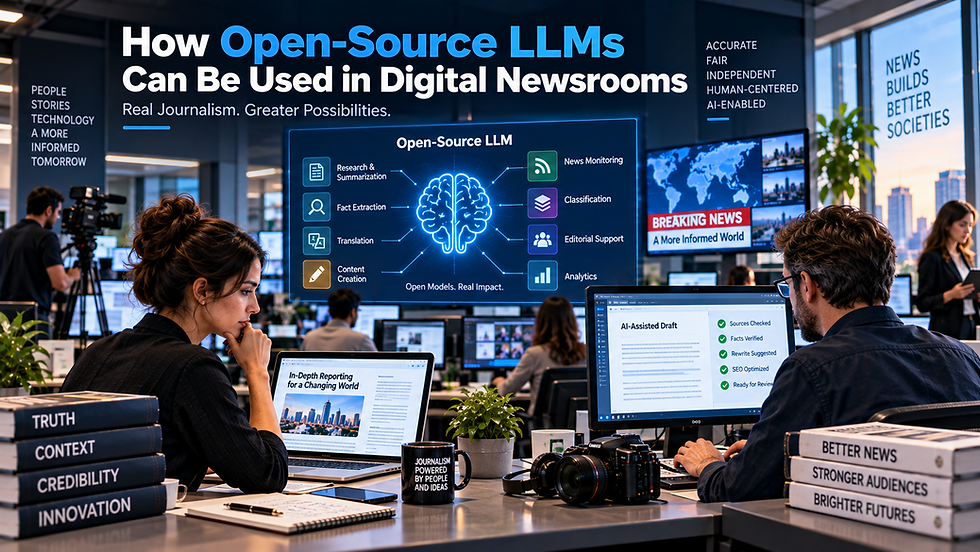
How Open-Source LLMs Fit Into A Digital Newsroom
The practical value of an open-source LLM is not simply that a newsroom can “run its own ChatGPT.”
The larger opportunity is to place language-model capabilities inside specific editorial workflows.
A publisher might use an open model to:
summarize long documents
classify incoming news events
extract facts from source material
translate reports
create interview summaries
identify related stories
generate article outlines
assist with headlines and metadata
repurpose articles into social posts
support internal search
create structured research briefs
help editors compare documents
assist with transcription workflows
generate first-draft material from verified inputs
The important distinction is that the model should operate as newsroom infrastructure, not as the newsroom itself.
The Associated Press's updated 2026 AI standards make a similar distinction: AI can assist with research, summarization, transcription, translation, headlines, summaries, grammar, and search optimization, while journalists retain responsibility for editorial judgment, verification, and accountability.
For publishers, this creates an important operating principle:
Use the model to accelerate newsroom work, but keep editorial authority with people.
What Is An Open-Source LLM?
An open-source LLM is a language model made available under terms that allow some degree of access, use, modification, or redistribution.
However, publishers should be careful with the phrase open-source.
Not every model described as “open” provides the same rights. Some models provide open weights but use their own licenses or terms. Others may provide code, weights, documentation, or different combinations of these components.
Hugging Face's documentation, for example, lists many different model licenses, including Apache 2.0, MIT, OpenRAIL variants, model-specific licenses, and community licenses.
Google's Gemma 4 documentation describes Gemma as a family of open models and identifies its model license as Apache 2.0. Mistral likewise publishes open models under different licensing arrangements, with its documentation noting that many of its open-source models use Apache 2.0 while some models have different terms.
That means a newsroom should never select a model based only on the words “open-source.”
Before deployment, the technology team should review:
Model license
Commercial-use permissions
Redistribution requirements
Model-weight availability
Training-data documentation where available
Hardware requirements
Security requirements
Supported languages
Context-window requirements
Vendor or community support
For a publisher, license compatibility is part of editorial technology governance.
Why Digital Newsrooms Are Considering Open-Source LLMs
The business case goes beyond avoiding API fees.
Open models can give publishers greater control over where inference happens, how the model is configured, and how it connects to internal systems.
This can be valuable for organizations handling unpublished reporting, internal documents, source material, embargoed information, proprietary research, or sensitive business data.
Modern open models are also available across a wide range of sizes. For example, Google's Gemma 4 family includes models designed for different deployment environments, while Mistral has continued releasing models under open-weight and permissive licensing approaches.
The strategic advantages can include:
Advantage | Why It Matters To Publishers |
Greater infrastructure control | The publisher can decide where and how the model runs |
Customization | Models can be adapted to specific workflows |
Data control | Sensitive material may be processed within publisher-controlled infrastructure |
Integration | Models can connect with CMS, search, analytics, research and editorial tools |
Cost control | High-volume workloads can potentially be optimized around infrastructure economics |
Model choice | Publishers can evaluate different models rather than depending on one provider |
Experimentation | Technical teams can test specialized workflows |
Resilience | A newsroom can reduce dependence on a single AI provider |
None of these advantages is automatic.
Running an open model can create new expenses for GPUs, infrastructure, monitoring, security, model updates, engineering, evaluation, and maintenance.
The correct question is therefore not:
“Are open-source LLMs cheaper?”
It is:
“Which newsroom workloads justify controlling the model and infrastructure ourselves?”
1. Open-Source LLMs For News Intelligence
One of the strongest applications is the first stage of the newsroom workflow: discovering what is happening.
A newsroom may receive information from:
RSS feeds
websites
press releases
government documents
regulatory filings
public datasets
social platforms
wire services
newsletters
transcripts
internal reporting systems
An LLM can help classify and organize this incoming information.
For example, an internal system could group documents around the same event and identify:
entities
locations
organizations
dates
topics
claims
potential story angles
relationships between documents
This does not mean the model determines what is true.
It means the model helps journalists navigate a large information stream.
This is particularly useful as newsrooms become more dependent on high-volume monitoring.
The Reuters Institute's 2026 Journalism, Media, and Technology Trends report found that 97% of surveyed publisher respondents considered back-end automation important, while 82% identified newsgathering applications as important. The survey covered 280 digital leaders across 51 countries and territories.
That makes news intelligence a logical area for controlled AI experimentation.
2. Open-Source LLMs For Document Research
Newsrooms often work with documents that are too long to read quickly.
Examples include:
court filings
government reports
annual reports
meeting minutes
research papers
legislation
regulatory documents
company reports
public records
transcripts
An open LLM can help transform these documents into structured research material.
A useful newsroom workflow could ask the model to identify:
major claims
dates
named entities
numerical figures
quotations
policy changes
references to previous events
unanswered questions
The journalist then returns to the original document to verify the relevant material.
This distinction matters.
The LLM should produce a research aid, not become the source.
The original document remains the authoritative reference.
3. Open-Source LLMs For Summarization
Summarization is one of the clearest newsroom applications.
Editors may need to understand a long document before deciding whether it deserves coverage.
Instead of manually reading every document at the beginning of the process, an LLM can produce a preliminary summary.
The newsroom can then decide whether deeper reporting is necessary.
A strong workflow separates:
Document → AI summary → journalist review → verified research notes
rather than:
Document → AI summary → published article
The second workflow creates unnecessary editorial risk.
A summary can omit context, misunderstand language, merge separate claims, or confidently state something that is not supported by the source.
Human review therefore remains essential.
4. Open-Source LLMs For Fact Extraction
LLMs can also convert unstructured reporting material into structured information.
For example, an editorial system could extract:
Information | Example |
Person | Named individual |
Organization | Company, government agency or institution |
Location | City, country or region |
Date | Event or publication date |
Claim | Statement requiring verification |
Number | Financial, demographic or other figure |
Source | Document or URL |
Topic | Subject classification |
This creates a Fact Pack that an editor can inspect before drafting.
That approach is more useful than asking an LLM to “write an article.”
The model becomes part of a controlled information pipeline.
This is also where an AI news intelligence workflow can connect with broader newsroom infrastructure.
5. Open-Source LLMs For AI-Assisted News Writing
Open models can support journalists during drafting without automatically controlling the final article.
Potential applications include:
turning verified notes into a draft structure
producing alternative headlines
improving clarity
simplifying complex language
generating summaries
creating metadata
suggesting questions for follow-up reporting
adapting content for different formats
The safest approach is to provide the model with verified newsroom inputs.
For example, instead of asking:
Write a story about this event.
the newsroom can provide a structured research package containing verified facts, source references, quotations, dates, and editorial requirements.
The model then helps organize the material.
This is consistent with AP's current position that AI-generated output must be reviewed and edited by journalists before publication and that AI does not replace reporting, sourcing, verification, or editorial judgment.
Publishers can also build this into an AI-assisted news writing workflow where AI handles drafting assistance while editors control publication.
6. Open-Source LLMs For Translation
Multilingual publishing is another important opportunity.
A digital publisher operating across multiple markets may need to translate:
breaking news
explainers
newsletters
headlines
captions
summaries
alerts
An open model can support translation workflows while allowing the publisher to evaluate and customize the process.
But translation quality must be assessed carefully.
News translation is not only about converting words.
The system must preserve:
names
quotations
dates
numbers
legal language
political terminology
cultural context
attribution
For sensitive stories, human linguistic review should remain part of the workflow.
7. Open-Source LLMs For Internal Newsroom Search
An overlooked opportunity is internal search.
A newsroom may have years of:
articles
interviews
transcripts
research
documents
fact-checking notes
previous investigations
datasets
editorial guidelines
An open LLM can help create a natural-language interface over this knowledge base.
A journalist could ask:
“What have we previously reported about this company?”
The system could retrieve relevant internal documents and generate a summary based on them.
The critical component is retrieval.
The LLM should not be treated as the database.
A retrieval system should identify the relevant newsroom documents first. The model can then summarize those documents.
This reduces the temptation to rely on the model's general memory when the newsroom actually needs its own verified archive.
8. Open-Source LLMs For Content Repurposing
A single piece of reporting can become multiple formats.
For example:
Original reporting → article → newsletter summary → social copy → video script → podcast outline → push notification
An open-source LLM can assist with this transformation.
The important principle is that the underlying facts should remain consistent.
The newsroom should maintain a canonical version of the verified story and use AI to adapt that information for different channels.
This creates a more scalable form of content repurposing.
It can also help publishers respond to the increasingly fragmented way audiences consume news.
The Reuters Institute's 2026 Digital News Report found that social media and video networks were used by 54% of respondents across 48 markets for online news, compared with 51% for news organizations' websites and apps. The same report found that 10% used AI chatbots for news each week, up from 7% the previous year.
That makes multi-format publishing increasingly important.
9. Open-Source LLMs For SEO, GEO And AEO Workflows
LLMs can also assist the optimization layer of a newsroom.
They can help editors review:
headlines
subheadings
summaries
internal links
metadata
entity coverage
article structure
unanswered reader questions
But AI optimization should not become keyword stuffing.
Google's current guidance says foundational SEO remains relevant to AI features such as AI Overviews and AI Mode. Google also emphasizes valuable, unique content rather than producing large volumes of pages designed primarily to manipulate search or AI responses.
For publishers, this means an open-s
ource LLM should support better journalism and clearer information architecture, not mass-produce commodity pages.
A newsroom could use AI to identify whether an article clearly answers its primary question, whether important context is missing, or whether related internal coverage should be linked.
That is much more useful than asking an LLM to insert a keyword a certain number of times.
10. Open-Source LLMs For Editorial Quality Control
Open models can also support a newsroom's quality-control layer.
For example, an internal system could flag:
unsupported claims
inconsistent dates
duplicate statements
missing attribution
unusually strong language
missing source references
conflicting figures
incomplete article sections
potential policy violations
The model should flag issues rather than silently fix them when the issue could change factual meaning.
This preserves editorial visibility.
A useful rule is:
AI can recommend a correction; an editor approves the correction.
That principle becomes increasingly important as AI systems become capable of making changes across entire publishing workflows.
11. Running Open LLMs Inside A Publisher-Controlled Environment
One major attraction of open-weight models is the ability to run models within infrastructure selected by the publisher.
Hugging Face's Transformers documentation supports loading pretrained model weights locally and describes offline usage when model files have already been downloaded and cached.
This can create different deployment options.
Private Infrastructure
The publisher operates the model on its own infrastructure.
This provides maximum control but requires technical expertise and operational resources.
Managed Private Infrastructure
A cloud provider or infrastructure partner manages the underlying compute while the publisher maintains greater control over the deployment environment.
This can reduce operational complexity.
Hybrid Architecture
Some workloads can use open models internally while other workloads use external AI services.
This is often more practical than trying to force every newsroom task onto one model.
The right architecture depends on:
workload volume
sensitivity of data
latency requirements
available engineering resources
hardware costs
model performance
compliance requirements
licensing
12. Open LLMs Should Not Be Used As Unsupervised Journalists
This is the most important limitation.
An LLM can generate fluent text without having the editorial responsibility of a journalist.
A model can misunderstand:
a source
a quotation
a statistic
a legal document
a timeline
a person's role
a causal relationship
It can also turn uncertainty into apparently confident language.
Therefore, publishers should not equate language quality with factual reliability.
The editorial workflow must establish clear boundaries.
Automated Tasks
Good candidates include:
classification
tagging
formatting
basic summarization
transcription assistance
routine metadata generation
duplicate detection
AI-Assisted Tasks
These can include:
research summaries
article outlines
translation
headline suggestions
content repurposing
internal search
fact extraction
Human-Led Tasks
These should include:
source evaluation
original reporting
sensitive claims
final fact verification
editorial judgment
publication approval
corrections
legal and ethical decisions
This three-level model fits the broader principle of a human-governed AI newsroom.
The Biggest Risk: Treating An Open Model As A Trusted Source
Open-source does not mean accurate.
It does not mean unbiased.
It does not mean secure by default.
And it does not mean appropriate for every newsroom task.
The model itself should be treated as a processing component.
The source documents remain the evidence.
This distinction should be written directly into newsroom policy.
For example:
Source material is authoritative. AI output is advisory.
That single rule can prevent many workflow failures.
Model Selection Should Be Based On The Job
A newsroom does not necessarily need the largest available model.
Different tasks have different requirements.
Newsroom Task | Model Priority | Human Review |
Document classification | Speed and consistency | Low to medium |
Summarization | Context handling | Medium |
Translation | Language quality | High |
Research extraction | Accuracy and structure | High |
Article drafting | Instruction following | High |
Internal search | Retrieval quality | Medium to high |
Content repurposing | Style and consistency | Medium |
Sensitive reporting | Reliability and traceability | Very high |
A smaller model may be appropriate for repetitive classification.
A larger model may be justified for complex research assistance.
The objective should be task-model fit, not model prestige.
A Practical Open-Source LLM Workflow For Publishers
A publisher can begin with a relatively controlled workflow.
Step 1: Select One Repetitive Workflow
Do not begin by trying to redesign the entire newsroom.
Choose one measurable problem such as document summarization, classification, translation, or content repurposing.
Step 2: Define The Human Decision Point
Identify where a journalist must review the output.
The AI workflow should make this explicit.
Step 3: Build A Source Boundary
Define which documents the model can access.
Do not allow an internal newsroom model to retrieve every confidential document simply because it can.
Step 4: Select The Model And License
Review the model card, license, hardware requirements, context capabilities, languages, safety documentation, and update process.
Step 5: Create A Test Dataset
Use representative newsroom examples.
Measure the system against real editorial tasks rather than generic benchmarks alone.
Step 6: Measure Errors
Track:
incorrect summaries
missing information
hallucinated claims
incorrect entities
translation errors
formatting failures
editorial interventions
Step 7: Introduce Editorial Review
Make human approval part of the workflow instead of treating it as an optional final step.
Step 8: Connect The Workflow To The CMS
Only after the model demonstrates acceptable performance should it be connected to publishing infrastructure.
Step 9: Monitor Continuously
Models change.
Prompts change.
Source material changes.
Newsroom requirements change.
Evaluation should therefore continue after deployment.
Governance Matters More Than The Model
A sophisticated model with weak governance can create more problems than a modest model with strong controls.
NIST's AI Risk Management Framework organizes AI risk management around four functions: Govern, Map, Measure, and Manage. It describes governance as a cross-cutting function that informs the other activities throughout the AI system lifecycle.
Newsrooms can adapt this framework practically.
Govern: Define who owns AI systems and who approves their use.
Map: Identify the newsroom workflow, data, stakeholders and risks.
Measure: Test accuracy, reliability, editorial intervention and failure rates.
Manage: Monitor the system, respond to failures and update controls.
This turns AI governance from a vague policy document into an operating process.
Security And Privacy Considerations
Running an open model internally does not automatically make a newsroom secure.
Publishers should consider:
access controls
authentication
encryption
audit logs
model supply-chain risks
malicious documents
prompt injection
data retention
employee permissions
model update procedures
network isolation
monitoring
backup systems
The newsroom should also decide what information must never be sent to external AI services.
This policy becomes especially important for investigative reporting and unpublished material.
Common Mistakes Publishers Should Avoid
Choosing A Model Because It Is Popular
Popularity is not the same as suitability.
Select models according to newsroom requirements.
Assuming Open Means Free
Model weights may be available without licensing or infrastructure being cost-free.
Compute, engineering and maintenance still have costs.
Ignoring Licenses
Every model should undergo license review before commercial deployment.
Publishing AI Output Without Verification
This is one of the most serious mistakes a newsroom can make.
Using AI To Replace Reporting
Research assistance is different from original journalism.
Building Before Defining The Workflow
Technology should solve a newsroom problem rather than create another system that journalists must learn.
Measuring Only Speed
Faster publishing is not necessarily better publishing.
A newsroom should also measure accuracy, corrections, editorial intervention and reader value.
Creating AI Slop At Scale
Google explicitly warns that generating many pages with generative AI without adding value can fall under scaled content abuse. Its current guidance emphasizes accuracy, quality, relevance and people-first content.
How Publishers Should Measure An Open-Source LLM
The success of an open-model newsroom system should be measured through newsroom outcomes.
Useful metrics include:
time saved per workflow
editorial review time
correction rate
factual error rate
unsupported-claim rate
percentage of AI outputs accepted
percentage requiring major edits
cost per processed document
infrastructure utilization
system uptime
latency
journalist satisfaction
publishing throughput
audience performance
For example, a publisher might discover that an AI system reduces document-review time but increases editorial correction time.
That would not necessarily be a successful deployment.
The right question is:
Did the complete workflow become better?
How NewsBolts Fits Into This Model
An open-source LLM should not sit alone inside a publisher's technology stack.
It should connect to the broader newsroom operating system.
A modern publisher may need:
News intelligence → research → verification → AI assistance → human editorial governance → CMS → SEO/GEO/AEO → distribution → analytics
This is the broader concept behind an AI newsroom operating system.
NewsBolts can be positioned around this broader workflow rather than around one particular model.
The model is only one component.
The real value comes from connecting intelligence, source management, verification, editorial review, publishing, optimization and measurement into one controlled process.
That approach also avoids locking the newsroom's entire strategy to one model provider.
NewsBolts Research Opportunity
NewsBolts could develop an original Open-Source LLM Newsroom Benchmark rather than publishing generic claims about which model is “best.”
A useful benchmark could test several models against the same newsroom tasks.
Possible measurements include:
document summarization accuracy
fact extraction accuracy
headline quality
translation quality
source attribution
hallucination rate
editorial intervention
processing cost
latency
multilingual performance
structured-data extraction
content-repurposing quality
The benchmark should use a documented dataset and human editorial evaluation.
Until such a study is conducted, publishers should avoid unsupported claims that one open-source LLM is universally superior for newsroom work.
What Publishers Should Do Next
Publishers do not need to deploy an open-source LLM across every newsroom function.
A better strategy is to start narrowly.
First, identify a repetitive workflow where journalists spend significant time on mechanical processing.
Second, define what information the model is allowed to access.
Third, select models according to the specific task, licensing requirements and deployment environment.
Fourth, establish human review before the system touches publication.
Fifth, measure both productivity and editorial quality.
Finally, expand only when the evidence supports expansion.
This approach matches the direction of newsroom AI adoption identified by the Reuters Institute: publishers are increasingly experimenting with AI across newsgathering, packaging and distribution, but the benefits remain uneven. In its 2026 survey, 44% of respondents described their newsroom AI initiatives as promising while 42% described the results as limited.
The lesson is straightforward.
Do not deploy AI because the technology is available. Deploy it because a defined newsroom workflow can become better.
Frequently Asked Questions
What Are Open-Source LLMs In Digital Newsrooms?
Open-source or open-weight LLMs are language models that publishers can potentially access, deploy, adapt or integrate under specific licensing terms. They can support research, summarization, classification, translation, writing assistance, internal search and content repurposing. The exact rights depend on the model's license.
Can Newsrooms Run Open-Source LLMs Privately?
Yes, some open-weight models can be deployed on publisher-controlled infrastructure. Tools such as Hugging Face Transformers support loading model weights locally, including offline operation when the required files are already available.
However, private deployment requires appropriate infrastructure, security, monitoring and technical expertise.
Are Open-Source LLMs Better Than Closed AI Models For Newsrooms?
Not universally. Open models can offer greater control, customization and deployment flexibility, while managed models may provide easier access to advanced capabilities and infrastructure. Publishers should evaluate models against their actual newsroom tasks.
Can Open-Source LLMs Write News Articles Automatically?
Technically, they can generate article drafts. But responsible newsroom use should keep reporting, source evaluation, fact verification and publication decisions under human control. AP's 2026 newsroom standards explicitly maintain human responsibility for editorial judgment and verification.
Are Open-Source LLMs Safe For Confidential Newsroom Information?
They can support more controlled deployments, but “open-source” does not automatically mean secure. Publishers still need access controls, encryption, auditing, infrastructure security, data policies and model-risk management.
Do Open-Source LLMs Reduce Newsroom Costs?
They can reduce some dependency on external model APIs, but they do not automatically reduce total costs. Hardware, cloud infrastructure, engineering, monitoring, maintenance and model evaluation can become significant expenses.
Can Open-Source LLMs Help With SEO?
Yes. They can assist with headlines, summaries, internal linking suggestions, metadata and content structure. However, Google emphasizes valuable, original, people-first content and warns against generating large volumes of low-value AI content for search manipulation.
Should Journalists Trust An LLM's Summary?
No summary should be treated as the original source. Journalists should use AI summaries as research aids and verify important facts against the underlying documents.
Conclusion
Open-source LLMs can become an important part of modern digital newsroom infrastructure, particularly when publishers need greater control over AI deployment, data, customization and workflow integration.
The strongest applications are not necessarily fully automated article generation.
They are the less visible processes that consume newsroom time: monitoring information, organizing documents, extracting facts, summarizing research, translating material, improving internal search, creating content variations and assisting editors with repetitive work.
The key is governance.
An open model should not replace the newsroom's standards for sourcing, verification and accountability. It should operate inside those standards.
For publishers, the long-term opportunity is therefore not simply to find the most powerful open model. It is to build a human-governed AI newsroom where models can change without breaking the editorial system.
That is the more durable strategy for using open-source LLMs in digital journalism.



Comments