How Original Research Builds Search Visibility Across SEO, GEO, And AI Search

Original research can strengthen search visibility because it gives a publisher something genuinely new to reference: first-party data, documented methodology, original analysis, expert findings, or a useful dataset. For news and digital publishers, that originality can support traditional SEO while also creating clearer, citation-friendly material for generative search and AI answer systems. It does not guarantee rankings or citations, but it gives content a stronger reason to be referenced.
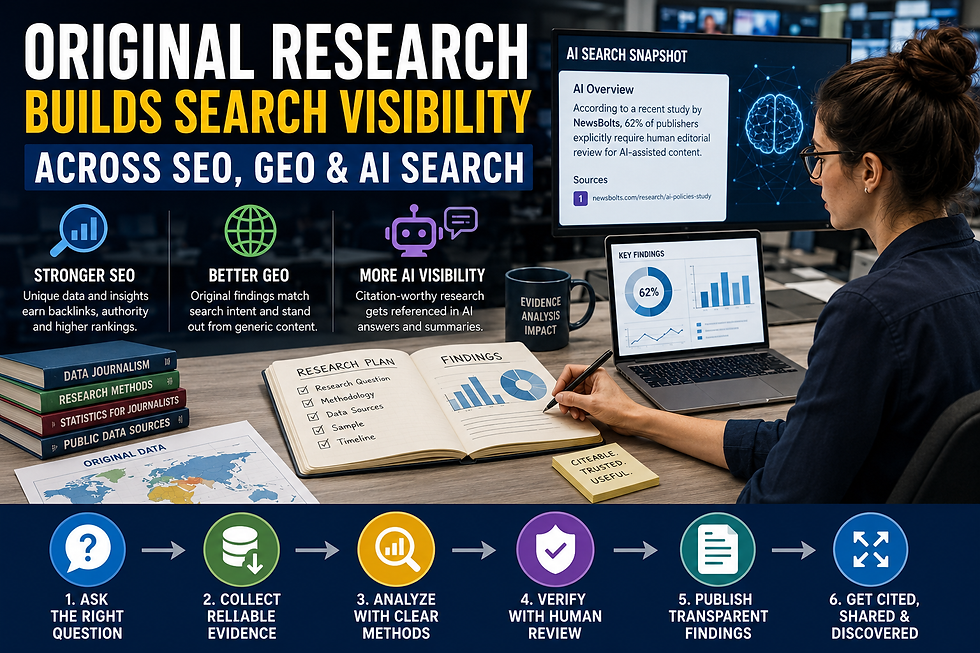
Why Original Research Matters for Publishers
Publishers face a difficult content problem: there is already an enormous amount of material covering most popular topics.
A conventional article may summarize what other websites have already reported. It can be accurate and well written, but it may contribute little that another publisher could not reproduce.
Original research changes that equation.
Instead of asking only:
“What has already been said about this topic?”
a newsroom asks:
“What can we investigate, measure, compare, document, or explain that is not already available?”
That difference matters for SEO, Generative Engine Optimization (GEO), and AI Search Visibility.
Google's guidance explicitly encourages creators to consider whether their content provides original information, reporting, research, or analysis and whether it adds substantial value beyond other pages. Google also says its systems aim to prioritize helpful, reliable, people-first content rather than content created primarily to manipulate rankings.
For publishers, the practical lesson is straightforward: originality should be treated as an editorial input, not merely an SEO tactic.
What Counts As Original Research?
Original research does not necessarily mean conducting a large academic study.
For a newsroom, it can take several forms.
Research Type | Example For A Publisher | Potential Content Asset |
Survey | Survey newsroom leaders about AI workflows | Research report |
Dataset analysis | Analyze a defined collection of public records | Data story |
Content audit | Compare how publishers cover a topic | Industry analysis |
Experiment | Test a documented publishing workflow | Methodology report |
First-party data | Analyze the publisher's own anonymized data | Trend report |
Expert interviews | Interview qualified practitioners using a consistent method | Research article |
Comparative analysis | Compare tools, policies, or workflows using defined criteria | Benchmark |
Document analysis | Examine government, regulatory, or corporate documents | Investigative analysis |
The important distinction is between original analysis and simply rewriting existing information.
For example, collecting five articles and summarizing them is not necessarily original research.
Comparing those five articles using a transparent methodology, identifying differences, documenting the sources, and drawing carefully supported conclusions can create something more valuable.
The Three-Layer Research Model
A useful NewsBolts perspective is to think about research as three layers:
Evidence → Method → Finding
Evidence is what you collected.
Method is how you collected, filtered, compared, or analyzed it.
Finding is what the evidence supports.
This structure is particularly useful for AI-oriented publishing because it makes the content easier to understand and evaluate.
A research article should make it possible for a reader to answer three questions:
Where did this information come from?
How was it analyzed?
What conclusion does the evidence actually support?
If any of those steps are unclear, the research becomes harder to trust.
It can also become harder for other publishers, journalists, researchers, or AI systems to confidently summarize.
Original Research And SEO Are Not The Same Thing
Original research can support SEO, but it should not be reduced to an SEO technique.
Google's people-first guidance asks whether content provides original information, reporting, research, or analysis and whether it provides substantial value compared with other pages.
That does not mean:
Original research = automatic ranking.
There is no such guarantee.
A research article can still perform poorly because of weak search intent, poor technical implementation, unclear writing, insufficient evidence, weak distribution, or limited demand.
The better model is:
Original Research + Useful Topic + Strong Evidence + Clear Presentation + Technical Accessibility
SEO then becomes part of the distribution system rather than the reason the research exists.
How Original Research Supports GEO And AI Search
Generative search systems often need concise, understandable information that can be connected to a specific claim or question.
That makes research particularly useful when its findings are presented clearly.
Consider these two statements:
“Publishers are increasingly using AI.”
That is broad and difficult to treat as a specific research finding.
Compare it with:
“In our analysis of 200 publicly available publisher AI policies, 62% explicitly addressed human editorial review.”
The second statement is potentially much more useful but only if the publisher actually conducted that analysis and can document the sample, methodology, date, and calculation.
The point is not that a statistic is automatically better.
The point is that a clearly documented finding creates a discrete information object.
That object can potentially be referenced by journalists, researchers, search engines, and AI systems.
This is one reason publishers should design research around citation-ready findings.
What Makes A Research Finding Citation-Worthy?
A strong finding should usually have five characteristics.
1. It Is Specific
Avoid conclusions that could apply to almost anything.
Instead of:
“AI is changing newsrooms.”
A stronger research finding might explain a measured change within a defined sample.
2. It Has A Defined Scope
State what was studied.
For example:
50 publisher websites
12 months of archived articles
100 public AI policies
a defined group of news organizations
a particular geographic market
Do not imply that a sample represents an entire industry unless the methodology supports that conclusion.
3. It Has A Date
Research becomes contextual quickly.
A finding about publisher AI adoption from one year may not describe the industry several years later.
Include the research period and publication date.
4. It Explains The Method
Readers should understand how the result was produced.
The methodology does not need to be academic in every case, but it should be sufficiently transparent to allow reasonable evaluation.
5. It Separates Findings From Interpretation
A finding is what the evidence demonstrates.
Interpretation is what the publisher believes that finding means.
Keeping the two separate improves editorial discipline.
The NewsBolts Research Workflow
For an AI newsroom, original research can be integrated into the editorial workflow rather than treated as a separate project.
A practical workflow is:
Research Question → Scope → Evidence Collection → Verification → Analysis → Editorial Review → Publication → Distribution → Update
Step 1: Define The Research Question
Start with a question that can actually be investigated.
Weak:
“How is AI changing journalism?”
Better:
“How do major digital publishers describe human review of AI-assisted content in their public editorial policies?”
The second question defines an observable research object.
Step 2: Define The Scope
Specify:
geographic area
time period
sample size
inclusion criteria
exclusion criteria
source types
This prevents the research from expanding indefinitely.
Step 3: Collect Evidence
Use appropriate sources.
Depending on the project, this could include:
government datasets
public filings
publisher policies
official documentation
academic papers
public records
company reports
published datasets
newsroom archives
Do not treat a search-result snippet as evidence when the underlying source is available.
Step 4: Verify The Evidence
This is particularly important in AI-assisted workflows.
Every important data point should have a traceable source.
A useful internal rule is:
No Source → No Finding
If a claim cannot be traced to evidence, it should not be presented as a research finding.
Step 5: Analyze The Material
Use a documented methodology.
For example, if analyzing publisher AI policies, define what counts as:
AI disclosure
human review
prohibited use
permitted use
attribution
verification requirement
Without definitions, different researchers could classify the same document differently.
Step 6: Conduct Editorial Review
AI can assist with:
categorization
extraction
summarization
pattern detection
preliminary analysis
But editorial authority should remain with people.
That distinction is central to a Human-Governed AI Newsroom Operating System such as NewsBolts.
AI can help process evidence. Human editors determine whether the evidence supports publication.
Step 7: Publish The Method Alongside The Finding
Do not hide the methodology.
A research page can include:
Research question
Sample
Methodology
Limitations
Findings
Interpretation
This makes the work easier for readers to evaluate and easier for other publishers to reference.
Original Research Can Become A Publisher's Citation Asset
One of the strongest opportunities is to stop thinking of research as a single article.
A well-designed research project can produce multiple editorial assets.
For example:
Research Dataset
↓
Primary Research Article
↓
Executive Summary
↓
Charts And Visualizations
↓
Expert Commentary
↓
Follow-Up Stories
↓
Annual Update
↓
Industry Reference Page
This creates a research asset that can continue generating editorial value.
It also gives journalists something concrete to reference when covering the subject.
A Research Asset Should Be Designed For Reuse
Suppose a publisher conducts an analysis of AI editorial policies.
The primary article might explain the findings.
A separate page could document the methodology.
A chart could show the categories.
An executive summary could present the most important findings.
A later article could investigate changes over time.
This creates a research ecosystem rather than one isolated URL.
The key is to avoid publishing multiple pages that merely repeat the same information.
Each asset should have a distinct purpose.
Research, AI Citations, And Source Provenance
Original research becomes more useful when its provenance is clear.
Source provenance means being able to understand where information originated, how it moved through the editorial process, and what evidence supports the final claim.
For AI journalism, provenance can be especially important.
A newsroom may have:
Original Source → Research Notes → AI-Assisted Analysis → Human Verification → Published Finding
The final article should not imply that AI independently discovered or verified the finding if the actual process involved human analysis and review.
A transparent workflow protects editorial credibility.
For publishers building AI-assisted systems, this is closely connected to AI Editorial Workflow design.
The workflow should preserve the relationship between evidence and published claims.
How To Design Research For AI Retrieval
If the goal includes AI search visibility, write important findings so they can stand alone.
For example:
“The study analyzed 150 publisher AI policies published between January 2025 and June 2026. The sample was limited to policies publicly available on official publisher websites.”
Then explain the finding.
This is stronger than burying the methodology several paragraphs later.
Useful research pages should make key facts easy to identify.
Use:
descriptive headings
concise findings
clear dates
explicit methodology
tables
source references
named organizations
defined terminology
limitations
This also supports Answer Engine Optimization, because important questions can be answered directly rather than forcing readers to reconstruct the answer from a long narrative.
What Publishers Should Measure
Do not measure research success only through rankings.
A broader measurement framework can include four categories.
Search Visibility
Measure:
impressions
clicks
rankings
search queries
referring pages
branded search growth where relevant
Citation And Reference Signals
Track:
backlinks from relevant publications
mentions by journalists
citations in reports
references in academic or industry material
links from organizations discussed in the research
AI Visibility
Where measurable, monitor whether important findings or brand entities appear in relevant AI-generated answers.
This should be treated as an observation rather than a guaranteed outcome.
Editorial Value
Measure whether the research produces:
follow-up stories
newsroom discussions
expert responses
updated editions
new reporting opportunities
useful internal datasets
A research project that earns limited search traffic but produces substantial journalism may still be editorially valuable.
Research Quality Checklist
Before publishing original research, an AI newsroom can use this checklist.
Research Design
Is the research question specific?
Is the sample clearly defined?
Are inclusion and exclusion criteria documented?
Is the research period stated?
Is the methodology understandable?
Evidence
Can every major finding be traced to evidence?
Are primary sources used where possible?
Have important claims been independently checked?
Are calculations reproducible?
Editorial Review
Has a human editor reviewed the methodology?
Are findings separated from opinions?
Are limitations clearly stated?
Have unsupported conclusions been removed?
Search And AI Visibility
Does the article answer the main question directly?
Are key findings easy to extract?
Are dates and entities clearly identified?
Are important sources linked or identified?
Is the research substantially different from existing coverage?
Maintenance
Is there a planned update date?
Can new data be added later?
Are historical findings preserved appropriately?
Common Mistakes
Publishing A Survey Without Explaining The Sample
A survey result is difficult to interpret without knowing who participated and how they were recruited.
Turning A Small Sample Into An Industry-Wide Claim
A sample can produce useful evidence without representing an entire market.
Avoid statements such as “publishers now believe…” when the research only examined a limited group.
Using AI To Invent The Research
AI can help design questions, categorize information, or analyze structured data.
It should not fabricate respondents, sources, observations, or findings.
Hiding The Methodology
A research claim without methodology forces readers to trust the publisher without giving them enough information to evaluate the work.
Treating Original Research As A Ranking Shortcut
Research can improve content quality and differentiation, but no methodology guarantees rankings or AI citations.
Publishing Once And Never Updating
Research about fast-changing subjects can become outdated.
A clear update policy makes the asset more durable.
A Practical Decision Framework
Not every article needs original research.
Use this simple editorial decision:
Situation | Recommended Approach |
The topic is already well documented | Add original analysis or expert interpretation |
Reliable public data exists | Analyze the data |
Important information is missing | Conduct targeted research |
The question changes rapidly | Build an updateable research asset |
The topic is opinion-led | Clearly separate evidence from commentary |
The publisher has unique first-party data | Consider a carefully anonymized analysis |
The research cannot be verified | Do not present it as original research |
It is to find legitimate opportunities where the newsroom can contribute something useful.
NewsBolts Research Opportunity
A valuable first-party research program for NewsBolts could examine how digital publishers structure AI governance.
Potential research questions could include:
How do publishers describe human review of AI-assisted journalism?
Which editorial stages are most commonly assigned to humans?
How do publishers disclose AI assistance?
What types of content receive additional verification?
How are AI-generated errors handled after publication?
Which editorial policies distinguish assistance from autonomous publishing?
This should be treated as a NewsBolts Research Opportunity, not as an existing finding.
The research should only be published after the sample, methodology, evidence, and limitations have been established.
What Publishers Should Do
Publishers that want to build research into their SEO and AI-search strategy should start small.
Choose one recurring question in your industry where existing coverage is repetitive but the underlying evidence can be investigated.
Then create a repeatable process:
Question → Evidence → Method → Finding → Editorial Review → Publication → Distribution → Update
The strongest research programs are usually not built around chasing keywords.
They are built around becoming a reliable source of information in a specific subject area.
That distinction matters.
A keyword-first strategy asks:
“What should we publish to attract search traffic?”
A research-first strategy asks:
“What useful information can our newsroom establish that others do not currently have?”
The second question is more likely to produce material with lasting editorial value.
How Original Research Supports Long-Term AI Search Visibility
Generative search will continue to change how people discover information. Publishers therefore have an incentive to create content that is not merely another summary of material already available elsewhere.
Original research offers one practical route.
It gives publishers:
unique evidence
original findings
identifiable methodology
authoritative source material
opportunities for follow-up reporting
reusable datasets
clearer citation targets
None of these guarantees inclusion in an AI-generated answer.
But they give the publisher something much more important: information worth citing.
That should be the strategic foundation.
The goal is not to create content that looks optimized for machines. The goal is to create journalism and analysis that is useful enough for people and sufficiently well documented that other information systems can understand where the claims came from.
Conclusion
Original research can give publishers an advantage that generic content cannot easily reproduce: new information supported by identifiable evidence and methodology.
For SEO, that can strengthen content differentiation. For GEO and AI search, it can create clear factual units that other systems can understand and potentially reference. For journalism itself, it can generate new reporting opportunities.
The best approach is not to manufacture statistics or conduct research merely for search visibility. It is to identify questions that matter to your audience, investigate them carefully, document how the work was done, have humans verify the conclusions, and publish the evidence clearly.
That is how research becomes more than an SEO asset. It becomes a durable newsroom information asset.
FAQs
Does Original Research Improve SEO?
Original research can strengthen content differentiation and usefulness, but it does not guarantee higher rankings. Google specifically encourages creators to consider whether content provides original information, research, reporting, or analysis and substantial value beyond competing pages.
What Is Original Research In SEO Content?
Original research is information a publisher independently collects, analyzes, or documents using a defined methodology. Examples include surveys, datasets, experiments, document analysis, interviews, and original comparative research.
Is First-Party Data Always Required?
No. Original research can analyze public information if the publisher applies an original, transparent methodology and contributes meaningful analysis. The important issue is whether the work adds genuine value rather than simply repeating existing material.
Can AI Be Used To Conduct Original Research?
AI can assist with tasks such as organizing documents, extracting structured information, categorizing material, and identifying patterns. Human researchers and editors should remain responsible for validating evidence and approving conclusions.
How Does Original Research Help GEO?
Research can create specific findings, definitions, data points, and methodological explanations that are easier for other systems to understand and potentially reference. However, there is no guaranteed formula for AI citation.
Should Every News Article Include Original Research?
No. Breaking news, routine updates, announcements, and straightforward reporting may not require original research. Research is most valuable when it can answer an unresolved question or add meaningful evidence.
How Often Should Research Articles Be Updated?
The appropriate schedule depends on the subject and how quickly the underlying information changes. Publishers should state the research date and establish an update policy where new evidence is expected.
What Is The Biggest Research Mistake Publishers Make?
One of the biggest mistakes is presenting a conclusion without enough information about the underlying evidence or methodology. A smaller, transparent study is generally easier to evaluate than an impressive-sounding claim with unclear provenance.


Comments