How Publishers Can Increase Their Chances Of Being Cited By AI Answer Engines

Publishers increase their chances of being cited by AI answer engines by making content easy to discover, understand, verify, and attribute. There is no guaranteed citation tactic. Google says foundational SEO remains the basis for visibility in AI Overviews and AI Mode, while Bing explicitly connects crawlability, content clarity, authority, and technical accessibility with eligibility for grounding and citations. ChatGPT and Perplexity also provide publisher controls and crawler guidance that affect discoverability.

Why AI Citations Matter to Publishers
For years, publishers optimized primarily for a familiar sequence:
Search query → Search result → Click → Article → Engagement
AI answer engines introduce another path:
User question → AI retrieval → Synthesized answer → Publisher citation → Optional visit
That difference changes the publishing problem.
A publisher may receive fewer traditional clicks for some information-seeking queries while becoming a source used inside an AI-generated response. The citation itself can become an important visibility signal, even when the user does not immediately visit the page.
Bing now provides an AI Performance report that shows which publisher URLs are cited in supported AI-generated answers, associated grounding queries, and changes in citation activity over time. Bing explicitly notes that these citation measurements are not rankings or direct measures of authority, traffic, or importance.
This creates a new measurement question for publishers:
Which pages are being used as evidence by answer engines, for which questions, and why?
That is more useful than asking only whether a page "ranks in AI."
What Is AI Citation Optimization?
AI citation optimization is the practice of creating and technically exposing content so that AI-powered search and answer systems can discover, understand, evaluate, retrieve, and attribute the page when answering relevant questions.
The important distinction is that publishers cannot directly command an AI system to cite a page.
They can improve the conditions under which a page is eligible and useful.
Google explicitly says there are no additional technical requirements or special optimizations required for inclusion in AI Overviews or AI Mode. Pages need to meet the normal technical requirements and be indexed and eligible to appear with a snippet in Google Search.
Google's newer guidance on generative AI search makes a similar point: publishers should prioritize unique, valuable, non-commodity content rather than relying on special "GEO hacks." Google specifically says there is no need for special AI markup, llms.txt, artificial content chunking, or inauthentic mentions for Google Search.
So the practical objective is not to "game the AI."
It is to build citation-worthy publishing assets.
How AI Answer Engines Decide What to Cite
Different systems use different retrieval, ranking, grounding, and generation processes. Publishers should therefore avoid treating "AI search" as one algorithm.
Google AI Overviews and AI Mode can use query fan-out, where related searches are performed across subtopics and sources before producing a response. The supporting links can therefore vary depending on the question and the systems used to generate the answer.
Bing describes its AI experiences in terms of grounding, where indexed content can be retrieved and used to support generated answers. Its current webmaster guidance specifically connects clear content, authority, discoverability, and technical accessibility with grounding and citation eligibility.
ChatGPT search also uses multiple factors to determine which results are relevant and reliable, and OpenAI states that placement is not guaranteed. Public websites can appear in ChatGPT search, while allowing OAI-SearchBot helps make site content available for summaries and snippets.
Perplexity similarly operates a web-search layer. Its documentation says PerplexityBot is designed to surface and link websites in search results and recommends allowing the crawler if a publisher wants its site to appear there.
The common lesson is important:
Citation visibility depends on both content quality and retrieval eligibility.
A brilliant article that a crawler cannot access has limited opportunity.
A technically accessible article with little original value may also have little reason to be selected.
The Six Properties of a Citation-Worthy Publisher Page
A useful NewsBolts framework is to evaluate every important page across six properties:
Discoverable → Understandable → Verifiable → Attributable → Useful → Maintained
These properties describe the path from crawling to citation.
Discoverable
Can the relevant system find and access the URL?
Understandable
Can the system identify the page's topic, entities, claims, and relationships?
Verifiable
Can important claims be checked against evidence?
Attributable
Is it obvious who created the information and where important facts came from?
Useful
Does the page provide something worth retrieving instead of merely repeating common information?
Maintained
Is the information current enough for the subject?
This framework is not an official ranking formula. It is a publisher-side operating model for diagnosing citation readiness.
1. Make Important Pages Crawlable
The first requirement is basic but frequently overlooked: the page has to be accessible.
Google's technical requirements say a page must be accessible to Googlebot, return a successful HTTP status such as 200, and contain indexable content to be eligible for indexing. Meeting those requirements does not guarantee indexing.
For Google AI features, a page must be indexed and eligible to appear in Google Search with a snippet. Google says there are no additional technical requirements for AI Overviews or AI Mode.
Bing similarly advises publishers to allow Bingbot to crawl and render important URLs and warns that content that cannot be reliably rendered may not be indexed or selected for grounding.
Publishers should therefore audit:
Robots.txt
Noindex directives
HTTP status codes
Canonical URLs
Internal links
XML sitemaps
JavaScript rendering
Authentication barriers
CDN and firewall rules
Bot-management systems
For ChatGPT, publishers should separately check whether OAI-SearchBot is being blocked. OpenAI says allowing OAI-SearchBot helps make content available for summaries and snippets in ChatGPT search.
For Perplexity, the publisher should check access for PerplexityBot.
This is why GEO is partly a technical publishing discipline.
2. Give Every Important Page One Clear Primary Topic
AI systems need to determine what a page is actually about.
A page titled "Digital Publishing Guide" that simultaneously discusses newsroom automation, advertising, SEO, video, subscriptions, and unrelated technology creates a broader interpretation problem than a page with a clearly defined purpose.
Bing's current webmaster guidelines explicitly recommend focusing each URL on a primary topic and aligning the title, headings, and content intent.
That does not mean every article must be narrow.
A comprehensive article can cover many related subtopics while still maintaining one central question.
For example:
Primary topic: How publishers can increase AI citations.
Supporting topics:
Crawlability
Source attribution
Content structure
Original research
Internal linking
Freshness
Measurement
AI crawler access
Those topics reinforce the primary entity instead of competing with it.
3. Put the Direct Answer Near the Top
Answer engines need to understand the page quickly.
That does not mean turning every article into a collection of one-sentence snippets.
It means answering the central question before making the reader work through several paragraphs of background.
Bing's current guidelines explicitly recommend surfacing key information early and avoiding long introductions before addressing the main topic.
For publishers, a strong opening structure is:
Question → Direct answer → Qualification → Explanation → Evidence
For example:
Publishers cannot guarantee AI citations, but they can improve citation readiness by making important pages crawlable, topic-focused, evidence-backed, clearly attributed, and useful enough to retrieve.
The rest of the article then explains the claim.
This is useful to people and machines for the same reason: the central proposition is unambiguous.
4. Write Claims That Can Be Extracted Without Losing Meaning
One of the biggest opportunities in GEO is claim clarity.
Consider this sentence:
"The changing nature of search means publishers need to rethink the way they approach content visibility."
It sounds reasonable but provides little extractable information.
Compare it with:
"Google says pages appearing in AI Overviews and AI Mode still need to meet the normal technical requirements for Google Search, and Google says there are no additional technical requirements for these AI features."
The second statement has:
A defined subject
A defined relationship
A specific claim
A clear source
A limited scope
That makes it easier for a human reader to verify and easier for an answer engine to represent accurately.
5. Build Evidence Into the Page
A citation-worthy article should not force the answer engine to infer everything.
When making an important factual claim, provide evidence close to the claim.
Evidence can include:
First-party data
Original reporting
Government datasets
Official documentation
Academic research
Regulatory documents
Primary company documentation
Expert interviews
Clearly identified methodology
Google's people-first guidance asks whether content provides original information, reporting, research, or analysis and whether it adds substantial value beyond simply rewriting other sources.
Google's generative AI guidance similarly emphasizes unique, non-commodity content and first-hand or expert perspectives.
For publishers, this suggests an important editorial shift:
Do not merely summarize the source. Build a page that contains something worth citing.
6. Make Original Reporting More Explicit
News publishers have an advantage that generic content sites often lack: original reporting.
A reported story may contain:
A new interview
A document obtained by the newsroom
A local observation
Original photographs
A dataset
A public-record discovery
A first-party experiment
A timeline assembled from primary records
Original analysis
Those elements should be visible and clearly explained.
For example, instead of writing:
"Experts say publishers should improve AI visibility."
A newsroom could publish:
"NewsBolts analyzed 200 publisher URLs over a defined period and found..."
But only if the newsroom actually performed that analysis.
If it has not, it should not manufacture the finding.
This is where NewsBolts Research Opportunity becomes useful.
A publisher can identify questions that deserve first-party research, define the methodology, collect the evidence, publish the findings, and then create a source that other articles—and potentially AI systems can reference.
7. Strengthen Attribution and Authorship
A page should make its provenance understandable.
Publishers should make clear:
Who wrote it
Who edited it
When it was published
When it was updated
What sources were used
Whether the article contains original reporting
Whether AI assisted production
What methodology was used for original research
Google's people-first guidance recommends clear authorship and explains that showing who created content can help users understand the expertise behind it. Google also discusses the usefulness of explaining how content was created where that context matters.
This is not about adding an "AI optimized" label to every page.
It is about making provenance easier to understand.
Perplexity's current source-labeling documentation provides an interesting example of how source quality can be evaluated at the domain level. Its source-review process considers factors such as whether a site corrects mistakes, identifies authors, and separates news from advertising and opinion.
That reinforces a broader publisher lesson:
Editorial transparency is part of discoverability infrastructure.
8. Use Internal Links to Build Topic Relationships
A publisher should not expect every article to establish its own authority independently.
Internal links help connect related pages.
Google says properly linked important pages can usually be discovered, while Bing's current guidance specifically recommends crawlable internal links and relevant anchor text for discovery and authority signals.
For a publisher covering AI search, a topic cluster could connect:
AI search
GEO
AEO
News SEO
Search Console
AI news intelligence
News event clustering
Source verification
First-party research
Editorial governance
The important point is not simply adding more links.
The links should communicate relationships.
For example:
"Google AI Overviews and AI Mode" is more informative than a generic "click here."
9. Keep Sitemaps and Freshness Signals Accurate
Sitemaps are not an AI-citation shortcut.
Google says sitemaps help search engines discover URLs but do not guarantee crawling or indexing.
They still matter for publishers because large news sites can have thousands or millions of URLs, and fresh content needs reliable discovery.
Bing likewise recommends accurate XML sitemaps and freshness signals such as appropriate lastmod values, while also supporting IndexNow for notifying participating search engines about URL changes.
For publishers, the practical rule is simple:
Do not treat the sitemap as a ranking signal; treat it as part of content-discovery infrastructure.
10. Structured Data Helps With Understanding, But It Is Not a Citation Hack
Structured data can help search systems understand what a page represents.
Google says Article structured data can help it understand article pages and potentially improve how title, image, and date information are represented. It is not required for eligibility for Google News features such as Top stories.
Google also says there is no special structured-data requirement for AI Overviews or AI Mode.
Therefore, publishers should use accurate structured data where it makes sense, but they should not expect schema alone to make an article citation-worthy.
The correct hierarchy is:
Good content → Clear HTML → Crawlability → Accurate metadata/structured data
Not:
Schema → AI citation
11. Design Pages for Retrieval, Not Just Reading
Human readers and retrieval systems have overlapping but different needs.
A strong publisher page can serve both.
Use:
Descriptive headings
Short explanatory paragraphs
Tables when comparisons matter
Definitions for specialized terms
Clear source attribution
Lists for sequential processes
Examples
Relevant internal links
Meaningful captions
Accessible text
Clear publication and update information
Bing's guidelines specifically recommend clear HTML structure, logical heading hierarchy, accessible content, and content that can be independently verified.
Google likewise recommends making important content available in textual form and maintaining strong foundational SEO practices for AI features.
The objective is not to create "AI-readable" prose.
It is to create clear human-readable information that machines can also interpret reliably.
12. Build Citation-Friendly Tables
Tables can be particularly useful for comparison queries.
Suppose an article compares:
Concept | Definition | Publisher Action |
Crawlability | Whether systems can access the page | Audit robots, status codes, rendering and access controls |
Topic clarity | Whether the page has a clear subject | Align title, headings and body around one primary topic |
Evidence | Support for important claims | Link claims to authoritative or first-party sources |
Attribution | Clear provenance | Add author, date, methodology and source context |
Freshness | Whether information remains current | Review changing facts and update pages appropriately |
Measurement | Evidence of AI visibility | Monitor available AI citation and search reporting |
This structure gives readers a decision tool instead of another abstract explanation.
13. Do Not Manufacture "AI-Optimized" Signals
The GEO market has generated a large number of proposed tactics.
Publishers should be skeptical of any recommendation that claims to guarantee citations.
Google's current generative AI guidance explicitly rejects several commonly promoted tactics for Google Search, including special AI files such as llms.txt, artificial content chunking, rewriting content solely for AI systems, and pursuing inauthentic mentions.
Bing also warns against attempts to manipulate AI systems and says GEO does not guarantee grounding or citations.
The safer approach is to improve the underlying information asset.
If a tactic does not improve the page for a human reader, a publisher should ask why it should exist.
A Publisher Citation-Readiness Scorecard
NewsBolts can turn the framework into a practical editorial audit.
Area | Diagnostic Question | Evidence to Check |
Access | Can relevant crawlers reach the page? | Robots, WAF, HTTP status, rendering |
Topic | Is the page focused on one primary subject? | Title, H1, headings, body |
Answer | Is the main question answered early? | Opening section |
Evidence | Can important claims be verified? | Sources, data, documents |
Attribution | Is provenance clear? | Byline, author page, methodology |
Originality | Does the page add information beyond summaries? | Reporting, analysis, first-party material |
Structure | Can key information be located easily? | Headings, tables, lists |
Freshness | Are changing facts maintained? | Dates, updates, source checks |
Relationships | Are related pages connected? | Internal links and anchor text |
Measurement | Can citation visibility be observed? | Search Console, Bing AI Performance, analytics |
This is a diagnostic framework, not a proprietary ranking score.
A publisher could assign its own internal status such as:
Ready → Needs Work → Blocked
That is often more actionable than pretending citation probability can be calculated precisely.
The NewsBolts Human-Governed AI Search Workflow
For a newsroom, citation optimization should become part of publishing rather than a separate SEO task performed after publication.
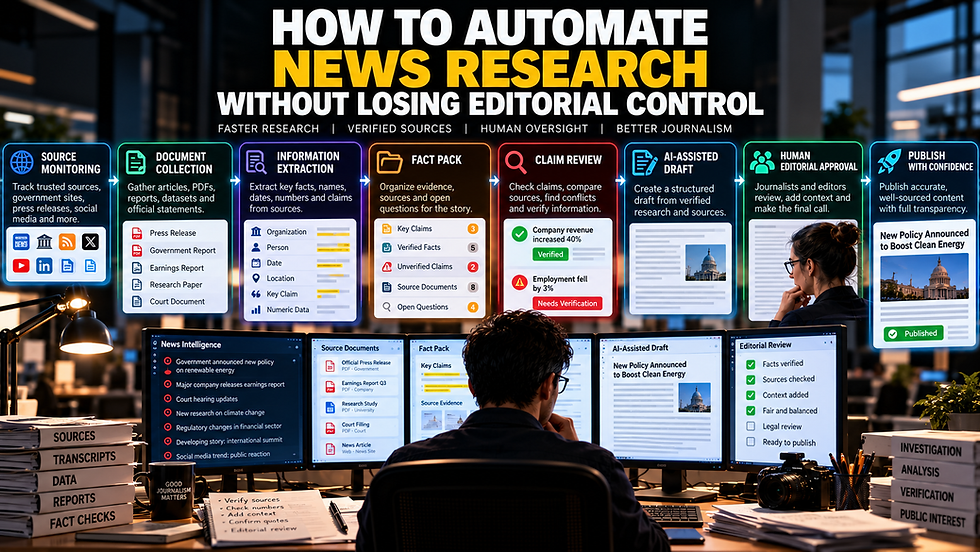
A practical NewsBolts workflow is:
Story Discovery
Identify the topic, event, question, or reporting opportunity.
Source Verification
Collect authoritative sources and verify the core facts.
Fact Pack
Create a structured evidence record containing claims, sources, dates, entities, quotations, statistics, and unresolved questions.
Editorial Brief
Define the article's primary question, audience, angle, evidence requirements, and related topics.
AI-Assisted Production
Use AI where appropriate for outlining, summarization, classification, repurposing, or drafting.
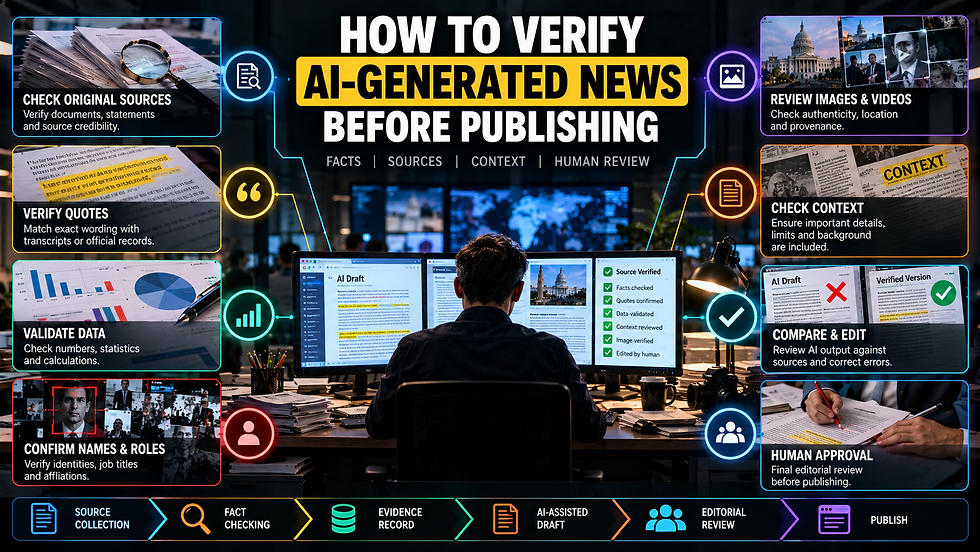
Human Verification
Editors and journalists verify factual claims, context, attribution, quotations, and source relationships.
GEO/AEO Review
Check whether the page gives clear answers, definitions, evidence, entity relationships, and supporting context.
Technical Publication
Confirm crawlability, internal links, canonicalization, sitemap inclusion, structured data, and other applicable technical elements.
Measurement
Monitor search performance and available AI citation data.
This is where NewsBolts' Human-Governed AI Newsroom Operating System has a practical role.
AI can help organize and accelerate the workflow, but the system should preserve human authority over verification and publication.
AI Assistance vs Automation vs Autonomous Publishing
These terms should not be treated as interchangeable.
Approach | AI Role | Human Role |
AI assistance | Helps with research organization, drafting or analysis | Human controls decisions |
Workflow automation | Moves information or performs predefined tasks | Human defines rules and handles exceptions |
AI-directed production | AI coordinates multiple content steps | Human oversight becomes more important |
Autonomous publishing | AI can make publication decisions | Human authority is substantially reduced |
For publisher trust, the distinction matters.
A newsroom should be able to explain where AI entered the workflow and where a human verified the result.
Google's guidance does not prohibit useful AI assistance; it emphasizes whether content is useful, original, reliable, and created for people rather than primarily to manipulate search rankings.
How Publishers Should Measure AI Citation Visibility
Traditional SEO metrics remain important, but they are no longer the entire measurement model.
Publishers should separate at least four layers.
Search Visibility
Track:
Impressions
Clicks
CTR
Queries
Landing pages
Search positions where useful
AI Citation Visibility
Where supported, track:
Cited URLs
Citation frequency
Grounding queries
Citation trends
Topics associated with citations
Bing's AI Performance report now exposes cited pages, citation activity, and grounding queries for supported Microsoft AI experiences.
Referral Traffic
Track traffic arriving from AI platforms where identifiable.
OpenAI says ChatGPT referrals can be tracked through analytics, with utm_source=chatgpt.com included in referral URLs from ChatGPT search.
Business and Editorial Outcomes
Measure:
Newsletter subscriptions
Registrations
Returning users
Leads
Membership actions
Content engagement
Brand searches
Other publisher-specific outcomes
A citation is not the same as a click.
Bing explicitly warns that its AI Performance citation measurements do not represent traffic, clicks, engagement, rankings, or authority.
That distinction should be preserved in publisher reporting.
Common Mistakes Publishers Make
Treating GEO as a Keyword-Density Exercise
Repeating a question several times does not make an article authoritative.
Writing Separate Pages for Every AI Prompt
Google specifically warns against producing large quantities of content primarily to capture search variations or manipulate generative AI responses.
Hiding the Evidence
If a claim matters, show the source or explain the methodology.
Publishing Generic Summaries
A page that simply rewrites five other articles has limited differentiation.
Blocking Important Crawlers Accidentally
Robots.txt, WAF, CDN, authentication, and bot-management rules can all affect discoverability.
Confusing Indexing With Citation
A page can be indexed without being selected as a citation.
Confusing Citation With Traffic
A page can be cited without generating a measurable click.
Overusing Structured Data
Schema can help systems understand pages, but Google does not require special schema for AI features.
Using AI Without Verification
AI-generated claims, sources, quotations, numbers, and summaries require appropriate human review.
Practical GEO/AEO Diagnostic Checklist
Before publishing an important page, ask:
Content
Does the page answer one primary question?
Is the answer clear near the beginning?
Does the article add original information, reporting, analysis, or experience?
Are important claims supported?
Are definitions explicit?
Are dates and scope clear?
Entity Clarity
Are organizations, people, products, events, and concepts named consistently?
Are ambiguous terms explained?
Does the page make relationships between entities clear?
Editorial Trust
Is there an accurate byline?
Is the publication date visible?
Is the update date meaningful?
Are sources identifiable?
Is original research explained?
Technical Access
Can Googlebot access the page?
Can Bingbot access the page?
Is OAI-SearchBot blocked?
Is PerplexityBot blocked?
Does the page return a successful response?
Is important content available as text?
Is the canonical URL correct?
Search Structure
Are headings descriptive?
Are internal links useful?
Is the page included in the sitemap?
Does structured data accurately match visible content?
Measurement
Is Search Console configured?
Is Bing Webmaster Tools configured?
Is AI Performance available for the site?
Can AI referrals be identified in analytics?
Are citation observations kept separate from traffic claims?
What Publishers Should Do
Publishers should stop thinking of AI citations as a separate optimization trick.
Instead, treat citation readiness as a quality and infrastructure layer across the newsroom.
Start with the pages that matter most commercially or editorially.
For each priority page:
Confirm crawler access.
Define one primary topic.
Put the direct answer near the top.
Identify the important claims.
Attach evidence to those claims.
Make authorship and provenance clear.
Add original reporting or analysis where available.
Connect the page to related authoritative content.
Keep changing information current.
Measure both search visibility and available AI citation activity.
Then apply the same process to the wider content portfolio.
The objective is not to make every page "AI optimized."
The objective is to make the publisher's best information easier for people and information-retrieval systems to discover, understand, verify, and attribute.
NewsBolts Research Opportunity
NewsBolts could conduct a first-party study of AI citation patterns across publisher websites.
A credible methodology could include a defined sample of publisher domains, a fixed set of recurring queries, repeated observations across multiple AI search environments, and page-level classification.
The study could record:
Which URLs were cited
Query category
Search intent
Article age
Article format
Presence of original reporting
Source density
Author information
Internal-link structure
Update frequency
Entity clarity
Citation frequency over time
The study should also record the limitations of observing AI systems because model behavior, retrieval sources, user queries, geographic context, and system updates can change.
Most importantly, NewsBolts should not publish a "citation factor" unless the underlying dataset actually supports that conclusion.
The valuable output would be a transparent methodology and a reproducible set of observations.
The Future of Publisher Visibility in AI Search
AI search does not eliminate traditional SEO.
Google explicitly says foundational SEO remains relevant to AI Overviews and AI Mode.
Bing similarly states that its traditional crawling, indexing, and ranking foundations support AI grounding and citation eligibility.
What changes is the visibility layer.
Publishers now need to understand not only:
"Where do we rank?"
but also:
"When an answer is generated, does our information become part of the evidence?"
That is a different editorial question.
It favors publishers that can produce original reporting, trustworthy explanations, structured evidence, strong entity relationships, and technically accessible pages.
It also favors publishers that can measure what is actually happening rather than relying on assumptions about how AI systems work.
Conclusion
Publishers cannot force Google, Bing, ChatGPT, Perplexity, or another AI answer engine to cite a particular page.
They can, however, make their content more discoverable, understandable, verifiable, attributable, useful, and maintainable.
That is the real foundation of GEO for publishers.
The strongest strategy is not to manufacture AI-specific signals. It is to improve the underlying information product: original reporting, explicit claims, reliable evidence, clear authorship, strong internal relationships, accessible pages, accurate technical signals, and measurable editorial quality.
For NewsBolts, that means treating AI visibility as part of the newsroom workflow rather than a final SEO checklist.
Story discovery → source verification → Fact Pack → editorial brief → AI-assisted production → human verification → publication → GEO/AEO review → measurement
When that workflow is governed properly, AI can help the newsroom produce and organize information faster while journalists and editors remain responsible for what ultimately gets published.
And that is the more durable objective: not writing for an AI answer engine, but publishing information that an answer engine has a strong reason to trust and cite.
Frequently Asked Questions
How can publishers get cited by AI answer engines?
Publishers cannot guarantee citations. They can improve citation readiness by making pages crawlable, focused, evidence-backed, clearly attributed, useful, and technically accessible. Google, Bing, OpenAI, and Perplexity all provide guidance emphasizing discoverability and access, while Google and Bing specifically reject the idea of guaranteed AI-citation tactics.
Does Google require special GEO or AEO markup?
No. Google says there are no additional technical requirements or special schema requirements for AI Overviews or AI Mode. Google also says special AI files such as llms.txt are not used by Google Search for this purpose.
Does getting indexed guarantee AI citations?
No. Indexing is an eligibility condition, not a citation guarantee. Google says even pages meeting its technical requirements may not be indexed or served, while Bing describes citation activity as a separate visibility outcome.
Should publishers allow AI crawlers?
If a publisher wants to make content discoverable to a particular AI search service, it should review that service's crawler guidance and its own access policies. OpenAI says allowing OAI-SearchBot helps make site content available for ChatGPT summaries and snippets, while Perplexity recommends allowing PerplexityBot for appearance in its search results.
Does structured data increase AI citations?
There is no official evidence that structured data by itself guarantees or directly causes AI citations. Google says structured data can help it understand pages, but it also says there is no special structured-data requirement for AI Overviews or AI Mode.
What type of content is most useful for AI citation visibility?
There is no single guaranteed content type. Google emphasizes unique, valuable, non-commodity, people-first content, while Bing emphasizes clear, focused, original, authoritative, independently verifiable content. Original reporting, research, evidence, analysis, and clearly explained expertise can give publishers more distinctive information to contribute.
Can AI-generated content be cited by answer engines?
AI-assisted content can potentially appear in search and AI experiences, but using AI does not make content authoritative. Google focuses on whether content is helpful, reliable, original, and people-first, and warns against scaled content created primarily to manipulate search rankings.
How should publishers measure AI visibility?
Use available platform-specific reporting alongside traditional SEO and analytics. Bing's AI Performance report provides cited pages, citation activity, and grounding queries for supported AI experiences, while Google reports AI-feature traffic within the broader Web search data in Search Console. AI citations should be treated separately from clicks and traffic.

Comments