How To Calculate Newsroom Automation ROI: A Practical Guide For Publishers

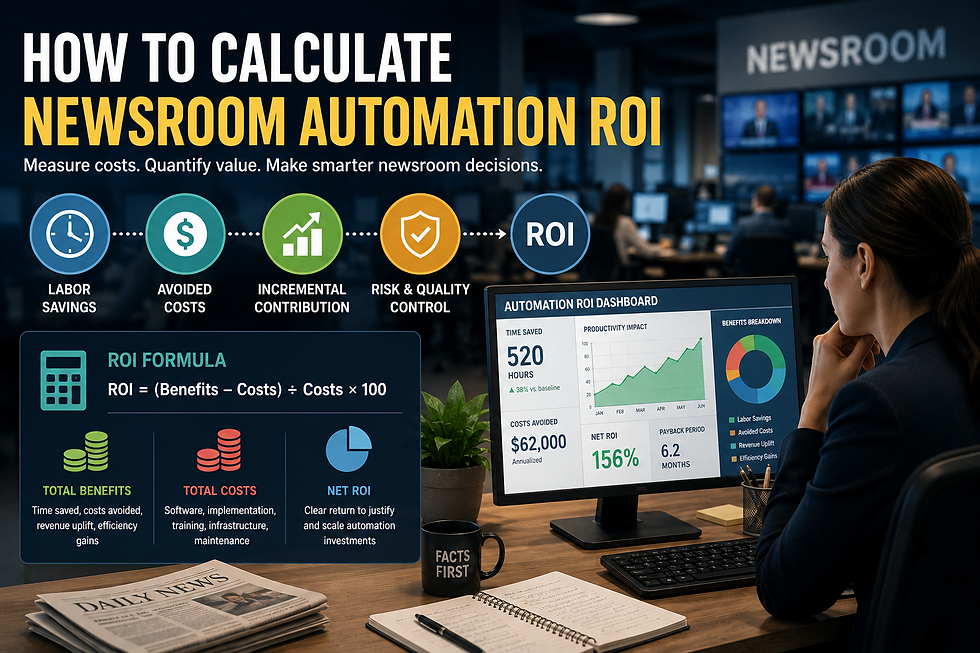
Newsroom automation ROI is best calculated by comparing the measurable economic value created by an automated workflow with its full cost, rather than counting how many tasks an AI tool can perform. Publishers should measure labor capacity released, avoided costs, incremental contribution, implementation expenses, ongoing software and infrastructure costs, and editorial risk. The result should be evaluated alongside payback period and strategic value.
Why Newsroom Automation ROI Is Harder Than A Simple Cost-Savings Calculation
Newsroom automation often starts with an apparently simple question:
“How much money will this automation save us?”
That question is useful, but incomplete.
Automation can reduce repetitive work without reducing headcount. It can allow an editor to spend more time on reporting, verification, audience development, newsletters, investigations, SEO, or commercial projects. In that situation, the economic value comes from capacity released, not necessarily payroll eliminated.
Automation can also increase output, shorten publishing cycles, reduce manual data entry, improve content repurposing, or make previously uneconomic workflows possible.
Those benefits are real potential sources of value, but they need to be measured carefully.
This matters because publishers are investing in automation while results remain uneven. The Reuters Institute's 2026 Journalism, Media, and Technology Trends report found that 97% of surveyed publisher respondents considered back-end automation important, while 44% described their newsroom AI initiatives as showing promising results and 42% described results as limited.
That is exactly why ROI measurement matters.
The question is not whether automation is popular.
The question is whether a particular automation produces enough net economic and editorial value to justify its cost and risk.
What Is The ROI Of Newsroom Automation?
Newsroom automation ROI is the percentage return generated by an automation investment after accounting for its attributable benefits and costs.
A practical formula is:
ROI = (Quantified Benefits − Total Automation Costs) ÷ Total Automation Costs × 100
For example, if a publisher generates $120,000 in measurable annual benefits from an automation initiative and incurs $80,000 in total costs, the net benefit is $40,000 and the ROI is 50%.
The formula itself is simple.
The difficult part is determining what should legitimately be counted as a benefit and what should be counted as a cost.
That is where most newsroom ROI calculations become unreliable.
The Five Value Categories Publishers Should Measure
A useful newsroom ROI model separates value into five categories.
1. Labor Capacity
Measure the amount of human time removed from repetitive work.
Examples include:
Monitoring sources
Copy formatting
Metadata preparation
Transcription
Translation
Content classification
Article repackaging
Newsletter preparation
Data collection
Image or document processing
Routine reporting workflows
The calculation can begin with:
Hours saved × loaded hourly cost = theoretical labor value
But do not automatically treat every saved hour as cash savings.
If an editor spends five fewer hours each week formatting articles but remains employed at the same salary, the newsroom has created capacity, not necessarily reduced expenses.
2. Avoided External Costs
Automation can sometimes reduce spending on:
Freelance production
Overtime
Manual data-entry services
Transcription services
Translation services
Repetitive production contractors
Multiple disconnected software subscriptions
These savings are easier to quantify because there may be an actual invoice or budget line that disappears.
3. Incremental Contribution
Automation can create additional output or revenue.
For example, a workflow might allow a publisher to produce localized versions of important stories that previously were not economically viable.
But use incremental contribution, not simply gross revenue.
If automation creates $20,000 in additional revenue but requires $8,000 in additional delivery and sales costs, the relevant economic benefit is closer to the contribution created by the activity rather than the full $20,000.
4. Error And Rework Reduction
Automation can reduce repetitive mistakes, duplicated work, or avoidable production delays.
This can have economic value.
For example, if a workflow routinely requires editors to spend time correcting metadata, manually transferring information, or fixing formatting errors, reducing that rework can create measurable capacity.
The challenge is to establish a baseline before automation.
5. Strategic Capacity
Some benefits are difficult to express in immediate dollars.
Automation might allow a newsroom to:
Investigate more complex topics
Publish more original reporting
Improve source verification
Develop newsletters
Expand audience products
Create additional content formats
Improve SEO workflows
Build better archives
Test new commercial products
These benefits should be tracked, but they should not be turned into invented financial figures.
If they cannot be credibly monetized, label them as strategic or non-financial benefits rather than forcing them into the ROI calculation.
What Costs Should Be Included?
One of the biggest mistakes publishers make is measuring only the software subscription.
The actual cost of automation is broader.
Cost Category | What To Include |
Software | Platform and SaaS fees |
AI usage | Model or API consumption where applicable |
Implementation | Configuration, integration, migration |
Infrastructure | Hosting, storage, databases, monitoring |
Human oversight | Editorial review and quality assurance |
Training | Staff onboarding and workflow training |
Maintenance | Ongoing technical and operational support |
Governance | Testing, documentation, permissions, audits |
Opportunity cost | Time spent implementing and managing the system |
Change management | Workflow redesign and adoption effort |
A publisher should calculate total cost of ownership, not just the price shown on a vendor's pricing page.
The U.S. Small Business Administration similarly recommends considering both recurring and nonrecurring costs and benefits when performing cost-benefit analysis.
A Better Calculation: Measure The Baseline First
Do not introduce automation and then try to guess what changed.
Establish a baseline first.
For a specific workflow, measure:
Number of tasks
Number of stories processed
Human hours required
Average processing time
Error or rework rate
External production cost
Publishing frequency
Revenue or contribution associated with the workflow
Editorial review time
Delay between information arrival and publication
Then run the automated workflow under controlled conditions.
The goal is to compare:
Before automation
with
After automation
This makes the ROI calculation much more defensible.
A Practical Newsroom Automation ROI Example
Consider a hypothetical publisher that wants to automate repetitive content processing.
These numbers are illustrative assumptions, not NewsBolts customer data or industry benchmarks.
Suppose three editors collectively spend 24 hours per week on repetitive processing.
At 48 working weeks per year:
24 × 48 = 1,152 hours per year
Assume the newsroom uses a loaded labor cost of $45 per hour.
The theoretical annual labor value is:
1,152 × $45 = $51,840
Now suppose the automation reduces this workload by 40%.
That would theoretically release:
1,152 × 40% = 460.8 hours
At $45 per hour:
460.8 × $45 = $20,736
But the newsroom should not immediately claim $20,736 of cash savings.
Suppose only 70% of those hours are actually redeployed into productive newsroom work.
The recognized capacity value would then be:
$20,736 × 70% = $14,515
Now consider annual automation costs:
Software and AI services: $12,000
Integration and maintenance: $8,000
Training and implementation: $5,000
Quality assurance and governance: $5,000
Total annualized cost:
$30,000
The resulting economic ROI based only on recognized capacity would be:
($14,515 − $30,000) ÷ $30,000 × 100 = −51.6%
That does not necessarily mean the project is useless.
It means the publisher has not yet demonstrated enough quantified economic value from that specific benefit category.
Perhaps the automation also enables additional newsletter production, reduces freelance costs, increases publishing capacity, or supports a revenue-generating product.
Those benefits should be measured separately rather than quietly inserted into the labor-saving calculation.
This is a much more useful approach than claiming that "40% of work was automated, therefore ROI is 40%."
Do Not Double-Count Benefits
Double counting is one of the biggest threats to a credible ROI model.
Imagine automation saves an editor 400 hours.
You cannot necessarily count those 400 hours as:
$20,000 in labor savings, and
$30,000 in revenue from using those hours for additional content.
If the editor's salary did not fall, the first figure may represent capacity rather than cash savings.
The second figure may represent a genuine additional contribution.
The model needs to specify exactly what each number represents.
A useful rule is:
Every dollar in the ROI model should have one clearly defined economic reason for existing.
ROI Should Be Calculated Per Workflow, Not Only Per Platform
A publisher may buy one automation platform and use it for ten different workflows.
Calculating one giant ROI figure can hide what is actually working.
Instead, calculate ROI at the workflow level.
For example:
Workflow | Baseline Problem | Primary Benefit | Best Metric |
Source monitoring | Manual checking | Time saved | Hours per week |
Transcription | Manual transcription | Lower production cost | Cost per transcript |
Article repurposing | Slow production | More formats | Cost per format |
Newsletter preparation | Manual assembly | Faster production | Editor minutes per edition |
Metadata production | Repetitive work | Capacity | Minutes per article |
Verification preparation | Research overhead | Faster review | Time to verification |
Translation | External production | Lower cost or greater coverage | Cost per language |
This prevents the platform from becoming the unit of analysis.
The workflow should be the unit of analysis.
Build The ROI Model Around A Control Group When Possible
If a publisher has enough volume, a stronger measurement approach is to compare automated and non-automated workflows.
For example, the newsroom could select similar article categories and compare:
Processing time
Editorial review time
Correction rate
Output volume
Publishing speed
Cost per article
Engagement
Revenue contribution
The comparison does not have to be a formal scientific experiment to be useful.
However, the publisher should document its methodology.
NewsBolts Research Opportunity
NewsBolts could develop a standardized newsroom automation ROI measurement template that allows publishers to record baseline performance, automation costs, human review time, capacity released, output changes, and business outcomes for each workflow.
Such a framework should be presented as a measurement methodology, not as evidence of average industry ROI unless actual aggregated data are collected and published.
The NewsBolts Workflow ROI Framework
A practical NewsBolts approach is to evaluate automation through seven stages:
Discover
Identify repetitive newsroom activities that consume meaningful resources.
Do not start with "Where can we use AI?"
Start with:
"Where is the newsroom spending time that could be better used elsewhere?"
Measure
Record the current workflow.
Measure volume, time, cost, errors, delays, and human involvement.
Automate
Introduce automation only where the task is sufficiently structured and the expected benefit justifies implementation.
Verify
Measure whether the automated workflow produces reliable outputs.
This is especially important when AI is involved.
Review
Track how much human editorial effort remains.
Automation that removes ten minutes of manual work but creates eight minutes of checking may have limited economic value.
Approve
Ensure that appropriate human authority remains in control of publication.
This distinction is important because AI assistance, workflow automation, and autonomous publishing are not the same thing.
Learn
Recalculate the economics after the workflow has operated long enough to produce meaningful data.
The goal is not to prove that automation was a good decision.
The goal is to determine whether the workflow is actually producing enough value to continue, change, or stop.
AI Assistance, Automation And Autonomous Publishing Have Different ROI Profiles
Publishers should not put all AI activity into one category.
Approach | Typical Role | ROI Question |
AI assistance | Supports an editor | How much useful time does it save? |
Workflow automation | Moves structured tasks automatically | How much cost or delay does it remove? |
Human-governed AI workflow | AI processes while people control decisions | Does it improve productivity without unacceptable editorial risk? |
Autonomous publishing | AI performs production and publishing with limited intervention | Is the incremental value worth the much higher governance and reputational exposure? |
The economic calculation changes as automation becomes more autonomous.
Removing a human review step might save money, but it can also increase quality-control risk.
That risk should not be ignored simply because it is difficult to assign a dollar value.
NIST's AI Risk Management Framework provides a voluntary framework for managing AI risks and emphasizes governance, measurement, and management throughout the AI lifecycle.
Editorial Risk Belongs In The ROI Decision
A newsroom automation project can have positive financial ROI and still be a bad editorial investment.
Consider an automation that reduces production costs by 30% but increases the probability of serious factual or attribution errors.
The financial spreadsheet may look attractive.
The newsroom decision should not.
Editorial risk can include:
Incorrect facts
Misleading summaries
Missing context
Source attribution errors
Fabricated information
Unverified claims
Privacy problems
Copyright concerns
Reputational damage
Loss of audience trust
This is why ROI should be combined with a risk assessment.
A simple decision matrix can help:
Economic Result | Editorial Risk | Decision |
High value | Low | Strong candidate |
High value | Medium | Pilot with controls |
High value | High | Executive/editorial review required |
Low value | Low | Usually deprioritize |
Low value | High | Avoid |
Unclear value | Unclear risk | Run a measurement pilot |
This is more useful than selecting projects solely according to estimated time savings.
Why Faster Publishing Is Not Automatically Higher ROI
Speed is often presented as an obvious automation benefit.
It is not.
Publishing ten minutes earlier only creates financial value if that additional speed produces a measurable outcome.
Possible outcomes include:
Capturing more audience demand
Reducing missed publishing opportunities
Improving newsletter timing
Increasing commercial value
Supporting breaking-news coverage
Reducing overtime
Improving workflow coordination
If none of these outcomes can be demonstrated, faster processing may simply mean the newsroom completes the same work earlier.
That may still have strategic value, but it should not automatically be recorded as revenue.
Automation Can Create Capacity Without Reducing Headcount
This is particularly important for newsroom leaders.
A publisher may automate 1,000 hours of repetitive work without eliminating one employee.
That does not mean the automation produced no ROI.
The freed capacity may be redirected into higher-value work.
For example, editors might spend less time formatting and more time on:
Original reporting
Investigations
Source verification
Audience engagement
Newsletters
Video
Podcasts
SEO
Explainers
Follow-up reporting
The ROI model should therefore distinguish between:
Cash savings
and
productive capacity released.
They are related but not identical.
Measure The Cost Per Published Story Carefully
A useful metric for many publishers is cost per published story.
A simplified version is:
Total attributable newsroom production cost ÷ number of published stories
But automation can make this metric misleading if output increases while quality falls.
A better dashboard combines cost with quality and editorial outcomes.
For example:
Cost per published story
Editor minutes per story
Verification time
Correction rate
Time from source arrival to publication
Revenue contribution per story
Engagement per story
Percentage of stories requiring substantial AI correction
The objective is not simply to reduce the cost of each article.
It is to improve the economics of useful journalism.
How SEO, GEO And AEO Fit Into Automation ROI
Search optimization can become part of the economic model when automation affects how efficiently publishers prepare and maintain content.
Google states that the same foundational SEO practices remain relevant for AI Overviews and AI Mode, including crawlability, internal linking, textual content, useful content, and structured data that matches visible page content.
Google's current guidance on generative AI also emphasizes valuable, unique, non-commodity content rather than mass-produced pages with little added value.
For publishers, this means an automation workflow should not measure success simply by counting how many pages it can produce.
A better measurement question is:
Did automation help the newsroom create or maintain more valuable content without increasing unacceptable editorial or operational risk?
Potential SEO/GEO/AEO metrics include:
Search impressions
Organic traffic
Search conversions
AI citation visibility where measurable
Content indexing
Engagement
Newsletter signups
Returning users
Revenue per content unit
These should be compared against a baseline and evaluated over an appropriate period.
Do not claim that automation itself caused a change unless the measurement design supports that conclusion.
Common Mistakes When Calculating Newsroom Automation ROI
Counting Software Savings But Ignoring Implementation
A $10,000 annual tool can become a much larger investment when integration, training, maintenance, and oversight are included.
Treating Every Saved Hour As Cash
If nobody's compensation changes, the financial benefit may be capacity rather than direct savings.
Measuring Output Instead Of Value
Publishing more articles does not automatically mean the newsroom became more profitable.
Ignoring Human Review
The time required to check AI output belongs in the cost model.
Double-Counting Revenue And Labor Savings
Capacity used to create additional revenue should be modeled carefully so the same benefit is not counted twice.
Using Vendor ROI Claims As Publisher ROI
A vendor's benchmark may use different workflows, staffing models, volumes, and assumptions.
Publishers should calculate their own economics.
Ignoring The Baseline
Without knowing the original cost and performance of the workflow, the improvement cannot be reliably measured.
Treating A Pilot As A Permanent ROI Result
Early pilots may have unusual implementation costs or unusually high staff involvement.
Measure again after the workflow stabilizes.
What Publishers Should Do Before Buying Or Expanding Automation
Start with one workflow.
Document how it currently operates.
Measure the baseline.
Identify the human time involved.
Calculate the loaded cost of that time.
Identify external costs.
Estimate realistic automation performance.
Include implementation and ongoing costs.
Define the editorial review requirement.
Choose two or three measurable business outcomes.
Run the workflow for a defined pilot period.
Compare actual results with the original assumptions.
Then make the decision.
The possible outcomes are not simply "buy" or "cancel."
A publisher might:
Scale the workflow
Modify the workflow
Restrict automation to lower-risk tasks
Change vendors
Keep the technology but redesign the process
Stop using automation for that particular task
That makes ROI measurement a management system rather than a one-time spreadsheet exercise.
A Newsroom Automation ROI Checklist
Before approving an automation investment, ask:
What exact workflow are we automating?
What does that workflow cost today?
How many hours does it consume?
What is the loaded labor cost?
Which external costs can actually be avoided?
What percentage of saved time will be productively redeployed?
What are the implementation costs?
What are the recurring costs?
How much human review remains?
What new revenue or contribution can be directly attributed?
Are we double-counting any benefits?
What is the expected payback period?
What happens if the automation performs below expectations?
What editorial risks could increase?
Who has authority to approve publication?
What baseline data will we compare against?
When will we recalculate ROI?
If the answers are unclear, the project may not be ready for full-scale deployment.
A Simple Decision Model For Publishers
A publisher can classify potential automation projects into four groups.
High-value, low-risk workflows should usually receive priority.
Examples might include highly repetitive formatting, routine metadata preparation, structured content transformation, or administrative processing where the inputs and outputs are predictable.
High-value, higher-risk workflows may still be worth pursuing, but require stronger controls.
Examples could include research assistance, source analysis, or AI-assisted drafting.
Low-value, low-risk workflows may be postponed because implementation resources are better spent elsewhere.
Low-value, high-risk workflows should generally be avoided.
This framework helps prevent the common mistake of automating something simply because automation is technically possible.
The Architecture Behind A Measurable Automation Workflow
A measurable newsroom automation system needs more than an AI model.
Information first enters through approved sources or newsroom systems. The system records the relevant source and workflow information. Processing services then perform defined tasks such as classification, extraction, summarization, or transformation. Results are stored so editors can inspect them. The editorial workspace presents the work for review. Approved material moves into the publishing system, while analytics capture the resulting operational and audience outcomes.
For larger systems, queues can separate processing components so that one workload does not have to wait synchronously for another. AWS documentation, for example, describes SQS as a way to decouple distributed application components and process work asynchronously.
The important point for ROI measurement is that every major stage should have measurable inputs and outputs.
If the system cannot tell you what entered the workflow, what happened to it, how much human work remained, and what the final outcome was, it becomes much harder to calculate ROI accurately.
The Future Of Newsroom Automation ROI
The economics of newsroom automation are likely to become less about simple labor substitution and more about capacity allocation.
As AI tools become embedded in newsroom systems, the important question may increasingly be:
What higher-value work can the newsroom perform because routine work is handled more efficiently?
That could include original reporting, specialist coverage, verification, audience products, newsletters, video, podcasts, localization, data journalism, or commercial services.
The Reuters Institute's 2026 research shows that publishers are already looking beyond basic experimentation, with back-end automation described as important by 97% of surveyed respondents. At the same time, the mixed assessment of results shows why implementation should be evaluated rather than assumed to create value.
This also strengthens the case for human-governed systems.
The goal is not to maximize the number of tasks delegated to machines.
The goal is to maximize the value created by the newsroom while maintaining appropriate editorial control.
Conclusion
Calculating the ROI of newsroom automation requires more than dividing software costs by the number of tasks an AI system can perform.
Publishers should establish a baseline, identify the specific workflow being changed, measure human capacity and direct costs, account for implementation and ongoing expenses, calculate attributable revenue or contribution, and avoid double-counting benefits.
The most important distinction is between cash savings and capacity released.
If automation saves 500 hours but does not reduce payroll, those hours still have potential value, but the publisher should measure what happens to them. If they are redirected toward original reporting, newsletters, audience development, verification, or new revenue-generating activities, that value can be evaluated separately.
NewsBolts' human-governed approach fits this model because the objective is not simply to automate newsroom tasks. The stronger operating principle is to connect news intelligence, verification, AI assistance, editorial approval, publishing, and measurement into a workflow where humans retain editorial authority.
The best automation investment is therefore not the one that promises the largest percentage of automation.
It is the one where the publisher can clearly answer four questions:
What did the workflow cost before?
What does it cost after automation?
What additional value was created?
What editorial and operational risks came with the change?
When those questions can be answered with real newsroom data, automation ROI becomes a management discipline rather than a vendor promise.
Frequently Asked Questions
How Do You Calculate The ROI Of Newsroom Automation?
Use the formula: ROI = (quantified benefits − total automation costs) ÷ total automation costs × 100. Benefits can include attributable cost savings, productive capacity released, avoided external costs, and incremental contribution. Costs should include software, implementation, infrastructure, training, maintenance, human review, and governance.
Should Saved Journalist Hours Be Counted As ROI?
They can be counted as economic value, but they should not automatically be treated as cash savings. If employees remain on payroll, the hours represent released capacity. The publisher should measure how that capacity is redeployed and whether it creates additional measurable value.
What Costs Should Be Included In Newsroom Automation ROI?
Include software, AI usage, integration, implementation, infrastructure, training, maintenance, quality assurance, editorial oversight, governance, and relevant opportunity costs. Looking only at a software subscription can significantly understate the real cost of automation.
What Is The Most Important Metric For Measuring Automation?
There is no single universal metric. A useful starting set includes cost per workflow, editor time, processing time, correction or rework rate, output, revenue contribution, and time from information arrival to publication. The correct metrics depend on the workflow being automated.
Can Automation Have Positive ROI Without Reducing Staff?
Yes. Automation can release employee capacity without reducing headcount. If that capacity is productively redirected into higher-value reporting, audience development, verification, newsletters, or other activities, it can create economic value that should be measured separately from payroll savings.
How Long Should A Publisher Run An Automation Pilot?
There is no universal period. The pilot should run long enough to capture normal workload variation and stable operating costs. Publishers should define the measurement period before starting and compare results with the documented baseline.
Should AI Editorial Risk Be Included In ROI?
Yes. Financial ROI does not capture every consequence of automation. Publishers should evaluate factual, attribution, privacy, reputational, quality, and governance risks alongside financial results. A financially attractive project may still be inappropriate if its editorial risk is unacceptable.
Is Faster Publishing Always A Better ROI?
No. Faster publishing only creates measurable economic value when the additional speed produces a meaningful outcome, such as better coverage, reduced costs, additional contribution, or improved audience value. Speed alone should not be treated as revenue.



Comments