How To Verify AI-Generated News Before Publishing: A Practical Newsroom Framework

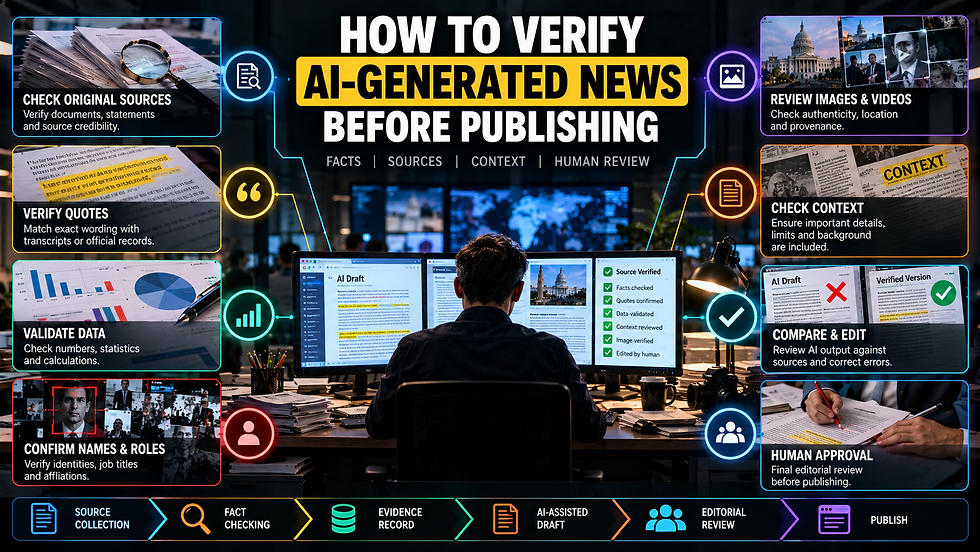
To verify AI-generated news before publishing, journalists should trace important claims back to original sources, verify names, dates, numbers, quotes, images, and context, document the evidence, and require human editorial approval. AI can assist with research, comparison, transcription, and draft preparation, but it should not be treated as the final authority for whether a news claim is publishable.
Why AI-Generated News Requires a Different Verification Workflow
AI can make newsroom production faster, but speed changes the verification problem.
A journalist working manually may introduce an error while reporting, transcribing, calculating, or writing. An AI-assisted workflow can introduce errors at additional points: during summarization, extraction, interpretation, drafting, translation, or automated rewriting.
The most dangerous errors are not always obvious hallucinations.
A fabricated person or absurd statistic may be easy to catch. A more difficult problem is a plausible sentence that is almost correct but changes the meaning of the original evidence.
For publishers, that creates a fundamental rule:
Do not verify whether an AI-written article sounds credible. Verify whether its important claims are supported by evidence.
That distinction should shape the entire newsroom workflow.
The Associated Press's updated AI standards, published in July 2026, state that AI can assist with tasks including early-stage research, document summarization, transcription, translation, headline suggestions, grammar, and search optimization. AP also states that AI-generated output is reviewed and edited by journalists and that AI does not replace reporting, sourcing, editorial judgment, or verification.
AP's data-journalism guidance makes the same point from another angle: journalists should ask whether AI was used, why it was used, how it was applied, and how the results were verified.
For a digital publisher, verification therefore needs to be a designed process, not simply an editor's final glance at an AI draft.
What Is AI-Generated News Verification?
AI-generated news verification is the process of checking AI-assisted or AI-generated reporting against reliable evidence before publication.
It includes checking:
Original sources
Factual claims
Names and roles
Dates and locations
Numbers and statistics
Direct quotations
Attributions
Timelines
Context
Images and video
AI-generated or manipulated media
Headlines and summaries
Claims that remain uncertain or disputed
The important concept is traceability.
Every consequential claim in an AI-assisted article should ideally be traceable to an appropriate source or evidence record.
A newsroom should be able to answer:
“Where did this claim come from?”
and then:
“Does the source actually support what the article says?”
This is stronger than simply asking an AI model to fact-check its own output.
The Core Problem: AI Output Is Not Evidence
An AI model produces language.
It does not automatically produce evidence.
That distinction sounds simple, but it changes how a newsroom should design its workflow.
Consider a hypothetical article about a new government policy.
An AI system might produce:
The government announced a new program that will provide funding to 50,000 businesses.
The journalist should not verify that sentence by asking another AI system whether it is accurate.
Instead, the journalist should locate the original government announcement and check:
Did the government actually announce the program?
Is the number 50,000 correct?
Does “provide funding” accurately describe the program?
Is 50,000 the number of eligible businesses or expected beneficiaries?
Is the figure a target, estimate, or confirmed allocation?
What date does the announcement apply to?
Are there eligibility conditions?
Does the article preserve those conditions?
The sentence may be broadly based on the source while still being materially misleading.
That is why claim-level verification is more useful than simply checking whether an entire AI article appears reasonable.
A NewsBolts Evidence-First Verification Framework
NewsBolts can structure AI verification around five evidence states:
Evidence State | Meaning | Publishing Action |
Verified | Claim directly supported by reliable evidence | May proceed |
Attributed | A source makes the claim, but it is not independently established | Attribute clearly |
Corroborated | Multiple appropriate sources support the information | May proceed with context |
Disputed | Credible sources conflict | Explain disagreement |
Unverified | Evidence is insufficient | Do not present as established fact |
This is a useful distinction because “source says X” and “X is true” are not the same editorial statement.
An AI system may collapse those categories into one sentence.
The editor should not.
How to Verify AI-Generated News Before Publishing
A practical verification workflow can be divided into eight stages.
1. Identify the Article's Material Claims
Do not begin by checking every sentence equally.
First identify the claims that could materially change the reader's understanding of the story.
These often include:
Main event
Main allegation
Key statistic
Financial figure
Policy change
Scientific finding
Legal development
Quote
Date
Cause-and-effect claim
Identity of a person or organization
A simple rule is:
If removing the claim would materially change the article, verify it.
This creates a manageable verification queue.
2. Find the Original Source
Once the claim is identified, trace it back to the earliest appropriate source.
Depending on the story, that could be:
Government document
Court filing
Company filing
Research paper
Official statement
Interview transcript
Dataset
Public record
Original photograph
Original video
First-party announcement
Secondary coverage can help locate information, but the newsroom should use the most authoritative source available for the particular claim.
3. Compare the AI Claim With the Source
This is where many verification workflows are too shallow.
Do not ask only:
“Is this information in the source?”
Ask:
“Does the source support this exact interpretation?”
Check:
Wording
Scope
Time period
Qualifications
Conditions
Exceptions
Attribution
Numerical units
Definitions
A source can contain the same number while the AI article gives that number a different meaning.
4. Verify Names, Dates, Numbers and Quotes Separately
These are common failure points and should receive individual checks.
Names
Check:
Correct spelling
Organization
Job title
Current role
Identity
Dates
Check:
Publication date
Event date
Effective date
Historical reference
Numbers
Check:
Original value
Unit
Currency
Time period
Percentage calculation
Denominator
Whether the figure is estimated or confirmed
Quotes
Check:
Exact wording
Speaker
Original source
Context
Date
Whether the quote has been shortened appropriately
A quotation should never become “close enough” because an AI model reconstructed it from context.
The Fact Pack: A Better Verification Layer
One of the most useful additions to an AI newsroom workflow is a structured Fact Pack.
Instead of moving directly from research to AI-generated prose, the newsroom creates an evidence record first.
A Fact Pack can contain:
Field | Purpose |
Claim | What the article intends to say |
Source | Where the information originated |
Evidence | Document, transcript, dataset, recording, etc. |
Status | Verified, attributed, disputed, or unverified |
Date | Relevant date |
Attribution | Person or organization making the claim |
Context | Qualification or limitation |
Editor Note | Additional verification required |
This creates separation between:
Evidence → Editorial facts → AI draft
That separation is important.
Without it, the AI-generated article can gradually become the source for its own claims.
With it, the article remains connected to the underlying evidence.
For NewsBolts, this Fact Pack concept can become a reusable layer across news intelligence, AI-assisted drafting, verification, SEO, and publishing.
Verify the Source, Not Just the Statement
A statement can be accurate but come from a source that is unsuitable for the claim.
For example, a social media account might accurately quote a government announcement while adding its own interpretation.
If the article relies on the interpretation, the newsroom should identify who actually made the claim.
Source verification should therefore ask:
Who created the information?
Is this the original source?
Is the source authoritative for this particular claim?
Is the source current?
Has the material been altered?
Does the source contain qualifications that the AI omitted?
Source quality is contextual.
A government agency may be authoritative for its own announcement but not necessarily independent evidence for a disputed claim about the agency's performance.
That distinction is important for serious reporting.
How to Verify AI-Generated Quotes
Quotes require a stricter process than ordinary paraphrasing.
If AI produces:
“The new policy will transform the industry.”
The journalist should locate the original interview, transcript, speech, recording, statement, or document.
Then check:
Did the person actually say it?
Was the wording exact?
Was it translated?
Was it edited for length?
Does surrounding context change its meaning?
Did AI combine two statements?
If the original wording cannot be established, the sentence should not be presented as a direct quotation.
This is particularly important because generative AI can produce fluent language that looks like a realistic quotation without having a reliable evidentiary basis.
How to Verify AI-Generated Statistics
Statistics deserve a separate verification pass.
For each important number, identify:
Source → Original figure → Unit → Time period → Calculation → Article wording
For example, an AI draft may say:
“Revenue increased by 35%.”
The editor should determine:
Compared with what period?
Revenue or profit?
Reported or adjusted?
Consolidated or segment-level?
Currency?
Nominal or inflation-adjusted?
Is 35% the company's reported number or an AI calculation?
A mathematically correct calculation can still produce a misleading journalistic statement if the underlying categories are wrong.
For data journalism, AP specifically emphasizes transparency, reproducibility, and accuracy, and recommends verification of AI-assisted results.
How to Verify AI-Generated Images and Videos
Text verification is only part of the problem.
Newsrooms also need to verify visual material.
A verification workflow for images and video can include:
Identify the original uploader or publisher.
Locate the earliest available version.
Check the date and location.
Compare visual details with independent evidence.
Examine metadata when available.
Use reverse-image or frame-search techniques where appropriate.
Look for signs of manipulation.
Check whether the media has been reused from an older event.
Determine whether AI generation or editing materially affected the content.
Preserve provenance information where possible.
The Coalition for Content Provenance and Authenticity (C2PA) develops technical standards for documenting the provenance and history of digital media. Its Content Credentials approach can record information about how an asset was created or changed using cryptographically verifiable provenance information.
C2PA does not replace editorial verification. It is better understood as an additional provenance layer.
Similarly, AP's 2026 newsroom standards include specific guidance for verifying and reporting AI-generated and manipulated material and say such material should be identified and presented in context when included in AP journalism.
Breaking News Needs a Different Verification Threshold
AI systems can be useful for detecting potential breaking stories.
But the first signal is not necessarily the confirmed story.
A newsroom may receive an AI-generated alert based on:
A social media post
A government update
A company statement
A wire report
A video
A public data change
A breaking-news keyword
The correct response is investigation.
A practical breaking-news workflow is:
Signal → Source Identification → Primary Evidence → Corroboration → Fact Pack → Draft → Human Review → Publish → Continuous Update
This creates an important distinction between speed of detection and speed of publication.
AI can reduce the time needed to identify a potential story without forcing the newsroom to publish before verification is complete.
Reuters Institute's 2026 reporting on AI and journalism highlights growing attention to verification and provenance, while its 2026 trends report says publishers expect greater emphasis on fact-checking and verification as AI-generated content becomes more widespread.
AI Should Help Find Verification Problems, Not Decide the Final Answer
AI has a useful role in the verification process.
For example, it can compare two documents and highlight:
Different dates
Different numbers
Conflicting names
Missing paragraphs
Contradictory claims
Changes in wording
Potentially unsupported statements
This can make the journalist's review faster.
But the workflow should distinguish between:
AI flags a possible problem
and
Editor confirms the problem
That difference is central to human governance.
A newsroom should be able to escalate uncertain cases rather than forcing an AI system to make a binary decision when the evidence is ambiguous.
A Risk-Based Verification Matrix
Not every AI-generated sentence requires the same level of review.
A useful newsroom model is to combine claim impact with evidence uncertainty.
Risk | Example | Verification Requirement |
Low | Formatting or spelling | Routine editorial check |
Moderate | Headline suggestion | Editor review |
Moderate | Document summary | Compare with source |
High | Statistic | Original data/source |
High | Direct quote | Original transcript/recording |
High | Legal allegation | Primary documents + editorial review |
High | Breaking-news claim | Primary source + appropriate corroboration |
Critical | Identity or accusation | Strong evidence + senior editorial review |
Critical | AI-generated visual presented as real | Provenance and authenticity review |
This approach prevents a newsroom from wasting equal effort on every AI output while ensuring that consequential claims receive stronger scrutiny.
A Technical System Flow for AI News Verification
For publishers building verification into their CMS or newsroom platform, the workflow can be represented as:
News Intelligence → Source Collection → Evidence Store → Claim Extraction → Fact Pack → AI Draft → Claim-to-Source Matching → Editorial Review → CMS → Publication
Each stage has a different responsibility.
News Intelligence
Detect potential stories and gather signals.
Source Collection
Store the original documents, links, transcripts, datasets, and media.
Evidence Store
Preserve the material used to support important claims.
Claim Extraction
Identify factual statements from the proposed article.
Fact Pack
Assign evidence and status to those claims.
AI Draft
Generate or refine prose from verified material.
Claim-to-Source Matching
Check whether important statements remain connected to their evidence.
Editorial Review
Resolve uncertainty, context, fairness, attribution, and publication risk.
CMS
Move approved content into the publishing workflow.
Publication
Publish only after the required approval gate is complete.
This architecture is consistent with NewsBolts' broader Human-Governed AI Newsroom Operating System approach: AI assists the workflow while editorial authority remains with people.
AI News Verification and Search Visibility
Verification also matters for publishers concerned about Google Search and AI-powered search.
Google's current guidance does not say that AI-assisted content is automatically excluded from Search. Instead, Google emphasizes accuracy, quality, relevance, original value, and people-first content. It warns that using generative AI to produce many pages without adding value can fall under scaled content abuse.
Google's guidance for generative AI features similarly emphasizes unique, valuable, non-commodity content and says publishers should focus on satisfying users rather than creating separate pages simply to target every possible AI-search variation.
For a news publisher, this creates a practical SEO principle:
Verification is not an SEO trick. It is part of producing journalism that deserves to be discovered, cited, and trusted.
The stronger opportunity is to make the article useful because it contains:
Original reporting
Primary evidence
Transparent sourcing
Expert context
First-party data
Clear methodology
Human editorial judgment
Google's Search Essentials likewise emphasizes helpful, reliable, people-first content and clear, crawlable site structure.
What Publishers Should Measure
A newsroom cannot improve its verification process if it never measures where errors occur.
Useful operational metrics include:
Metric | What It Reveals |
Claims reviewed per story | Verification workload |
Claims requiring correction | AI/editorial error patterns |
Source traceability rate | Evidence quality |
Pre-publication errors caught | Strength of review process |
Post-publication corrections | Failures that escaped review |
Average verification time | Operational cost |
Escalation rate | Frequency of uncertain cases |
AI override rate | How often editors change AI output |
Source mismatch rate | Problems connecting claims to evidence |
Media verification failures | Visual/audio risk |
These are proposed operational metrics, not NewsBolts performance statistics.
A publisher should collect its own data before drawing conclusions about efficiency or accuracy.
NewsBolts Research Opportunity: AI News Verification Benchmark
NewsBolts could develop a first-party AI News Verification Benchmark using real newsroom workflow data.
A credible methodology could include:
Sample
Collect a defined sample of AI-assisted articles across several publishers or newsroom teams.
Data
For each article, record:
Number of material claims
Number of claims verified
Source types
AI tasks used
Corrections
Verification time
Editorial overrides
Post-publication changes
Methodology
Classify errors by type:
Factual
Attribution
Numerical
Quotation
Contextual
Temporal
Source
Multimedia
Limitations
The benchmark would need to account for:
Different newsroom standards
Different AI tools
Different story types
Different levels of editorial expertise
Different verification procedures
No findings should be published until actual data has been collected and analyzed.
That is the difference between an original research asset and an invented “industry statistic.”
Common Mistakes Publishers Make When Verifying AI News
1. Asking the AI to Verify Its Own Work
A model can assist with identifying questionable claims, but its answer is not independent evidence.
2. Checking Only the Main Claim
Secondary details can contain serious errors even when the central story is correct.
3. Trusting Search Snippets
A search result can help locate a source, but the underlying source should be reviewed.
4. Treating a Source Claim as a Verified Fact
“Company X says revenue will increase” is different from “Revenue will increase.”
Attribution matters.
5. Ignoring Context
A technically accurate sentence can still mislead if important qualifications are removed.
6. Verifying After Publication
Post-publication correction is sometimes unavoidable, especially during breaking news, but it should not be the default verification strategy.
7. Automating the Final Editorial Gate
Automation can move information through the newsroom.
It should not silently replace editorial accountability.
8. Optimizing Before Verifying
SEO optimization should not come before factual verification.
Making an inaccurate story more discoverable does not solve the underlying editorial problem.
What Publishers Should Do Before Publishing AI-Assisted News
Use this practical checklist at the editorial desk.
Source Checklist
Original source identified
Source appropriate for the claim
Publication/event date confirmed
Source material preserved
Secondary sources separated from primary evidence
Claim Checklist
Material claims identified
Important facts verified
Names checked
Dates checked
Numbers checked
Timelines checked
Attribution checked
Quote Checklist
Original quote located
Speaker confirmed
Wording checked
Context preserved
Translation checked where relevant
Media Checklist
Image/video source identified
Date and location checked
Reused media ruled out where necessary
Manipulation considered
Provenance checked where available
AI-generated or materially altered media appropriately identified
Editorial Checklist
Uncertainty preserved
Conflicting evidence addressed
Headline accurately reflects the story
AI did not introduce unsupported claims
Human editor reviewed the final article
Publication approval recorded
How NewsBolts Fits Into AI News Verification
For NewsBolts, verification should not exist as an isolated “fact-check button.”
It should operate as a layer across the newsroom.
The broader model is:
News Intelligence → Source Verification → Fact Pack → AI-Assisted Drafting → Human Editorial Approval → SEO/GEO/AEO → Publishing → Analytics
This connects naturally with the AI Newsroom Operating System, which addresses the broader newsroom workflow.
The AI Newsroom Architecture: Technical Blueprint provides the technical foundation for connecting these workflow components.
The AI Editorial Workflow: From Research To Draft To Human Approval addresses the transition from research to editorial approval.
And AI Newsroom Breaking News Verification can support the specific verification requirements of fast-moving stories.
The NewsBolts perspective can therefore be summarized in one operational principle:
AI should make verification more systematic, not make verification optional.
The Future of AI News Verification
AI-assisted reporting is likely to increase the amount of information journalists can process.
That makes verification more important, not less.
Reuters Institute's 2026 research identifies increasing demand for verification work as one of the recurring themes around AI and journalism. Its 2026 trends report also says publishers are shifting attention toward distinctive reporting, analysis, human stories, and fact-checking and verification.
The long-term advantage for publishers may therefore come from combining automation with stronger evidence practices.
A newsroom that can rapidly identify a story, collect primary sources, build an evidence record, draft with AI, verify claims, and preserve editorial accountability has a different operating model from a newsroom that simply generates more articles.
The difference is not the amount of AI.
It is the quality of the system around the AI.
FAQs About Verifying AI-Generated News
How Do You Verify AI-Generated News Before Publishing?
Verify AI-generated news by identifying material claims, tracing them to original sources, checking facts, names, dates, numbers and quotes, reviewing context, verifying media where necessary, and requiring human editorial approval before publication.
Can AI Fact-Check AI-Generated News?
AI can assist with identifying claims, comparing documents, locating evidence, and flagging inconsistencies. However, important claims should be checked against reliable external evidence rather than relying solely on another AI-generated answer.
What Should Journalists Check in AI-Generated Articles?
Journalists should check material facts, original sources, names, dates, statistics, quotations, attribution, chronology, context, images, video, and any claim that could materially affect how readers understand the story.
How Can Publishers Reduce AI Hallucinations in News Articles?
Publishers can reduce hallucination risk by grounding drafts in verified source material, creating structured Fact Packs, separating claims from evidence, checking important statements individually, and requiring human review before publication.
Should AI-Generated Quotes Be Published?
A quote generated by AI should not be presented as a direct quotation unless the wording can be verified against the original transcript, recording, statement, or other authoritative source.
How Do You Verify AI-Generated Images Used in News?
Verify the image's source, earliest known appearance, date, location, context and potential manipulation. Provenance technologies such as C2PA Content Credentials can provide additional information about how media was created or modified, but provenance should complement rather than replace editorial verification.
Does Google Penalize AI-Generated News?
Google does not state that AI-assisted content is automatically penalized. Its guidance focuses on accuracy, quality, relevance, originality, and people-first value. Using AI to generate large volumes of pages without adding user value can violate Google's scaled content abuse policy.
What Is the Best AI Verification Workflow for a Newsroom?
A practical workflow is: detect the story, collect original sources, identify material claims, create a Fact Pack, verify evidence, generate or refine the AI draft, perform human editorial review, optimize the approved story, and then publish.
Conclusion
How to verify AI-generated news before publishing is fundamentally an evidence-management problem, not simply an AI-detection problem.
Publishers should not rely on whether an article sounds human, whether an AI detector approves it, or whether another AI model says the information is correct.
The stronger approach is to trace important claims to evidence.
That means:
Source → Evidence → Fact Pack → AI Draft → Claim Verification → Human Editorial Review → Publication
AI can help journalists process more documents, compare information, identify potential inconsistencies, and prepare drafts. But editorial authority should remain with people who can evaluate source quality, context, uncertainty, fairness, and publication risk.
For NewsBolts, that is the practical meaning of a Human-Governed AI Newsroom Operating System.
The objective is not to remove human verification from publishing.
It is to build a newsroom where technology makes evidence, verification, and editorial accountability easier to manage at scale.



Comments