Source Verification In AI Journalism: A Publisher’s Framework For Trusted AI Newsrooms

Source verification in AI journalism means checking whether every important claim, quote, statistic, image, document, and attribution can be traced to a credible source before publication. In an AI-assisted newsroom, verification should happen before AI drafting and again during editorial review. The goal is not simply to detect AI mistakes, but to establish a reliable evidence chain from source to published story.

Why Source Verification Matters in AI Journalism
AI can help a newsroom summarize documents, identify claims, organize information, draft copy, and surface possible sources. But an AI-generated statement is not evidence.
That distinction is fundamental.
A newsroom may begin with a legitimate government document, interview, press release, research paper, social post, or wire report. During AI-assisted processing, however, information can be compressed, reworded, combined, or misunderstood.
A verified source can therefore produce an unverified derivative claim.
This is why source verification in AI journalism should be treated as a workflow rather than a final proofreading step.
The central question is:
Can an editor trace this published claim back to evidence that supports exactly what the story says?
If the answer is unclear, the claim requires further review.
For publishers building AI-assisted newsroom workflows, this creates a useful principle:
AI can help process evidence, but humans must determine whether the evidence supports publication.
What Is Source Verification in AI Journalism?
Source verification in AI journalism is the systematic process of checking information against reliable evidence before an AI-assisted or AI-generated news story is published.
Verification can involve:
Confirming the original source
Checking the date and context
Comparing claims with primary documents
Confirming names and identities
Checking numbers and statistics
Verifying quotations
Confirming attribution
Distinguishing confirmed information from allegations
Checking whether an image or video represents what the story claims
Recording unresolved uncertainty
This process applies whether AI is used to write the entire draft or only to assist with one small production task.
The amount of AI involved does not change the newsroom's responsibility for the final published claim.
The Evidence Chain Behind a Trusted News Story
A useful way to understand verification is through an evidence chain:
Source → Evidence → Claim → Draft → Editorial Review → Published Story
Each step has a different purpose.
Source
Where did the information originate?
Evidence
What does the source actually establish?
Claim
What specific statement can reasonably be made from that evidence?
Draft
How is the information expressed for the audience?
Editorial Review
Does the wording accurately represent the evidence?
Published Story
What ultimately becomes part of the public record?
The weakest link can affect the entire chain.
For example, an AI system may correctly summarize a document but incorrectly infer that a proposal has already become law.
The document may be authentic.
The AI summary may be fluent.
The final claim may still be wrong.
That is why verification must examine the relationship between evidence and claim, not simply whether a source exists.
Primary Sources Should Usually Anchor Important Claims
A primary source is material originating directly from the person, organization, institution, event, dataset, or authority being reported.
Examples can include:
Government documents
Court records
Regulatory filings
Official statistics
Company filings
Research papers
Original datasets
Official statements
Direct interviews
Public records
Original video or photographic evidence
Secondary sources can also be valuable, particularly when they provide reporting, context, or independent confirmation.
The key is to understand what each source can legitimately establish.
A press release can establish what an organization announced.
It does not automatically establish that every claim in the announcement is independently true.
Similarly, a social media post can establish that an account published a statement. It does not automatically establish the factual accuracy of that statement.
A Practical Source Verification Framework
Newsrooms can classify evidence before using it.
Level 1: Direct evidence
The source directly supports the claim.
Example:
An official document contains the exact date being reported.
Level 2: Independent confirmation
A second credible source independently confirms the information.
This can be particularly valuable for significant developments.
Level 3: Attributed claim
The information is reported as someone's claim rather than presented as independently established fact.
For example:
“Company officials said…”
This wording preserves attribution.
Level 4: Unverified information
The claim cannot currently be established reliably.
It should not be presented as confirmed news.
This framework helps editors distinguish between what is known, what someone claims, and what remains uncertain.
The AI Newsroom Verification Workflow
A reliable AI newsroom can structure verification as a series of checkpoints.
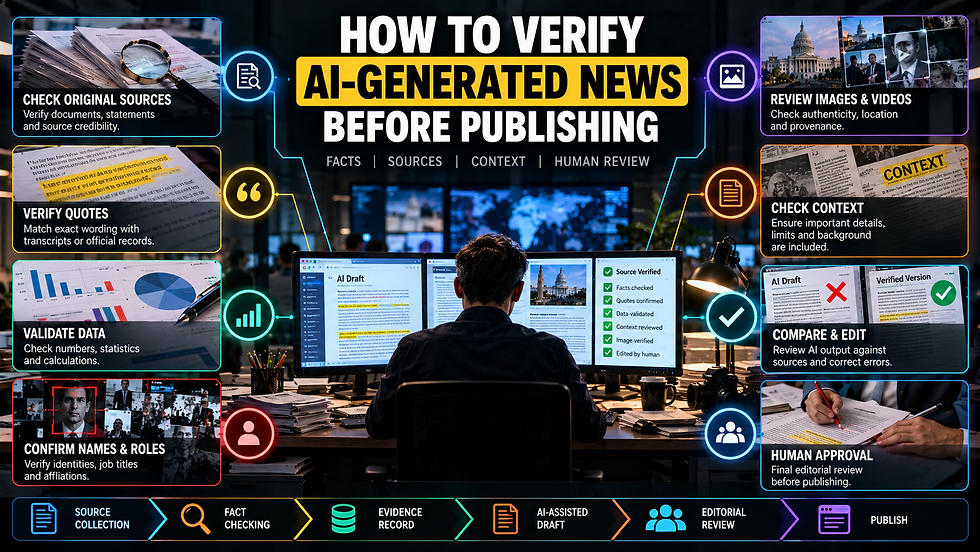
Step 1: Collect the source material
Gather the documents, links, recordings, transcripts, images, datasets, statements, and other evidence relevant to the story.
Do not begin with an AI-generated summary if the original material is available.
Step 2: Identify the core claims
Break the proposed story into individual factual statements.
For example:
A policy was announced.
The announcement occurred on a particular date.
A particular group is affected.
The policy begins at a particular time.
Officials made a specific statement.
Each claim may require different evidence.
Step 3: Connect claims to sources
Create a claim-to-source relationship.
Claim → Supporting source → Verification status
This can be maintained in a Fact Pack or editorial research record.
Step 4: Check the original context
Read enough of the source to understand what it actually says.
Do not verify a sentence by searching for the same sentence elsewhere.
Step 5: Check independent confirmation where appropriate
Important or consequential claims may warrant confirmation from another credible source.
Step 6: Give AI only approved material
Once the evidence base is established, AI can assist with summarization, organization, drafting, or transformation.
Step 7: Compare the AI draft with the evidence
This is where editors look for:
Added facts
Changed meaning
Missing qualifications
Incorrect numbers
Altered quotes
Unsupported conclusions
Incorrect attribution
Step 8: Approve or reject individual claims
Do not treat an entire AI draft as either “verified” or “unverified.”
A single article can contain both supported and unsupported statements.
Step 9: Preserve the verification record
Keep the relationship between important claims and their sources available to the editorial team.
The Claim-to-Source Matrix
One of the most useful newsroom tools is a simple claim-to-source matrix.
Claim | Evidence Needed | Preferred Source | Status |
What happened | Direct confirmation | Primary source | Verify |
When it happened | Official date/time | Primary record | Verify |
Who was involved | Direct identification | Official or direct source | Verify |
Numerical claim | Original data | Dataset or official source | Verify |
Quote | Original recording/transcript | Direct source | Verify |
Reaction | Direct statement | Attributed source | Verify |
Interpretation | Supporting evidence | Multiple credible sources | Editorial review |
This does not need to be a complicated technical system.
The important feature is traceability.
An editor should be able to move from an important statement in the article to the evidence supporting it.
Why AI Hallucinations Make Verification More Important
AI hallucination refers to an AI system producing information that appears plausible but is unsupported, incorrect, or fabricated.
In journalism, this can take several forms.
An AI system may:
Invent a source
Misstate a source
Attribute a quote to the wrong person
Combine information from different events
Change a number
Infer a conclusion that the source does not make
Present an old event as current
Confuse similarly named people or organizations
Fill an information gap with plausible-sounding language
The problem is particularly serious because fluent writing can make weak information appear authoritative.
A newsroom therefore should not use writing quality as a proxy for factual quality.
A polished sentence still requires evidence.
How to Verify AI-Assisted Drafts
An AI-assisted draft should be reviewed differently from a conventional copy-editing pass.
Start by asking:
What claims did the AI introduce?
Compare the draft against the approved source material.
What did the AI change?
Look for altered dates, numbers, names, descriptions, quotes, and qualifiers.
What did the AI remove?
Context can disappear during summarization.
A source may say:
“The proposal could affect…”
The AI draft might accidentally turn that into:
“The policy will affect…”
That is not merely a stylistic change. It changes the level of certainty.
What did the AI infer?
Inference can be useful for brainstorming but dangerous when presented as established fact.
What cannot be verified?
Mark unresolved claims rather than forcing certainty.
The NewsBolts Fact Pack Approach
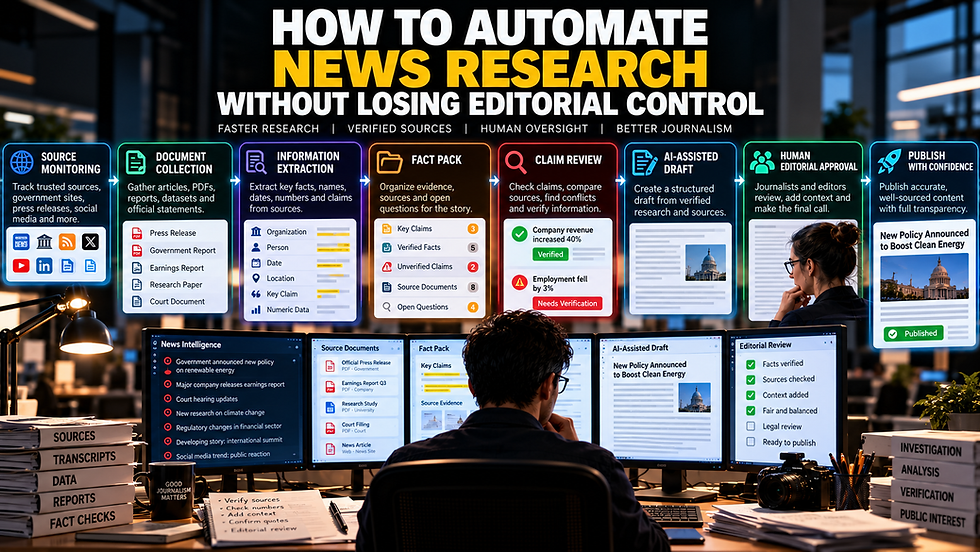
A Fact Pack can serve as the evidence layer between source research and AI-assisted production.
A useful Fact Pack might contain:
Story identity
Working headline
Story type
Publication date
Update time
Verified facts
Short statements supported by sources.
Source records
The original documents, statements, datasets, interviews, or other evidence.
Quotes
Approved quotations with attribution and source references.
Numbers
Statistics, dates, measurements, and other quantitative information with their sources.
Unknowns
Information that remains unresolved.
Editorial notes
Context, caveats, terminology, and issues requiring human judgment.
The benefit is conceptual as much as technical:
The AI works from a controlled evidence layer instead of treating the open internet or an unstructured article as its factual database.
For NewsBolts, this fits the role of a Human-Governed AI Newsroom Operating System: AI assists newsroom production while editorial teams retain authority over what becomes publishable journalism.
Verification Should Continue During Content Repurposing
Verification does not stop when the article is approved.
Consider a newsroom that turns an article into:
A short-form video
Newsletter
Social post
Audio briefing
Infographic
Each derivative creates another opportunity for factual drift.
A useful workflow is:
Verified Article → Approved Fact Pack → Derivative Draft → Claim Check → Human Approval
For example, a video script might shorten:
“Officials said the measure could take effect later this year, subject to further approval.”
into:
“The measure will take effect later this year.”
The second version may be materially different.
The same evidence that approved the article should therefore inform the derivative-content review.
Source Verification for Breaking News
Breaking news creates a special challenge because information develops faster than verification can sometimes occur.
The correct response is not to lower the verification standard.
Instead, publishers can separate information into categories:
Confirmed
Information supported by reliable evidence.
Reported
Information published by a credible source but requiring additional confirmation.
Claimed
Information attributed to a person, organization, or account.
Unverified
Information circulating without sufficient evidence.
This allows a newsroom to publish responsibly without pretending that an evolving story is more certain than it is.
Common Source Verification Mistakes
Mistake 1: Verifying the source instead of the claim
A credible organization can publish a claim that still requires attribution or independent confirmation.
Mistake 2: Treating search results as evidence
A search result can help locate information, but the underlying source should be examined.
Mistake 3: Trusting AI citations automatically
A citation appearing in an AI-generated answer does not eliminate the need to inspect the underlying source.
Mistake 4: Checking only the first source
Important claims may require independent confirmation.
Mistake 5: Losing context during summarization
Shorter wording can change certainty.
Mistake 6: Treating social posts as confirmed facts
A social post establishes that someone posted something. It does not necessarily establish the truth of the underlying claim.
Mistake 7: Failing to preserve verification records
If editors cannot reconstruct why a claim was approved, future updates and corrections become harder.
Source Verification Checklist for AI Newsrooms
Before publication, editors can ask:
Source
Is the original source identified?
Is the source appropriate for this claim?
Has the source been accessed directly?
Is the source current?
Evidence
Does the evidence actually support the claim?
Has relevant context been reviewed?
Are important numbers independently checked?
Are quotations confirmed against the original material?
AI review
Did AI introduce new information?
Did AI alter certainty?
Did AI change attribution?
Did AI combine separate facts?
Did AI create unsupported conclusions?
Editorial review
Are allegations clearly identified?
Are uncertainties preserved?
Is attribution clear?
Has a human editor approved the final version?
Human Editorial Authority Still Matters
The goal of AI-assisted journalism should not be to eliminate editors.
A responsible newsroom separates different levels of automation.
AI assistance can help process information and prepare drafts.
Workflow automation can move approved material between production stages.
Autonomous publishing would allow a system to make publication decisions without meaningful human intervention.
Human editorial authority means an editor remains accountable for verification, context, judgment, and publication.
These are different operating models.
For news publishers, keeping this distinction explicit helps prevent a production tool from quietly becoming an editorial decision-maker.
How Publishers Can Build a Trusted-Source Framework
A publisher can build its verification system around five rules.
Rule 1: Define source tiers
Establish which sources receive priority for different types of claims.
Rule 2: Require claim traceability
Important claims should be connected to supporting evidence.
Rule 3: Separate facts from attribution
“Officials said” and “it happened” are not equivalent statements.
Rule 4: Record uncertainty
Unknown information should remain unknown until evidence supports a stronger conclusion.
Rule 5: Require human approval
The final publication decision belongs to the editorial team.
This framework is simple enough for a small newsroom but structured enough to support more advanced AI-assisted publishing systems.
What Publishers Should Measure
Verification quality should be measured alongside production efficiency.
Useful newsroom metrics can include:
Verification metrics
Number of claims requiring correction
Source-related corrections
Attribution errors
Quote corrections
Number of unresolved claims at review
Workflow metrics
Time spent verifying a story
Time spent reviewing AI drafts
Rework required after AI assistance
Time from source discovery to editorial approval
Quality metrics
Correction frequency
Recurring error categories
Editorial rejection reasons
Source-quality issues
The purpose is not to create a single “AI accuracy score.”
Instead, publishers should identify where their workflow is failing and improve that specific checkpoint.
Risks and Limitations
No verification framework can guarantee that every published fact will remain correct.
Sources can contain errors. Information can change. Developing events can invalidate earlier reporting. Documents can be incomplete. Human editors can make mistakes.
Verification is therefore a risk-reduction process, not a promise of absolute certainty.
Another limitation is cost.
High-quality verification requires time, editorial expertise, and access to reliable sources. Automating administrative tasks may reduce workload, but it does not eliminate the need for professional judgment.
Finally, the appropriate verification threshold depends on the story.
A minor update may require less evidence than a serious allegation, legal claim, public-safety report, or major breaking-news development.
What Publishers Should Do
Publishers building an AI-assisted newsroom should begin with the evidence layer rather than the writing layer.
Start by defining:
Which sources the newsroom trusts for different claims.
How claims are recorded and verified.
How Fact Packs or equivalent evidence records are maintained.
Which AI tasks are permitted.
Which claims require human review.
How corrections and source updates are handled.
Who has final editorial authority.
Then test the workflow on a limited number of stories.
The goal is not to automate everything.
The goal is to create a repeatable process in which AI makes production more efficient without weakening the relationship between evidence and published journalism.
Conclusion
Source verification in AI journalism is not simply a fact-checking step added after an AI draft has been written.
It is the foundation of a trustworthy AI-assisted newsroom.
The strongest workflow is:
Sources → Evidence → Verified Claims → Fact Pack → AI Assistance → Claim Review → Human Editorial Approval → Publication
This approach allows publishers to use AI for research organization, drafting, summarization, and content production while keeping editorial authority with people.
For digital publishers, the strategic advantage is not merely producing content faster. It is building a newsroom where every important claim has a defensible relationship with its evidence.
That is the standard an AI newsroom should be designed around.
Frequently Asked Questions
What is source verification in AI journalism?
Source verification in AI journalism is the process of checking claims in AI-assisted content against credible evidence before publication. It includes verifying sources, dates, numbers, quotations, attribution, context, and the exact meaning of the supporting material.
Why is source verification important when using AI?
AI can produce fluent statements that are unsupported or incorrect. Source verification gives editors a way to determine whether the claims in an AI-assisted draft are actually supported by reliable evidence.
Should AI-generated articles always be fact-checked?
AI-assisted news content should undergo editorial verification appropriate to the claims and risk involved. The fact that an article was generated from existing reporting does not guarantee that every statement in the resulting draft remains accurate.
What is a Fact Pack in a newsroom?
A Fact Pack is a structured collection of verified facts, source records, quotations, numbers, context, and unresolved questions that can provide an evidence layer for newsroom research and AI-assisted content production.
How should breaking news be verified?
Breaking news should be separated into confirmed information, attributed claims, credible reports requiring further confirmation, and unverified information. Editors should communicate uncertainty rather than presenting developing claims as established facts.
Can AI verify news sources by itself?
AI can assist with finding, comparing, organizing, and analyzing source material, but human editors should retain responsibility for deciding whether evidence is sufficient for publication.
What is the difference between a primary and secondary source?
A primary source originates directly from the relevant person, organization, institution, event, dataset, or record. A secondary source reports, analyzes, or interprets information originating elsewhere. Both can be useful, but they serve different verification purposes.
How can publishers reduce hallucinations in AI-assisted journalism?
Publishers can reduce risk by using trusted sources, structured evidence records, claim-to-source mapping, controlled AI inputs, fact-checking of generated drafts, preservation of uncertainty, and human editorial approval.

Comments