Sponsored Content Distribution in Digital Newsrooms: A Publisher’s Guide

Sponsored content distribution is the process of delivering commercially funded content to a defined audience through publisher websites, newsletters, social channels, video platforms, and other media properties. For a digital newsroom, effective distribution requires more than publishing an article: it connects advertiser objectives with audience fit, editorial review, disclosure, publishing workflows, audience development, and performance measurement.
What Is Sponsored Content Distribution?
Sponsored content distribution refers to the process of publishing and promoting content that has been funded, commissioned, or supported by a commercial sponsor.
Depending on the publisher and campaign, that content may include:
Sponsored articles
Branded explainers
Sponsored newsletters
Sponsored videos
Sponsored podcasts
Sponsored research
Branded guides
Sponsored social posts
Interactive content
Publisher-hosted commercial features
The important distinction is between content production and content distribution.
Creating the sponsored article is only one stage of the process. Distribution determines how the finished content reaches the audience and through which channels.
A publisher may distribute sponsored content through its own website, newsletter, social accounts, video properties, recommendation placements, or other agreed channels. The exact mix depends on the campaign objective, audience, commercial agreement, and publisher capabilities.
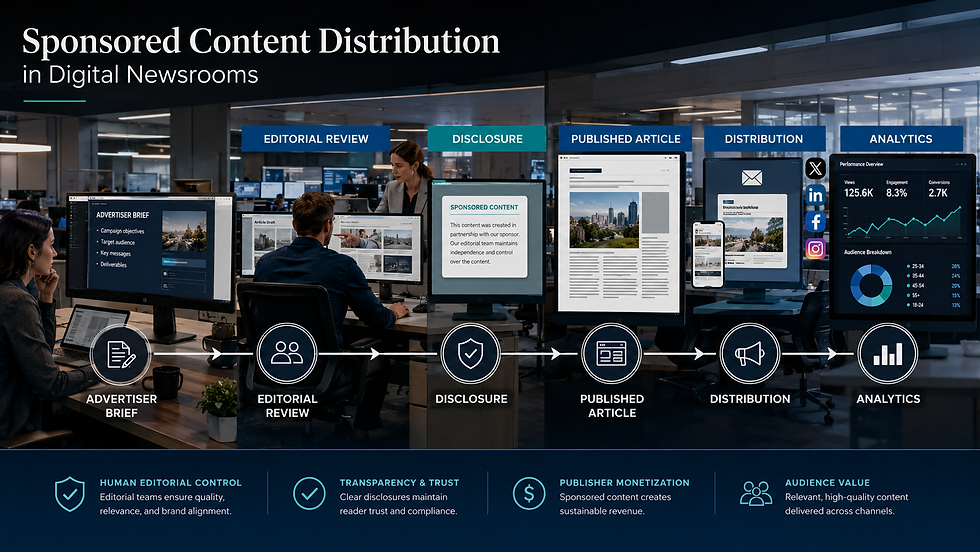
For a modern newsroom, the process of Sponsored Content Distribution in Digital Newsrooms fits into a broader publisher monetization and content operations workflow, connecting commercial campaigns with editorial processes, audience distribution, and performance measurement.
Why Sponsored Content Matters to Digital Newsrooms
Digital publishers need multiple ways to build sustainable revenue. Advertising, subscriptions, memberships, events, licensing, commerce, and sponsorship can all play different roles depending on the publication's business model.
Sponsored content can connect commercial revenue with the publisher's existing editorial infrastructure.
That does not mean every sponsor is a good fit.
The commercial opportunity should be evaluated against questions such as:
Does the topic fit the publication?
Is the audience relevant?
Can the newsroom maintain appropriate editorial standards?
Can the commercial relationship be clearly disclosed?
Does the content provide value to readers?
Can the publisher distribute it effectively?
Can performance be measured against a defined objective?
This changes the conversation from “Can we publish this sponsored article?” to “Can we deliver a responsible and valuable sponsored content product?”
That distinction is important for newsroom operators because monetization decisions can affect both revenue and audience trust.
How Sponsored Content Distribution Works
A structured sponsored content distribution workflow can follow these stages:
Commercial brief → Audience definition → Publisher fit → Content production → Editorial review → Disclosure → Publication → Distribution → Measurement → Optimization
Each stage has a different responsibility.
1. Define the commercial objective
The sponsor should establish what the campaign is intended to accomplish.
Possible objectives include:
Brand awareness
Audience education
Product education
Thought leadership
Research distribution
Qualified traffic
Lead generation
Event promotion
The objective determines what content and distribution strategy make sense.
2. Define the audience
The publisher and sponsor should identify the intended audience before choosing the distribution channels.
Audience considerations may include:
Industry
Location
Professional role
Interests
Content preferences
Existing publisher relationship
Relevant search or social behavior
The publisher should use actual audience information where available rather than making unsupported assumptions.
3. Evaluate publisher fit
A publication with a large audience is not automatically the best distribution partner.
The relevant question is whether its audience and editorial environment match the campaign.
4. Produce the content
Content can be produced by the sponsor, publisher, agency, or a combination of teams.
The workflow should define who is responsible for:
Research
Writing
Fact checking
Brand review
Legal review where necessary
Editorial review
Final approval
5. Review and disclose
Before publication, the newsroom should verify important claims and ensure that the commercial relationship is clearly disclosed.
6. Publish and distribute
Once approved, the content can be published through the agreed channels.
7. Measure performance
Results should be compared with the campaign's original objective rather than judged only by raw traffic or impressions.
The Sponsored Content Newsroom Workflow
A useful way to manage sponsored campaigns is to separate commercial control, editorial control, and publishing operations.
Stage | Commercial Team | Editorial Team | Publishing Team |
Campaign brief | Define objective | Assess topic fit | Identify requirements |
Content planning | Provide brand requirements | Establish editorial direction | Plan production |
Drafting | Review brand accuracy | Review quality and claims | Prepare assets |
Approval | Commercial approval | Editorial approval | Technical QA |
Publication | Confirm campaign details | Confirm disclosure | Publish |
Distribution | Support promotion | Protect editorial context | Activate channels |
Reporting | Review business outcomes | Review content performance | Supply analytics |
This separation reduces ambiguity.
A sponsor may have authority over whether its factual brand information is accurately represented. That does not necessarily mean it should control independent editorial decisions made by the publisher.
Similarly, an AI writing system may assist with production without having authority to approve the final article.
That distinction is central to responsible newsroom operations.
Choosing Publishers, Audiences, and Distribution Channels
Publisher selection should consider relevance, credibility, audience fit, distribution capability, and editorial compatibility.
A simple decision framework is:
Factor | Low Fit | Medium Fit | Strong Fit |
Audience relevance | Little overlap | Partial overlap | Strong overlap |
Topic relevance | Outside coverage | Related subject | Core coverage area |
Distribution reach | Limited | Moderate | Established |
Format suitability | Poor | Acceptable | Strong |
Editorial compatibility | Difficult | Manageable | Strong |
This is not a universal scoring formula. It is a decision tool that helps publisher teams evaluate opportunities consistently.
For example, a specialist technology publication may be more appropriate for a technology-focused sponsored guide than a general-interest publication with a much larger but less relevant audience.
The right choice depends on the campaign objective and verified audience information.
Sponsored Content Formats for Publishers
Sponsored Articles
Sponsored articles can provide space for educational material, industry analysis, explainers, or branded guides.
They should be clearly distinguished from independent editorial content where applicable.
Sponsored Newsletters
A publisher can include sponsored content or placements in an existing newsletter.
This gives the campaign access to an established subscriber relationship.
Sponsored Video
Video can turn an article, interview, demonstration, or explainer into a visual format.
Sponsored Podcasts
Podcast sponsorship can combine audio storytelling with commercial messaging.
Sponsored Research and Reports
Publishers may distribute sponsor-funded research or reports. When research is presented as factual or independent, methodology, funding, data, and claims require appropriate scrutiny.
Sponsored Social Distribution
Publishers can use social channels to extend the reach of sponsored material according to the applicable commercial agreement and platform rules.
Editorial Governance and Disclosure
Sponsored content creates a responsibility that goes beyond content production: readers should be able to understand the commercial relationship.
Disclosure should be clear and sufficiently prominent for the format and jurisdiction involved.
Specific requirements can vary by country, advertising format, and platform. Publishers should verify the applicable rules before publication.
Editorial governance should also define:
What content publishers will accept
Which sponsors are restricted
Which claims require evidence
Who performs editorial review
Who approves commercial information
How sponsorship is labeled
Who can request corrections
Who has final publication authority
The purpose is not to make sponsored content identical to independent journalism. The purpose is to establish a transparent process in which commercial content is handled responsibly.
How AI Can Support Sponsored Content Workflows
AI can support several operational stages of a sponsored content workflow.
For example, AI-assisted newsroom tools can help teams:
Organize sponsor briefs
Extract requirements from source material
Identify missing information
Create article structures
Generate draft variations
Prepare metadata
Repurpose approved content
Create newsletter drafts
Create short-form video scripts
Prepare social copy
Organize publishing checklists
Surface potentially inconsistent information
However, AI assistance should not be confused with autonomous editorial authority.
An AI system can generate a statement that sounds credible without establishing whether the statement is correct.
Human reviewers should therefore remain responsible for decisions involving:
Factual accuracy
Source verification
Material claims
Disclosure
Editorial suitability
Corrections
Final publication
This is where a Human-Governed AI Newsroom Operating System such as NewsBolts can fit naturally into the workflow: AI can assist with intelligence, production, optimization, and repurposing while human teams retain editorial authority.
Measuring Sponsored Content Distribution
There is no single metric that proves a sponsored campaign succeeded.
Measurement should begin with the original objective.
Objective | Useful Measurement Areas |
Awareness | Reach, impressions, exposure |
Engagement | Page engagement, video viewing, interactions |
Traffic | Referral visits, landing-page sessions |
Audience quality | Relevant audience behavior, qualified visits |
Lead generation | Leads, registrations, downloads |
Conversion | Defined campaign actions |
Publisher value | Revenue, renewal potential, audience impact |
Metrics should be interpreted in context.
For example, a campaign designed primarily for awareness should not be judged solely by conversions. A campaign designed to generate qualified leads may require much deeper measurement than page views.
Publishers should also distinguish distribution performance from content performance.
An article may be well written but poorly distributed. Conversely, extensive distribution cannot compensate indefinitely for content that fails to satisfy the intended audience.
Does Sponsored Content Distribution Help SEO?
Sponsored content should not be treated as an automatic SEO strategy.
A paid placement does not guarantee organic rankings, search traffic, or visibility in AI-generated answers.
Publishers should follow current search-engine guidance concerning paid content, sponsored links, advertising relationships, and link attributes.
The stronger approach is to create useful content for the audience first and treat search visibility as one potential discovery channel rather than a guaranteed outcome.
For SEO teams, sponsored content should also be evaluated separately from the publisher's independent editorial strategy.
Risks and Limitations
Audience mismatch
A campaign may reach many people without reaching the people the sponsor actually needs.
Weak disclosure
Insufficient disclosure can create audience-trust problems and may conflict with applicable advertising requirements.
Unsupported sponsor claims
Brand-provided claims may require additional verification, qualification, or attribution.
Editorial interference
Sponsors may request changes that conflict with the publisher's editorial standards.
Vanity metrics
Large impression numbers can obscure weak engagement or poor audience relevance.
Over-commercialization
An excessive volume of sponsored material can change how audiences perceive a publication.
Platform dependency
External distribution platforms can change algorithms, policies, formats, or measurement systems.
AI-generated errors
AI-assisted drafting can introduce factual or contextual errors if source material and human review are inadequate.
Common Sponsored Content Distribution Mistakes
1. Choosing publishers only by traffic
Reach without audience relevance can produce inefficient distribution.
2. Treating sponsor copy as finished editorial content
Brand copy often needs adaptation to the publisher's audience and editorial environment.
3. Adding disclosure at the last moment
Disclosure should be part of the publishing workflow from the beginning.
4. Promising SEO outcomes
Publishers should avoid guaranteeing rankings, traffic, or AI visibility.
5. Measuring only impressions
A campaign's measurement framework should reflect its actual objective.
6. Allowing AI to invent supporting information
AI-generated claims should not be accepted merely because they sound plausible.
7. Ignoring the post-publication lifecycle
Publishers should have a process for corrections, updates, archival decisions, and continued distribution.
What Digital Newsrooms Should Do
A publisher building a sponsored content operation should establish a repeatable workflow rather than handling every campaign differently.
Step 1: Create a sponsorship intake process
Record:
Sponsor
Objective
Audience
Topic
Deliverables
Distribution requirements
Timeline
Disclosure requirements
Step 2: Apply an editorial fit check
Ask:
Is the topic relevant to our readers?
Can we verify important claims?
Does the campaign fit our editorial standards?
Are there conflicts or restricted subjects?
Step 3: Assign responsibilities
Clearly identify the commercial owner, editorial reviewer, production owner, and final publisher.
Step 4: Build the content and distribution plan together
Do not wait until publication to decide how the content will reach its intended audience.
Step 5: Add disclosure before final approval
Treat disclosure as a standard publishing requirement, not an optional design element.
Step 6: Measure against the original objective
Use campaign-specific metrics and document what the publisher and sponsor agreed to measure.
Step 7: Feed results back into newsroom operations
Performance data can inform future decisions about formats, audiences, channels, production processes, and sponsorship packages.
Sponsored Content Distribution Checklist
Before publishing a sponsored campaign, a newsroom can use this checklist:
Sponsor and commercial objective documented
Target audience defined
Publisher-topic fit reviewed
Content format selected
Source material organized
Material claims reviewed
Editorial approval completed
Commercial approval completed
Sponsorship disclosure prepared
Distribution channels confirmed
Analytics configured
Success criteria documented
Correction process defined
Post-publication review scheduled
This checklist can become part of a publisher's broader newsroom publishing workflow.
What a NewsBolts Workflow Could Look Like
A human-governed workflow can connect the different stages without giving AI final editorial authority:
Sponsor Brief ↓News Intelligence & Source Collection ↓Fact Pack / Evidence Review ↓AI-Assisted Drafting ↓Human Editorial Review ↓SEO / GEO / AEO Optimization ↓Commercial Approval ↓Human Publication Approval ↓Multi-Channel Distribution ↓Analytics & Repurposing
This approach treats sponsored content as an operational workflow rather than simply an article-generation task.
It also creates clear points where humans can stop, modify, verify, or reject material.
Conclusion
Sponsored content distribution works best when it is treated as a structured digital newsroom workflow, not simply as a paid article placement.
The strongest model connects the sponsor's objective with audience relevance, publisher fit, useful content, source review, editorial governance, transparent disclosure, multi-channel distribution, and measurable outcomes.
For publishers, this creates a more disciplined approach to newsroom monetization. For sponsors, it creates a clearer path from content investment to relevant audience exposure.
AI can make many parts of the workflow faster. It can organize source material, assist with drafting, prepare metadata, repurpose approved content, and support distribution operations. But those capabilities do not remove the need for human editorial authority.
The practical model is:
Commercial Objective → Audience Fit → Publisher Fit → Verified Content → Editorial Review → Disclosure → Publication → Distribution → Measurement → Optimization
That is the difference between simply selling sponsored articles and building a sustainable sponsored content operation inside a modern digital newsroom.
Frequently Asked Questions
What is sponsored content distribution?
Sponsored content distribution is the process of delivering commercially funded content to an intended audience through publisher websites, newsletters, social channels, video properties, paid media, or other distribution channels.
How does sponsored content work in a digital newsroom?
A typical workflow begins with a sponsor brief and audience definition, followed by publisher fit assessment, content production, editorial review, disclosure, publication, distribution, and performance measurement.
Is sponsored content the same as native advertising?
Not necessarily. Sponsored content generally describes commercially funded content, while native advertising describes an advertising approach designed to fit the surrounding user experience. The terms can overlap depending on the publisher and context.
Should sponsored content be labeled?
Publishers should provide appropriate disclosure of commercial relationships. The exact requirements vary by jurisdiction, format, and platform, so publishers should verify applicable rules.
Can sponsored content help a publisher make money?
Yes, sponsored content can form part of a publisher's monetization model, but its financial value depends on factors such as audience fit, pricing, distribution, campaign performance, production costs, and commercial demand.
Can AI create sponsored content?
AI can assist with research organization, drafting, optimization, repurposing, and publishing operations. Human review remains important for factual accuracy, claims, disclosure, editorial quality, and final publication decisions.
Does sponsored content guarantee SEO traffic?
No. Sponsored content does not guarantee rankings or organic traffic. Search visibility depends on many factors, and publishers should follow current search-engine guidance concerning paid content and links.
What should publishers measure?
Publishers should measure performance against the campaign objective. Depending on the goal, this may include reach, engagement, qualified traffic, leads, conversions, or publisher revenue.


Comments