AI Fact-Checking Tools For Newsrooms: A Practical Guide For Publishers

AI fact-checking tools help newsrooms find claims, compare information, search existing fact checks, verify images and video, prioritize potentially important claims, and organize evidence. They should be treated as verification assistants, not autonomous editors. The strongest newsroom workflow combines tools such as claim-search systems, media-verification platforms, and AI-assisted claim detection with original sources and human editorial judgment.

Search & Editorial Brief
Element | Focus |
Primary search intent | Find and evaluate AI fact-checking tools for newsroom use |
Main reader | News editor, journalist, publisher, newsroom operator, media founder |
Core problem | How to use AI verification tools without trusting automated results blindly |
Primary entity | AI fact-checking tools for newsrooms |
Related concepts | Claim detection, source verification, fact-checking, media authentication, C2PA, reverse image search, human-in-the-loop AI, ClaimReview, newsroom workflow |
Likely next questions | Which tools verify claims? Which tools check images and video? Can AI fact-check itself? How should editors use these tools? |
Unique contribution | A publisher-focused tool-selection matrix plus a NewsBolts evidence-first verification workflow |
Why AI Fact-Checking Tools Matter for Newsrooms
Fact-checking has traditionally depended heavily on journalists locating sources, comparing claims, checking documents, and determining whether the available evidence supports what someone said.
The scale of digital information changes that workload.
A newsroom may now have to process:
Live broadcasts
Social media posts
Podcasts
Press releases
Government documents
Company announcements
Research papers
Videos
Images
AI-generated text
AI-generated or manipulated media
AI can help journalists find what deserves attention.
That is different from allowing AI to decide what is true.
The distinction matters because automated fact-checking still has limitations around context, ambiguity, source quality, and complex claims. A Reuters Institute review of automated fact-checking research concluded that human supervision remains necessary and that the strongest role for automation is helping fact-checkers identify and investigate claims and communicate conclusions.
This makes the right question less about finding a single “AI fact-checker” and more about building a verification stack.
What Are AI Fact-Checking Tools?
AI fact-checking tools are software systems that use artificial intelligence, machine learning, search, databases, or automated analysis to help journalists identify, investigate, compare, or document potentially factual claims.
Different tools perform different jobs.
Some are designed to:
Detect potentially checkable claims
Find repeated claims
Search existing fact checks
Compare statements
Analyze images
Extract video frames
Search for previous uses of media
Examine metadata
Identify locations
Monitor information streams
Prioritize claims for human review
That means a newsroom should not evaluate tools only by asking:
“Can this tool tell me whether something is true?”
A better question is:
“Which part of my verification workflow can this tool make faster or more systematic?”
That change in framing prevents publishers from expecting one AI system to solve every verification problem.
The Four Jobs AI Fact-Checking Tools Can Perform
A practical newsroom model divides verification tools into four jobs.
1. Detection
The tool finds potentially important or checkable claims.
Example:
A newsroom monitors a live political debate. An AI system identifies sentences containing statistics, causal claims, or specific factual assertions.
The journalist then decides which claims deserve investigation.
2. Retrieval
The tool helps find evidence.
This might involve:
Existing fact checks
Primary documents
Previous statements
Similar claims
Archived material
Relevant datasets
Retrieval reduces research time, but the journalist still needs to evaluate the evidence.
3. Verification Assistance
The tool compares material or identifies inconsistencies.
Examples include:
Comparing two documents
Checking whether a quotation appears in a transcript
Comparing images
Extracting video keyframes
Checking metadata
Identifying potential duplicates
4. Documentation
The tool helps preserve the verification process.
This can include:
Source records
Notes
Evidence
Claim status
Verification history
Team collaboration
For professional publishers, documentation can be just as important as detection.
If an editor asks, “Why did we publish this?”, the newsroom should be able to reconstruct the evidence behind the decision.
The Most Important Distinction: Detection Is Not Verification
This is one of the most important concepts for publishers evaluating AI fact-checking tools.
An AI system might detect:
“The government says unemployment fell by 3%.”
Detection tells the newsroom that the sentence contains a checkable claim.
Verification requires additional work:
What government source?
Which unemployment measure?
Which period?
Is the figure actually 3%?
Is the comparison month-over-month or year-over-year?
Is the number seasonally adjusted?
Does the source support the wording?
The tool can accelerate the first stages.
The editor still needs to establish whether the claim is adequately supported.
Current AI Fact-Checking and Verification Tools
There is no single tool that covers every newsroom verification task. Several current systems illustrate different approaches.
Full Fact AI
Full Fact AI is designed around scalable fact-checking workflows. Full Fact says its systems can monitor information from sources such as news websites, live TV, podcasts and social media, identify potentially checkable claims, classify them, and match repeated claims to previous fact checks. The organization also explicitly says human experts remain central to the fact-checking process.
This makes Full Fact AI particularly relevant to publishers interested in claim detection, monitoring and prioritization rather than simply asking an AI model to answer whether an article is true.
AP Verify
AP Verify is a verification dashboard introduced by The Associated Press that combines AI-powered capabilities with established verification tools. AP says its features include geolocation, object and landmark detection, transcription, generative-AI text detection, reverse image search, frame-by-frame video analysis and social listening. It also allows verification work to be stored and shared across teams.
The important lesson is that verification is broader than text fact-checking.
Images, videos, locations, dates and provenance can all determine whether a piece of news material is usable.
Google Fact Check Tools
Google Fact Check Tools provides access to fact-checked claims and ClaimReview-related functionality. Its Claim Search API can query fact-check results similar to the Fact Check Explorer, while its APIs also support ClaimReview markup management.
A newsroom can use this type of system to answer a different question:
“Has this claim already been fact-checked, and what did the existing fact check conclude?”
That can save journalists from repeating work that has already been documented.
There is an important current SEO detail, however: Google is phasing out support for ClaimReview markup in Google Search, although the markup remains supported by Fact Check Explorer.
Publishers should therefore avoid building a strategy around the expectation that ClaimReview markup will automatically create a Google Search enhancement.
InVID and WeVerify
InVID Verification Plugin is designed for journalists verifying social-media images and videos. Its published capabilities include reverse image searching, video keyframe extraction, metadata inspection, image magnification, contextual analysis and forensic filters.
WeVerify describes its broader platform as an open-source approach to collaborative verification, tracking and debunking involving journalists and other communities.
These tools demonstrate why media verification should be treated as a separate layer from text claim verification.
A text fact-checking system cannot by itself establish whether a viral video was recorded where someone claims it was recorded.
AI Fact-Checking Tool Comparison
The following comparison is based on the documented capabilities of the tools and is intended as a selection framework, not a ranking.
Tool / System | Primary Use | Claim Detection | Existing Fact Checks | Image / Video Verification | Human Review |
Full Fact AI | Claim monitoring and prioritization | Strong fit | Yes, through matching workflows | Not its primary focus | Essential |
AP Verify | Digital content verification | Supporting role | Not its primary focus | Strong fit | Essential |
Google Fact Check Tools | Fact-check discovery and API access | Search-oriented | Strong fit | Image-based claim search available | Required for interpretation |
InVID Verification Plugin | Social media image/video verification | Limited | Not its primary focus | Strong fit | Essential |
WeVerify | Collaborative verification | Supporting role | Verification-oriented | Strong fit | Essential |
General-purpose AI assistants | Research and comparison assistance | Variable | Depends on connected sources | Variable | Essential |
The table highlights a key point: the best newsroom verification stack may contain several specialized tools rather than one universal fact-checking system.
How a Newsroom Should Actually Use AI Fact-Checking Tools
A newsroom should build the tools into a controlled workflow.
A practical process is:
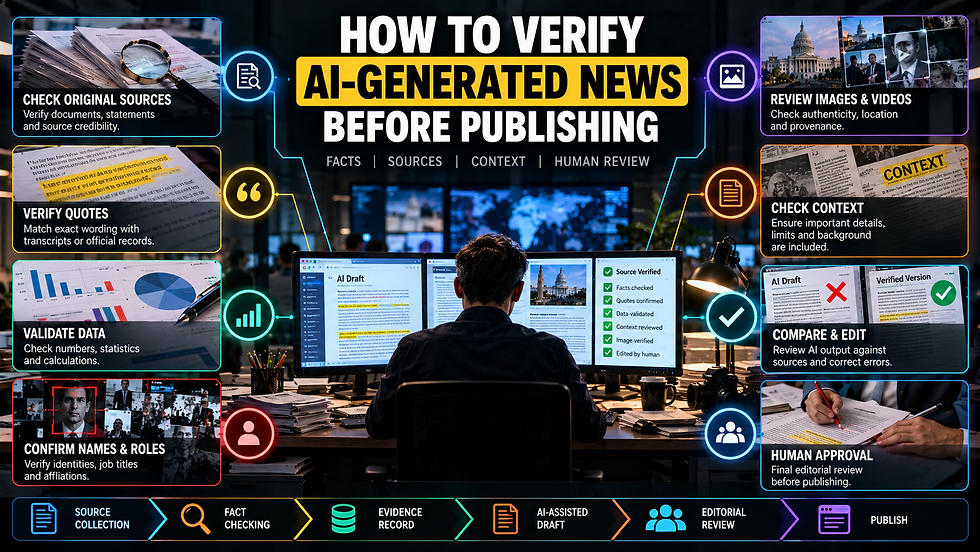
Signal → Claim Detection → Source Retrieval → Evidence Check → Fact Pack → Editorial Review → Publication
Stage 1: Detect
AI identifies potential claims worth investigating.
Stage 2: Prioritize
Not every factual sentence deserves the same amount of verification effort.
Editors can prioritize claims based on:
Potential harm
Audience impact
Story prominence
Source uncertainty
Legal sensitivity
Novelty
Whether the claim is central to the story
Stage 3: Retrieve
Find the original source and existing fact checks.
Stage 4: Compare
Compare the claim against:
Primary documents
Transcripts
Official statements
Datasets
Research
Independent reporting
Stage 5: Build a Fact Pack
Record what is known, what is disputed, and what remains uncertain.
Stage 6: Human Review
An editor determines whether the evidence supports publication.
Stage 7: Publish and Monitor
Verification should continue after publication when a story is developing.
New evidence may change the story.
The NewsBolts Evidence-State Framework
NewsBolts can turn the verification process into a structured editorial state rather than a simple “fact checked / not fact checked” label.
Use five states:
Verified
The claim is adequately supported by appropriate evidence.
Attributed
The statement is reported as a claim made by a named source but has not necessarily been independently established.
Corroborated
Multiple appropriate sources independently support the information.
Disputed
Relevant sources conflict and the disagreement needs to be represented accurately.
Unverified
Evidence is insufficient for publication as an established fact.
This framework is particularly useful for AI-assisted drafting.
An AI system can be instructed to preserve the state of a claim instead of flattening every piece of information into confident prose.
For example:
Source claim: Company says product sales increased 40%.
Editorial status: Attributed.
Evidence: Company earnings release.
Independent confirmation: Not yet established.
The AI should not transform that into:
“Product sales increased 40%.”
That is a meaningful editorial difference.
The Fact Pack as the Bridge Between AI and Editors
A newsroom Fact Pack can serve as the evidence layer between research and writing.
A practical Fact Pack could contain:
Field | Example |
Claim | Sales increased 40% |
Source | Company earnings release |
Evidence | Quarterly filing |
Status | Attributed |
Date | Reporting period |
Supporting source | Industry dataset |
Conflict | Independent figure differs |
Editor note | Verify denominator |
This is more useful than storing only the final AI-generated article.
The article is the output.
The Fact Pack is the evidence behind the output.
That distinction is central to a Human-Governed AI Newsroom Operating System.
What AI Fact-Checking Tools Can Do Well
AI-assisted verification is particularly useful for repetitive information-processing tasks.
Finding Repeated Claims
A tool can identify when the same claim appears repeatedly using different wording.
Full Fact describes systems that identify repeated claims even when different wording is used.
Monitoring Large Information Streams
AI can scan much more material than a human editor can manually review.
That is useful for:
Live broadcasts
Large social feeds
Multiple news sites
Podcasts
Transcripts
Public statements
The objective is not to replace journalists.
It is to reduce the amount of information they must manually sift through.
Comparing Documents
AI can highlight differences between documents.
This can be useful for:
Updated policy documents
Earlier and later statements
Corporate announcements
Research revisions
Transcripts
The highlighted difference still needs human interpretation.
Investigating Images and Video
Verification platforms can help identify:
Previous appearances
Keyframes
Metadata
Locations
Visual inconsistencies
Context
AP describes a verification workflow that includes reverse-image search, geolocation, comparison of landmarks and other contextual details, frame-by-frame manipulation checks, and contacting original uploaders.
What AI Fact-Checking Tools Cannot Reliably Decide Alone
A newsroom should be cautious about fully automated decisions involving:
Complex causal claims
Ambiguous statements
Sarcasm
Political context
Legal allegations
Scientific uncertainty
Conflicting expert interpretations
Emerging breaking news
Context-dependent claims
Questions where source credibility itself is disputed
NIST's Generative AI Risk Management Profile identifies “confabulation” as a risk in which generative AI produces and confidently presents erroneous or false content, including fabricated citations or reasoning that can encourage inappropriate trust.
This creates a practical rule:
Never treat the confidence of an AI output as evidence of the truth of the underlying claim.
AI Fact-Checking Tools vs General AI Assistants
General-purpose AI assistants can be useful in verification, but they should not automatically be classified as fact-checking systems.
A general AI assistant can help a journalist:
Extract claims
Create a verification checklist
Compare supplied documents
Identify questions
Summarize evidence
Organize notes
Suggest additional sources to investigate
But the journalist still needs to inspect the underlying evidence.
Dedicated fact-checking and verification systems may have more specialized workflows, databases, provenance functions, media-analysis features or claim-monitoring capabilities.
The difference is workflow specialization.
AI Fact-Checking Tools vs Human Fact-Checkers
These are not interchangeable.
Function | AI Tools | Human Fact-Checker |
Scan large information volumes | Strong fit | Limited by time |
Detect repeated claims | Strong fit | Possible but slower |
Extract claims | Strong fit | Strong |
Find candidate evidence | Strong fit | Strong |
Evaluate source credibility | Supporting role | Strong |
Understand complex context | Limited | Strong |
Resolve conflicting evidence | Supporting role | Strong |
Make editorial judgment | Should not be autonomous | Core responsibility |
Decide publication risk | Supporting role | Core responsibility |
Explain nuanced conclusions | Assistance | Core responsibility |
The goal is not to decide whether humans or AI are “better.”
The useful question is:
Which part of the process benefits from automation, and which part requires accountable judgment?
A Risk-Based Decision Matrix for Publishers
Newsrooms can formalize tool usage with a simple matrix.
Task | AI Assistance | Human Approval | Evidence Requirement |
Claim extraction | Yes | Review exceptions | Source text |
Duplicate-claim detection | Yes | Recommended | Existing fact checks |
Document comparison | Yes | Yes | Original documents |
Quote matching | Yes | Mandatory | Transcript/recording |
Number checking | Yes | Mandatory | Original dataset/report |
Image search | Yes | Mandatory | Provenance/context |
Video keyframe analysis | Yes | Mandatory | Original media/context |
Source credibility | Assist only | Mandatory | Source evaluation |
Breaking-news verification | Assist only | Mandatory | Primary + appropriate corroboration |
Final publication | Workflow only | Mandatory | Completed evidence record |
This gives publishers a practical governance model without requiring every newsroom task to have the same level of automation.
Common Mistakes When Using AI Fact-Checking Tools
Mistake 1: Treating the Tool as the Verdict
A green checkmark, confidence score, or AI-generated explanation does not eliminate editorial responsibility.
Mistake 2: Checking the Claim but Not the Source
A source may be outdated, misquoted, manipulated, or inappropriate for the claim.
Mistake 3: Using AI to Fact-Check AI Without External Evidence
This creates a closed loop.
The system effectively evaluates its own output.
Mistake 4: Ignoring Context
A fact can be technically correct and still misleading when separated from its original context.
Mistake 5: Assuming Every Tool Is an AI Fact-Checker
Some tools specialize in media verification.
Others search existing fact checks.
Others detect claims.
Others help organize evidence.
Calling all of them “AI fact-checkers” hides important differences.
Mistake 6: Optimizing for Speed Alone
The fastest verification process is not necessarily the safest.
For high-impact stories, the appropriate workflow may require more evidence and human review.
Mistake 7: Building Around One Vendor
Verification systems change.
Publishers should design workflows around functions and evidence, not around a single tool.
Technical Architecture for an AI-Assisted Fact-Checking Workflow
A publisher building verification into a newsroom platform can use this system flow:
News Signals → Content Intake → Claim Extraction → Verification Queue → Source Retrieval → Evidence Store → Fact Pack → AI Analysis → Human Review → CMS → Publication
Each layer has a defined role.
Content Intake
Collect articles, transcripts, social posts, documents, images and video.
Claim Extraction
Identify statements that may require verification.
Verification Queue
Prioritize claims based on editorial importance and risk.
Source Retrieval
Locate primary documents, previous fact checks and relevant evidence.
Evidence Store
Preserve the material used to support or challenge claims.
Fact Pack
Convert evidence into structured editorial information.
AI Analysis
Assist with comparison, classification, extraction and anomaly detection.
Human Review
Resolve ambiguity and determine whether the evidence is sufficient.
CMS
Move approved material into publishing.
Publication
Release the story with appropriate attribution and context.
This architecture prevents the AI layer from becoming the final publishing gate.
How Google Search Fits Into a Fact-Checking Workflow
There is also an SEO consideration for publishers creating dedicated fact-checking content.
Google's current documentation says ClaimReview support is being phased out from Google Search, while remaining supported by Fact Check Explorer.
That means publishers should not build their fact-checking strategy around structured data alone.
The actual article should remain useful without relying on a search-result enhancement.
For a fact-check page, that means making visible:
The claim
Who made it
The evidence examined
The methodology
The conclusion
Relevant sources
Corrections information
Google's documentation also says fact-check content should be transparent and traceable and should clearly attribute the claim being evaluated.
This aligns with the broader SEO principle of producing useful, non-commodity content.
Google's current generative-AI guidance emphasizes valuable, unique, reliable, people-first content rather than special “GEO tricks.”
For publishers, original verification work can therefore provide substantially more value than publishing generic articles about misinformation.
What Publishers Should Do
A publisher considering AI fact-checking tools should not start by buying the largest available platform.
Start with the workflow.
Step 1: Map Current Verification
Document how journalists currently verify:
Text claims
Sources
Quotes
Numbers
Images
Video
Breaking news
Step 2: Identify the Bottleneck
Ask where editors lose the most time.
Is it:
Finding claims?
Finding sources?
Searching old fact checks?
Verifying images?
Comparing documents?
Tracking evidence?
Managing approvals?
Step 3: Select Tools by Function
Choose the tool that addresses the bottleneck.
Do not choose a tool because it uses the word “AI.”
Step 4: Create Editorial States
Use a consistent vocabulary such as:
Verified → Attributed → Corroborated → Disputed → Unverified
Step 5: Build a Fact Pack
Make the evidence record part of the workflow.
Step 6: Establish Human Approval Gates
High-impact claims should require human review.
Step 7: Measure the Process
Track verification time, corrections, source traceability and escalation.
Step 8: Review the Workflow
AI tools evolve.
The newsroom's verification policy should evolve with them.
NewsBolts Editorial Workflow
News Intelligence → Source Verification → Fact Pack → AI-Assisted Draft → Claim Review → Human Editorial Approval → SEO/GEO/AEO → Publishing → Analytics
This connects naturally with the AI Newsroom Operating System, which covers the broader newsroom workflow.
The AI Newsroom Architecture is relevant when publishers need to connect verification with CMS, research, and publishing infrastructure.
The AI Editorial Workflow covers the transition from evidence collection to editorial approval.
And Breaking News Verification addresses verification under time pressure.
The NewsBolts perspective is straightforward:
AI should make evidence easier to find, organize and review. It should not make editorial accountability disappear.
What Publishers Should Measure
Tool adoption should be evaluated through newsroom outcomes, not the number of AI features available.
Useful measurements include:
Metric | Why It Matters |
Claims detected | Shows monitoring coverage |
Claims escalated | Shows prioritization |
Verification time | Measures workflow efficiency |
Source traceability | Measures evidence quality |
Pre-publication errors caught | Measures review effectiveness |
Post-publication corrections | Shows errors escaping review |
Human override rate | Shows where AI output requires correction |
Duplicate claims identified | Measures research efficiency |
Media verification time | Measures visual workflow efficiency |
Escalation rate | Shows how often cases need deeper review |
These are proposed newsroom metrics, not NewsBolts performance claims.
NewsBolts should collect first-party data before publishing any benchmark or efficiency statistics.
NewsBolts Research Opportunity: AI Fact-Checking Benchmark
NewsBolts could eventually create an AI Fact-Checking Workflow Benchmark for Digital Publishers.
A credible research project could examine:
Sample
A defined number of AI-assisted stories from participating publisher teams.
Data Collected
Number of material claims
Number of claims reviewed
Tool used
Verification time
Source type
Errors discovered
Human overrides
Corrections
Story category
Methodology
Classify errors into:
Factual
Numerical
Attribution
Quotation
Contextual
Temporal
Source-related
Multimedia
Limitations
Results would need to account for differences in:
Editorial policies
AI systems
Story types
Staff experience
Verification standards
Publishing environments
No benchmark findings should be published until NewsBolts has collected and analyzed the underlying data.
The Future of AI Fact-Checking in Newsrooms
The direction of AI-assisted fact-checking is likely to be less about one magical “truth engine” and more about integrated verification workflows.
The Reuters Institute's 2026 discussion of AI and fact-checking highlights this dual role: generative AI increases the volume of misleading material while also giving fact-checking teams tools to detect and investigate claims at greater scale.
That distinction is important.
More automation does not eliminate the need for judgment.
It can increase the amount of material that human experts are capable of investigating.
That is where AI fact-checking tools have the strongest newsroom value.
The winning architecture is therefore not:
AI → Truth → Publish
It is:
AI → Detect → Retrieve → Compare → Organize → Human Review → Publish
That is a much more realistic model for publishers building responsible AI-assisted newsrooms.
FAQs About AI Fact-Checking Tools for Newsrooms
What Are AI Fact-Checking Tools?
AI fact-checking tools are systems that help journalists identify, investigate, compare, or document factual claims. They can support claim detection, source retrieval, existing fact-check searches, document comparison, image verification, video analysis and evidence organization.
What Is the Best AI Fact-Checking Tool for a Newsroom?
There is no single tool that fits every newsroom. Tool selection should depend on the verification task. Full Fact AI focuses on claim monitoring and identification, AP Verify combines AI and digital-media verification, Google Fact Check Tools provides access to fact-checked claims, and InVID focuses heavily on image and video verification.
Can AI Fact-Check News Automatically?
AI can automate parts of fact-checking, particularly claim detection, information retrieval, matching and media analysis. Complex verification still requires human supervision because context, source credibility and ambiguous evidence can require editorial judgment.
Can AI Fact-Checking Tools Verify Quotes?
They can help locate matching text and compare a draft with transcripts or source documents. A journalist should still confirm the original quotation and its context before publication.
How Do Newsrooms Verify AI-Generated Images?
Newsrooms can investigate the original source, previous appearances, metadata, location, timing, visual context and potential manipulation. Tools such as InVID and AP Verify provide functions that can assist with these investigations.
Can General AI Chatbots Replace Fact-Checking Tools?
General AI assistants can help with research, claim extraction and document comparison, but they should not automatically be treated as independent fact-checking systems. Important claims should be verified against external evidence.
What Is a Human-in-the-Loop Fact-Checking Workflow?
It is a workflow in which AI performs defined assistance tasks while journalists and editors remain responsible for evaluating evidence, resolving uncertainty and approving publication.
Should Publishers Build Their Own AI Fact-Checking System?
Some publishers may benefit from building workflow infrastructure when their verification process is specialized or closely integrated with their CMS, source database and editorial system. Others may be better served by combining existing specialized tools through a governed workflow. The decision should be based on workflow requirements, integration needs, cost, security and editorial risk.
Conclusion
AI fact-checking tools are most useful when they make human verification faster, broader and more organized not when they are treated as autonomous truth machines.
For publishers, the practical model is to divide the workflow into clear responsibilities:
Detect claims → Find evidence → Compare sources → Build a Fact Pack → Assess risk → Review with humans → Publish
Tools such as Full Fact AI, AP Verify, Google Fact Check Tools and InVID demonstrate different parts of this ecosystem.
The important decision is therefore not simply which tool a newsroom should buy.
It is which verification tasks should be automated, which evidence must remain traceable, and where human editorial authority must remain mandatory.
That is the role AI should play inside a Human-Governed AI Newsroom Operating System.


Comments