AI News Monitoring vs AI News Intelligence: What Publishers Need To Know

AI news monitoring and AI news intelligence sound like two names for the same thing, and vendors often use them that way. They do different jobs. Monitoring watches sources and tells a newsroom what appeared. Intelligence analyzes that material to show what is growing, what is missing and what is worth an editor's time. Publishers who buy one while expecting the other end up with either a noisy alert feed or a polished dashboard sitting on thin data. This guide explains the difference, with real examples, and how to choose.

What is AI news monitoring?
AI news monitoring is the continuous tracking of chosen sources, such as news sites, feeds, filings, press releases and social accounts, with software that flags new or changed items. It is the collection layer. The output is a stream of items: this source published this, at this time, mentioning this topic.
Industry vendors describe it the same way. Opoint defines monitoring as tracking and collecting coverage, and Cision calls it tactical and reactive. For a newsroom, that fits tasks like spotting a new agency notice, catching a competitor's scoop or seeing that a source updated a page.
For a deeper look at how this works in a breaking-news setting, read our guide to AI source monitoring for newsrooms.
What is AI news intelligence?
News intelligence takes the monitored material and adds analysis: which topics are rising, which entities keep appearing, how coverage differs across outlets, and what readers are likely to engage with. Cision describes the media-industry version as strategic, adding sentiment and trend analysis on top of the mentions. cision
AssemblyAI explains the difference as a data structure question. Monitoring produces a list of hits, while intelligence produces structured records with entities, topics, sentiment and speakers attached, which can be aggregated, charted or routed into a workflow. That structure is what lets an editor ask questions like "which beat are we under-covering?" instead of "what came in this hour?"
One caution: most of these definitions come from PR and media-monitoring vendors writing for brands and communications teams, so their examples focus on reputation. Publishers can borrow the idea, but the questions they ask are different.
The difference at a glance
AI news monitoring | AI news intelligence | |
Core question | What just appeared or changed? | What does it mean, and what should we do? |
Output | Alerts, feeds, clip lists | Trends, gaps, predictions, structured insights |
Typical use | Catch breaking developments and source updates | Plan coverage, spot rising topics, find gaps |
Time horizon | Now | Now to the next day, week or quarter |
Main user | Desk editors, reporters | Editors-in-chief, audience and strategy teams |
Risk if used alone | Alert overload with no priorities | Confident analysis built on incomplete data |
How publishers use each
Monitoring in practice. A local publisher watches council notices, court listings and a short list of trusted outlets. The system flags a new notice, groups repeat mentions and sends it to the right editor. Nothing here requires analysis; the value is speed and completeness.
Intelligence in practice. NewsWhip's Spike is a well-known example of the intelligence layer built for newsrooms. It calculates current and predicted engagement for articles and posts, looking up to 24 hours ahead. NewsWhip has also described alerts for stories gaining engagement faster than usual, and using machine learning to find "white space" in coverage: stories that a set of publishers are not covering but that are gaining attention on social media. Its publisher tools cover content discovery, competitor analysis and monitoring across regions and languages. That is a different job from watching a source for changes. It helps editors decide what to commission, not just what arrived.
Verification tools sit in a third group. AP Verify and Full Fact AI, covered in our source monitoring guide, help check whether something is true. Predicted engagement says nothing about accuracy, so keep these roles separate.
Why intelligence depends on monitoring
Intelligence can only analyze what monitoring captured. Opoint makes this point sharply: the quality of the intelligence layer is capped by the monitoring feeding it, and a story that broke in regional or non-English press never reaches the analysis if monitoring missed it. Muck Rack agrees that monitoring is one component of intelligence and the first step, tracking content across newspapers, TV, radio, websites, blogs, podcasts and social media. opointmuckrack
This has a practical meaning for publishers. If your source list is narrow, any dashboard built on top of it will look confident and still be wrong about what is happening. Fix coverage first, then add analysis.
Which one does your newsroom need?
This is our recommendation, not a rule from the sources above:
Small newsroom, limited time: start with monitoring. A short list of trusted sources, clear alert tiers and one editor reviewing alerts will pay off faster than any dashboard.
Growing publisher with several beats: add intelligence once monitoring is stable. Trend and gap analysis is useful when you have enough data and enough staff to act on it.
Large or multi-region operation: use both, and check that the monitoring layer covers the languages and regions you publish in.
Whichever you pick, measure it with your own numbers: how many alerts became real stories, how many were duplicates, and how many insights changed an editorial decision.
Neither one replaces editorial judgment
A rising topic is not a true one. A fast-growing story can be wrong, old or recycled. AP's updated AI standards keep sourcing, judgment and verification with journalists, and that should hold whether the tool is called monitoring or intelligence. Treat every output as a lead for an editor, never as a finished fact.
Where NewsBolts fits
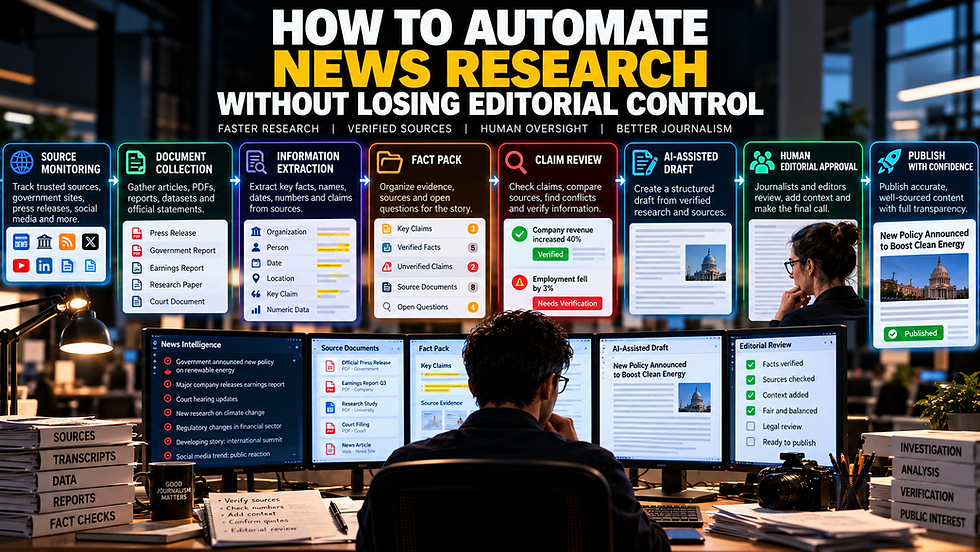
We build NewsBolts as an AI newsroom platform for publishers, covering research, writing, SEO and publishing with editors staying in control. In our AI newsroom operating system guide, monitoring and intelligence are two stages inside one human-governed workflow, not separate products, and the editor decides what gets published.
FAQ
What is the difference between AI news monitoring and AI news intelligence?
Monitoring tracks and collects what appears across sources. Intelligence analyzes that material to show trends, gaps and predictions that help an editor decide what to do. Monitoring is the input, and intelligence builds on it.
Is AI news intelligence just a new name for monitoring?
No. The terms are often used loosely, but the distinction is real: monitoring finds and tracks coverage, while intelligence adds analysis and context. Monitoring is one part of the broader intelligence process.
Do small publishers need news intelligence?
Not at first. A small team usually gets more value from reliable monitoring with clear alert rules. Intelligence becomes useful once there is enough data and staff to act on trends and gaps.
Can AI news monitoring verify a story?
No. Monitoring tells you something appeared. Verification needs original sources, independent confirmation and an editor's judgment.
What should I look for in an AI news monitoring tool?
Look at source coverage (including regions and languages you publish in), how fast new items are detected, whether original URLs are preserved, how duplicates are grouped, and whether alerts can be tuned by beat.
Conclusion
AI news monitoring tells a newsroom what appeared. AI news intelligence helps it decide what matters. Publishers need reliable monitoring before intelligence is worth adding, and neither replaces an editor's verification. Start with the sources you trust, measure what actually helps, and add analysis once the foundation is solid.


Comments