AI Source Monitoring For Newsrooms: Tracking Breaking News

Breaking news rarely arrives in one place. A story can start with a government notice, spread through social posts, and be repeated by a dozen websites before an editor finishes the first read. AI source monitoring helps newsrooms keep up by watching chosen sources, grouping related items and flagging what changed. It cannot tell an editor whether something is true. This guide covers how the workflow runs, what AP and Full Fact already do in practice, and what to require before an alert becomes a published story.

What AI source monitoring does, and what it leaves to editors
AI source monitoring means using software to watch a defined set of sources, such as agency websites, filings, press releases, feeds and social accounts, and to surface developments worth a journalist's attention. The useful jobs are sorting, grouping and summarizing. The editorial jobs stay with people: deciding whether a claim is supported, whether a source is credible, and whether the story is ready to run.
Publishers are moving in this direction. The Reuters Institute's 2026 trends report surveyed 280 digital leaders in 51 countries and territories, and 97% of publisher respondents rated back-end automation as important, with 82% saying the same about newsgathering uses. The survey covers a strategic group of senior leaders rather than a representative sample, so the figures show where publishers are heading, not how well the tools perform.
How a monitoring workflow runs
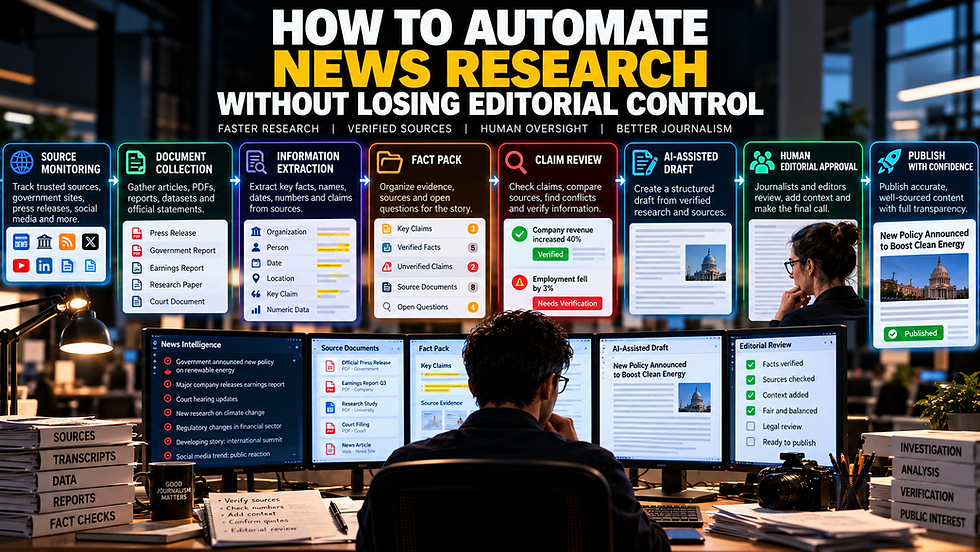
A workable setup separates detection from decisions at every stage:
Stage | What AI can do | What a person decides |
Define sources | Nothing yet; the list comes first | Which sources may trigger an alert, and which are primary |
Collect | Pull new items from feeds, pages and filings | Whether the original is kept with its URL and timestamp |
Group | Cluster duplicate and related items | Whether the items are truly independent |
Extract claims | Pull out names, numbers, dates and quotes | Which claims matter to the story |
Prioritize | Score items by topic, novelty and urgency | Alert thresholds for each beat |
Verify | Help with transcription, search and comparison | Whether the claim is supported |
Publish and update | Watch for changes after publication | Corrections and updates |
Start with the source list, not the software. Separate primary sources (an official filing, a court document, a direct statement from someone involved) from secondary signals (another outlet's report, a social post, a newsletter). If an AI summary blends ten items into one alert, readers on the desk can no longer tell which ones carry weight.
Keep the original evidence for every alert: source name, URL, time published, time detected, the extracted claims and the current verification status. When a story changes at 3 p.m., that record shows what triggered the change.
What real newsrooms already do
Two working examples show the pattern.
AP Verify. AP introduced AP Verify in December 2025, a dashboard that combines AI-powered features with established tools for authenticating online photos, videos and other digital content. It brings reverse image search, frame-by-frame video analysis, social listening, AI geolocation, object detection and transcription into one interface. AP says its journalists had previously relied on a patchwork of separate tools. In one case, the team used it to trace original Texas flood footage back to its source. The tool speeds up the checking; the journalist still decides what the evidence shows.
Full Fact AI. Full Fact's monitoring tools review newspapers, TV, radio, online video and social media, tag articles by topic, label each claim by type and speaker, and score claims for how worth checking they are. The tools can also alert fact-checkers when a claim that has already been fact-checked appears again. After 25 Arabic-speaking fact-checking organizations were introduced to the tools, they reported faster and simpler monitoring, and more than 200 fact checks have come from claims found there.
Both systems do discovery and organization at a scale no desk could match by hand, and both leave the judgment to people. That is a good model to copy.
Why an alert is not verification
Finding a post does not verify it. Finding ten articles does not mean ten sources. If five websites repeat one press release, the newsroom has one source and four copies. A monitoring system should therefore track who published first, who quoted whom and who confirmed independently, so an editor can ask how many independent pieces of evidence support a claim instead of how many pages mention it.
AP's standards draw the same line. Its updated AI standards, released in July 2026, approve AI for early-stage research, document summarization, transcription and translation, with AI output reviewed and edited by AP journalists before publication. AP says AI is no substitute for reporting, sourcing, editorial judgment or verification. The standards also add guidance for verifying and reporting on AI-generated and manipulated content. Photos and videos that surface in monitoring deserve extra care: check where the material came from, when it was made and whether it is being recycled from an older event.
Set alert rules editors can live with
A system that alerts on every keyword quickly gets ignored. Build tiers around editorial importance:
Breaking: an official emergency notice or a confirmed major development. Interrupt an editor immediately.
Developing: several credible sources mention the same event. Review and verify.
Beat: a new filing, rule or announcement. Add to the reporting queue.
Watchlist: a recurring company or topic. Check in a daily digest.
There is no universal alert threshold, so tune the rules to your beats. A practical approach is to start with a short list of sources you already trust, review every alert for two weeks, and note how many became real leads, how many were duplicates and how many summaries were wrong. Those numbers, from your own newsroom, tell you whether the setup is working better than any vendor claim.
Mistakes to avoid
Treating a confidence score as proof. A score shows how well an item matched a pattern, not that an event happened.
Counting repeats as confirmation. Trace each claim back to its first source.
Publishing straight from an alert. Keep an editor between the signal and the page.
Turning alerts into thin pages. Google's guidance says generative AI can help with research and with structuring original content, but generating many pages without adding value for users may violate its scaled content abuse policy. Use monitoring to find stories worth reporting, then add original reporting, context or analysis.
FAQ
What is AI source monitoring for newsrooms?
It is the use of AI-assisted software to watch selected sources, group related items, extract claims and flag developments for journalists. It supports discovery and prioritization; it does not verify facts or decide what to publish.
Can AI verify a breaking news story automatically?
No. AI can help with transcription, geolocation, image search and comparison, but an editor still has to check the original source and look for independent confirmation before publishing.
Which sources should a newsroom monitor?
It depends on the beat. Common choices include government agencies, courts, regulators, company announcements, public records, trusted outlets and a short list of social accounts. Keep primary sources clearly separate from secondary reports.
How do you reduce alert fatigue?
Group duplicates, rank alerts by editorial importance, and send low-priority items in a digest instead of instant notifications. Review the rules regularly, because too many alerts only move the problem from searching to ignoring.
Is AI monitoring realistic for a small publisher?
Yes, if the setup stays small. A short list of trusted sources, clear verification steps and a human decision before publication is enough to start with.
Conclusion
AI source monitoring is most useful when it helps editors notice what matters sooner without weakening verification. Pick trusted sources, keep the original evidence, group related signals and leave the publishing decision to a journalist. The best setup is not the one that sends the most alerts. It is the one that moves a newsroom from signal to verified fact with the least wasted effort.


Comments