AI Newsroom Architecture: Technical Blueprint

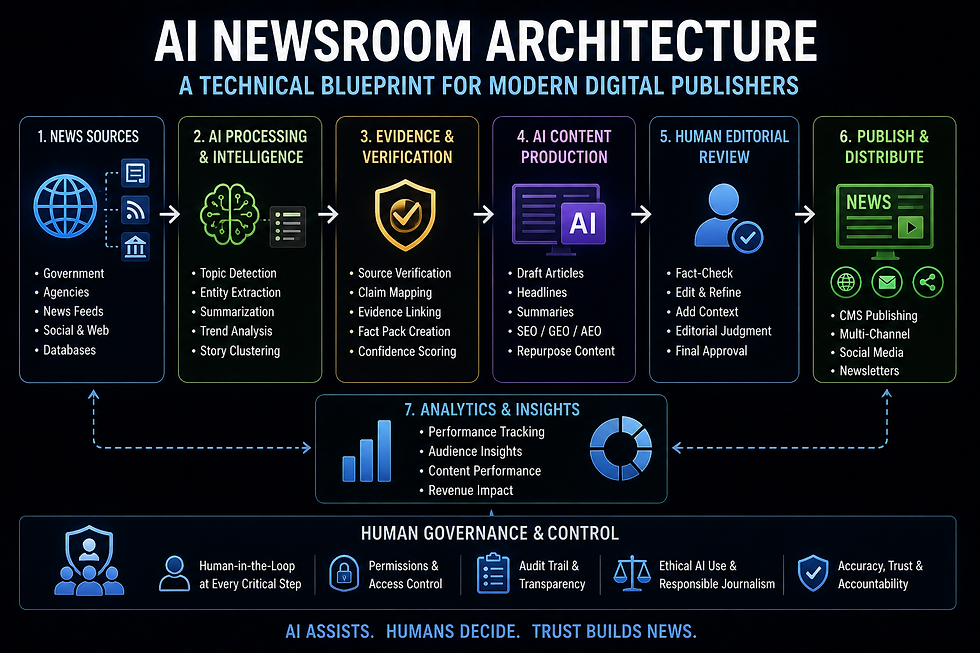
AI newsroom architecture is the technical foundation that connects news intelligence, source verification, evidence management, AI-assisted production, human editorial review, publishing, analytics, and content distribution.
A strong architecture does not simply connect AI tools. It creates clear boundaries between data, AI processing, editorial decisions, publishing, and measurement. The goal is to make newsroom operations faster and more scalable while keeping humans responsible for accuracy and editorial authority.
What Is AI Newsroom Architecture?
AI newsroom architecture is the combination of systems, data flows, AI services, databases, editorial controls, and publishing tools that support a digital newsroom.
A simplified architecture looks like this:
Sources
↓
News Intelligence
↓
Evidence & Verification
↓
Fact Pack
↓
AI Content Production
↓
Human Editorial Review
↓
SEO / GEO / AEO
↓
CMS & Publishing
↓
Analytics
↓
Repurposing
Each layer performs a different function.
The important principle is that AI should not sit between a source and publication without appropriate verification and editorial controls.
Why Publishers Need a Structured AI Architecture
A newsroom may already use many separate systems:
RSS feeds
Search tools
Research databases
AI assistants
Fact-checking tools
CMS
SEO platforms
Analytics
Social publishing tools
Newsletter platforms
The problem is often not a lack of technology.
It is the lack of connection between technologies.
Without a defined architecture, information can become fragmented.
A journalist may research a story in one system, create a draft in another, verify information somewhere else, publish through a CMS, and measure performance in another platform.
A strong AI newsroom architecture connects these processes.
The Six Core Layers of an AI Newsroom
A practical technical blueprint can be divided into six major layers.
1. Source Layer
This is where information enters the newsroom.
2. Intelligence Layer
AI processes and organizes incoming information.
3. Evidence Layer
Claims are connected to sources and verification status.
4. Content Layer
AI assists with drafting, editing, optimization, and repurposing.
5. Governance Layer
Human review, permissions, approvals, and audit history control the workflow.
6. Publishing and Measurement Layer
Approved content moves to the CMS and performance data returns to the newsroom.
This separation makes the architecture easier to manage and audit.
Layer 1: Source Architecture
The source layer collects information from approved sources.
These may include:
Government websites
Regulatory bodies
Company announcements
Court documents
Research publications
Public records
News feeds
Interviews
Internal newsroom research
Licensed databases
The architecture should record where information came from.
At minimum, useful source metadata can include:
Source name
Source type
URL or document reference
Publication date
Collection date
Topic
Geographic relevance
Verification status
This creates a foundation for later source tracing.
Layer 2: News Intelligence
The intelligence layer processes incoming information.
AI can assist with:
Topic classification
Story clustering
Duplicate detection
Entity extraction
Trend identification
Document summarization
Priority scoring
Related-story discovery
For example, a newsroom might receive 50 documents related to the same developing story.
Instead of treating them as 50 independent items, the system can group them into one story cluster.
The journalist can then investigate the cluster.
This reduces information overload without allowing AI to decide automatically what should be published.
Layer 3: Evidence and Verification
This is one of the most important architectural layers.
The system should maintain a relationship between:
Claim → Source → Evidence → Verification Status
For example:
Claim: A company announced a new product.
Source: Official company announcement.
Evidence: Published announcement.
Status: Confirmed.
A different claim might be:
Claim: The product will create 10,000 jobs.
Source: Third-party statement.
Evidence: No primary evidence found.
Status: Requires verification.
The architecture should preserve that distinction.
This prevents the AI drafting system from treating every piece of collected information as equally reliable.
The Fact Pack as an Evidence Object
A useful architectural component is the Fact Pack.
Instead of passing raw research directly to an AI model, the system creates a structured information package.
A Fact Pack can contain:
Story
Working title and editorial angle.
Confirmed facts
Information supported by reliable evidence.
Sources
Primary and supporting sources.
Claims
Important statements that may appear in the article.
Verification
Status of each claim.
Uncertainty
Information that remains unclear.
Editorial notes
Important context and reporting requirements.
The AI drafting layer can then use the Fact Pack as a controlled input.
Layer 4: AI Content Production
The content layer is where AI becomes an editorial assistant.
It can support:
Article drafting
Headline suggestions
Summaries
Metadata
FAQs
Translation assistance
Grammar
Content restructuring
Newsletter drafts
Social content
Repurposing
The architecture should ideally separate the source information from the generated output.
For example:
Fact Pack
↓
AI Draft
↓
Editorial Changes
↓
Approved Article
This creates a clear content lifecycle.
The Associated Press provides a useful real-world example of this principle. Its updated July 2026 standards permit AI assistance for tasks including early-stage research, document summarization, transcription, translation, headlines, summaries, grammar, and search optimization, while stating that editorial judgment, verification, and accountability remain with AP journalists.
Layer 5: Human Editorial Governance
AI newsroom architecture needs a governance layer.
This layer determines:
Who can create content
Who can edit content
Who can approve content
Which content requires additional review
Which sources are approved
Which AI tools can be used
What information can be sent to AI systems
How corrections are handled
A simple permission structure might be:
Reporter → Editor → Senior Editor → Publisher
Not every article needs every level.
The system can use risk-based rules.
For example:
Routine content → Standard review
Breaking news → Stronger verification
Sensitive allegations → Senior editorial review
This makes human governance part of the architecture rather than an informal process.
Layer 6: Publishing Architecture
Once an article receives final approval, it can move into the publishing layer.
This can connect to a CMS such as:
WordPress
Wix
Webflow
Ghost
Custom publishing systems
The publishing layer can manage:
Article content
Authors
Categories
Tags
Images
Metadata
Publication dates
Internal links
Structured data
The important control is simple:
Only approved content should enter the publication pipeline.
SEO, GEO and AEO as an Optimization Layer
Search optimization should be connected to the content workflow.
The system can analyze:
Search intent
Primary keyword
Related questions
Entities
Heading structure
Internal links
Metadata
Structured data
Content clarity
For Google AI features, Google says existing SEO fundamentals remain relevant and that there are no additional technical requirements specifically required for appearing in AI Overviews or AI Mode.
This means the architecture should not be designed around tricks for AI search.
It should be designed around:
Useful content + clear structure + accessible pages + strong technical SEO.
Analytics Architecture
The analytics layer closes the loop.
After publication, data can flow back into the newsroom.
Possible data includes:
Search impressions
Clicks
Traffic
Engagement
Returning visitors
Newsletter activity
Social performance
Revenue
Subscription activity
The architecture can then connect performance data with content data.
For example:
Article → Topic → Author → Format → Traffic → Engagement → Revenue
This allows publishers to understand which types of editorial work create value.
Content Repurposing Layer
Approved content can become multiple formats.
For example:
Approved Article
↓
Newsletter
↓
Social Post
↓
Video Script
↓
Audio Summary
↓
Explainer
The key architectural rule is that repurposing should use the approved source content.
This reduces the risk of generating completely new claims during transformation.
A Complete AI Newsroom System Flow
A practical end-to-end architecture can look like this:
Sources
↓
Ingestion
↓
Normalization
↓
Story Detection
↓
Entity & Topic Classification
↓
Source Verification
↓
Claim & Evidence Store
↓
Fact Pack
↓
AI Drafting
↓
Human Editorial Review
↓
SEO / GEO / AEO
↓
Final Approval
↓
CMS
↓
Distribution
↓
Analytics
↓
Content Repurposing
↓
Performance Feedback
The feedback can then return to the intelligence layer.
This creates a continuous newsroom loop rather than a one-way publishing process.
The Data Architecture Behind an AI Newsroom
A publisher does not necessarily need a complicated database design, but several core objects are useful.
Source
Stores information about where evidence came from.
Story
Represents the editorial topic or developing event.
Claim
Represents an individual factual statement.
Evidence
Connects a claim to supporting material.
Fact Pack
Organizes evidence for a specific story.
Draft
Stores AI-generated or journalist-created content.
Review
Records editorial feedback and changes.
Approval
Records who approved publication.
Article
Represents the published content.
Asset
Stores images, video, audio, and other media.
Performance Record
Stores analytics and business results.
This object-based approach makes the newsroom easier to audit and scale.
Why an Evidence Graph Can Be Useful
A more advanced architecture can connect claims and sources as a graph.
For example:
Story A
→ Claim 1
→ Source A
→ Evidence A
Story A
→ Claim 2
→ Source B
→ Evidence B
Story A
→ Claim 3
→ Source C
→ Verification pending
This structure can help editors quickly identify which parts of an article are well supported and which require additional reporting.
It can also make corrections easier.
If a source changes or is found to be unreliable, the newsroom can identify the claims and articles connected to it.
AI Model Architecture
The AI layer does not necessarily need one model doing everything.
Different tasks can have different requirements.
For example:
Classification model
→ Categorizes incoming information.
Extraction model
→ Extracts entities, dates, numbers, and claims.
Research assistant
→ Summarizes documents and organizes information.
Drafting model
→ Produces article drafts.
Optimization model
→ Reviews structure, metadata, and search intent.
Repurposing model
→ Converts approved articles into other formats.
The architecture should choose models based on the task rather than assuming that the largest model is always the best choice.
Human-in-the-Loop Architecture
A human-in-the-loop system means that people remain involved at defined points in the workflow.
A simple model is:
AI detects
↓
Human verifies
↓
AI prepares
↓
Human edits
↓
AI optimizes
↓
Human approves
This creates a balance between automation and editorial responsibility.
The important thing is that human review should not be treated as a button at the end of the process.
It should exist at the stages where human judgment matters.
Risk-Based Architecture
Different stories should move through different workflows.
Content type | AI involvement | Human control |
Routine information | High | Standard review |
Explainers | High | Editorial review |
Breaking news | Moderate | Strong verification |
Financial claims | Moderate | Strong verification |
Health claims | Limited to assistance | Strong review |
Allegations | Limited | Senior editorial review |
Sensitive personal information | Highly restricted | Strong human control |
The exact rules should be determined by each publisher's editorial policy.
Content Provenance and AI Media
Newsroom architecture increasingly needs to consider where images and other digital assets come from.
C2PA's Content Credentials standard provides a technical framework for recording provenance information about digital assets, including how an asset was created or modified. It uses digitally signed information and content bindings to make provenance information verifiable.
For publishers, provenance can help create a record for:
Original photographs
Edited images
AI-generated images
AI-assisted media
Third-party assets
However, provenance is not the same as truth verification. C2PA is designed to provide verifiable information about provenance; it does not itself determine whether the content is factually true.
That distinction should remain clear in the architecture.
Security and Privacy
AI newsroom systems can handle sensitive information.
That creates security requirements.
Publishers should consider:
User authentication
Role-based permissions
Data encryption
API security
Audit logs
Vendor access
Data retention
Sensitive-information policies
Backup and recovery
Particular attention should be given to information that should not be sent to external AI services.
Examples may include:
Confidential sources
Unpublished investigations
Personal information
Legal documents
Embargoed information
The architecture should make it possible to control what data can enter each AI system.
Observability and Error Handling
A production AI newsroom needs monitoring.
The system should detect problems such as:
Source ingestion failure
→ Alert
Missing evidence
→ Stop workflow
Verification incomplete
→ Block approval
AI service unavailable
→ Route to fallback process
CMS publishing failure
→ Alert publishing team
Analytics failure
→ Mark measurement incomplete
This is important because automation without observability can make failures difficult to detect.
Scaling the Architecture
Publishers should not build the entire architecture at once.
A practical rollout can happen in stages.
Phase 1: Intelligence
Build source ingestion and news monitoring.
Phase 2: Evidence
Add source tracking, claims, verification, and Fact Packs.
Phase 3: Production
Add AI-assisted drafting and editing.
Phase 4: Governance
Add permissions, review stages, and approval workflows.
Phase 5: Publishing
Connect the CMS.
Phase 6: Measurement
Connect analytics and business data.
Phase 7: Repurposing
Automate transformations of approved content.
This staged approach makes problems easier to isolate.
Common Architecture Mistakes
Building around an AI model
The model should support the architecture, not define it.
Connecting tools without defining data ownership
Every important piece of information should have a clear source of truth.
Sending raw information directly to the drafting model
Research should be organized and verified first.
Treating AI output as verified evidence
Generated text should never automatically become evidence.
Removing human approval
Automation should not silently become editorial authority.
Ignoring failure states
Every production workflow needs a way to stop, retry, escalate, or fall back when something goes wrong.
Building too much too early
A complex architecture can become difficult to maintain.
Start with the highest-value newsroom workflow.
The NewsBolts Architecture Framework
For NewsBolts, the architecture can be represented as:
INTELLIGENCE → EVIDENCE → PRODUCTION → GOVERNANCE → DISTRIBUTION → MEASUREMENT
Intelligence
Identify and organize important information.
Evidence
Connect claims with sources and verification.
Production
Use AI to assist with drafting and content transformation.
Governance
Keep journalists and editors responsible for review and approval.
Distribution
Publish approved content across relevant channels.
Measurement
Connect content performance back to newsroom decisions.
This is consistent with positioning NewsBolts as a Human-Governed AI Newsroom Operating System rather than simply an AI writing tool.
What Publishers Should Build First
Start with the workflow that creates the most operational friction.
For many publishers, a useful starting point is:
News Monitoring → Source Verification → Fact Pack → Editorial Review
Once that works reliably, add:
AI Drafting → SEO/GEO/AEO → CMS Publishing → Analytics
Then add repurposing and advanced automation.
This reduces technical risk while giving the newsroom time to establish governance rules.
AI Newsroom Architecture Checklist
Before deploying an AI newsroom, confirm that the architecture has:
Source ingestion
Source metadata
News intelligence
Claim tracking
Evidence management
Fact Packs
AI-assisted drafting
Human review
Approval controls
Risk-based workflows
CMS integration
SEO/GEO/AEO support
Analytics
Content repurposing
User permissions
Audit logs
Security controls
Error handling
Data retention policies
The goal is not to check every box immediately.
The goal is to build an architecture that can evolve without losing editorial control.
What Publishers Should Measure
Technical architecture should ultimately support measurable newsroom outcomes.
Editorial
Verification completion
Correction rate
Source quality
Editorial review time
Production
Research time
Drafting time
Editing time
Publishing time
Technical
Workflow failure rate
API reliability
Processing time
Automation success rate
Search
Search impressions
Clicks
Organic traffic
Search visibility
Business
Revenue per article
Subscription activity
Advertising performance
Cost per published article
The best architecture is not necessarily the most technically sophisticated.
It is the one that improves the newsroom's ability to produce accurate, useful, measurable journalism at sustainable scale.
FAQs
What is AI newsroom architecture?
AI newsroom architecture is the technical design that connects sources, AI systems, evidence management, editorial workflows, publishing systems, analytics, and content distribution.
What is the most important layer in an AI newsroom?
The evidence and governance layers are especially important because they connect information to sources and ensure that humans retain control over important editorial decisions.
Should one AI model run the entire newsroom?
Not necessarily. Different newsroom tasks may have different technical requirements. A modular architecture can allow publishers to use different models or services for classification, extraction, drafting, optimization, and repurposing.
Where should human review happen?
Human review should occur wherever editorial judgment, verification, ethics, or potential harm is involved. High-risk content should have stronger controls than routine content.
What is a Fact Pack?
A Fact Pack is a structured collection of sources, claims, evidence, verification status, and editorial context used as a controlled foundation for content production.
How does AI newsroom architecture improve scalability?
It separates newsroom functions into repeatable stages and allows suitable tasks to be automated while maintaining defined human controls around verification and publication.
Does C2PA prove that an image is true?
No. C2PA can provide verifiable provenance information about an asset's creation and modification history, but provenance does not by itself establish factual truth.
Conclusion
AI newsroom architecture is not simply a collection of AI tools.
It is the technical operating structure behind an AI-enabled publishing workflow.
A strong architecture connects:
Sources → Intelligence → Evidence → Fact Pack → AI Production → Human Governance → Optimization → Publishing → Analytics
The most important architectural principle is separation.
Separate sources from generated content.
Separate evidence from assumptions.
Separate AI assistance from editorial authority.
Separate automation from approval.
For digital publishers, this creates a foundation that can scale AI use without turning the newsroom into an uncontrolled content-generation system.
The future-ready newsroom is therefore not simply automated.
It is connected, observable, evidence-based, and human-governed.


Comments