Article-To-Reel Automation: A Complete Guide For Digital Publishers

Digital publishers no longer have to treat an article and a short-form video as two completely separate production projects. With the right workflow, one verified news article can become a structured reel or short video using AI for script extraction, scene planning, captions, voice, formatting, and editing while human editors retain control over facts, context, tone, and final publication.
The goal is not to turn every article into an automated video. The goal is to build a repeatable article-to-reel automation workflow that helps publishers extend the reach and useful life of strong reporting without creating another full production burden for the newsroom.

Why Article-to-Reel Automation Matters for Digital Publishers
News consumption is increasingly happening through social and video platforms.
The Reuters Institute's 2026 Digital News Report found that 77% of respondents across 48 markets consumed online news video during the previous week. Social media and video networks were used by 54% for news, compared with 51% for news organizations' own websites and apps. Reuters also reported that growth in online news video is largely occurring on third-party platforms rather than publisher-owned websites and apps.
For publishers, this creates an important operational problem.
A newsroom may already have:
a reported article
verified sources
quotes
statistics
images
video footage
editorial context
headlines
related stories
But producing a short-form video from those materials can still require scripting, editing, captioning, voiceover, formatting, thumbnail creation, publishing, and distribution.
Article-to-reel automation connects these steps.
Instead of starting with a blank video project, the newsroom starts with material it has already researched and approved.
That changes the economics of video production.
What Is Article-to-Reel Automation?
Article-to-reel automation is a workflow that converts a published or editorially approved article into a short-form video using automated and AI-assisted production steps.
A typical workflow can extract the article's main facts, identify the central angle, create a short script, select relevant media, generate captions, structure scenes, add narration, and prepare the video for platforms such as YouTube Shorts, Instagram Reels, TikTok, or other vertical-video channels.
The important distinction is between automation and editorial independence.
Automation can handle repetitive production work.
It should not automatically decide whether an allegation is true, whether a source is reliable, whether a quote is being represented fairly, or whether a sensitive story should be converted into a short video.
That distinction is especially important for news publishers.
How Does Article-to-Reel Automation Work?
A strong article-to-reel workflow can be divided into several stages.
Article → Fact Extraction → Reel Brief → Script → Visual Plan → Production → Human Review → Publishing → Analytics
The process begins with an article that has already passed the newsroom's required editorial checks.
1. Select the Right Article
Not every article deserves a reel.
The best candidates usually have a clear central idea that can be explained quickly.
Examples include:
breaking developments
major policy announcements
business updates
technology launches
explainers
election developments
major court decisions
data-driven stories
important international events
"what happened" stories
"why it matters" stories
Long investigative pieces may also generate videos, but they may require more careful editorial treatment.
A useful selection system can score stories according to:
Factor | Question |
News value | Is the story important to the audience? |
Clarity | Can the central point be explained quickly? |
Visual potential | Are useful images, footage, charts, or graphics available? |
Verification | Are the important claims adequately supported? |
Audience interest | Is there a clear reason to watch? |
Video fit | Does short-form video add value? |
Risk | Could compression remove important context? |
This prevents the newsroom from measuring automation success by the number of videos produced.
The better metric is the number of useful videos produced from strong editorial material.
2. Build a Reel Brief From the Article
The article should not be sent directly into a video generator without editorial structure.
First, create a compact reel brief.
The brief can contain:
story headline
one-sentence summary
primary news development
three to five verified facts
important names
dates
numbers
direct quotes
source references
context
visual opportunities
potential risks
intended audience
target platform
target video length
This creates an intermediate layer between the article and the final video.
That layer is valuable because an article may contain 1,000 words while a reel may need to communicate the essential idea in a much shorter format.
The automation system should therefore compress the story without changing its meaning.
3. Extract Verified Facts
This is one of the most important stages.
An AI system can extract claims from an article quickly, but extraction is not verification.
For example, suppose an article says:
"Company X announced a new product on Tuesday."
The reel workflow should preserve:
the company name
the product
the announcement
the date
the source
It should not transform that statement into something stronger such as:
"Company X has launched the industry's most advanced product."
That would introduce a claim that may not exist in the source material.
For news publishers, the article-to-reel system should therefore work from a structured evidence layer whenever possible.
This fits naturally with an AI news intelligence workflow, where source material and important developments are organized before content production.
4. Turn the Article Into a Short Video Script
The next step is script generation.
A short news script normally needs a simple structure:
Hook → Development → Context → Why It Matters → Source/Next Step
The hook should explain why the viewer should care.
For example:
"Google has changed how publishers should think about video visibility in search."
The next section provides the core development.
Then the video adds enough context to prevent the story from becoming misleading.
The final section can explain why the development matters or direct viewers toward the full article.
AI is useful here because it can quickly produce several script variations.
The editor can choose between:
breaking-news style
explainer style
question-and-answer style
statistic-led style
timeline style
"what you need to know" style
The final script should still be reviewed by a human.
5. Create a Visual Plan
A script alone does not make a good reel.
Each sentence should have an appropriate visual treatment.
For example:
Script Element | Possible Visual |
Main announcement | Relevant footage or article image |
Person mentioned | Verified photo or licensed footage |
Statistic | Simple animated number |
Timeline | Timeline graphic |
Location | Map |
Product | Product footage |
Quote | On-screen quote |
Explanation | Simple diagram |
Final point | Branded closing frame |
The objective is not to fill every second with visual effects.
The objective is to make the story easier to understand.
For news publishers, simple visual storytelling is often safer than highly synthetic scenes that could confuse viewers about what actually happened.
6. Generate or Assemble the Reel
Once the script and visual plan are approved, the production layer can automate repetitive tasks.
Depending on the publisher's technology stack, this may include:
video resizing
scene creation
caption generation
text overlays
voiceover generation
music selection
image sequencing
transitions
logo placement
intro and outro templates
aspect-ratio conversion
subtitle positioning
rendering
file naming
publishing preparation
This is where automation can produce significant operational value.
The newsroom does not need an editor to manually repeat the same formatting process for every article.
Instead, the system can apply predefined templates.
7. Human Editorial Review Must Come Before Publication
Automation should not remove editorial accountability.
A human review should check at least:
Are all facts accurate?
Are names spelled correctly?
Are dates correct?
Are numbers accurate?
Are quotes represented correctly?
Are visuals relevant?
Could any visual imply something that did not happen?
Does the shortened script remove important context?
Is the tone appropriate?
Does the video accurately represent the article?
This is particularly important when AI generates voice, images, animations, or synthetic footage.
The human editor should have the authority to reject the reel.
That is consistent with a human-governed AI newsroom, where AI assists newsroom processes while editorial responsibility remains with people.
Article-to-Reel Automation Should Not Mean Article-to-Video Spam
One of the biggest risks is assuming that every article should automatically become a video.
That can create hundreds of low-value videos that nobody watches.
It can also overwhelm the newsroom's social channels.
A better system uses editorial eligibility rules.
For example:
High priority: major stories with strong visual potential.
Medium priority: useful explainers and evergreen stories.
Low priority: routine updates with little visual value.
Do not automate: sensitive stories where compression or synthetic visuals could create substantial editorial risk.
The automation system should therefore answer two questions:
Can this article become a reel?
and
Should this article become a reel?
Those are different questions.
How AI Can Help With Article-to-Reel Production
AI can assist at multiple points in the workflow.
Article Analysis
AI can identify:
key claims
entities
dates
locations
statistics
quotes
story angle
related topics
Script Generation
AI can transform a long article into different script lengths.
For example:
15-second version
30-second version
45-second version
60-second explainer
The editor can then select the version appropriate for the story and platform.
Visual Suggestions
AI can suggest where to use:
photos
video clips
charts
maps
screenshots
animations
headlines
The suggestions still need to be checked against available rights and editorial accuracy.
Captions
Automatic caption generation can reduce manual transcription work.
Captions also make videos easier to consume without sound.
Translation and Localization
A publisher operating in multiple markets can use AI-assisted translation to create localized scripts.
However, names, political terminology, legal terms, cultural references, and quotes should receive human review.
Repurposing
The same article can potentially generate:
a vertical reel
a YouTube Short
a longer explainer
a newsletter summary
a social post
an audio version
a carousel
a push notification
This turns one reporting asset into a coordinated content package.
How Article-to-Reel Automation Fits Into an AI Newsroom
Article-to-reel automation should not operate as an isolated tool.
It works better as part of a broader newsroom workflow.
A modern AI newsroom operating system can connect news discovery, research, verification, writing, editorial review, publishing, content repurposing, and analytics.
Within that system, the article becomes an approved editorial asset.
The reel workflow then uses the approved asset rather than independently researching the story from scratch.
This reduces the risk of two different content teams creating inconsistent versions of the same story.
For example:
The article contains the verified facts.
The reel uses those facts.
The newsletter summarizes those facts.
The social post promotes those facts.
The video description links back to the full story.
The result is a connected publishing workflow rather than five disconnected content-production processes.
The Importance of CMS and Publishing Integration
Automation becomes much more valuable when the video workflow connects with the publisher's existing CMS and distribution systems.
A newsroom may need the system to:
identify newly published articles
determine whether an article qualifies for video
create a reel brief
generate a draft video
send it for editorial approval
store the final asset
publish metadata
distribute the video
record the resulting URL
send performance data back to analytics
This is where APIs become important.
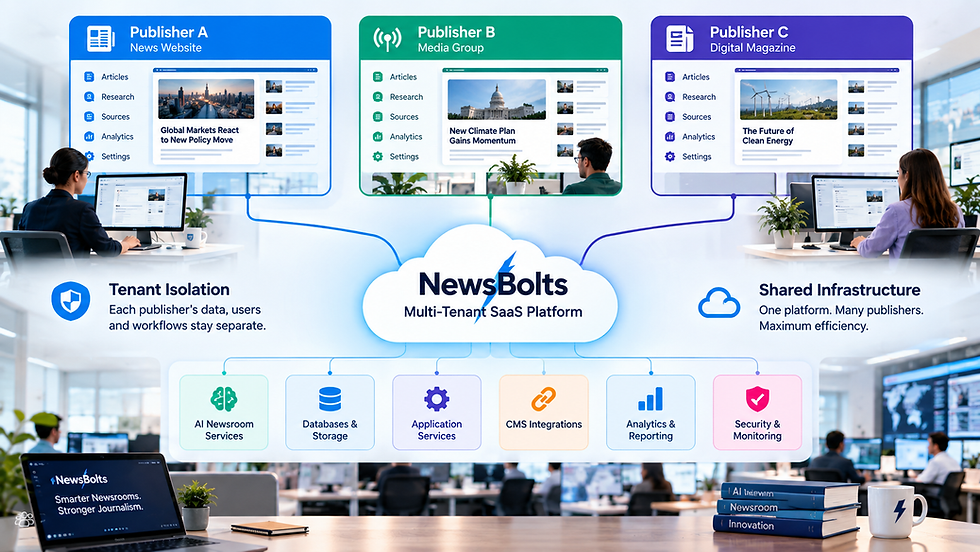
NewsBolts already focuses on how APIs connect AI, CMS, analytics and publishing systems, which is the broader infrastructure required to turn content automation into an operational workflow rather than a collection of disconnected tools.
Article-to-Reel Automation and YouTube SEO
Publishers should also think about the video as a searchable asset.
Google says videos can appear in several Search surfaces, including the main results page, Video mode, Google Images, and Discover. Google recommends making videos discoverable and indexable, using appropriate metadata and structured data, stable video and thumbnail URLs, and dedicated watch pages where appropriate.
For publishers, this means the workflow should generate more than a video file.
It should also create:
video title
description
thumbnail
transcript
captions
publication date
relevant keywords
article URL
platform-specific metadata
timestamps where useful
Google also supports video key moments through mechanisms such as Clip, SeekToAction, or timestamps in YouTube descriptions.
This creates an important connection between video production and search optimization.
A reel should not be treated as an isolated social asset if it can also contribute to a publisher's broader video discovery strategy.
Article-to-Reel Automation for YouTube Shorts
YouTube can be particularly relevant for publishers because its news features use signals that include relevance to a news topic or event, freshness, live streams, reporting intent, standard recommendation signals, and association with websites whose content surfaces in Google News.
That does not mean automation guarantees visibility.
Instead, publishers should focus on creating useful, timely, clearly sourced video.
A practical workflow can create a Short from an approved article and then generate:
a concise title
description
captions
thumbnail concept
article link
relevant timestamps where appropriate
disclosure information when required
AI Disclosure Matters in Automated Video Production
Publishers using generative AI for video production need a clear disclosure policy.
YouTube currently requires creators to disclose realistic AI-generated or meaningfully altered content in situations such as making a real person appear to say or do something they did not do, altering footage of a real event or location, or generating a realistic scene that did not occur.
By contrast, YouTube says some production assistance—such as AI-generated scripts, outlines, thumbnails, titles, captions, or minor editing assistance—does not itself require disclosure under its listed examples.
For a news publisher, the safest approach is to maintain an internal AI-use policy that distinguishes:
AI-assisted production
AI-generated visuals
synthetic narration
altered real footage
reconstructed scenes
fictional illustrations
realistic synthetic media
The more realistic and potentially misleading the output, the stronger the editorial controls should be.
Common Mistakes in Article-to-Reel Automation
Automating Before Verification
If the article contains an error, automation can reproduce the error across multiple formats.
Making Every Article Into a Reel
Not every story has enough visual or audience value to justify video production.
Removing Too Much Context
Short-form video rewards compression, but news reporting often depends on context.
Using AI Visuals as If They Were Real Footage
Synthetic visuals should never be presented in a way that falsely suggests they document a real event.
Creating Generic AI Voiceovers
A technically correct voiceover can still sound unnatural or reduce audience trust.
Optimizing Only for Views
Views alone do not tell a publisher whether the video helped the broader editorial or business strategy.
Ignoring Rights
Automation does not automatically grant rights to images, footage, music, screenshots, or third-party content.
Publishing Without Human Review
The biggest operational mistake is treating AI output as publication-ready by default.
How Publishers Should Measure Article-to-Reel Automation
A mature workflow should measure both production efficiency and editorial performance.
Useful metrics include:
Production Metrics
time from article publication to video draft
time spent editing
cost per video
percentage of videos requiring major revision
automation completion rate
human review time
Editorial Metrics
factual corrections
unsupported claims
caption errors
visual corrections
editorial rejection rate
disclosure compliance
Audience Metrics
views
average watch time
completion rate
retention
shares
comments
follows
clicks to the original article
Business Metrics
article sessions generated from video
newsletter registrations
subscriptions
memberships
advertising value
return on production cost
The most useful measurement is not simply:
How many reels did we automate?
It is:
Did automation help us produce more useful journalism in more formats without reducing editorial quality?
A Practical NewsBolts Article-to-Reel Framework
For a publisher building this workflow, NewsBolts can frame article-to-reel automation around seven layers:
Layer | Purpose | Human Role |
Story Selection | Identify articles suitable for video | Approve editorial priority |
Fact Layer | Extract verified facts and sources | Verify claims |
Reel Brief | Define angle, audience, and format | Approve framing |
Script | Convert article into short narrative | Edit wording and context |
Production | Generate video assets | Review visuals and voice |
Publishing | Distribute to platforms | Final approval |
Analytics | Measure audience and business results | Interpret performance |
This structure prevents AI from becoming an uncontrolled publishing layer.
Instead, AI becomes a production assistant inside an editorial system.
When Should a Publisher Build Article-to-Reel Automation?
A publisher should consider automation when:
the newsroom publishes a significant volume of articles
video demand is increasing
editors repeatedly perform the same production tasks
the publisher already has reliable source and editorial workflows
multiple platforms require different video formats
there is enough reusable visual material
performance data can be connected to the workflow
A publisher should be more cautious when:
the newsroom has no clear editorial review process
source verification is inconsistent
rights management is weak
video topics are highly sensitive
AI-generated visuals could easily mislead viewers
there is no clear audience or distribution strategy
Automation should follow newsroom maturity, not replace it.
What Publishers Should Do First
Publishers do not need to automate the entire video operation immediately.
A practical rollout can happen in phases.
Phase 1: Manual Workflow
Choose several article categories that consistently have video potential.
Create a standard reel template and manual review checklist.
Phase 2: AI-Assisted Workflow
Automate:
fact extraction
script drafts
caption creation
visual suggestions
metadata drafts
Keep final production and publishing human-controlled.
Phase 3: Production Automation
Introduce:
automated templates
voice generation
automatic captioning
asset assembly
format conversion
rendering
Keep editorial approval mandatory.
Phase 4: Connected Publishing
Connect the workflow to the CMS, analytics platform, social publishing tools, and video platforms.
This is where article-to-reel automation becomes part of the newsroom operating system.
Phase 5: Optimization
Use performance data to determine:
which article categories convert well into video
which hooks retain viewers
which formats work by platform
which stories generate article traffic
which production steps create unnecessary costs
The system should improve from evidence rather than assumptions.
Frequently Asked Questions
What Is Article-to-Reel Automation?
Article-to-reel automation is a workflow that uses software and AI to transform an approved article into a short-form video. It can assist with fact extraction, scripting, visual planning, captions, voiceover, editing, formatting, metadata, and publishing preparation while human editors retain final control.
Can AI Automatically Turn a News Article Into a Reel?
Yes, AI can assist with many production steps, but fully automatic publication is risky for news. A better approach is to automate repetitive production work while keeping fact verification, sensitive claims, visual accuracy, context, and final publication under human editorial control.
How Long Should a News Reel Be?
There is no single ideal length for every story. The appropriate length depends on the topic, platform, audience, and amount of context required. A short breaking-news update may need only a few key facts, while an explainer may require more time.
Can Article-to-Reel Automation Improve Publisher Efficiency?
It can reduce repetitive production work by reusing existing reporting, facts, visuals, templates, captions, and metadata. The actual efficiency gain depends on the publisher's workflow, technology stack, editorial review requirements, and volume.
Should Every News Article Become a Short Video?
No. Publishers should prioritize stories with strong audience interest, clear narratives, visual potential, and appropriate risk levels. Automatically converting every article into a video can create low-value content and consume distribution capacity.
Can AI-Generated News Videos Be Published on YouTube?
AI-assisted and AI-generated videos can be published subject to YouTube's policies. YouTube requires disclosure for certain realistic AI-generated or meaningfully altered content, particularly when it could make viewers believe that a real person or event was represented differently from reality.
Does Article-to-Reel Automation Help SEO?
It can support a broader video SEO strategy, but automation itself does not guarantee search visibility. Google recommends making videos discoverable and indexable, providing appropriate metadata, stable URLs, valid thumbnails, and dedicated watch pages where appropriate.
What Is the Biggest Risk of Automated News Video?
The biggest risk is scaling an editorial error or misleading presentation. If an automated system incorrectly interprets a claim, removes essential context, or uses synthetic visuals as though they were real, the error can spread across multiple platforms quickly. Human editorial review is therefore essential.
Conclusion
Article-to-reel automation can help digital publishers turn existing journalism into more useful formats without building every video from scratch.
The strongest approach is not to replace video editors or journalists with an automatic content generator.
It is to connect the existing newsroom workflow.
An approved article becomes the source. Verified facts become the evidence layer. AI assists with the reel brief, script, captions, visual planning, and repetitive production. Human editors review the result. The finished video is then distributed across the platforms where audiences increasingly consume news.
The opportunity is particularly relevant as online news video consumption continues to grow on third-party platforms. Reuters Institute's 2026 research shows that 77% of respondents across 48 markets consumed online news video weekly, while social media and video networks reached 54% for news.
For publishers, the strategic question is therefore not simply whether to create more video.
It is whether the newsroom can reuse verified reporting across formats efficiently while maintaining editorial quality.
That is where article-to-reel automation becomes part of a broader AI newsroom strategy rather than just another video-generation tool.


Comments