How Multi-Tenant SaaS Architecture Works For Digital Newsrooms

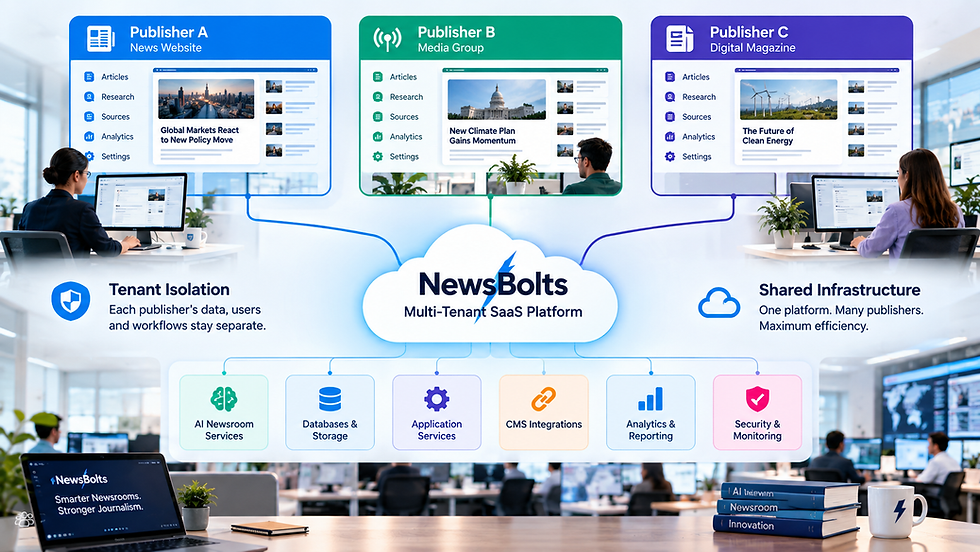
A digital newsroom platform serving one publisher can be relatively simple. A platform serving dozens or hundreds of publishers is different. Each publisher needs its own users, editorial workflows, content, permissions, integrations, analytics, and configuration, while the SaaS provider still needs to operate the platform efficiently. Multi-tenant SaaS architecture solves this problem by allowing multiple customers, or tenants, to use the same software platform while maintaining logical boundaries between their data, users, and resources.
For an AI newsroom platform such as NewsBolts, multi-tenancy is particularly important. Publishers may share common capabilities such as news intelligence, AI-assisted research, editorial workflows, CMS integrations, analytics, and automation, but one publisher must never gain access to another publisher's newsroom data.
Modern SaaS architecture therefore has to balance tenant isolation, security, scalability, performance, customization, reliability, and operating cost. AWS and Microsoft both describe tenancy as a set of architectural choices rather than a single design pattern, with different trade-offs between shared and dedicated resources.
What Is Multi-Tenant SaaS Architecture?
Multi-tenant SaaS architecture is a software design in which multiple customers use the same SaaS application while the platform maintains boundaries between their data, users, configurations, and resources.
Each customer is a tenant.
For a digital newsroom platform, one tenant could be:
A newspaper
A digital news website
A media group
A magazine publisher
A regional newsroom
A broadcaster
A content agency
An enterprise communications team
The application may be shared, but each tenant needs its own logical environment.
For example, Publisher A should see Publisher A's:
Journalists
Editors
Stories
Sources
Fact Packs
AI workflows
CMS credentials
Analytics
Publishing settings
Publisher B should see only Publisher B's corresponding resources.
This is where tenant isolation becomes fundamental.
AWS describes tenant isolation as a mechanism that prevents one tenant from accessing another tenant's resources, even when those resources are running on shared infrastructure. It also makes an important distinction: authentication and authorization alone do not automatically provide tenant isolation.
Why Digital Newsrooms Need Multi-Tenant SaaS Architecture
A modern newsroom has more than an article editor.
Its technology environment can include:
News monitoring
Source collection
Research
Verification
AI-assisted writing
Human editorial review
CMS publishing
SEO
Analytics
Social distribution
Multimedia workflows
User management
Third-party integrations
If a SaaS provider builds a separate application stack for every publisher, isolation can be strong, but operating hundreds of independent environments becomes expensive and complex.
If every publisher shares everything without strong tenant boundaries, costs may be lower, but the security and operational risks become much greater.
Multi-tenant SaaS architecture attempts to find the right balance.
AWS identifies three broad approaches to tenant isolation: silo, bridge, and pool. These models can be applied at different layers of an application rather than necessarily choosing one model for the entire system.
That flexibility is particularly useful for digital newsroom platforms.
How Multi-Tenant SaaS Architecture Works
At a high level, the architecture has several layers.
A publisher's user enters the platform.
The system identifies the tenant associated with that user.
The request is then processed within the correct tenant context.
The application retrieves only resources belonging to that tenant.
The response is returned to the authorized user.
The same application infrastructure may handle requests from many publishers, but every request carries tenant context that determines which resources can be accessed.
A practical architecture therefore needs clear separation between:
Identity
Tenant management
Application services
Data storage
AI services
Integrations
Analytics
Security
Administration
Observability
The exact implementation varies by product, cloud environment, database technology, and customer requirements.
The important principle is that tenant context must remain consistent throughout the request lifecycle.
Tenant Identity Is the Foundation
Every multi-tenant system needs to know which tenant a request belongs to.
This sounds simple, but it is one of the most important architectural decisions.
A user's identity may tell the platform:
Who the user is
Which organization they belong to
What role they have
Which permissions they have
The platform then needs to establish the tenant context for that request.
For example:
User | Tenant | Role |
Editor A | Publisher Alpha | Editor |
Reporter B | Publisher Alpha | Reporter |
Editor C | Publisher Beta | Editor |
Analyst D | Publisher Beta | Analyst |
An editor from Publisher Alpha should never be able to request Publisher Beta's articles simply by changing a URL, parameter, or request value.
AWS specifically recommends treating tenant identity and tenant isolation as explicit architectural concerns. Its guidance asks SaaS teams to consider where tenant identity lives and whether the system can prevent cross-tenant access if developers accidentally omit tenant filtering.
For a newsroom platform, this means tenant identity should not be an informal convention understood only by developers.
It should be part of the architecture.
Tenant Isolation Is More Than Login Security
One common misconception is that a secure login automatically makes a SaaS platform multi-tenant secure.
It does not.
Authentication answers:
Who are you?
Authorization answers:
What are you allowed to do?
Tenant isolation answers:
Which tenant's resources are you allowed to access?
These are related but different questions.
Imagine a publisher has 50 editors.
All 50 users may be authenticated correctly.
But the system still needs to make sure that their requests can access only resources belonging to their publisher.
AWS explicitly distinguishes tenant isolation from general authentication and authorization. A user can be authenticated and authorized while still being able to reach another tenant's resources if isolation is not correctly implemented.
For NewsBolts, this principle applies to every major newsroom object:
Articles
Sources
Fact Packs
Authors
Media files
AI prompts
AI outputs
Publishing credentials
Analytics
Workflow configurations
The Three Main Multi-Tenant Isolation Models
There is no single multi-tenant architecture that works for every SaaS platform.
The three common models are:
Silo Model
Each tenant receives dedicated infrastructure or dedicated resources.
Pool Model
Multiple tenants share infrastructure and data resources, with logical isolation between them.
Bridge Model
The platform combines shared and dedicated resources.
AWS documents these three models as common approaches to SaaS partitioning and tenant isolation.
The right choice depends on security requirements, customer expectations, cost, compliance, performance, and operational complexity.
How the Silo Model Works
In a silo model, each publisher receives dedicated resources.
For example, a SaaS provider might give each large publisher:
Dedicated application resources
Dedicated database
Dedicated storage
Dedicated processing resources
Dedicated infrastructure environment
The major advantage is stronger physical or logical separation.
If Publisher Alpha has its own database, Publisher Beta's data is not sitting in the same database tables.
AWS describes silo architectures as providing dedicated resources for a tenant, with stronger isolation but greater cost and operational overhead.
Advantages
Strong isolation
Easier tenant-specific resource control
Easier customer-specific performance tuning
Useful for highly regulated customers
Easier to dedicate infrastructure to premium customers
Disadvantages
Higher infrastructure costs
More environments to manage
More complex provisioning
More complicated upgrades
Greater operational overhead
For a digital newsroom SaaS platform, a silo model may make sense for large enterprise publishers with strict security or compliance requirements.
How the Pool Model Works
In a pooled architecture, multiple tenants share application and data infrastructure.
The database may contain data belonging to many publishers.
The application then uses tenant context to ensure that each query and operation accesses only the correct tenant's data.
For example, a shared article store could contain articles belonging to Publisher Alpha, Publisher Beta, and Publisher Gamma.
The platform must ensure that every operation is correctly scoped to the appropriate tenant.
AWS describes the pool model as the most shared approach, where tenants use common storage constructs and tenant data is separated logically through partitioning mechanisms.
Advantages
Lower infrastructure cost
Easier centralized management
Easier deployment
Efficient resource utilization
Strong fit for large numbers of tenants
Disadvantages
Isolation is more dependent on correct implementation
Noisy-neighbor risks can be greater
Cross-tenant data exposure can have serious consequences
Tenant-specific customization can be more complicated
For a SaaS platform serving many smaller publishers, pooled infrastructure can be operationally attractive.
But it requires disciplined tenant isolation.
How the Bridge Model Works
The bridge model combines elements of silo and pool architecture.
For example, a newsroom SaaS provider could share:
Web application
Authentication
API layer
Common AI services
while separating:
Enterprise databases
Sensitive storage
Certain processing workloads
Customer-specific integrations
AWS describes bridge architectures as a hybrid approach in which different components can use different isolation strategies.
This is often attractive for SaaS platforms because not every component has the same risk or resource requirements.
A public-facing application may be efficiently shared.
A publisher's private publishing credentials may require stronger isolation.
An AI processing service may be pooled.
A highly sensitive customer dataset may be placed in a dedicated environment.
This is why multi-tenancy should be viewed as an architectural spectrum rather than a binary choice. Microsoft similarly describes tenant isolation as a continuum, allowing different components or customers to use different degrees of isolation.
Multi-Tenant Data Architecture for Digital Newsrooms
Data architecture is one of the most important parts of a multi-tenant newsroom platform.
A publisher's data can include:
Articles
Drafts
Authors
Editorial notes
Source records
Research documents
Fact Packs
Media
Publishing credentials
CMS configurations
Analytics
Workflow settings
The architecture must define how these resources are partitioned.
A pooled database might use a tenant identifier to distinguish records.
A bridge architecture might use separate schemas.
A silo architecture might use separate databases.
AWS identifies these as common partitioning strategies and notes that each has different trade-offs involving cost, isolation, operational complexity, and agility.
The important point is that data partitioning and tenant isolation are related but not identical.
A database structure alone does not guarantee security.
The application, identity system, access policies, database controls, and operational processes must work together.
Tenant Isolation for AI Newsroom Data
AI introduces another layer to multi-tenant architecture.
A newsroom platform may send tenant data to AI systems for tasks such as:
Summarization
Research assistance
Classification
Translation
Draft generation
Content repurposing
Metadata generation
Editorial analysis
That creates additional questions.
For example:
Which tenant owns the input?
Where is the AI request processed?
Where is the output stored?
Can another tenant access the output?
How long is the data retained?
Which models can process the data?
Are customer-specific AI settings preserved?
Are prompts and outputs included in analytics?
How are AI credentials managed?
A multi-tenant architecture therefore needs tenant boundaries around the AI workflow, not just around the database.
A Fact Pack generated for Publisher Alpha should remain associated with Publisher Alpha.
An AI-generated article draft for Publisher Beta should not appear in Publisher Alpha's workspace.
A tenant's editorial instructions should not accidentally become another tenant's configuration.
Multi-Tenant Architecture and CMS Integrations
Digital newsrooms rarely operate entirely inside one SaaS platform.
They may use:
WordPress
Custom CMS platforms
Webflow
Shopify
Social platforms
Analytics systems
Email platforms
Video platforms
Advertising systems
A multi-tenant newsroom SaaS platform therefore needs tenant-specific integrations.
Publisher Alpha might connect one CMS.
Publisher Beta might connect another.
Each publisher's credentials must remain isolated.
The integration layer should understand:
Tenant
Destination
Credentials
Permissions
Content mapping
Publishing status
Error state
This becomes particularly important when the platform supports automated publishing.
A failure in tenant isolation at the integration layer could potentially send one publisher's content to another publisher's CMS.
Therefore, tenant boundaries need to continue through the entire workflow.
How Multi-Tenant SaaS Architecture Supports Newsroom Scalability
The major attraction of multi-tenancy is operational scalability.
Suppose a SaaS platform serves five publishers.
Then 50.
Then 500.
Operating a completely separate technology environment for every customer can become increasingly expensive.
A shared platform can allow common services to scale across customers.
That can make it easier to provide:
Centralized software updates
Shared monitoring
Shared infrastructure
Automated onboarding
Consistent security controls
Centralized analytics
Common AI capabilities
AWS and Microsoft both emphasize that tenancy choices affect cost, operational complexity, scalability, and isolation.
However, multi-tenancy does not mean every resource should be shared.
A scalable architecture needs to identify what should be shared and what should be isolated.
Handling the Noisy-Neighbor Problem
One tenant can sometimes consume significantly more resources than others.
Imagine one publisher launches a major breaking-news event and suddenly generates:
Thousands of source-monitoring operations
Large numbers of AI requests
Heavy media processing
High API traffic
Large analytics workloads
If every tenant shares the same resource pool, one customer's workload could affect others.
This is commonly described as the noisy-neighbor problem.
A newsroom SaaS platform can address it through techniques such as:
Rate limits
Resource quotas
Queue management
Tenant-aware scheduling
Priority levels
Workload isolation
Autoscaling
Dedicated resources for high-demand tenants
This is another reason hybrid architectures can be useful.
A premium or enterprise publisher might receive more dedicated resources than a smaller customer.
AWS specifically notes that isolation choices can be influenced by noisy-neighbor characteristics and customer tiering.
Multi-Tenant SaaS Architecture and Customer Tiers
Tenancy architecture can also support pricing strategy.
A SaaS provider could offer different infrastructure levels.
For example:
Customer Type | Possible Architecture | Business Reason |
Small publisher | Pooled | Lower operating cost |
Growing publisher | Bridge | Balance of isolation and efficiency |
Enterprise publisher | Dedicated or hybrid | Stronger isolation and control |
Regulated customer | Higher-isolation deployment | Specific security requirements |
These are architectural examples, not universal pricing rules.
Microsoft's SaaS architecture guidance explicitly notes that customer-specific security requirements can influence tenancy design and that dedicated deployments can be introduced when a customer requires additional isolation.
This can create a practical relationship between:
Product Tier → Infrastructure Tier → Isolation Level → Operating Cost
That relationship can be important for SaaS economics.
Multi-Tenant Authentication and Permissions
A digital newsroom may have several roles:
Reporter
Editor
Managing editor
Publisher
Administrator
Analyst
Content manager
A user can belong to a specific tenant and have a specific role.
The system therefore needs to evaluate both:
Who is the user?
and:
Which tenant does the user belong to?
and:
What can that user do within that tenant?
For example, an editor may be allowed to approve an article but not change billing settings.
A reporter may be able to create drafts but not publish directly.
An analyst may see analytics but not editorial drafts.
These permissions should remain scoped to the user's tenant.
Tenant isolation should therefore be treated as an independent security layer rather than something that emerges automatically from role-based access control.
Observability Must Also Be Tenant-Aware
Monitoring is another overlooked part of multi-tenant architecture.
A platform needs to know:
Which tenant generated an error?
Which tenant is consuming resources?
Which tenant is experiencing slow requests?
Which tenant is generating unusually high AI usage?
Which tenant's integration failed?
Which tenant's publishing workflow is delayed?
At the same time, operational dashboards must avoid exposing one customer's sensitive information to another customer.
A SaaS provider therefore needs internal observability that can analyze tenant-level performance while maintaining appropriate access boundaries.
Useful metrics may include:
Requests per tenant
AI operations per tenant
Storage usage
Publishing operations
Queue depth
Error rate
API latency
Integration failures
Resource consumption
This can also support usage-based pricing and capacity planning.
Disaster Recovery in a Multi-Tenant Newsroom
Newsrooms cannot afford to treat resilience as an afterthought.
A publisher may have years of:
Articles
Images
Research
Source records
Editorial metadata
Analytics
Publishing configurations
A multi-tenant platform therefore needs a recovery strategy that considers both shared infrastructure and tenant-specific recovery requirements.
Questions include:
Can the whole platform be restored?
Can one tenant be restored independently?
How are backups separated?
How quickly can a tenant recover?
What happens if a shared service fails?
How are publishing integrations restored?
How is data consistency maintained?
The answer will depend on the architecture.
A silo model can make tenant-specific recovery more straightforward in some situations.
A pooled model may require more sophisticated tenant-level restoration processes.
This is another trade-off between operational efficiency and isolation.
Security Testing for Multi-Tenant SaaS
Multi-tenant systems need security testing that specifically targets cross-tenant access.
Testing should ask questions such as:
Can Tenant A access Tenant B's article?
Can a user modify another tenant's identifier?
Can API requests cross tenant boundaries?
Can media URLs expose another tenant's assets?
Can analytics endpoints return another tenant's data?
Can an AI workflow access another tenant's context?
Can an administrator accidentally expose tenant information?
Are tenant boundaries enforced consistently across services?
A successful login test is not enough.
The platform needs explicit tests for cross-tenant authorization and isolation.
AWS's SaaS guidance emphasizes that tenant isolation needs to be deliberately designed and enforced rather than assumed from general security mechanisms.
Multi-Tenant SaaS Architecture for NewsBolts
For a platform such as NewsBolts, a practical multi-tenant architecture can be organized around several layers.
Tenant Management
Handles:
Organizations
Users
Roles
Plans
Tenant configuration
News Intelligence
Provides:
Source monitoring
Story discovery
Event detection
Topic clustering
Tenant-specific preferences determine which sources and topics matter to each publisher.
Research and Verification
Handles:
Source records
Research material
Fact Packs
Verification status
Editorial notes
These resources must remain tenant-scoped.
AI Services
Provides:
Summarization
Drafting
Classification
Translation
Repurposing
Metadata assistance
AI operations need tenant-aware context and access controls.
Editorial Workflow
Handles:
Drafts
Assignments
Reviews
Approvals
Publishing decisions
CMS Integration
Connects each tenant to its own publishing destinations and credentials.
Analytics
Provides tenant-specific performance data while allowing the platform operator to understand overall system health.
This architecture fits the broader AI newsroom operating system concept: the newsroom platform is not just an AI writing interface but a connected system covering discovery, research, verification, editorial governance, publishing and analytics.
Should Every Newsroom Use the Same Tenant Model?
No.
This is one of the most important conclusions.
A SaaS provider should not assume that every publisher has identical requirements.
A small digital publication may prioritize:
Low cost
Fast onboarding
Standard workflows
Shared infrastructure
A large media organization may prioritize:
Dedicated resources
Stronger isolation
Custom integrations
Higher availability
Specific compliance controls
Microsoft's current SaaS architecture guidance recommends designing tenancy with flexibility because customer requirements can change over time. It also describes moving individual customers toward more dedicated deployments when their requirements justify that approach.
Therefore, a mature architecture should support evolution between tenancy models.
Common Multi-Tenant SaaS Architecture Mistakes
Treating Authentication as Tenant Isolation
A valid login does not prove that tenant boundaries are correctly enforced.
Putting Tenant IDs Only in Application Logic
Critical isolation should not depend on developers remembering a filter in every part of the application.
Sharing Sensitive Credentials
CMS, analytics, advertising and other credentials should remain properly scoped to the tenant.
Ignoring AI Data Boundaries
Prompts, documents, Fact Packs and AI outputs need the same tenant protection as conventional application data.
Using One Isolation Model Everywhere
Different workloads may require different isolation levels.
Ignoring Noisy Neighbors
One tenant's unusually high workload can affect other customers if resource consumption is not controlled.
Creating Too Much Dedicated Infrastructure
Full isolation can become expensive and operationally difficult at scale.
Creating Too Much Shared Infrastructure
Aggressive pooling can increase the complexity of isolation and resource management.
Forgetting Tenant-Aware Monitoring
A platform cannot effectively operate at scale if it cannot understand which tenant is experiencing a problem.
Designing for Today's Customers Only
Enterprise requirements may change as the SaaS product grows.
How to Choose the Right Multi-Tenant Model
A practical decision framework should consider at least six factors.
Factor | Pool | Bridge | Silo |
Infrastructure cost | Lower | Medium | Higher |
Isolation | Logical | Mixed | Stronger |
Operational complexity | Lower initially | Medium | Higher |
Customization | More limited | Flexible | Strong |
Scalability | Strong | Strong | More complex |
Enterprise requirements | Depends | Often suitable | Often suitable |
This is a conceptual comparison rather than a universal ranking.
AWS similarly describes the pool model as favoring cost and operational efficiency, the silo model as favoring stronger isolation, and the bridge model as a compromise that combines the two.
The correct architecture depends on the product's actual requirements.
What Publishers Should Look For in a Multi-Tenant Newsroom Platform
If a publisher is evaluating a SaaS newsroom platform, it should ask practical questions.
Data
How is our data isolated?
Is our database shared?
Can tenant data cross boundaries?
How are backups handled?
Users
Can we control roles?
Can editors and reporters have different permissions?
Is tenant membership explicit?
AI
How is our AI context separated?
How are prompts and outputs stored?
Can our AI workflows use tenant-specific configuration?
Integrations
Are CMS credentials isolated?
Can each publisher configure its own integrations?
What happens if one integration fails?
Performance
Can another tenant's workload affect ours?
Are there usage limits?
Are enterprise customers offered dedicated resources?
Security
How is cross-tenant access tested?
What audit logs exist?
How are administrative actions controlled?
Reliability
What happens if a shared service fails?
Can individual tenants be recovered?
How are backups and disaster recovery handled?
These questions help publishers evaluate the architecture behind the SaaS product rather than judging only the user interface.
What Publishers Should Do
For a digital newsroom adopting SaaS, the architecture decision should begin with requirements rather than infrastructure terminology.
First identify what data is most sensitive.
Then identify which workflows require strong isolation.
Then determine what workloads can safely be shared.
For many publishers, the most practical approach may be a hybrid architecture in which common services are shared while selected resources receive stronger isolation.
That approach is consistent with current cloud architecture guidance, which increasingly treats tenant isolation as a spectrum rather than a simple shared-versus-dedicated decision.
The key is to make the trade-offs explicit.
The Future of Multi-Tenant Architecture for AI Newsrooms
AI will make multi-tenant architecture more important, not less.
A modern newsroom SaaS platform may coordinate:
Large language models
Search and research systems
Source databases
Document processing
Media generation
CMS integrations
Analytics
Automation
Editorial workflows
Each new service introduces another place where tenant context must be preserved.
That means future AI newsroom platforms will need to treat tenancy as a cross-system design principle.
The tenant boundary should follow the publisher's data and workflow through the entire platform.
For NewsBolts, that means the same publisher identity should remain connected from:
News Discovery → Research → Verification → AI Assistance → Editorial Review → Publishing → Analytics
The technology underneath those stages may differ.
The tenant boundary should not.
FAQs
What is multi-tenant SaaS architecture?
Multi-tenant SaaS architecture allows multiple customers to use the same software platform while maintaining logical or physical boundaries between their data, users, configurations and resources.
Why is multi-tenancy important for digital newsrooms?
It allows a newsroom SaaS platform to serve multiple publishers efficiently while keeping each publisher's articles, users, workflows, integrations, analytics and other resources isolated.
What are the main multi-tenant architecture models?
The three commonly discussed models are silo, pool and bridge. Silo provides dedicated resources, pool uses shared resources with logical isolation, and bridge combines shared and dedicated approaches.
Is a pooled architecture secure?
It can be, but security depends on how tenant isolation is implemented and enforced. A pooled architecture requires strong controls to prevent one tenant from accessing another tenant's resources. AWS emphasizes that tenant isolation must be explicitly designed rather than assumed.
What is the difference between multi-tenancy and tenant isolation?
Multi-tenancy describes the use of a shared SaaS environment by multiple customers. Tenant isolation describes the mechanisms that prevent those customers from accessing each other's resources.
Should enterprise publishers use a silo architecture?
Not automatically. Dedicated resources can provide stronger isolation, but they also introduce greater cost and operational complexity. The right model depends on security, compliance, performance and business requirements.
How does multi-tenancy affect AI newsroom platforms?
AI services need tenant-aware controls just like databases and application services. Prompts, research documents, Fact Packs, AI outputs and workflow configurations should remain associated with the correct publisher.
Can a SaaS platform use multiple tenancy models?
Yes. Modern SaaS architectures can use different isolation approaches for different customers, services or resources. AWS and Microsoft both describe hybrid approaches in which some resources are shared while others receive stronger isolation.
What is the noisy-neighbor problem?
The noisy-neighbor problem occurs when one tenant consumes enough shared resources to negatively affect other tenants. SaaS platforms can address it through quotas, rate limits, workload isolation, scheduling and dedicated resources.
How should publishers evaluate a multi-tenant newsroom platform?
Publishers should ask how their data, users, AI workflows, CMS credentials, analytics and integrations are isolated, and whether the platform can provide stronger isolation if their security or operational requirements increase.
Conclusion
Multi-tenant SaaS architecture gives digital newsroom platforms a way to serve multiple publishers through a shared software environment without treating every publisher as if it were the same customer.
The central architectural challenge is not simply sharing infrastructure.
It is sharing infrastructure while maintaining reliable tenant boundaries.
The three major approaches—silo, pool and bridge—provide different trade-offs. Silo architectures provide stronger dedicated isolation but generally increase cost and operational complexity. Pool architectures improve resource efficiency but require careful logical isolation. Bridge architectures combine the two and can provide more flexibility for different customers and workloads.
For AI newsrooms, the problem extends beyond traditional application data.
Tenant boundaries need to follow:
Users → Content → Research → AI workflows → Integrations → Publishing → Analytics
That is why multi-tenancy should be designed as a system-wide principle.
For NewsBolts, the strongest architecture is unlikely to be one rigid model for every publisher. A flexible approach can allow smaller publishers to use efficient shared infrastructure while giving enterprise customers stronger isolation where their requirements justify it.
The goal is not simply to build a multi-tenant platform.
The goal is to build a secure, scalable and operationally efficient newsroom platform where every publisher gets its own trusted workspace while benefiting from shared SaaS infrastructure.

Comments