How To Build Editorial Approval Workflows For AI-Generated Content

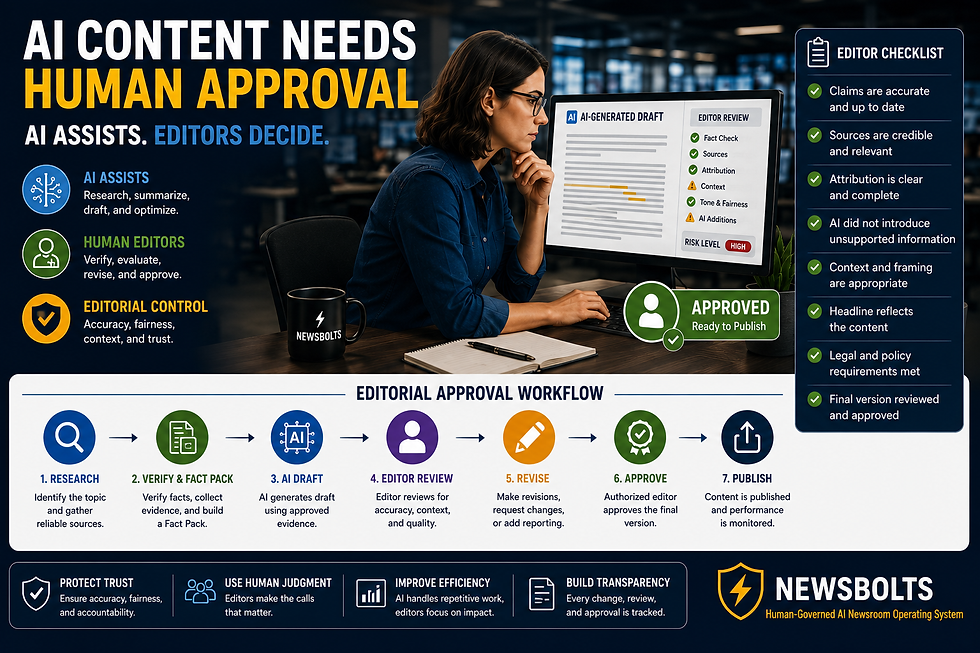
An effective editorial approval workflow for AI-generated content separates AI assistance from editorial authority. AI can help research, summarize, draft, format, optimize, and repurpose content, but publishers should establish explicit human review and approval stages for accuracy, sourcing, context, fairness, and publication. The workflow should also classify content by risk so editors spend the most time where mistakes could cause the greatest harm.
The goal is not to make every AI-assisted article pass through the same slow process.
The goal is to make the right human decision happen at the right point in the workflow.
Why Editorial Approval Matters For AI-Generated Content
AI can produce polished prose very quickly.
That creates a particular editorial risk: presentation quality can make unsupported information appear trustworthy.
A fluent paragraph does not establish that its claims are accurate.
For publishers, this means the approval workflow must evaluate more than grammar and readability.
Editors may need to determine:
Whether the underlying sources are credible
Whether important claims are supported
Whether the AI introduced unsupported information
Whether quotations are accurate
Whether context has been removed
Whether the headline accurately reflects the story
Whether the story requires additional reporting
Whether the article is appropriate for publication
Whether disclosures are required
Whether the final version differs materially from the approved evidence
The Associated Press's updated newsroom AI standards are a useful example of this principle. AP says AI can assist with tasks such as early-stage research, document summarization, transcription, translation, headlines, summaries, grammar, and search optimization, but AI-generated output is reviewed and edited by AP journalists before publication. AP also states that AI does not replace reporting, sourcing, editorial judgment, or verification.
That distinction should sit at the center of any publisher's AI content workflow.
What Is An Editorial Approval Workflow?
An editorial approval workflow is a defined sequence that determines how content moves from creation to publication and who has authority to approve each stage.
For AI-generated or AI-assisted content, it should answer five questions:
What was created?
What evidence supports it?
What did AI contribute?
What did the editor review?
Who authorized publication?
A basic workflow might look like this:
Brief → Research → Evidence Check → AI Draft → Editorial Review → Revision → Final Approval → Publishing → Monitoring
The exact stages can vary by newsroom.
A breaking-news article may require intensive source verification.
A low-risk evergreen update may need a lighter review.
The important thing is that approval is explicit, rather than being assumed because an AI system successfully generated the content.
The NewsBolts Editorial Approval Framework
NewsBolts can frame editorial approval around six control points:
1. Evidence
Does the article have adequate supporting evidence?
2. Accuracy
Are the factual claims correct and current?
3. Editorial Judgment
Is the story framed appropriately for the audience and subject?
4. AI Review
Did AI introduce unsupported claims, distortions, omissions, or misleading wording?
5. Publication Authority
Has an authorized editor approved the final version?
6. Traceability
Can the newsroom determine what was reviewed, changed, approved, and published?
This framework is deliberately broader than “proofread the AI article.”
The editor is not simply correcting language.
The editor is controlling the transition from machine-assisted production to publishable journalism.
Build The Workflow Around Risk, Not Just Content Type
One of the biggest workflow mistakes is treating every article as equally risky.
They are not.
Consider the difference between:
A product roundup
A weather explainer
A breaking political allegation
A health claim
A financial report
A court story
An article involving a private individual
The potential consequences of an error vary substantially.
A useful internal model is:
Risk Level | Example | Recommended Review |
Low | Routine formatting or metadata | Quick human check |
Moderate | Evergreen explainer | Factual and editorial review |
High | Breaking news | Full source and claim review |
Very High | Allegations or sensitive subjects | Senior editorial review |
Critical | High-consequence public-interest content | Enhanced verification and approval |
These categories are a publisher-specific framework, not a universal industry standard.
Each newsroom should define its own risk thresholds.
The principle is simple:
The higher the editorial risk, the stronger the human control.
Where Human Review Should Happen
Human review should not necessarily occur only at the end.
A better workflow places humans at strategic control points.
Before AI Drafting
An editor or journalist determines:
What the story is about
Which sources are relevant
What claims need verification
What angle is appropriate
Whether the story should be written at all
During AI-Assisted Drafting
The system should use approved evidence and defined instructions.
The AI should not be treated as the authority on facts.
After Drafting
The editor checks:
Claims
Sources
Quotations
Numbers
Dates
Context
Headline
Structure
Tone
Attribution
AI-generated additions
Before Publication
An authorized editor confirms that the final version is ready for publication.
This distinction matters because a person merely looking at AI output is not necessarily exercising meaningful editorial oversight.
The Evidence Layer Should Come Before The AI Draft
A strong workflow should not begin with:
“Write an article about X.”
Instead, the newsroom should first establish what is known.
A practical sequence is:
Story Signal → Source Collection → Verification → Fact Pack → Editorial Brief → AI Draft → Human Review
A Fact Pack can contain:
Verified facts
Sources
Important dates
Names and organizations
Relevant numbers
Quotations
Attribution
Conflicting information
Unresolved questions
Verification status
Editorial notes
This gives the AI a controlled information layer to work from.
It also gives the editor something concrete to review.
Instead of asking:
“Does this AI article sound right?”
the editor can ask:
“Can every important claim in this article be traced to the approved evidence?”
That is a much stronger editorial question.
How Editors Should Review AI-Generated Content
A useful review process can be divided into five passes.
Pass 1: Source Review
Ask:
Are the sources appropriate?
Are primary sources available?
Is attribution clear?
Are important claims supported?
Are there conflicting sources?
Do not let polished AI language distract from weak evidence.
Pass 2: Claim Review
Review the article claim by claim.
Pay particular attention to:
Numbers
Dates
Names
Statistics
Legal claims
Medical claims
Financial information
Quotes
Causal statements
Superlatives
The more consequential the claim, the stronger the verification requirement should be.
Pass 3: AI Distortion Review
Look for information that was changed during generation.
For example, an AI system might turn:
“Officials are investigating the incident.”
into wording that implies:
“Officials confirmed wrongdoing.”
Those statements are not equivalent.
Editors should therefore check whether the AI has strengthened, weakened, generalized, or reframed the evidence.
Pass 4: Editorial Review
Check whether the article:
Answers the reader's question
Provides enough context
Uses appropriate framing
Avoids unnecessary speculation
Clearly distinguishes fact from analysis
Uses appropriate attribution
Matches the publication's editorial standards
Pass 5: Publication Review
Before approval, check:
Headline
Images
Captions
Links
Metadata
Author information
Disclosure requirements
Publication date
Corrections or updates
Final formatting
The final check should use the actual version that will be published, not an earlier draft.
A Practical Approval Workflow For Newsrooms
For publishers building this into an operating system, a useful workflow is:
Article Brief → Source Collection → Fact Pack → AI Draft → AI Quality Checks → Human Editorial Review → Revision → Final Accuracy Check → Editorial Approval → CMS Publishing → Analytics
The important control point is Editorial Approval.
The CMS should not interpret “AI Draft Complete” as permission to publish.
Instead, the system should distinguish between:
Draft
Under Review
Changes Requested
Approved
Published
Updated
Corrected
This makes editorial authority visible in the workflow.
It also reduces ambiguity when multiple people collaborate on the same story.
Editorial Approval Should Be A Real System State
A common implementation mistake is having a button labeled “Approve” without defining what approval actually means.
An approval state should have a clear meaning.
For example:
Approved = An authorized editor has reviewed the final publication version and determined that it meets the newsroom's applicable editorial and verification requirements.
That definition can then become a system rule.
For example:
Approved → CMS Publishing Enabled
while:
Draft → Publishing Disabled
and:
Changes Requested → Return To Editorial Review
This is a simple but powerful design principle.
It turns editorial governance from a policy document into an operational control.
Human Review Does Not Mean Reviewing Everything The Same Way
The objective should not be maximum manual intervention.
It should be appropriate intervention.
Consider three articles.
Article A: Routine Evergreen Update
The AI summarizes an already verified internal source.
A lightweight editorial check may be appropriate.
Article B: Breaking News
The AI summarizes rapidly changing reports.
The editor may need to verify each major claim and confirm the latest information.
Article C: Sensitive Allegation
The AI produces a draft involving an accusation against an identifiable person.
The story may require substantially stronger verification, attribution, legal review, or senior editorial approval.
This is why risk classification should happen early.
It allows the newsroom to route content to the appropriate review path.
AI Assistance Versus Autonomous Publishing
These concepts should not be confused.
Approach | AI Role | Human Role |
AI Assistance | Performs defined tasks | Controls editorial decisions |
Workflow Automation | Moves work between defined stages | Defines rules and handles exceptions |
Human-Governed AI | AI assists across workflow | Humans retain authority |
Autonomous Publishing | System can publish with minimal intervention | Limited or exception-based intervention |
NewsBolts should be positioned around AI assistance and human-governed workflow automation, rather than treating autonomous publishing as the default.
That distinction is particularly important for news organizations because the cost of a mistake is not always captured by production metrics.
How To Prevent Editors From Becoming The Bottleneck
The answer is not to remove editors.
It is to make editorial review more structured.
Use Risk Routing
Low-risk content follows a lighter workflow.
High-risk content receives deeper review.
Provide Evidence Alongside The Draft
Editors should not have to search through multiple systems to discover where important claims came from.
Highlight Changes
When AI revises an approved draft, the system should make material changes visible to the reviewer where technically feasible.
Separate Mechanical Checks From Editorial Decisions
Automated checks can flag:
Missing metadata
Broken links
Duplicate text
Missing attribution
Formatting issues
Potentially unsupported claims
The editor can then focus on judgment rather than repetitive inspection.
Use Approval Gates
Do not require an editor to manually perform the same procedural task every time.
Let the system enforce the gate.
The editor should make the decision.
What An AI Editorial Approval Dashboard Should Show
A useful editor interface should prioritize the information needed for a decision.
For example:
Article
Risk Level
Source Status
Fact Pack Status
AI Draft Status
Unverified Claims
Editor Notes
Changes Since Last Review
Approval Status
Publication Status
The interface should make it easy to answer:
“What do I need to know before I approve this?”
That is more useful than simply showing an AI-generated article in a large text editor.
A NewsBolts Decision Matrix
A practical decision matrix can help determine the appropriate approval path.
Question | Low Risk | High Risk |
Are the sources primary? | Usually | Preferably |
Are claims independently verified? | Required where material | Strong verification |
Could an error cause significant harm? | Low | High |
Is the information rapidly changing? | No | Yes |
Does the story contain allegations? | No | Potentially |
Is senior approval needed? | Usually no | Based on policy |
Can routine automation continue? | Often | Only within approved boundaries |
This matrix should be customized for each newsroom.
The purpose is not to create bureaucracy.
It is to make editorial judgment consistent and explainable.
Common Mistakes In AI Editorial Approval
1. Treating Grammar As Verification
A grammatically correct article can still contain incorrect information.
2. Reviewing Only The Final Paragraphs
Important errors can appear anywhere in a generated article.
3. Trusting The Model's Confidence
AI confidence is not evidence.
4. Checking Sources After Writing
Verification should influence the article from the beginning.
5. Using One Approval Level For Everything
Risk varies.
6. Allowing AI To Decide Whether Its Own Work Is Publishable
Automated checks can assist editors, but they should not silently replace editorial authority.
7. Publishing Automatically After Generation
Content generation and publication should be separate workflow states.
8. Making Human Review A Formality
An editor needs the authority to reject, revise, request evidence, or stop publication.
Benefits Of A Structured Editorial Approval Workflow
A well-designed workflow can provide several operational advantages.
Better Accountability
The newsroom can establish who approved a story and under what workflow state.
More Consistent Review
Editors can work from defined standards instead of relying entirely on individual habits.
Better Use Of Editorial Time
Risk-based routing allows editors to focus attention where it matters most.
Easier Corrections
If a published claim later proves incorrect, the newsroom can trace the relevant workflow and evidence.
Safer AI Adoption
Publishers can introduce AI gradually instead of connecting a generative model directly to publication.
NIST's AI Risk Management Framework is designed to help organizations incorporate trustworthiness considerations into the design, development, deployment, use, and evaluation of AI systems. Its Generative AI Profile also identifies governance, content provenance, pre-deployment testing, and incident disclosure among major considerations for managing generative-AI risks.
Risks And Limitations
A structured workflow does not eliminate editorial risk.
It introduces its own challenges.
Too Many Approval Stages
Excessive gates can slow legitimate publishing.
False Confidence From Automation
A system that says “all checks passed” does not necessarily mean an article is editorially sound.
Incomplete Evidence
An approval workflow cannot compensate for missing or unreliable source material.
Reviewer Fatigue
If editors receive too many low-value alerts, they may begin ignoring them.
Poor Risk Classification
If everything is labeled high risk, the workflow becomes inefficient.
If everything is labeled low risk, the controls become meaningless.
Workflow Complexity
Publishers should avoid building a system so complicated that editors cannot understand why an article is waiting for approval.
The best workflow is not the one with the most checks.
It is the one with the right checks at the right stages.
What Publishers Should Do
Publishers starting an AI content workflow should begin with one content category rather than automating the entire newsroom.
For example:
Research → Fact Pack → AI Draft → Human Review → Approval → Publish
Then document:
What AI does
What humans do
Which sources are acceptable
What claims require verification
Who can approve
What happens after rejection
What happens when an article changes after approval
Which systems can publish
What gets logged
After the workflow works reliably, publishers can add automation around it.
This creates a crucial separation:
Automate the process around editorial judgment. Do not automate away editorial judgment.
NewsBolts As A Human-Governed Approval Layer
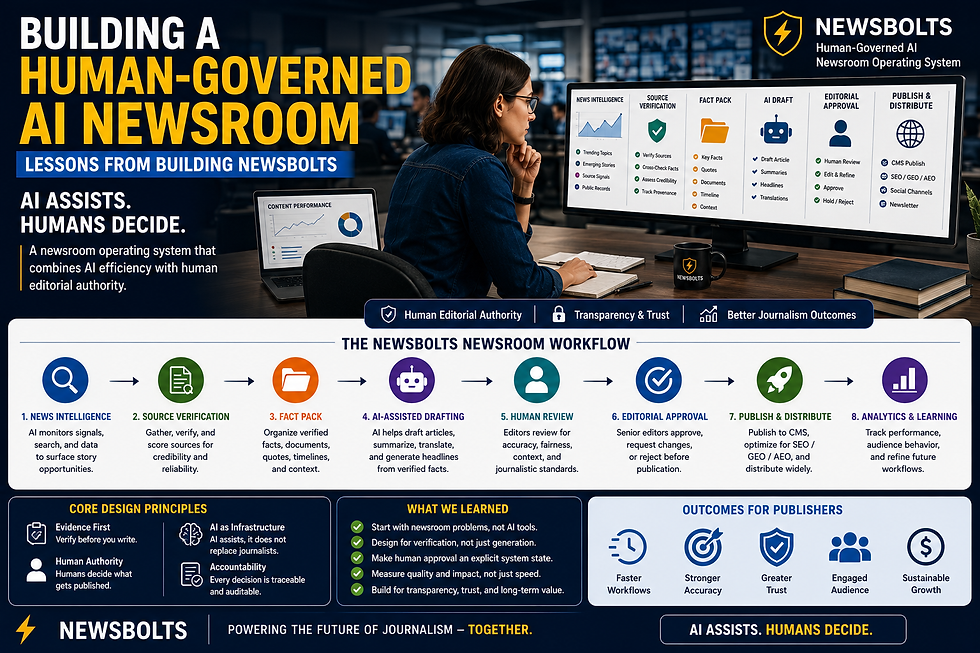
For NewsBolts, editorial approval fits naturally into the broader Human-Governed AI Newsroom Operating System.
A publisher could organize the workflow as:
News Intelligence → Source Verification → Fact Pack → AI-Assisted Draft → Human Editorial Review → Final Approval → Publishing → Analytics → Repurposing
NewsBolts should not be positioned as a system that decides what journalists should publish.
Its role is better understood as infrastructure that helps connect the evidence, production, review, optimization, and distribution stages while keeping human authority explicit.
That distinction is central to responsible newsroom automation.
How To Measure An Approval Workflow
Publishers should not judge the workflow solely by how quickly articles reach the CMS.
Useful measurements include:
Measurement Area | Questions To Ask |
Review Time | How long does meaningful editorial review take? |
Revision Rate | How often do editors request changes? |
Verification | How many material claims require correction? |
Rejection | How often is AI output rejected? |
Corrections | What errors appear after publication? |
Workflow Delay | Where do articles spend the most time waiting? |
Risk Routing | Are high-risk stories receiving deeper review? |
Quality | Are editorial standards being maintained? |
Output | Is the workflow increasing useful production without degrading quality? |
These are measurement recommendations, not claims about NewsBolts performance.
A publisher should establish its own baseline before judging whether AI-assisted approval has improved efficiency.
Editorial Approval Checklist
Before publishing AI-generated or AI-assisted content, editors should be able to answer:
Are the important claims supported?
Have important sources been checked?
Are quotations accurate?
Are dates and numbers correct?
Is attribution clear?
Has AI introduced unsupported information?
Has AI changed the meaning of any source?
Does the headline accurately represent the article?
Is important context missing?
Is speculation clearly identified?
Does the story meet the newsroom's editorial standards?
Has the appropriate risk level been assigned?
Has the final version been reviewed?
Is the approving editor authorized to publish?
Is the article's approval status recorded?
Is publication blocked until approval where required?
NewsBolts Research Opportunity
NewsBolts could eventually study whether risk-based editorial routing reduces review time without reducing editorial quality.
A defensible study would need to define:
Publisher types
Story categories
Risk categories
Baseline review time
AI-assisted workflow
Review criteria
Correction criteria
Rejection criteria
Sample size
Measurement period
Editorial quality methodology
Until such research exists, publishers should avoid claiming that a particular approval architecture automatically makes AI-generated content accurate or safe.
Conclusion
The strongest editorial approval workflow for AI-generated content is not the one with the most approval buttons.
It is the one that clearly separates AI assistance, evidence, editorial judgment, and publication authority.
A practical model is:
Research → Evidence → AI Draft → Human Review → Revision → Final Approval → Publishing
Risk determines how rigorous the review needs to be.
Evidence gives editors something concrete to verify.
Automation handles repetitive work.
Humans retain the authority to approve, reject, or stop publication.
That is the foundation of a responsible AI newsroom.
For NewsBolts, the broader principle is simple:
AI can accelerate production. Editorial approval protects the publication.
Frequently Asked Questions
What Is An Editorial Approval Workflow For AI-Generated Content?
It is a structured process that determines how AI-assisted content is researched, checked, reviewed, approved, and published. It gives human editors explicit authority over the final publication decision.
Should Humans Review All AI-Generated Content?
Not necessarily in the same way. Review intensity can be matched to editorial risk. Low-risk tasks may require lighter review, while high-risk journalism should receive deeper verification and stronger approval controls.
What Should An Editor Check In AI-Generated Content?
Editors should check sources, factual claims, quotations, numbers, dates, attribution, context, framing, unsupported additions, headlines, and any material changes introduced during AI generation.
Can AI Approve Its Own Content?
AI can perform automated quality checks, but publishers should not treat those checks as equivalent to editorial approval when human judgment is required.
How Can Publishers Prevent Unapproved AI Content From Being Published?
Separate the content-generation state from the approval state and configure the publishing workflow so that only an authorized approval status can trigger publication.
What Is Human-In-The-Loop AI?
Human-in-the-loop AI is an operating model in which people participate in important parts of an AI workflow rather than allowing the system to operate without meaningful human intervention. In editorial environments, this can include review, correction, verification, approval, and rejection.
Does Human Review Make AI-Generated Content Accurate?
No. Human review is a control mechanism, not a guarantee of accuracy. Its effectiveness depends on the quality of the evidence, the review process, the editor's authority, and the amount of time and information available for review.


Comments