How We Built NewsBolts: Designing A Human-Governed AI Newsroom

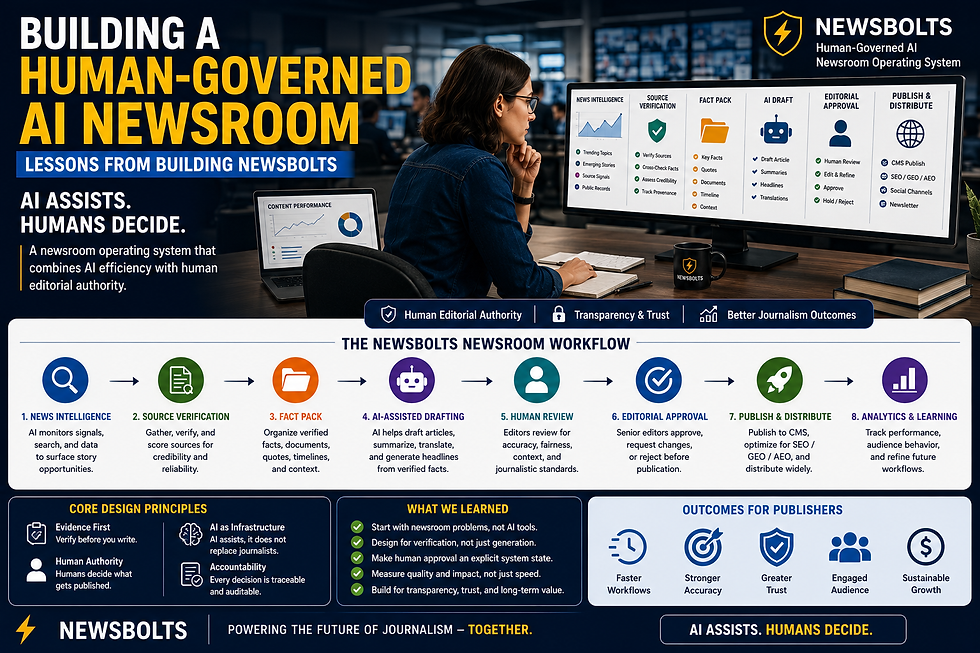
A Human-Governed AI Newsroom should be designed around one principle: AI can accelerate newsroom work, but humans must retain authority over evidence, editorial judgment, and publication. A practical system connects news intelligence, source verification, Fact Packs, AI-assisted drafting, human approval, SEO/GEO/AEO, publishing, analytics, and content reuse without treating any AI-generated output as automatically publishable journalism.
The important design question is therefore not:
“How can we automate the newsroom?”
It is:
“How can we automate useful work while preserving editorial control?”
That distinction shapes almost every important decision in a newsroom operating system.
Why Building An AI Newsroom Is Different From Adding An AI Writer
A publisher can buy an AI writing tool in minutes.
Building a newsroom system is considerably more complicated.
A writing tool mainly addresses one task: generating or transforming text.
A newsroom operating system must coordinate a chain of decisions:
News Discovery → Source Verification → Fact Pack → Editorial Decision → AI-Assisted Draft → Human Review → SEO/GEO/AEO → Publishing → Analytics → Content Repurposing → Editorial Learning
Each stage has a different risk profile.
News discovery can tolerate a large amount of automation because a signal is not yet a published fact.
Source verification requires much stronger controls.
AI drafting can be highly useful when it is grounded in approved evidence.
Final publication requires explicit editorial authority.
This separation is one of the most important design principles for a Human-Governed AI Newsroom.
The EBU's 2025 report on leading newsrooms found that media organizations were becoming more strategic about AI while continuing to consider risks involving accuracy, public trust, creativity, and human control.
That makes workflow design more important than simply selecting a powerful model.
The First Design Principle: Separate Discovery From Evidence
One of the easiest mistakes is allowing the first thing an AI system finds to become the foundation of an article.
Discovery and evidence are different.
AI can help identify:
Emerging topics
News signals
Documents
Relevant entities
Related stories
Search patterns
Potential sources
Contradictory information
But a discovery signal does not automatically become a verified fact.
A social post might identify a potential story.
A government document might establish what an agency officially announced.
An interview might provide first-hand testimony.
A research paper might provide evidence for a scientific claim.
The system should preserve those distinctions.
A useful internal rule is:
Discovery tells the newsroom what to investigate. Evidence tells the newsroom what it can responsibly publish.
This is why a Human-Governed AI Newsroom needs an evidence layer between intelligence and drafting.
The Second Design Principle: Make Verification A First-Class Workflow
Verification should not be a final checkbox after an AI-generated article already exists.
It should be part of the system.
A strong workflow can move through:
Potential Story → Source Collection → Claim Identification → Verification → Fact Pack → Drafting
This creates an important change in newsroom behavior.
Instead of asking an AI system:
“Write an article about this topic.”
The newsroom can ask:
“Using the verified evidence in this Fact Pack, create a draft that clearly distinguishes confirmed information, attributed claims, and unresolved questions.”
That is a much safer operating model.
The Associated Press's current newsroom AI standards provide a useful industry example. AP says AI can assist with activities including early-stage research, document summarization, transcription, translation, headlines, summaries, grammar, and search optimization, while AI-generated output is reviewed and edited by AP journalists before publication. AP also states that AI does not replace reporting, sourcing, editorial judgment, or verification.
For a publisher building its own system, the lesson is straightforward:
AI assistance should operate inside editorial controls rather than outside them.
The Third Design Principle: Build A Fact Pack Before The Draft
A Fact Pack is one of the most useful concepts for an AI newsroom because it creates a controlled evidence layer between research and prose.
A Fact Pack can contain:
Verified facts
Source references
Important dates
People and organizations
Relevant numbers
Direct quotations
Conflicting claims
Unverified claims
Context
Verification status
Editorial notes
The exact fields should depend on the newsroom.
The underlying principle is more important:
The draft should be downstream from evidence.
This helps solve a common problem with AI-assisted writing.
Once an AI-generated paragraph exists, it can look authoritative even when its underlying evidence is weak.
A Fact Pack reverses that relationship.
The newsroom establishes what is known first.
The AI then helps transform that approved information into useful formats.
The NewsBolts Design Framework
A useful way to think about NewsBolts is as five connected layers.
1. Intelligence Layer
Find potential stories, developments, trends, sources, and relevant information.
2. Evidence Layer
Collect and verify information before it becomes editorial content.
3. Production Layer
Use AI to assist with drafting, summaries, headlines, optimization, translations, and other appropriate transformations.
4. Governance Layer
Give journalists and editors authority over verification, framing, risk, approval, and publication.
5. Distribution And Learning Layer
Publish approved content, measure performance, repurpose it, and feed useful learning back into future editorial workflows.
This model prevents AI from becoming the center of the newsroom.
The editorial workflow remains the center.
AI becomes infrastructure within that workflow.
The Fourth Design Principle: Treat Human Approval As A System State
Human review becomes weak when it exists only as an informal instruction.
A better approach is to make approval part of the workflow itself.
For example:
AI Draft → Editorial Review → Approved → Published
The system should distinguish these states.
A draft is not an approved story.
An approved story is not necessarily published.
A published story may later receive corrections or updates.
Those distinctions matter for accountability.
They also matter technically.
If a publishing workflow automatically distributes content whenever a draft reaches a particular status, the system needs a clear definition of which status actually authorizes publication.
This is where the concept of human-in-the-loop becomes practical rather than theoretical.
The human is not simply watching AI work.
The human is an explicit decision point in the system.
The Fifth Design Principle: Automate Tasks, Not Accountability
Automation is valuable when it removes repetitive work.
Examples include:
Monitoring feeds
Sorting information
Transcribing interviews
Summarizing documents
Extracting entities
Creating metadata suggestions
Preparing social copy
Formatting content
Routing articles
Aggregating analytics
But automation should not quietly absorb responsibilities that require editorial judgment.
Examples include:
Deciding whether an allegation is sufficiently supported
Determining whether a source is credible
Choosing whether sensitive information should be published
Establishing the final editorial framing
Approving a high-risk article
Deciding whether a correction is necessary
NIST's Generative AI Profile recommends managing generative-AI risks across the AI lifecycle and organizing risk management around governance, mapping, measurement, and management.
For newsrooms, that provides a useful general principle:
Risk controls should be designed into the workflow rather than added after deployment.
Designing Risk-Based Editorial Review
Not every newsroom output requires identical human review.
A metadata suggestion and a breaking-news allegation have very different consequences.
A publisher can therefore classify work according to editorial risk.
Content Type | Example | Review Intensity |
Low Risk | Metadata suggestion | Quick editor check |
Moderate Risk | Explainer update | Factual and editorial review |
High Risk | Breaking news | Full verification |
Very High Risk | Sensitive allegation | Senior editorial review |
Critical | Public safety or other highly consequential claims | Enhanced verification and approval |
These categories are examples, not universal industry standards.
Each newsroom should define its own risk taxonomy.
The important design principle is that review effort should correspond to potential editorial harm.
That allows publishers to avoid two opposite failures:
Automating too much
Creating a review process so slow that editors become the bottleneck for everything
The Sixth Design Principle: Keep Evidence Attached To The Work
A newsroom system should avoid losing the connection between an article and the evidence used to create it.
For an important claim, the system should ideally make it possible to determine:
Claim → Source → Verification → Fact Pack → Draft → Editor → Published Version
This is particularly important when AI is involved in multiple transformations.
For example:
Official Document → AI Summary → Journalist Verification → Fact Pack → AI Draft → Human Edit → Published Article
If an error appears later, the newsroom has a much better chance of identifying where the problem entered the workflow.
This is closely related to source provenance.
Technical standards such as C2PA are designed to preserve verifiable provenance information for digital content and record information about creation and changes.
But provenance technology should complement editorial systems rather than replace them.
The Seventh Design Principle: Separate AI Assistance From Autonomous Publishing
These terms are often mixed together.
They should not be.
AI Assistance means AI helps a human complete a task.
Workflow Automation means predefined system actions happen automatically under known conditions.
Autonomous Publishing means a system can move from information to publication with little or no human intervention.
These are fundamentally different operating models.
NewsBolts should be positioned around the first two while preserving human editorial authority over the decisions that matter.
A newsroom may automate article formatting after approval.
It may automatically create a social-media draft from an approved article.
It may generate a newsletter summary for editor review.
None of these requires the system to autonomously decide what journalism should be published.
The Eighth Design Principle: Design For Multiple Outputs From One Verified Story
One of the strongest reasons to connect newsroom intelligence, evidence, AI, and publishing into one workflow is content reuse.
A verified story can potentially become:
Website article
Newsletter summary
Social post
Short-form video script
Audio summary
Push notification
Explainer
FAQ
Follow-up article
Search-optimized update
The critical principle is:
Repurpose verified journalism, not unverified AI output.
That distinction can substantially improve the consistency of the content ecosystem.
The Fact Pack can act as the common evidence layer.
The approved article becomes one editorial expression of that evidence.
Other formats can then be generated from the approved material and reviewed according to their risk.
The Ninth Design Principle: Build SEO, GEO And AEO Into Production Without Letting Them Control Journalism
Search optimization should support editorial quality.
It should not determine whether an unsupported claim gets published.
A modern newsroom can add an optimization stage after substantive editorial review:
Approved Story → SEO Review → GEO/AEO Review → Publishing
That stage can evaluate:
Search intent
Primary topic
Related questions
Entity clarity
Headings
Metadata
Internal links
Answer-first sections
Structured content
Content freshness
This is especially useful for publishers operating across traditional search and AI-generated answer environments.
But optimization should remain downstream from accuracy.
The correct order is:
Evidence → Journalism → Optimization
not:
Keyword → AI Draft → Publication
The Tenth Design Principle: Make The CMS A Destination, Not The Brain
A CMS is essential for publishing.
But it should not become the entire editorial operating system.
A publisher may need separate systems for:
News intelligence
Source research
Verification
Editorial planning
AI assistance
Content management
SEO
Analytics
Distribution
APIs can connect those systems.
The important architectural question is not simply whether systems can communicate.
It is:
Which system is authoritative for each decision?
For example:
The intelligence system may identify a potential story.
The evidence workflow may determine verification status.
The editorial workflow may determine approval status.
The CMS may be authoritative for the published article.
Analytics may be authoritative for performance data.
This separation reduces the risk of one system silently becoming responsible for decisions it was never designed to make.
A Practical NewsBolts Workflow
A publisher implementing the model can use this sequence:
News Intelligence → Story Eligibility → Source Collection → Verification → Fact Pack → Editorial Angle → AI-Assisted Draft → Human Editorial Review → SEO/GEO/AEO → Approval → Publishing → Analytics → Content Repurposing → Editorial Learning
The workflow should not be interpreted as a rigid process for every story.
Breaking news may move differently from an investigative article.
A routine update may require less review than a sensitive investigation.
The value is in making the stages explicit so the newsroom can define where different controls apply.
What We Would Avoid When Designing The System
A few architectural choices are especially risky.
Building Around The AI Model
Models change.
Prompts change.
Providers change.
The editorial workflow should not depend on one model behaving exactly the same way forever.
Treating AI Output As A Source
AI-generated text is an output.
It is not automatically evidence.
Creating A Single “Publish” Button
Publication should be the result of an approved editorial state, not simply successful content generation.
Hiding Verification Inside AI
If the system verifies something, editors should understand what was checked and against which evidence.
Making Every Decision Automatic
Some decisions are valuable precisely because a human is responsible for them.
Measuring Only Production Speed
If a workflow publishes faster but creates more corrections, the optimization is incomplete.
What Publishers Should Measure
A Human-Governed AI Newsroom should measure more than content volume.
Useful categories include:
Area | Example Measures |
Discovery | Relevant signals identified |
Research | Research time and source coverage |
Verification | Claims verified and exceptions found |
Drafting | Drafting and revision time |
Editorial | Review time and correction rate |
Publishing | Approval-to-publication time |
Search | Impressions and organic visits |
AI Visibility | Available AI citation/referral signals |
Audience | Engagement and return visits |
Operations | Workflow exceptions and automation failures |
These are measurement categories, not claimed NewsBolts results.
A publisher should establish its own baseline before concluding that a new AI workflow improved performance.
The Human Role Should Be Designed, Not Assumed
A common mistake is saying:
“There will be a human in the loop.”
That statement is incomplete.
The real questions are:
Which human?
At what stage?
With what information?
With what authority?
What happens if the human rejects the output?
Can the system record that decision?
Can the workflow prevent rejected content from being published?
Who handles corrections?
Human governance becomes meaningful when the system gives editors visibility, authority, and a clear intervention point.
This is consistent with the direction described by the EBU and AP: news organizations are exploring AI for efficiency while maintaining human responsibility for editorial quality, verification, and trust.
A NewsBolts Implementation Framework
For publishers starting from scratch, a staged approach is more practical than trying to build everything simultaneously.
Stage 1: Map
Document the current workflow:
Discovery → Research → Verification → Draft → Review → Publish → Measure
Stage 2: Identify
Mark repetitive tasks where AI can provide useful assistance.
Stage 3: Govern
Define what AI can do and what requires human approval.
Stage 4: Ground
Create the evidence layer through source records, verification workflows, and Fact Packs.
Stage 5: Integrate
Connect newsroom intelligence, AI assistance, CMS, analytics, SEO/GEO/AEO, and distribution.
Stage 6: Measure
Track efficiency, quality, corrections, workflow exceptions, and audience outcomes.
Stage 7: Improve
Use real newsroom observations to refine workflows.
This approach also makes it easier to identify where a problem actually exists.
If editors spend too much time finding sources, improve research.
If drafting is slow, improve AI assistance.
If verification is weak, strengthen the evidence layer.
If publishing is slow after approval, improve CMS integration.
Do not use one AI feature to solve every operational problem.
Common Mistakes When Building An AI Newsroom
Mistake 1: Starting With Technology
Begin with newsroom problems, not model capabilities.
Mistake 2: Automating Before Defining Editorial Rules
The system needs boundaries before it needs scale.
Mistake 3: Treating Every Story The Same
Risk varies by subject, source, claim, and potential consequence.
Mistake 4: Losing Evidence During Drafting
The connection between claims and sources should survive the transition from research to publication.
Mistake 5: Confusing AI Efficiency With Editorial Quality
A faster workflow is useful only when the resulting journalism remains fit for publication.
Mistake 6: Making Editors Review Everything Manually
Risk-based review can reduce unnecessary editorial bottlenecks.
Mistake 7: Treating Human Review As A Formality
An editor should have the authority to reject, revise, request evidence, or stop publication.
AI Newsroom Checklist
Before deploying an AI-assisted editorial workflow, publishers should be able to answer:
Where do story signals enter the newsroom?
How are sources collected?
How are important claims verified?
Is there an evidence or Fact Pack layer?
What can AI assist with?
What can AI not decide?
Which stories require enhanced review?
Is human approval an explicit workflow state?
Can unapproved content reach the CMS?
Can unapproved content reach distribution channels?
Are important editorial decisions traceable?
Are AI transformations distinguishable from source evidence?
Can the newsroom identify who approved publication?
Are corrections incorporated into the workflow?
Are SEO/GEO/AEO checks performed without overriding editorial standards?
Are performance and quality measured together?
What Publishers Should Do
Publishers considering an AI newsroom should resist the temptation to begin with a large automation project.
Start with one editorial workflow.
For example:
News Discovery → Verification → Fact Pack → AI Draft → Human Approval → Publishing
Measure where editors spend time.
Identify where errors occur.
Then automate the repetitive parts.
This approach creates a much stronger foundation than starting with the question, “How can we generate more articles?”
The more useful question is:
“How can we help a newsroom produce trustworthy journalism with less unnecessary manual work?”
That is the design problem a Human-Governed AI Newsroom Operating System is intended to address.
For NewsBolts, the core concept is therefore not “AI writes the news.”
It is:
AI assists the newsroom. Evidence grounds the workflow. Humans govern the outcome.
Risks And Limitations
A Human-Governed AI Newsroom does not eliminate the risks associated with AI.
It manages them.
Potential risks include:
Incorrect AI-generated information
Outdated source material
Weak or misleading summaries
Automation failures
Overreliance on AI output
Privacy and security issues
Vendor dependency
Poorly defined approval states
Editorial homogenization
Excessive workflow complexity
NIST's Generative AI Profile identifies risks associated with generative AI and provides actions organizations can use to govern, map, measure, and manage those risks across the AI lifecycle.
The lesson for publishers is not to eliminate every possible risk.
That would be unrealistic.
The objective is to understand where risk enters the workflow and place appropriate controls around it.
NewsBolts Research Opportunity
A valuable first-party NewsBolts research project would measure how different newsroom teams allocate time across:
Discovery → Research → Verification → Drafting → Editing → Publishing → Repurposing
The research could compare workflows before and after specific AI-assisted interventions.
A defensible methodology would need to define:
Sample size
Publisher type
Story types
Baseline workflow
AI intervention
Review criteria
Time measurements
Error categories
Correction rates
Quality criteria
Limitations
Until such research is conducted, NewsBolts should not claim specific productivity improvements, accuracy gains, customer results, or ROI.
That restraint is itself part of responsible AI product positioning.
Conclusion
Building an AI newsroom is not primarily a model-selection problem.
It is a workflow and governance problem.
The most useful architecture separates:
Discovery → Evidence → Production → Governance → Distribution → Learning
AI can accelerate activities within those layers.
It should not silently become the authority across all of them.
The design principles are straightforward:
Discover broadly.
Verify carefully.
Ground AI in evidence.
Make human approval explicit.
Automate repetitive work.
Measure quality as well as speed.
Learn from the published workflow.
That is the foundation of a Human-Governed AI Newsroom.
For NewsBolts, the strongest positioning is not that AI replaces journalists.
It is that publishers can use AI as infrastructure while preserving the editorial controls that make journalism accountable.
The long-term value of an AI newsroom will not be determined simply by how much content it can generate.
It will depend on whether the system helps a newsroom become more informed, more traceable, more efficient, and still firmly governed by people.
Frequently Asked Questions
What Is A Human-Governed AI Newsroom?
A Human-Governed AI Newsroom is a newsroom operating model in which AI assists with selected editorial and operational tasks while human journalists and editors retain authority over evidence, editorial judgment, verification, and publication.
What Should AI Do In A Newsroom?
AI can assist with tasks such as information discovery, document summarization, transcription, translation, drafting, metadata, search optimization, analytics, and content repurposing, depending on the publisher's policies and risk controls. AP's current standards provide examples of several permitted assistance tasks.
What Should Humans Control?
Humans should control source credibility decisions, fact verification, story framing, sensitive editorial judgments, final approval, corrections, and other decisions where accuracy and accountability are critical.
Why Does A Fact Pack Matter?
A Fact Pack creates an evidence layer between source research and AI-assisted drafting. It can organize verified facts, sources, dates, quotations, conflicts, context, and uncertainties so that drafting starts from documented information rather than an unstructured prompt.
Does Human Review Make AI Journalism Safe?
Human review is an important safeguard, but it does not automatically make an AI workflow safe. Review must be meaningful, supported by evidence, and matched to the risk of the content being published.
Should Publishers Automate News Publishing?
Publishers can automate appropriate operational steps, particularly after editorial approval. Whether fully autonomous publication is appropriate depends on the content type, risk level, editorial policy, and controls in place.
What Makes NewsBolts Different From An AI Writing Tool?
An AI writing tool primarily assists with content generation or transformation. NewsBolts is positioned as a Human-Governed AI Newsroom Operating System that connects news intelligence, source verification, Fact Packs, AI-assisted drafting, editorial approval, optimization, publishing, analytics, content repurposing, and monetization workflows.


Comments