What Is Generative Engine Optimization (GEO)? A Guide For Digital Publishers

Generative Engine Optimization (GEO) is the practice of improving content so generative search and AI systems can more easily understand, retrieve, summarize, and potentially cite it in answers. For digital publishers, GEO is best treated as an extension of strong SEO and editorial practices: create original, useful information, make important claims clear and verifiable, structure content logically, maintain technical accessibility, and measure AI visibility where reliable data is available.

Introduction
Generative search changes the publishing question.
For years, publishers largely asked:
How do we get this article to rank?
Now there is another question:
How do we make this article useful enough, understandable enough, and accessible enough to become a source in an AI-generated answer?
That does not mean traditional search has disappeared.
Google's current guidance says its existing SEO fundamentals remain relevant to generative AI search experiences. Google also says publishers do not need special requirements or special schema specifically to appear in AI Overviews or AI Mode.
At the same time, platforms are beginning to expose AI-specific visibility signals. Bing Webmaster Tools' AI Performance report, for example, shows cited pages, citation activity, and grounding queries across supported Microsoft AI experiences.
For publishers, GEO therefore should not be treated as a replacement for SEO.
It is better understood as a publishing discipline for an environment where content can be discovered, synthesized, and cited by AI systems as well as traditional search engines.
What Is Generative Engine Optimization GEO?
Generative Engine Optimization is the process of improving digital content so generative AI and search systems can understand its subject, extract useful information, connect it with relevant questions, and potentially reference it when generating answers.
The important word is potentially.
There is no universal GEO formula that guarantees citation.
AI systems can change their retrieval methods, models, indexes, ranking systems, interfaces, and source-selection behavior.
Google's documentation specifically cautions against thinking of AI search optimization as a collection of special tricks. Its current guidance emphasizes foundational SEO, unique value, technical accessibility, and people-first content.
GEO is therefore less about manipulating an AI system and more about making valuable information easier to discover and interpret.
Why GEO Matters For Digital Publishers
Traditional search usually presents a set of results that users can select.
Generative search can instead synthesize information from multiple sources into a response.
That creates a different visibility opportunity.
A publisher's article might contribute:
A reported fact
An original interview
A primary-source interpretation
A useful explanation
A dataset
A comparison
Historical context
Expert analysis
A current development
The publisher may not own the entire answer.
Its article may provide one important piece of the answer.
This changes how digital publishers should think about content value.
A page does not necessarily need to be the longest article on a subject.
It needs to provide information that another answer could meaningfully use.
Bing's AI Performance documentation illustrates this emerging model by showing which URLs are cited in AI-generated answers and which grouped grounding queries are associated with that citation activity.
GEO, SEO, And AEO: What Is The Difference?
These terms overlap, which can create unnecessary confusion.
Discipline | Primary Objective | Publisher Focus |
SEO | Search visibility | Rankings, indexing, relevance, technical health |
AEO | Answer visibility | Direct answers, questions, concise explanations |
GEO | Generative AI visibility | Useful source material for AI-generated responses |
Editorial Strategy | Audience and information value | Original reporting, authority, relevance |
Content Governance | Accuracy and accountability | Verification, review, updates, corrections |
In practice, publishers should not build five completely separate workflows.
A strong article can support all of them.
For example, an investigative article can have:
A search-focused title
Clear question-based sections
Strong source attribution
Original reporting
Structured information
Relevant internal links
Technical accessibility
Human editorial review
That is simultaneously useful for readers, search engines, and AI discovery systems.
How Generative Search Changes Content Discovery
A conventional search query might be:
“What is Generative Engine Optimization?”
A generative query might be more complex:
“How should a news publisher optimize its website for AI search without relying on keyword stuffing?”
The second question can involve several subtopics:
GEO
SEO
AEO
AI citations
content quality
technical accessibility
source credibility
editorial authority
AI search systems may retrieve information from multiple pages or sources to construct an answer.
Google has described AI search experiences as using retrieval techniques to help construct responses, including approaches that break complex questions into multiple searches.
This means publishers should think beyond individual keywords.
The better question is:
What information does our publication uniquely contribute to this topic?
The NewsBolts GEO Framework
NewsBolts can approach GEO through six editorial layers:
Intent → Evidence → Entity Clarity → Original Value → Accessibility → Measurement
Intent
Identify what the audience actually wants to know.
A keyword is only a signal.
The underlying information need is more important.
Evidence
Connect important factual claims with appropriate sources.
A news publisher should distinguish between:
What the publisher independently reports
What a source states
What is documented
What is analysis
What remains uncertain
Entity Clarity
Make people, organizations, products, locations, events, and concepts easy to distinguish.
Use consistent names and explain important relationships.
Original Value
Give readers something beyond a rewritten version of information already available elsewhere.
That could be:
Original reporting
Data analysis
Expert interpretation
Local knowledge
First-hand documentation
A useful framework
A comparison
A new synthesis supported by sources
Accessibility
The information must be technically accessible to the systems expected to discover it.
Measurement
Track traditional search performance alongside available AI visibility signals.
This framework deliberately puts editorial value before optimization.
What Makes Content More Useful For Generative Search?
There is no confirmed universal checklist that guarantees an AI citation.
However, several principles are consistently sensible for publishers.
Provide Information That Is Not Commodity Content
A generic article that restates widely available information gives a publisher little reason to be selected over hundreds of alternatives.
Original value is more defensible.
For example, a publisher covering AI regulation might contribute:
Original interviews
Analysis of a regulatory document
A timeline
A comparison of proposed rules
Data from public records
Local implications
Expert commentary
Google's current generative AI guidance specifically highlights the importance of providing non-commodity content and continuing to follow established SEO principles.
Answer Important Questions Clearly
If an article is supposed to answer a question, answer it.
Do not bury the answer beneath several paragraphs of generic background.
A strong section can begin with a concise answer and then explain the evidence.
Support Important Claims
Evidence increases editorial usefulness.
A publisher should identify which source supports each important factual claim rather than attaching a generic list of references to the bottom of an article.
Explain Relationships
Don't assume an AI system or a reader will infer every relationship.
Instead of:
“The agency released new rules. The company responded.”
write:
“The Federal Communications Commission released the proposed rules, and Company X responded by arguing that the changes would affect…”
The second version establishes who did what.
The GEO Newsroom Workflow
For publishers, GEO should fit into the existing editorial process rather than become a separate SEO department exercise.
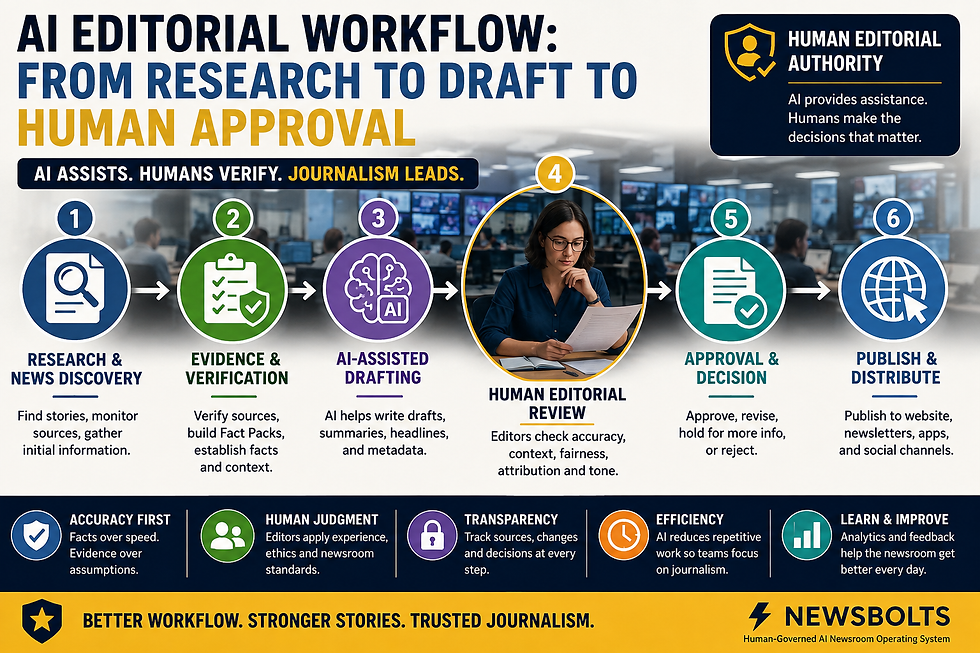
A practical workflow is:
Topic Discovery → Intent Mapping → Source Research → Verification → Fact Pack → Drafting → GEO Review → Human Editorial Approval → Publishing → Visibility Measurement
The important control point is human editorial approval.
AI can assist with research organization, drafting, question discovery, summarization, metadata, and content analysis.
But the editor remains responsible for deciding:
Whether a claim is supported
Whether a source is credible
Whether the article is sufficiently original
Whether uncertainty is represented accurately
Whether the article should be published
Whether corrections are necessary
This is the distinction between AI assistance and autonomous publishing.
A GEO strategy that removes editorial accountability would create more risk, not more authority.
Entity Clarity Is A GEO Advantage
Generative systems need to distinguish entities and relationships.
Consider a story involving:
A government department
A company
A product
A regulation
A named executive
A geographic market
Ambiguous writing can make those relationships harder to interpret.
Publishers should therefore use:
Full names on first reference
Consistent organization names
Specific dates
Clear locations
Defined acronyms
Explicit relationships
Descriptive headings
This is also good journalism.
The same clarity that helps machines understand an article helps humans understand it faster.
Original Reporting Can Strengthen Publisher Differentiation
GEO creates an important strategic opportunity for publishers: original journalism becomes a more valuable source asset.
Suppose ten websites publish the same press release.
An eleventh publisher adds:
Interviews with affected people
Local data
Documents
Historical context
Expert analysis
Original photographs
A fact-checked timeline
The eleventh article has created additional information value.
That does not guarantee AI citation.
But it gives the publisher something more meaningful to contribute.
For NewsBolts, this is an important principle:
Optimize the information value before optimizing the information format.
Why Source Verification Matters In GEO
AI-generated answers can compress several claims into a short paragraph.
That makes source quality important.
For news publishers, a useful evidence hierarchy might begin with:
Primary documents
Official statements
Public records
Direct interviews
Original reporting
Reputable research
Expert analysis
Secondary reporting
The correct source depends on the claim.
An official agency statement can establish what the agency announced.
It does not automatically establish whether every claim made in that announcement is independently true.
That distinction should remain visible in the article.
GEO And Content Freshness
Freshness is particularly important for publishers covering:
Breaking news
Politics
Finance
Technology
Regulation
Product launches
Public safety
Live events
A page can become less useful when facts change.
A GEO-conscious newsroom should therefore ask during updates:
Has the answer changed?
If yes, update more than the final paragraph.
Review:
Headline
Opening answer
Key facts
Dates
Images
Metadata
Internal links
Structured data
Social posts
Related articles
Bing's AI Performance documentation notes that citation trends can change because of content updates, user demand, model or system changes, and other factors. It specifically cautions that citation trends are observational and should not be attributed automatically to a single content change.
Does Structured Data Improve GEO?
Structured data can help search engines understand content, but publishers should not treat it as a GEO shortcut.
Google's current documentation says there are no special structured-data requirements for appearing in AI Overviews or AI Mode. It also emphasizes that structured data should accurately represent visible content.
For publishers, the practical order should be:
Accurate Content → Clear Structure → Technical Accessibility → Appropriate Structured Data
Not:
Add Schema → Expect AI Citations
Structured data is supporting infrastructure, not a substitute for journalism.
What About llms.txt?
Publishers should be cautious about claims that an llms.txt file is a universal requirement for GEO.
Google's current documentation updates state that llms.txt files are not needed for Google Search and do not positively or negatively affect Google Search visibility or rankings. Google notes that publishers may maintain such files for other services or systems that use them.
Therefore, publishers should not make llms.txt the center of a GEO strategy.
Technical controls should be based on the requirements of the specific platform being targeted.
AI Crawlers And Publisher Controls
Generative systems have their own crawling and access mechanisms.
For example, OpenAI's publisher guidance says public websites can appear in ChatGPT search and recommends that publishers who want their content discovered, surfaced, and clearly cited avoid blocking OAI-SearchBot. OpenAI also distinguishes OAI-SearchBot from GPTBot, which is used for different purposes.
This illustrates a broader principle:
GEO includes access management.
Publishers need to understand:
Which crawlers access their content
What each crawler is used for
What robots.txt rules apply
Whether content is indexable
Whether important pages are accessible
Which platform-specific controls exist
These decisions should be made deliberately rather than copied from generic GEO checklists.
GEO Content Architecture For Publishers
A strong publisher site should not rely on isolated articles.
Think of content as a connected information network:
News Story → Background Explainer → Data → Analysis → Related Coverage → Authoritative Source
For example, a publisher covering AI regulation could have:
Breaking news
Regulatory timeline
Explainer
Policy analysis
Company reactions
Expert interviews
Industry impact
Historical context
Internal links connect those pieces.
This creates a stronger topical structure for readers and search systems while helping the newsroom reuse verified information efficiently.
GEO Vs Traditional Content Marketing
GEO changes the emphasis from producing large quantities of generic content toward creating useful information assets.
Approach | Main Goal | Typical Weakness |
Keyword Content | Capture search terms | Can become repetitive |
Content Marketing | Attract and nurture audiences | May prioritize volume |
SEO Content | Gain organic visibility | Can over-focus on rankings |
AEO Content | Answer questions directly | Can become formulaic |
GEO Content | Become useful source material for AI answers | Citation outcomes remain uncertain |
Original Journalism | Create new information | Requires editorial resources |
The strongest publisher strategy combines the last five rather than choosing only one.
Common GEO Mistakes
Treating GEO As A Ranking Hack
There is no reliable trick that guarantees inclusion in AI answers.
Rewriting Existing Articles
Changing wording without adding information rarely creates meaningful differentiation.
Stuffing Entities Into Every Paragraph
Entity clarity is useful. Repetition is not.
Creating Fake Expertise
Do not manufacture authors, experts, quotes, statistics, or experience.
Ignoring Traditional SEO
Google's guidance continues to emphasize established SEO practices for its generative search experiences.
Publishing AI Drafts Without Editorial Review
AI assistance does not eliminate the need for verification.
Measuring Only Citation Counts
A citation is not the same as traffic, ranking, authority, or business value.
Bing explicitly says its AI Performance citation metrics measure citation activity rather than ranking, authority, importance, or traffic.
What Publishers Should Measure
GEO measurement should combine four layers.
Search Visibility
Track:
Impressions
Clicks
Queries
Organic traffic
Search performance
AI Citation Visibility
Where platform data is available, monitor:
Cited URLs
Citation volume
Grounding queries
Citation trends
AI referral traffic
Bing's AI Performance report currently provides page-level citation activity and grounding-query data for supported Microsoft AI experiences.
Editorial Quality
Track:
Corrections
Source verification failures
Update speed
Editorial review time
Accuracy issues
Business Outcomes
Track:
Newsletter registrations
Subscriptions
Returning users
Engagement
Conversion activity
Revenue contribution
The objective should not be:
“Get more AI citations at any cost.”
The objective should be:
Increase useful visibility without sacrificing editorial quality or audience trust.
GEO Diagnostic Checklist
Before publishing or refreshing an important article, ask:
Is the primary information need clear?
Does the article provide original value?
Is the core answer easy to find?
Are important claims supported by appropriate evidence?
Are sources clearly identified?
Are entities named consistently?
Are dates and time-sensitive claims current?
Are fact and analysis clearly separated?
Are headings descriptive?
Can important sections stand alone?
Are relevant internal links included?
Is the page crawlable and indexable?
Is important information available as text?
Does structured data accurately represent visible content?
Are crawler controls intentional?
Has a human editor approved the article?
Is there a clear reason this article deserves to exist?
What Publishers Should Do
A practical GEO strategy can begin with seven actions.
1. Identify Information Gaps
Find questions where your newsroom can contribute something genuinely useful.
2. Prioritize Original Value
Invest in reporting, data, interviews, analysis, and context that cannot be easily replicated.
3. Build Evidence Into The Workflow
Do not wait until publication to discover which claims lack support.
4. Write Clearly
Use descriptive headings, concise explanations, consistent entities, and direct answers.
5. Maintain Technical Accessibility
Keep important content crawlable, indexable, internally linked, and available in accessible formats.
6. Keep Human Editorial Authority
Use AI to assist newsroom teams, not to remove responsibility for publication.
7. Measure AI Visibility Carefully
Use available platform tools, but treat their data as visibility signals rather than guaranteed explanations of why an article was selected.
A Practical NewsBolts GEO Workflow
For a Human-Governed AI Newsroom Operating System, GEO can be incorporated into the newsroom without creating a separate production pipeline.
The workflow can be:
News Discovery → Intent Mapping → Source Verification → Fact Pack → AI-Assisted Draft → Entity And Answer Review → Human Editorial Approval → SEO/GEO/AEO Review → Publishing → Analytics → Editorial Learning
The important design principle is that optimization happens after evidence and editorial judgment, not instead of them.
A newsroom can use AI to identify related questions, organize sources, suggest article structures, detect missing context, generate draft metadata, and repurpose approved content.
The editor still decides whether the final article is accurate, useful, fair, and ready to publish.
That is the difference between a Human-Governed AI Newsroom Operating System and an autonomous content factory.
Risks And Limitations
GEO has several important limitations.
First, AI citation behavior is not fully controllable by publishers.
Second, different AI systems may retrieve and interpret the same article differently.
Third, AI visibility can change as models, indexes, queries, competitors, and content change.
Fourth, citation does not necessarily equal traffic.
Bing's documentation explicitly separates citation activity from clicks, traffic, rankings, authority, and importance.
Fifth, optimizing for AI systems can become counterproductive if publishers prioritize machine-readable structure over reader value.
The correct response is not to ignore GEO.
It is to keep GEO subordinate to editorial quality.
NewsBolts Research Opportunity
NewsBolts could develop first-party research examining whether specific editorial improvements correlate with changes in AI citation visibility.
A useful study could compare articles before and after controlled improvements to:
Original information
Source attribution
Entity clarity
Answer placement
Internal linking
Article freshness
Editorial review
Structured content
Methodology
Create a defined sample of articles across several topics.
Record baseline search and AI visibility where measurable.
Apply predetermined editorial changes.
Track results over a fixed period.
Compare changes against a control group where feasible.
Data Requirements
The research would ideally collect:
URLs
Publication dates
Article categories
Search performance
AI citation observations
Grounding queries where available
Update history
Editorial changes
Referral traffic
Limitations
AI systems are external environments.
Model updates, user demand, competing pages, retrieval changes, and freshness can all influence visibility.
Therefore, any NewsBolts study should avoid claiming that one editorial change caused a citation increase unless the methodology genuinely supports that conclusion.
Until such research is completed, no proprietary GEO performance statistics should be presented as established NewsBolts findings.
Conclusion
Generative Engine Optimization is not a replacement for SEO or journalism.
For digital publishers, GEO is better understood as a way to prepare valuable information for an environment in which search systems can retrieve, synthesize, and cite content inside generated answers.
The strongest strategy is therefore not to create content that merely looks optimized for AI.
It is to create content that is:
Original → Evidence-Based → Clear → Specific → Authoritative → Accessible → Current
That approach serves multiple discovery channels at once.
NewsBolts can operationalize this through a Human-Governed AI Newsroom Operating System in which AI assists with research, organization, drafting, optimization, and repurposing while human editors retain authority over verification and publication.
The central GEO question for publishers should be simple:
If an AI system needed reliable information about this subject, what would our article contribute that it could not easily get from a generic rewrite?
If the answer is original reporting, evidence, useful analysis, clear explanation, or genuinely valuable context, the publisher has something worth discovering.
Optimization should make that value easier to understand—not manufacture the value in the first place.
FAQs
What Is Generative Engine Optimization?
Generative Engine Optimization (GEO) is the practice of improving content so generative AI and search systems can understand, retrieve, summarize, and potentially reference it when generating answers.
Is GEO The Same As SEO?
No, but the two overlap significantly. Google says its existing SEO best practices remain relevant to its generative AI search experiences.
Does GEO Replace SEO?
No. Publishers should continue investing in crawlability, indexing, useful content, internal linking, technical quality, search intent, and other established SEO fundamentals.
How Do AI Systems Choose Which Websites To Cite?
There is no single universal source-selection formula across all AI systems. Retrieval and citation behavior varies by platform. Publishers should focus on relevance, useful information, evidence, clarity, originality, and technical accessibility rather than trying to reverse-engineer one universal algorithm.
Does llms.txt Improve GEO?
There is no basis for treating llms.txt as a universal GEO requirement. Google's current guidance says it is not needed for Google Search and does not affect Google Search visibility or rankings.
Does Schema Markup Help GEO?
Structured data can help search engines interpret content, but Google says there is no special schema required for AI Overviews or AI Mode. Structured data should accurately describe the visible content.
How Can Publishers Measure GEO?
Publishers can combine traditional search metrics with AI-specific visibility data where platforms provide it. Bing Webmaster Tools currently provides AI citation and grounding-query information for supported Microsoft AI experiences.
Does GEO Guarantee AI Citations?
No. AI visibility cannot be guaranteed. Citation activity can change because of user demand, content freshness, model changes, retrieval behavior, competing sources, and other factors.


Comments