What Makes Online Content Citation-Worthy For Generative AI Systems?

Online content is more likely to be useful as a citation source when it clearly answers a relevant question, provides original and trustworthy information, supports important claims with evidence, identifies its sources and authorship, and presents information in a structure that both people and search systems can understand. There is no guaranteed formula for earning AI citations, but publishers can systematically improve source quality, clarity, relevance, and discoverability.

Generative AI has changed the meaning of online visibility.
For years, publishers primarily asked:
Can people find our page in search results?
Now there is another question:
Can an AI system find, understand, trust, and reference our page when constructing an answer?
Those are related questions, but they are not identical.
Google says the same foundational SEO practices remain relevant to AI features such as AI Overviews and AI Mode. Google also emphasizes helpful, reliable, people-first content rather than special markup or a separate technical optimization system for appearing in those experiences.
Microsoft is also making AI citation visibility measurable. Bing Webmaster Tools' AI Performance report shows publishers which pages are cited in supported AI-generated answers and which grouped grounding queries are associated with those citations. Microsoft explicitly notes that citation activity is not the same thing as rankings, traffic, authority, or a quality score.
That distinction matters.
A publisher cannot guarantee that an AI system will cite a particular article.
But a publisher can create content that is much easier to understand, verify, retrieve, and reference.
What Does Citation-Worthy Content Mean?
Citation-worthy content is online material that provides sufficiently relevant, reliable, specific, and useful information for another system or publisher to reference when answering a question.
For generative AI, citation-worthiness is not simply about being long.
It is not achieved by adding more keywords.
It is not guaranteed by adding FAQ sections.
And it is not created by inserting structured data into an otherwise weak article.
Citation-worthy content gives an answer system something valuable to use.
That might be:
Original reporting
A verified fact
Primary-source analysis
Original research
A clear explanation
A useful comparison
A documented methodology
A specialized dataset
An expert interpretation
A well-supported definition
A current update to an evolving topic
Google's current guidance for generative AI features specifically emphasizes valuable, unique, non-commodity content and says publishers should provide a unique point of view rather than simply recycling information that already exists elsewhere.
Why AI Systems Need Citation-Worthy Sources
A generative answer is different from a traditional list of search results.
A user might ask:
“How are publishers using AI to verify news sources?”
An AI system may need to combine information from several pages.
One source may provide a definition.
Another may document a technology.
Another may provide research.
Another may provide current industry information.
The system then produces a synthesized answer and may show citations or links to supporting sources.
OpenAI's documentation says ChatGPT search can include citations and source links, while publishers can make public websites eligible for discovery by allowing OAI-SearchBot to crawl their content.
Bing similarly describes AI-generated answers as using cited pages and grounding queries to connect answers with source content.
The implication for publishers is important:
Your article is competing not only for a ranking position, but potentially for a role in an answer.
That makes information quality and extractable usefulness increasingly important.
The NewsBolts Citation-Worthiness Framework
NewsBolts can evaluate an article using six dimensions:
Evidence → Originality → Specificity → Clarity → Authority → Accessibility
A strong article does not necessarily need to maximize every dimension equally.
But serious weaknesses in one or more areas can reduce its usefulness as a reference source.
Evidence
Can important claims be checked?
Originality
Does the article contribute something beyond commonly available information?
Specificity
Does it provide concrete information rather than vague statements?
Clarity
Can a reader or retrieval system quickly understand what each section establishes?
Authority
Is there a credible reason to trust the information and the people or organization producing it?
Accessibility
Can search and AI systems discover and access the relevant content?
This framework is not a ranking formula.
It is an editorial diagnostic.
Evidence Is The Foundation
If a page makes an important factual claim, the reader should be able to understand where that claim comes from.
For publishers, evidence can include:
Primary documents
Official records
Government data
Academic research
Company filings
Direct interviews
Original reporting
Public datasets
Expert sources
First-party observations
The appropriate evidence depends on the topic.
A technology article might rely on official technical documentation.
A financial article might need filings, regulatory documents, or original datasets.
A news story may require direct reporting and primary-source verification.
A research article should explain its methodology and data.
The key principle is:
The stronger the claim, the stronger the evidence should be.
Google's people-first content guidance specifically encourages clear sourcing and evidence of expertise, including information about who created the content and why readers should trust it.
Originality Makes Content More Valuable
Generative systems have access to enormous amounts of repetitive information.
That creates a problem for publishers.
If ten thousand pages repeat the same definition, producing the eleven-thousandth version may add little value.
Originality gives an article something that is harder to replace.
For a publisher, original value could come from:
Original reporting
First-party data
A proprietary methodology
Expert interviews
A unique comparison
A documented workflow
A new dataset
An experiment
A detailed case analysis
A publisher-specific framework
If first-party evidence does not exist, publishers should not invent it.
Instead, they can clearly label future work as a NewsBolts Research Opportunity.
Google's current generative AI guidance specifically recommends unique viewpoints and non-commodity content rather than simply reproducing material that could be generated from common knowledge.
Specific Information Is Easier To Reference
Compare two statements.
AI can help publishers improve their workflows.
That is broad.
Now consider:
A publisher can use AI to summarize source documents before an editor reviews the evidence and prepares a Fact Pack.
The second statement is more specific.
It describes:
The actor
The technology
The task
The input
The editorial stage
Specificity makes content more useful.
A citation-worthy article should therefore replace vague claims with concrete explanations whenever the evidence allows.
Instead of:
“There are many risks.”
Explain:
“AI-assisted news production can create risks when generated claims are not checked against primary sources before publication.”
The second statement tells the reader what the risk actually is.
Clear Structure Helps Both Readers And AI Systems
Structure is not a trick for manipulating AI.
It is simply good publishing.
A well-structured article makes it easier to understand:
What the page is about
What each section answers
Which claims belong together
Which terms refer to the same entity
Where supporting evidence appears
What conclusions the author is making
Google's guidance for generative AI features recommends organizing content so that it is easy for readers to navigate, while Bing's AI guidance similarly recommends descriptive headings, concise sections, tables, FAQ-style content, and clear structure.
For publishers, a practical structure is:
Question → Direct Answer → Explanation → Evidence → Example → Implication
That format is useful for humans and makes important passages easier to identify.
Write Definitions That Stand On Their Own
A citation-worthy page should not make the reader reconstruct basic concepts from five paragraphs.
When introducing an important entity, define it directly.
For example:
A Fact Pack is an editorial evidence layer that organizes the sources, claims, supporting material, and verification status used to prepare a story.
That sentence can stand alone.
It can be understood without reading the rest of the article.
This is particularly useful for generative search because individual passages may be retrieved in response to specific questions.
The broader principle is:
Make important statements understandable outside the paragraph they appear in.
Build Citation-Friendly Evidence Blocks
A publisher can deliberately create sections that answer specific questions.
For example:
What Is A Fact Pack?
A Fact Pack organizes the evidence behind a story, including relevant sources, claims, supporting information, and verification status. It gives journalists and editors a structured reference point before drafting or publishing.
Why Does A Fact Pack Matter?
It separates evidence from generated prose, allowing editors to inspect the material supporting important claims before publication.
These blocks are useful even if no AI system ever cites them.
They improve the page for human readers.
That is an important principle:
Optimize for comprehension first, citation second.
Authority Is More Than A Brand Name
A publisher's domain name alone does not establish expertise on every subject.
Authority can be strengthened through:
Clear authorship
Author biographies
Relevant expertise
Editorial standards
Primary sourcing
Transparent methodology
Original reporting
Corrections policies
About pages
Contact information
Consistent topical coverage
Google's guidance specifically encourages clear information about who created content and relevant evidence of expertise.
For publishers, this means an article should not appear to have emerged from nowhere.
Readers should be able to understand:
Who wrote it?
Who reviewed it?
What is the publisher's expertise?
Where did the information come from?
How was the research performed?
Freshness Matters When Facts Change
Some information has a long shelf life.
A basic definition of an API may remain useful for years.
Other information changes quickly.
Examples include:
Product capabilities
Company leadership
Regulations
Search features
Software versions
Market data
Breaking news
Pricing
Policies
A citation-worthy article about changing information should have a process for review and updating.
That does not mean changing the publication date without meaningful changes.
Instead, publishers should:
Identify facts that can change.
Track the sources behind them.
Review the page when important changes occur.
Update the affected sections.
Preserve accurate historical context when necessary.
Bing's current webmaster guidance explicitly connects content freshness and accurate update signals with discovery and AI grounding, while cautioning that these signals do not guarantee visibility.
Citation-Worthy Does Not Mean Long
There is no magic word count that makes content citation-worthy.
Google explicitly says publishers should not create content to a particular word count simply because they believe Google has a preferred length.
A 700-word original analysis can be more useful than a 3,000-word article that repeats common information.
The right question is:
Does this page contain enough useful information to satisfy the intended question completely?
If yes, stop.
Do not add paragraphs merely to reach an arbitrary target.
Does Structured Data Make Content More Citation-Worthy?
Structured data can help search engines understand what a page represents.
But it should not be confused with a citation guarantee.
Google says structured data helps it understand page content and can make pages eligible for certain search features, but correctly implemented structured data does not guarantee that a particular search appearance will be shown. Google also requires structured data to accurately represent visible page content.
For publishers, the practical approach is:
Good Content → Clear HTML → Appropriate Structured Data
Not:
Weak Content → Schema → Guaranteed AI Citation
Use structured data when it accurately describes the page.
Do not treat schema as a substitute for editorial quality.
Discoverability Still Matters
An excellent article cannot be useful to an AI search system if the relevant content cannot be discovered or accessed.
Google says pages need to be indexed and eligible to appear with a snippet to be eligible as supporting links in AI Overviews or AI Mode, and it emphasizes foundational SEO practices such as crawlability and internal linking.
Bing likewise recommends clear discovery through mechanisms such as XML sitemaps, crawlable internal links, and appropriate URL submission.
OpenAI says public websites can appear in ChatGPT search and recommends allowing OAI-SearchBot to crawl content when publishers want it to be discoverable, surfaced, and cited.
Therefore, citation-worthiness has two parts:
Content Quality + Technical Accessibility
You need both.
The Citation-Worthiness Comparison
Content Type | Evidence | Originality | Specificity | Citation Potential |
Generic AI-generated article | Weak | Low | Often broad | Low |
Rewritten competitor article | Variable | Low | Moderate | Limited |
Expert explanatory guide | Strong | Moderate–High | High | Higher |
Original research report | Strong | High | High | High |
Original reporting | Strong | High | High | High |
Primary-source analysis | Strong | High | High | High |
Thin promotional page | Usually weak | Low | Product-focused | Low |
Data-backed industry analysis | Strong | High | High | High |
These categories are directional, not a prediction of actual AI citation behavior.
Citation systems vary, and individual AI responses can select different sources.
A Practical Newsroom Workflow For Citation-Worthy Content
Publishers can integrate citation-worthiness into their existing editorial workflow.
Use:
Topic Selection → Research → Source Verification → Original Value → Draft → Evidence Review → Publication → AI Visibility Monitoring
Topic Selection
Identify the actual question the audience needs answered.
Research
Collect primary and authoritative sources.
Source Verification
Check important claims.
Original Value
Determine what the publisher can contribute that is not already common knowledge.
Draft
Explain the subject clearly.
Evidence Review
Ensure important claims are supported.
Publication
Make the content technically accessible.
AI Visibility Monitoring
Monitor whether pages are being referenced and which topics are associated with citation activity.
This turns GEO from a writing trick into an editorial operating process.
The NewsBolts Citation-Worthiness Checklist
Before publishing, editors can ask:
Does the article directly answer a real reader question?
Is the main definition clear?
Are important factual claims supported?
Are primary sources used where appropriate?
Does the article add original information or analysis?
Is the author clearly identified?
Is relevant expertise visible?
Are important claims specific rather than vague?
Can key sections stand alone?
Are headings descriptive?
Are facts that change over time checked?
Does the article distinguish fact from interpretation?
Are tables accurate and understandable?
Is structured data accurate and consistent with visible content?
Can search engines crawl and index the page?
Are important pages connected through internal links?
Is the page free from unnecessary keyword repetition?
Is there a clear reason this article deserves to exist?
The final question is often the most useful.
Common Mistakes
Writing For AI Instead Of Readers
AI systems ultimately need useful information.
Writing strange sentences designed to “trigger” citations can make the content worse.
Repeating The Same Fact Many Times
Keyword repetition does not create authority.
Copying Search Results
A page that merely summarizes other pages may contribute little original value.
Google explicitly encourages original information, reporting, research, or analysis and warns against simply rewriting other sources.
Adding Fake Expertise
Do not invent experience, surveys, experiments, customers, or proprietary data.
Creating Fake Citation Signals
Do not insert fabricated references, unsupported statistics, or artificial “research findings.”
Overusing FAQs
FAQs are useful when they answer genuine follow-up questions.
Adding dozens of repetitive questions creates clutter rather than authority.
Treating Schema As A Shortcut
Structured data describes content. It does not manufacture trust.
Ignoring Technical Accessibility
Strong content that cannot be crawled, indexed, or accessed appropriately has limited discovery potential.
Confusing Citation With Traffic
A page can be cited without generating a click, and a citation is not the same thing as a ranking.
Bing explicitly distinguishes AI citation activity from rankings, traffic, authority, and importance.
How Publishers Should Create More Citation-Worthy Content
A practical publishing process can follow seven steps.
1. Start With A Specific Question
Avoid broad topics when the reader actually needs a specific answer.
2. Identify The Evidence
Find primary and authoritative sources before drafting.
3. Define The Publisher's Unique Contribution
Ask:
What can NewsBolts explain, demonstrate, compare, measure, or document that a generic article cannot?
4. Write Self-Contained Answers
Important definitions and conclusions should be understandable without requiring readers to infer the answer.
5. Show The Evidence
Link claims to sources where appropriate.
6. Add Original Editorial Value
Use frameworks, workflows, research, analysis, examples, or documented methodology.
7. Monitor AI Visibility
Use available webmaster and analytics tools to understand which pages and topics are actually being cited.
Bing's AI Performance report is particularly relevant because it provides page-level citation activity and grouped grounding queries for supported AI experiences.
How To Measure Citation-Worthiness
Publishers should avoid inventing a single “AI citation score.”
Instead, track observable signals.
Search And Discovery
Indexed pages
Search impressions
Organic clicks
Crawl health
AI Visibility
Pages cited in AI answers
Citation frequency
Grounding queries
Citation share where available
Bing's AI Performance report currently exposes these types of signals for supported Microsoft AI experiences.
Editorial Quality
Original research published
Source coverage
Corrections
Update frequency
Expert reviews
Evidence-backed claims
Audience Value
Engagement
Return visits
Newsletter signups
Conversions
Reader feedback
Do not assume that a change in citation activity proves that one content edit caused the result.
Bing explicitly cautions that changes in citation activity can reflect user demand, content updates, model changes, freshness, and other factors, and do not establish causation.
The Human Role In AI Citation Strategy
Citation optimization should not become an exercise in manipulating AI systems.
Editors still need to ask:
Is this true?
Is it sufficiently supported?
Is the context fair?
Does the article add something useful?
Would we publish this even if no AI system existed?
That final question is powerful.
If the answer is no, the article may be too dependent on the distribution channel rather than the reader's needs.
Google's people-first guidance makes a similar distinction: content should exist primarily to help people rather than primarily to attract search-engine visits.
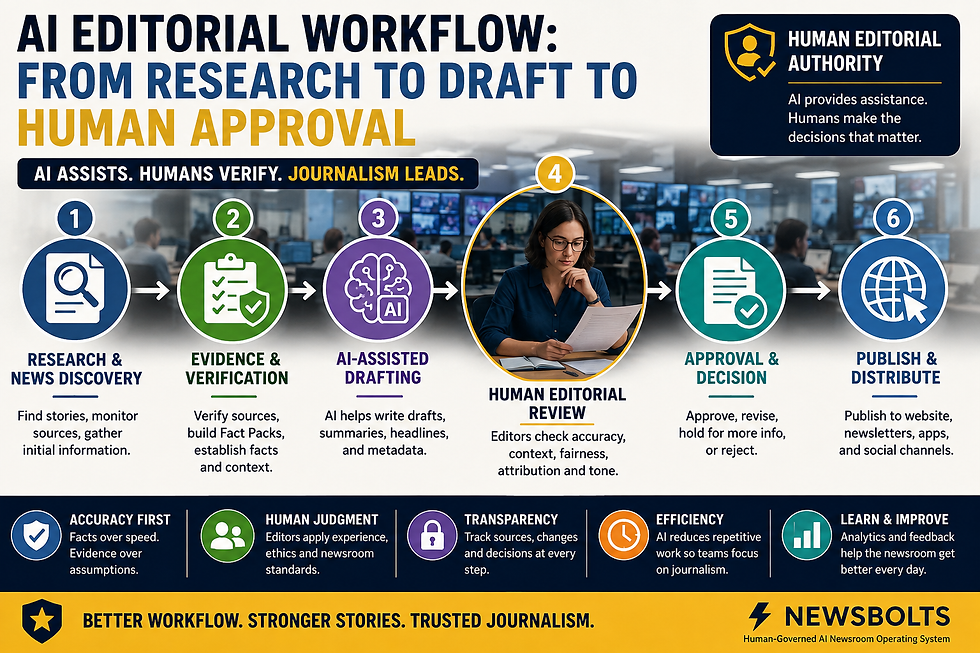
For NewsBolts, that aligns naturally with the Human-Governed AI Newsroom Operating System approach.
AI can assist with research organization, drafting, optimization, and repurposing.
Humans remain responsible for evidence, judgment, and publication.
Risks And Limitations
There is no guaranteed recipe for becoming an AI citation source.
Generative search systems can vary their answers based on:
User intent
Query wording
Available sources
Freshness
Model behavior
Retrieval systems
Search context
Geographic context
Changes across the web
Even strong content may not be cited for every relevant query.
Google explicitly states that meeting technical requirements and best practices does not guarantee crawling, indexing, or serving in AI features.
Bing similarly warns that AI citation metrics do not establish authority, ranking, traffic, or causation.
Publishers should therefore optimize for citation readiness, not promise a specific citation outcome.
What Publishers Should Do
The most practical strategy is to stop thinking of GEO as a separate layer placed on top of SEO.
Instead, build an editorial system that naturally produces useful, citable information.
Use this sequence:
Question → Evidence → Original Value → Clear Answer → Expert Context → Human Review → Technical Accessibility → Measurement
For NewsBolts, this can become part of the editorial workflow.
A story or guide enters the newsroom.
The team identifies the information readers actually need.
Sources are collected.
Claims are checked.
AI can assist with organization and drafting.
An editor reviews the result.
The final article is published with clear structure, authorship, sourcing, internal links, and appropriate technical implementation.
Then the publisher monitors how the content performs across traditional and AI-driven discovery.
That is a much more durable strategy than attempting to engineer individual sentences for an AI system.
NewsBolts Research Opportunity
NewsBolts could develop a first-party research program examining which characteristics appear most often in pages that receive AI citation activity.
A credible methodology could compare cited and non-cited pages across the same topical areas.
Potential variables could include:
Original reporting
Number and quality of sources
Author information
Content freshness
Section structure
Presence of original data
Internal linking
Search visibility
Content length
Use of tables
Presence of expert review
The research should use actual citation observations rather than assumptions.
It should also control for topic, site authority, publication age, query demand, and content type where possible.
Limitations
Citation behavior is influenced by external systems that publishers do not control.
A correlation between a content characteristic and citation activity would not automatically prove causation.
Until NewsBolts conducts such research, these factors should be treated as editorial hypotheses and practical checks, not guaranteed ranking or citation signals.
Conclusion
Citation-worthy content is not content engineered to look attractive to an AI model.
It is content that gives an answer system a strong reason to use it.
That means:
Evidence over unsupported claims.
Originality over repetition.
Specificity over vague statements.
Clear structure over dense prose.
Expertise over anonymous publishing.
Useful information over keyword manipulation.
Human editorial judgment over automated certainty.
Google's current guidance emphasizes people-first, helpful, reliable and original content, while its generative AI guidance specifically highlights unique, non-commodity value. Bing's current AI Performance tools show that publishers can now observe which pages and topics are actually appearing as citations in supported AI answers.
The practical NewsBolts model is therefore:
Evidence → Originality → Specificity → Clarity → Authority → Accessibility
These characteristics do not guarantee citation.
They do something more useful: they create content that is genuinely worth citing.
For publishers, that is the right long-term objective.
FAQs
What Makes Content Citation-Worthy For Generative AI?
Content is more useful as a potential citation source when it is relevant, accurate, original, specific, clearly structured, properly sourced, and accessible to search and AI systems. There is no guaranteed formula for earning citations.
Does Original Research Improve AI Citation Potential?
Original research can provide information that is less interchangeable with generic web content. It can therefore make a page more distinctive and useful, but no publisher can guarantee that an AI system will cite it.
Does Word Count Affect AI Citations?
There is no established word-count threshold that guarantees AI citation. Google explicitly advises against creating content to a particular word count because of assumptions about search preferences.
Does Schema Markup Make Content More Citation-Worthy?
Structured data can help search engines understand page content and may support eligibility for certain search features, but it does not guarantee an AI citation. It should accurately represent visible page content.
Are AI Citations The Same As Search Rankings?
No. AI citation activity and traditional search rankings are different measurements. Bing's AI Performance documentation explicitly distinguishes citation activity from rankings, traffic, authority, and importance.
Should Publishers Write Content Specifically For AI Systems?
Publishers should make content easy for AI systems to understand, but the primary audience should remain people. Google recommends people-first content and specifically warns against creating content primarily to manipulate search rankings.
Can AI-Generated Content Be Citation-Worthy?
AI can assist with content creation, but citation-worthiness depends on the resulting content's usefulness, accuracy, originality, evidence, and editorial quality. AI-generated text should not be treated as inherently authoritative simply because it was produced by a model.
How Can Publishers Track AI Citations?
Available tools vary by AI platform. Bing Webmaster Tools' AI Performance report can show cited pages, citation activity, and grouped grounding queries for supported Microsoft AI experiences.

Comments