What Is Answer Engine Optimization (AEO) And Why Does It Matter For News Websites?

Answer Engine Optimization (AEO) is the practice of making content easier for answer engines and AI-powered search systems to understand, retrieve, summarize, and reference when responding to user questions. For news websites, AEO matters because visibility increasingly includes appearing as a supporting source in AI-generated answers, not just ranking among traditional search results. AEO should complement strong journalism and SEO not replace them.

Editorial Intent Summary
Primary search intent: Informational with practical implementation intent.
Main reader persona: News publishers, editors, journalists, newsroom operators, media founders, SEO teams, and digital publishing professionals.
Key problem: Publishers want to understand how answer engines discover and use news content and how to improve visibility without resorting to artificial “AI optimization” tricks.
Primary topic/entity: Answer Engine Optimization (AEO).
Related entities: Generative Engine Optimization (GEO), Google AI Overviews, Google AI Mode, Microsoft Copilot, ChatGPT Search, retrieval-augmented generation, search indexing, structured data, source attribution, editorial authority.
Likely follow-up questions: Does AEO replace SEO? How does AEO work for news? Does schema help? How do publishers measure AI visibility? How should articles be structured? Can breaking news appear in AI answers?
Unique contribution: A publisher-focused NewsBolts AEO Framework that connects question targeting, evidence, answer clarity, editorial authority, technical accessibility, and AI visibility measurement.
Why AEO Is Becoming Relevant To News Publishers
Search is no longer limited to a page of links.
Users can increasingly ask complex questions and receive synthesized answers containing links to supporting websites.
Google's current documentation describes AI Overviews and AI Mode as experiences that can use retrieved web content to construct responses and provide supporting links. Google also says that its existing SEO fundamentals remain relevant to these AI experiences.
Microsoft has also introduced AI Performance in Bing Webmaster Tools, allowing publishers to see which pages are cited in supported AI-generated answers, the citation activity associated with those pages, and the grouped grounding queries connected with that visibility.
OpenAI similarly states that public websites can appear in ChatGPT search and that publishers who want their content discovered, surfaced, and clearly cited should avoid blocking OAI-SearchBot.
For a news publisher, this creates a broader visibility model:
Search Ranking + News Discovery + AI Citation + Direct Audience Relationship
AEO belongs inside that larger publishing strategy.
What Is Answer Engine Optimization?
Answer Engine Optimization is the practice of structuring and improving content so answer-oriented search systems can understand the subject, identify relevant information, and potentially use that information when generating answers.
The term is widely used in the SEO industry, but publishers should be careful about treating AEO as a separate technical ranking system.
Google's official guidance specifically says that terms such as AEO and GEO are used to describe work focused on AI search visibility, but from Google's perspective, optimizing for generative AI search is still fundamentally part of SEO. Google also says there are no special requirements or special schema needed to appear in AI Overviews or AI Mode beyond its normal Search requirements and best practices.
That gives publishers a useful way to think about AEO:
AEO is an editorial and optimization discipline, not a magic markup or guaranteed visibility system.
How AEO Differs From Traditional SEO
Traditional SEO often focuses on helping a page appear for a search query.
AEO adds another question:
Can the content provide a useful answer that an answer engine can accurately interpret and reference?
The two approaches overlap heavily.
Traditional SEO | AEO |
Target search intent | Target questions and information needs |
Improve crawlability | Improve crawlability and content accessibility |
Build topical relevance | Build clear relationships between entities and concepts |
Optimize titles and headings | Use clear question-and-answer structures where useful |
Earn visibility in search results | Improve potential visibility in generated answers |
Measure rankings, clicks, impressions | Add AI citations and AI visibility where measurable |
Focus on page discovery | Focus on discovery plus answer usefulness |
The important point is that publishers generally do not need two completely separate content strategies.
Strong SEO foundations can support AI search visibility.
Google explicitly recommends continuing foundational SEO practices for its generative AI search experiences.
Why AEO Matters More For News Websites
News websites have an unusual advantage and challenge.
They frequently publish information that is:
Current
Specific
Time-sensitive
Source-driven
Event-based
Updated as situations develop
Those characteristics can make news content useful when people ask questions about developing events.
But they also create risks.
A news article may become outdated within hours.
A developing story may contain conflicting reports.
A headline may be updated while an older paragraph remains unchanged.
An AI system may encounter multiple versions of the same event from different sources.
That means AEO for news cannot simply mean:
“Put the answer at the top.”
The publisher must also establish what is known, what is reported, what is verified, and what remains uncertain.
This is where editorial governance becomes central.
How Answer Engines Can Use News Content
Different AI systems work differently, so publishers should not assume there is one universal retrieval process.
However, Google's documentation describes approaches such as retrieval-augmented generation and query fan-out for its generative AI search experiences.
In simplified terms, a complex question may cause an AI search system to retrieve information from multiple relevant sources and then synthesize an answer.
For example, a user might ask:
“Why did the central bank change interest rates this month?”
A useful answer may require information about:
The announcement
The official decision
Previous rates
Economic conditions
Statements from officials
Market reaction
Expert interpretation
One article may not contain everything.
This means news publishers should not assume that one page must answer every possible question.
Instead, publishers should build clear topical coverage in which individual articles provide distinct, trustworthy pieces of information.
The NewsBolts AEO Framework
NewsBolts can approach AEO through six editorial controls:
Question → Evidence → Answer → Context → Authority → Accessibility
Question
What specific information is the audience trying to obtain?
Evidence
What sources support the answer?
Answer
Can the core answer be stated clearly and accurately?
Context
What qualification or background is necessary to prevent misunderstanding?
Authority
Why should the reader trust this publisher or author?
Accessibility
Can search engines and AI systems crawl, interpret, and retrieve the relevant content?
This framework is deliberately broader than keyword optimization.
It treats AEO as part of the newsroom's publishing process.
Start With The Question, Not The Keyword
AEO works best when publishers understand the question behind the search.
Consider the topic:
“Federal Reserve Interest Rate Decision”
That topic could produce many questions:
What did the Federal Reserve decide?
Why did it change rates?
When does the new rate take effect?
What did the Fed say about inflation?
What does the decision mean for consumers?
What did economists expect?
What happens next?
A single article may address several of these.
But the newsroom should know which questions the article actually answers.
This prevents a common publishing problem: creating a page around a broad keyword without clearly satisfying a specific information need.
Give The Direct Answer Early
AEO-friendly articles should not force readers through six paragraphs before revealing the main answer.
For a news article, the opening should usually establish:
What happened
Who is involved
When it happened
Where relevant
What is confirmed
Why it matters
For an explainer, the first section can provide a concise definition or answer.
For example:
What did the central bank announce?The central bank announced [verified decision], according to its official statement published on [date]. The decision changes [specific policy or rate], while officials indicated [verified context].
The important point is not the exact format.
It is the editorial discipline.
Answer first. Explain second.
Evidence Is A Core AEO Requirement For News
A concise answer without evidence is not necessarily a good answer.
News publishers should make the evidence behind important claims easy to identify.
Useful evidence can include:
Official statements
Government documents
Court records
Company filings
Research papers
Direct interviews
Original reporting
Public datasets
Regulatory documents
Verified social posts from relevant organizations or individuals
The source should match the claim.
A government announcement may establish what a government agency announced.
It does not automatically establish the truth of every interpretation about what the announcement means.
That distinction is important for AI-assisted search because synthesized answers can compress multiple claims into a few sentences.
A publisher's job is to make those claims defensible.
Build Clear Entity Relationships
Answer engines need to understand relationships between entities.
A news article should therefore make important relationships explicit.
For example:
Company A → announced → Product B
Government Agency → published → Report C
Official → said → Statement D
Court → ruled → Decision E
This is better than repeatedly using vague phrases such as:
“The organization said it would take action.”
Instead:
“The Federal Communications Commission said it would…”
Clear entity references reduce ambiguity for both readers and machines.
This becomes especially important when several people, companies, agencies, or organizations have similar names.
Use Headings That Describe The Information
Headings should help readers understand what each section contains.
Weak:
More Details
Better:
Why The Policy Changed
Better still, when appropriate:
Why Did The Policy Change?
Clear headings create a predictable information structure.
Bing's AI Performance guidance specifically recommends clarity and structure, including descriptive headings, concise sections, tables, and FAQ-style content as practices publishers can consider when improving content for AI-generated answers.
These are not guarantees of citation.
They are simply useful publishing practices.
Create Self-Contained Answer Blocks
A strong AEO article should contain passages that make sense without requiring the reader to reconstruct the meaning from surrounding paragraphs.
For example:
What Is AEO?
AEO is the practice of improving content so answer engines and AI-powered search systems can more easily understand and potentially use it when generating responses to user questions.
That definition can stand on its own.
Then the article can provide deeper context.
This is particularly useful for:
Definitions
Explanations
Comparisons
Processes
FAQs
Key facts
Methodologies
The goal is not to write artificial “AI snippets.”
The goal is to make important information clear enough to quote accurately.
News Websites Need Strong Freshness Controls
AEO becomes especially challenging when publishing time-sensitive information.
Suppose a story initially says:
Officials are considering a policy change.
Three hours later:
Officials announced the policy change.
The page must reflect the difference.
Publishers should establish update procedures for stories where facts can change rapidly.
A practical newsroom workflow is:
Monitor → Verify → Update → Timestamp → Review → Republish
The editor should also consider whether an update changes the article's headline, opening answer, metadata, or social distribution.
Google's current AI search guidance emphasizes keeping content useful and technically accessible, while Bing's AI Performance guidance notes that citation activity can change with content freshness, user demand, and system updates.
Freshness is therefore an editorial responsibility, not simply a date field in the CMS.
AEO For Breaking News Is Different From AEO For Evergreen Content
News publishers should not use one AEO workflow for every article.
Content Type | Main AEO Priority | Editorial Control |
Breaking news | Speed + verified facts | Very high |
Developing story | Updates + uncertainty | Very high |
News explainer | Context + clarity | High |
Evergreen guide | Completeness + accuracy | High |
Analysis | Evidence + interpretation | High |
Opinion | Clear authorship + argument | High |
Data story | Methodology + source data | Very high |
A breaking-news page may initially contain fewer details.
That is acceptable if it accurately represents what is known at publication time.
A publisher should not add unsupported details simply because an AI-oriented content template expects a complete answer.
Structured Data: Useful, But Not An AEO Shortcut
Structured data can help search engines interpret page information.
But publishers should avoid treating schema as an AEO ranking hack.
Google's current guidance says there is no special schema.org markup required for AI Overviews or AI Mode. It also says structured data should match the visible content on the page.
For news publishers, appropriate structured data can still be valuable when it accurately represents the page.
But the hierarchy should be:
Good Journalism → Clear Content → Technical Accessibility → Appropriate Structured Data
Not:
Schema → AI Visibility
AEO And Internal Linking
Internal linking can help establish relationships between related stories.
Consider a news publisher covering artificial intelligence.
Instead of publishing isolated articles:
AI regulation
AI copyright
AI newsroom tools
AI-generated news
AI search
the publisher can connect them through relevant internal links.
For example:
The new regulation follows earlier proposals on AI transparency requirements.
That anchor helps establish the relationship between two pieces of content.
Internal links can also help users move from breaking news to context and from context to deeper analysis.
This creates a stronger editorial information network.
AEO And Technical Accessibility
Content cannot be retrieved if important information is inaccessible to search systems.
Google says pages need to meet Search technical requirements and be indexed to be eligible for supporting links in AI Overviews or AI Mode. Google also recommends allowing crawling, making important content available in textual form, maintaining internal links, and ensuring structured data matches visible content.
For publishers, the technical checklist includes:
Crawlable pages
Indexable articles
Stable canonical URLs
Internal links
Accessible article text
Accurate metadata
Appropriate structured data
Fast, usable pages
Correct robots controls
Clear publication and update information
Google also states that meeting these requirements does not guarantee crawling, indexing, or serving.
That distinction should be reflected in any serious AEO strategy.
AEO Does Not Mean Writing For Robots
One of the biggest risks is creating awkward content designed around supposed AI preferences.
For example:
“According to the definition, what is AEO? AEO is defined as…”
Repeated phrasing does not make an article authoritative.
Likewise, publishers should be cautious about claims that they must:
Create special AI files
Add arbitrary “AI paragraphs”
Repeat questions dozens of times
Stuff entities into every sentence
Generate pages for every possible query variation
Google's current generative AI guidance explicitly says publishers do not need special AI files or markup to appear in Google's generative AI features and warns against strategies designed primarily to manipulate search or AI responses.
The best AEO writing is usually just clear, useful editorial writing.
Common AEO Mistakes For News Publishers
Treating AEO As Separate From SEO
The two disciplines overlap substantially.
Writing Extremely Long Answers
Length does not automatically create usefulness.
Repeating Questions
Answer genuine questions once and answer them properly.
Publishing Unsupported Claims
A concise false statement is still false.
Ignoring Source Attribution
AI systems and readers need context around important claims.
Failing To Update Developing Stories
Outdated information can become actively misleading.
Treating AI Citations As Rankings
A citation is not necessarily a ranking position or traffic source.
Bing explicitly says its AI Performance citation metrics do not measure rankings, authority, importance, or traffic.
Optimizing Only For AI
The article still needs to serve people.
The NewsBolts AEO Publishing Workflow
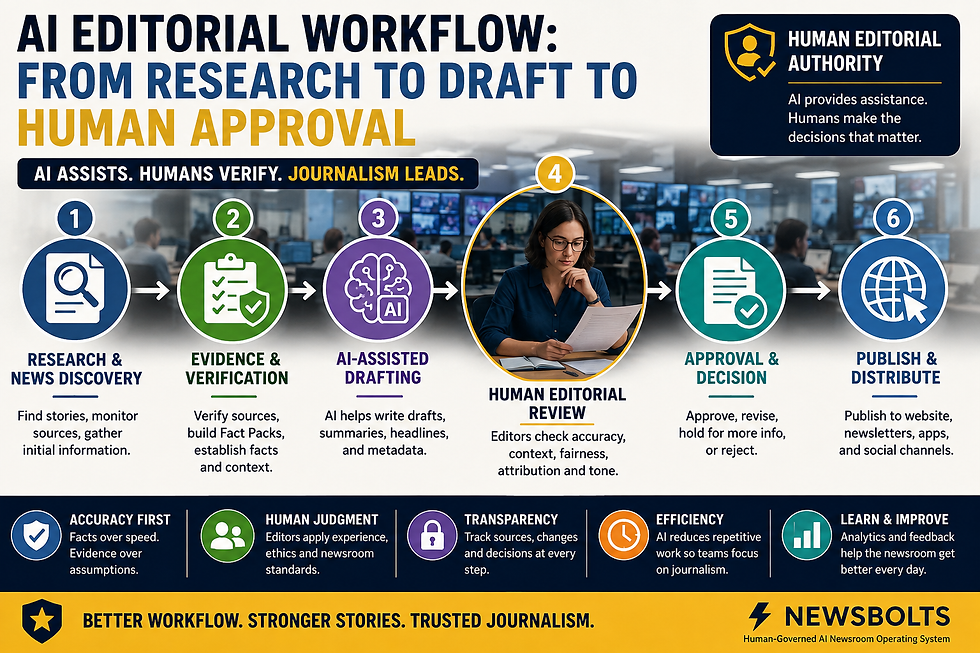
For a Human-Governed AI Newsroom Operating System, AEO can be integrated into the existing editorial process.
Use:
Question → Research → Source Verification → Fact Pack → Draft → Answer Review → SEO/GEO/AEO Review → Human Approval → Publish → AI Visibility Monitoring
Question
Identify the real information need.
Research
Collect relevant primary and authoritative sources.
Source Verification
Determine which claims can be supported.
Fact Pack
Organize the evidence before drafting.
Draft
Produce a clear article using AI assistance where appropriate.
Answer Review
Check whether the article directly answers the core questions.
SEO/GEO/AEO Review
Review headings, entities, internal links, metadata, structure, and technical accessibility.
Human Approval
An editor determines whether the final article meets newsroom standards.
Publish
The CMS distributes the approved article.
AI Visibility Monitoring
Review available signals showing whether content is being discovered or cited in AI experiences.
This workflow preserves the distinction between AI assistance and editorial authority.
What Publishers Should Measure
AEO should not be evaluated using one metric.
A more useful measurement model has four layers.
1. Traditional Search Visibility
Track:
Impressions
Clicks
Search queries
Rankings where available
Organic traffic
2. AI Visibility
Where tools provide the data, track:
Cited pages
Citation frequency
Grounding queries
AI referral traffic
AI-generated search visibility
Bing's AI Performance report currently provides page-level citation activity, cited pages, grounding queries, and citation trends across supported Microsoft AI experiences.
Google has also introduced a Generative AI performance report in Search Console for measuring performance in its generative AI search experiences.
3. Editorial Quality
Measure:
Corrections
Verification failures
Update speed
Source quality
Editorial review time
Accuracy issues
4. Business Value
Measure:
Newsletter registrations
Subscriptions
Returning visitors
Engagement
Conversions
Revenue contribution
The key question is not:
How many AI citations did we get?
It is:
Did our content become more discoverable while remaining useful, accurate, and commercially valuable?
AEO Diagnostic Checklist For News Websites
Before publishing an important article, editors can ask:
Is the main question clear?
Is the direct answer near the beginning?
Are important claims supported?
Are primary sources used where appropriate?
Are people and organizations clearly identified?
Are facts separated from analysis or opinion?
Does the article explain why the story matters?
Are important sections clearly headed?
Can key passages stand alone?
Does the article provide original reporting, analysis, or context?
Are dates and time-sensitive facts current?
Are relevant internal links included?
Is the page crawlable and indexable?
Does structured data accurately match visible content?
Has a human editor approved the final version?
Can the newsroom explain why this article deserves to exist?
That final question protects against one of the biggest AEO risks: publishing content simply because an AI-oriented keyword appears to exist.
What Publishers Should Do
Publishers should treat AEO as an extension of strong editorial and SEO practice rather than a separate collection of hacks.
A practical strategy is:
1. Identify real questions.
Use audience research, search data, newsroom knowledge, and existing AI visibility data.
2. Build evidence.
Use authoritative sources and original reporting.
3. Answer clearly.
Put the most important verified information where readers can find it quickly.
4. Add context.
Explain what the information means without overstating what the evidence proves.
5. Build entity clarity.
Use consistent names and explicit relationships.
6. Maintain technical accessibility.
Make the content crawlable, indexable, internally linked, and readable.
7. Preserve human editorial control.
AI can assist with research, drafting, optimization, and repurposing. Editors remain responsible for publication decisions.
8. Measure what actually happens.
Use Search Console, Bing Webmaster Tools, analytics, and publisher-specific AI visibility monitoring rather than relying on unverified AEO scores.
Risks And Limitations
AEO does not guarantee that a page will appear in an AI answer.
Google explicitly says that meeting technical requirements and following best practices does not guarantee crawling, indexing, or serving in AI features.
AI systems can also change.
Retrieval systems evolve.
User questions change.
Competing sources publish new information.
A page that is cited today may not be cited tomorrow.
Bing's documentation makes a similar point: changes in citation activity can reflect user demand, content changes, freshness, model updates, and other factors, so citation trends should not be treated as proof that one specific optimization caused the change.
There is another limitation for news publishers: speed and verification can conflict.
A publisher that waits for perfect information may lose the opportunity to report a developing story quickly.
A publisher that publishes too quickly may spread an incorrect claim.
The answer is not to remove editorial review.
It is to create different workflows for different levels of risk.
NewsBolts Research Opportunity
NewsBolts could develop first-party research into how AEO-oriented editorial changes affect AI visibility for news publishers.
A potential study could compare articles before and after controlled improvements to:
Direct-answer placement
Source attribution
Entity clarity
Internal linking
Original analysis
Article structure
Freshness
Editorial review
The study should track actual AI citation observations rather than assuming that a particular optimization caused an outcome.
Suggested methodology
Select a representative sample of published articles across several news categories.
Record baseline search and AI visibility data where available.
Apply defined editorial improvements.
Track changes over a predetermined period.
Compare the results against a control group where possible.
Data requirements
The study would require:
Article URLs
Publication dates
Topic categories
Search performance
AI citation observations
Update history
Editorial changes
Traffic and engagement data
Limitations
AI search systems are controlled by external platforms.
Model updates, query demand, competing content, freshness, and retrieval changes can affect results.
Therefore, any findings would need to distinguish correlation from causation.
Until such research is conducted, publishers should treat AEO frameworks as practical editorial guidance rather than guaranteed ranking or citation formulas.
FAQs
What Is Answer Engine Optimization?
Answer Engine Optimization is the practice of improving content so answer engines and AI-powered search systems can more easily understand, retrieve, summarize, and potentially reference information when responding to user questions.
Is AEO The Same As SEO?
No, but they overlap heavily. Google says AEO and GEO are terms used to describe optimization work around AI search experiences, while its own approach continues to rely on foundational SEO and Search quality systems.
Does AEO Replace Traditional SEO?
No. Google explicitly says its existing SEO best practices remain relevant to AI Overviews and AI Mode. Technical accessibility, crawlability, indexing, internal links, useful content, and other fundamentals continue to matter.
How Should News Websites Optimize For AEO?
News websites should focus on answering real questions clearly, supporting claims with reliable sources, using explicit entities and relationships, maintaining accurate and fresh reporting, structuring articles clearly, and ensuring content is technically accessible.
Does Schema Markup Improve AEO?
Structured data can help search engines understand page information, but Google says there is no special schema required for AI Overviews or AI Mode. Structured data should accurately represent visible page content.
Can Breaking News Be Optimized For AEO?
Yes, but accuracy and freshness should take priority over completeness. A developing article should clearly distinguish confirmed information from reports, uncertainty, and analysis, then be updated as reliable information becomes available.
How Can Publishers Measure AEO Performance?
Publishers can combine traditional search metrics with AI visibility data where platforms provide it. Bing Webmaster Tools now reports AI citation activity and grounding queries for supported Microsoft AI experiences, while Google provides a Generative AI performance report in Search Console.
Does AEO Guarantee AI Citations?
No. There is no guaranteed AEO formula. Google states that meeting technical requirements and following best practices does not guarantee that a page will be crawled, indexed, or served in AI features.
Conclusion
Answer Engine Optimization matters for news websites because the definition of digital visibility is expanding.
A publisher is no longer competing only for a position in a traditional search result.
Its content may also become a source that an AI system retrieves, summarizes, or cites while answering a user's question.
But the solution is not to write artificial content for machines.
The stronger approach is to build journalism that is:
Relevant → Evidence-Based → Clear → Specific → Authoritative → Accessible
For NewsBolts, that becomes an editorial workflow:
Question → Research → Verify → Fact Pack → Draft → Human Review → Publish → Measure
AI can assist at multiple stages.
It can help discover information, organize research, prepare drafts, suggest metadata, identify follow-up questions, and repurpose approved material.
But humans remain responsible for deciding what is verified, what is publishable, and what the newsroom is willing to stand behind.
That distinction is critical.
AEO should not become a new form of keyword stuffing.
It should become a disciplined way of asking whether a publisher's content provides clear answers, reliable evidence, useful context, and genuine editorial value.
That is the foundation on which news websites can build visibility across both traditional search and emerging AI-driven discovery.


Comments