How to Structure Articles for Google AI Overviews

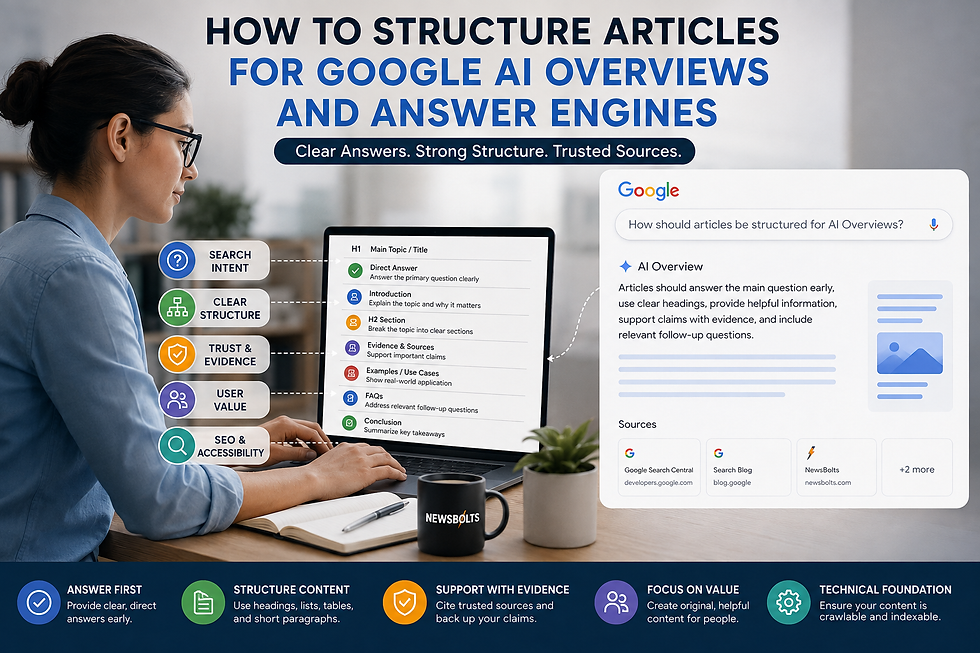
To structure articles for Google AI Overviews and answer engines, focus on clear, people-first content that answers the main question early, uses descriptive headings, explains important concepts, supports factual claims with reliable sources, and covers relevant follow-up questions. There is no special article format or schema that guarantees inclusion in Google AI Overviews. Google's current guidance says the same core SEO and quality principles remain foundational.
Introduction
Search is changing from a system where people mainly scan links into one where they can ask increasingly detailed questions and receive synthesized answers.
Google AI Overviews and AI Mode are part of that shift. Google says these experiences can use multiple searches and sources to develop responses, while providing links that allow users to explore supporting websites.
For publishers, this creates a new content challenge.
It is no longer enough to ask:
"How do I rank this article for my keyword?"
A better set of questions is:
Does the article answer the reader's main question?
Can the important information be understood quickly?
Are the claims supported by evidence?
Are important entities and concepts clearly explained?
Does the article answer natural follow-up questions?
Is the information original and useful?
Can search engines crawl, index, and understand the page?
These questions matter for traditional SEO as well as AI-driven search.
Google's current guidance is particularly clear on one point: there are no additional technical requirements or special optimizations required specifically for AI Overviews or AI Mode. Existing SEO fundamentals continue to apply.
That means publishers should not try to create a completely separate form of "AI content."
Instead, they should build better information architecture.
For NewsBolts, that means creating articles that are easy for readers to understand, easy for editors to verify, and structured clearly enough for search and answer systems to interpret.
What Does It Mean to Structure an Article for AI Overviews?
Structuring an article for Google AI Overviews means organizing information so that the main topic, answers, evidence, entities, relationships, and supporting details are easy to understand.
A strong article should make several things clear:
What is the article about?
What question does it answer?
Who is the intended reader?
What is the direct answer?
What evidence supports the answer?
What related questions should be addressed?
What are the limitations or uncertainties?
This is not about writing sentences specifically for an AI system.
It is about reducing ambiguity.
For example, instead of opening an article with:
AI search is changing the way people discover information online.
A stronger opening for a specific topic would be:
Google AI Overviews are AI-generated summaries that can appear in Google Search for some queries and provide links to supporting web pages.
The second sentence immediately defines the subject.
The rest of the article can then explain how the feature works, what it means for publishers, and what publishers should do.
Google AI Overviews Do Not Require a Separate SEO Formula
This point is important because there is a lot of confusion around "AI SEO."
Google's current documentation says existing SEO best practices remain relevant for AI features such as AI Overviews and AI Mode. There are no additional technical requirements specifically for appearing in those experiences. A page needs to be indexed and eligible to appear in Google Search with a snippet.
Google also says publishers do not need to create special AI files or special schema markup to appear in AI features.
So be careful with claims such as:
"Add this exact schema and Google will cite your article."
or:
"Use this 50-word answer and you will appear in AI Overviews."
There is no reliable basis for those guarantees.
A better strategy is:
Strong SEO foundation + useful content + clear structure + original value + evidence + technical accessibility.
That approach is more durable because it does not depend on an assumed AI-search trick.
Start With Search Intent, Not the Keyword
A keyword is only a starting point.
The real task is understanding why someone searched for it.
Suppose the primary keyword is:
AI for journalists
Different readers could have very different goals.
A journalist might ask:
What can AI do for my daily reporting?
A newsroom editor might ask:
Which AI tasks should we allow journalists to automate?
A publisher might ask:
How can we introduce AI without losing editorial control?
An SEO professional might ask:
How should AI-assisted news content be optimized for search?
These are related queries, but they are not identical.
A strong article identifies the dominant intent and then covers the most important related questions.
A practical planning model
Before writing, define:
Primary keyword → Search intent → Main question → Supporting questions → Evidence → Recommended action
This prevents the common mistake of creating an article that repeatedly uses a keyword without actually satisfying the reader's need.
Google's people-first guidance asks publishers to consider whether they have a clear audience, whether the content demonstrates expertise, whether it provides original information or analysis, and whether readers leave with enough information to achieve their goal.
Put the Main Answer Near the Beginning
For informational articles, answer the primary question early.
A useful structure is:
H1 → Direct answer → Introduction → Detailed explanation
The direct answer should be concise enough to understand quickly.
For example:
How Should Articles Be Structured for AI Overviews?
Articles should answer the main question early, use descriptive headings, organize information into clear sections, support important claims with evidence, explain relevant entities, address useful follow-up questions, and maintain strong technical SEO. These practices can improve clarity for both readers and search systems, but they do not guarantee inclusion in AI Overviews.
Then expand.
This creates two layers of information:
Layer 1: The answer
The reader immediately understands the point.
Layer 2: The evidence and explanation
The rest of the article provides depth, examples, limitations, and practical guidance.
This is useful for answer-oriented content without pretending that Google requires a specific word count or answer length.
Use Descriptive H2 and H3 Headings
Headings should explain what the reader will find in the section.
Weak:
Benefits
Better:
What Are the Benefits of Structuring Content for AI Search?
Weak:
More Information
Better:
How Do AI Overviews Change the Way Publishers Structure Content?
Weak:
Important Things
Better:
What Should Publishers Verify Before Publishing AI-Assisted Content?
Descriptive headings help readers scan the page.
They also create a clearer information hierarchy.
Google recommends clear organization and headings as part of its broader Search guidance, while its AI-search guidance emphasizes clear, useful content rather than a special AI-only optimization system.
Give Each Major Section a Clear Question or Purpose
A useful editorial rule is:
One major question → one clear answer → supporting detail
For example:
Can AI-Generated Content Appear in Google Search?
Start with the answer.
Yes. Google says AI can be useful for research and adding structure to original content, but generating many pages without adding value can violate its spam policies on scaled content abuse.
Then explain:
When AI assistance can be useful
Why human review matters
What "added value" means
What publishers should avoid
This is much better than putting several unrelated concepts into one generic section.
Use the Inverted Pyramid for Answer-Oriented Content
Journalists already understand the inverted pyramid.
Put the most important information first.
The same principle works well for many informational articles.
For an informational guide:
Answer → Explanation → Evidence → Example → Limitations
For a news article:
What happened → Key facts → Evidence → Context → What happens next
For a how-to article:
What to do → Steps → Details → Troubleshooting
This makes the article useful even for readers who only scan the first few sections.
It also reduces the chance that important information is buried beneath generic introductions.
Make Important Sections Self-Contained
A strong answer-oriented section should make sense on its own.
For example:
What Is Answer Engine Optimization?
Answer Engine Optimization, or AEO, is the practice of structuring and improving content so that it clearly addresses questions and can be understood by answer-oriented search experiences.
Then explain what that means.
Avoid forcing readers to search through several earlier sections to understand the definition.
Self-contained sections are particularly useful when an article contains many concepts, acronyms, or technical terms.
Define Important Entities When They First Appear
Entity clarity matters because readers and search systems need to understand exactly what you are discussing.
For example, if you mention Google AI Overviews, define the term when it first appears.
If you mention answer engines, explain what you mean.
If you mention GEO, AEO, structured data, or RAG, define the term before using it extensively.
A simple pattern is:
Entity → Definition → Role in the topic
For example:
Retrieval-augmented generation (RAG) is a technique in which an AI system retrieves relevant information before generating an answer. In search experiences, retrieval helps ground responses in information from available sources.
Google's current generative-AI guidance explains that its AI search experiences are grounded in information retrieved through its Search systems.
The goal is not to overload the article with definitions.
Define concepts when doing so removes ambiguity.
Build a Question Map Before Writing
Before drafting, create a question map around the primary query.
For this article, the map could look like this:
Primary question
How should I structure articles for Google AI Overviews and answer engines?
Supporting questions
What are Google AI Overviews?
Does SEO still matter for AI search?
Should articles answer questions immediately?
Do headings matter?
Should I use tables?
Should I use FAQs?
Does structured data help?
Do sources matter?
Does original research matter?
How important are internal links?
Does word count matter?
Can AI-generated content appear in Search?
How can publishers measure AI visibility?
This question map becomes the content architecture.
It also helps prevent a common problem: publishing an article that answers only the primary keyword while ignoring the questions readers naturally ask next.
Use Tables When the Reader Needs a Comparison
Tables are useful when the reader needs to understand differences between concepts.
For example:
Traditional SEO thinking | AI-search-oriented content thinking |
Focus on a target keyword | Focus on the user's question and intent |
Optimize one query | Cover the main question and useful follow-ups |
Think primarily about rankings | Consider search visibility and AI citations |
Write around keywords | Build clear concepts and entities |
Use links for navigation and authority | Build useful contextual relationships between pages |
Optimize the page | Optimize the overall information experience |
This does not mean traditional SEO is obsolete.
Google explicitly says its core SEO practices remain foundational to AI search.
The better approach is to combine both.
Use Lists for Processes and Checklists
Lists work particularly well when the reader needs to perform a task.
For example:
Before publishing an article for AI search, check:
Does the introduction answer the primary question?
Are the H2s descriptive?
Are important concepts defined?
Are important claims supported?
Does the article include original value?
Are relevant follow-up questions answered?
Are internal links useful?
Is the page technically accessible?
Does structured data match visible content?
Has the article been reviewed for accuracy?
This gives the reader something actionable rather than simply explaining that "AI optimization is important."
Use the Answer → Evidence → Context Model
For NewsBolts, I recommend a specific structure for important claims:
Answer
Give the direct answer.
Evidence
Show the source, research, documentation, or data.
Context
Explain limitations, exceptions, uncertainty, and practical implications.
For example:
Does Structured Data Guarantee AI Overview Visibility?
Answer: No. Structured data can help search engines understand page content and can support eligibility for certain Search features, but Google does not say that structured data guarantees inclusion in AI Overviews.
Evidence: Google's current AI-search guidance says there is no special schema.org structured data required for AI Overviews or AI Mode. It also says structured data should match the visible content on the page.
Context: Structured data is still useful when it accurately describes the page, but it should be treated as part of a broader technical SEO system rather than an AI-search shortcut.
This approach is particularly suitable for NewsBolts because it combines AEO clarity with editorial evidence discipline.
Support Important Claims With Reliable Sources
AI-search content should not become a collection of unsupported statements.
If you write:
Google prefers articles with 2,000 words for AI Overviews.
That requires evidence and there is no Google guidance establishing such a rule.
Instead, say:
Google does not prescribe a preferred word count. Publishers should focus on creating content that fully satisfies the user's needs.
Likewise, avoid claims such as:
Google AI Overviews always select pages with FAQs.
There is no basis for such a guarantee.
Use careful language:
"Google says..."
"Google's guidance recommends..."
"This can improve clarity..."
"This may help..."
"There is no guarantee..."
That distinction is essential when writing about a rapidly changing search environment.
Original Information Matters More Than Repackaging
One of the most important principles in AI-search publishing is original value.
Google's people-first guidance asks whether content provides original information, reporting, research, or analysis and whether it gives readers a substantial, complete, or comprehensive explanation.
That means an article should not simply rewrite Google's documentation.
For a NewsBolts article, original value could include:
An editorial framework
A decision matrix
A publisher checklist
A content architecture
Original analysis
A practical example
A measurement framework
A first-party observation
An experiment, if actually conducted
For example, NewsBolts could use this editorial framework:
Answer → Define → Support → Explain → Apply → Limit → Source
That gives publishers a repeatable method rather than another general explanation of AI search.
Show the Framework With an Example
Don't just tell readers to structure content clearly.
Show them.
Suppose the article topic is:
How to Verify AI-Generated News Research
A weak opening might be:
Artificial intelligence is changing journalism and creating new opportunities for newsrooms.
A stronger opening would be:
AI-generated news research should be treated as a research aid, not verified evidence. Journalists should check important claims against reliable original sources before publication.
Then the article can explain:
What AI can research
What needs verification
How to record evidence
What the journalist should approve
What the editor should check
The second approach gives readers the answer and the process immediately.
Build Topic Relationships, Not Just Keyword Lists
Strong content should make relationships between concepts clear.
For example:
Google AI Overviews
→ Google Search
→ AI-generated answers
→ supporting web pages
→ Search index
→ user questions
→ citations
Similarly, for NewsBolts:
Human-Governed AI Newsroom
→ News intelligence
→ source verification
→ Fact Packs
→ AI-assisted drafting
→ human editorial approval
→ SEO/GEO/AEO
These relationships create a coherent topic rather than a collection of disconnected keywords.
This is especially important for publishers building topic clusters.
Internal Linking Should Follow the Reader's Next Question
Internal links should not be inserted simply to increase the number of links.
Ask:
What would the reader logically want to understand next?
For example, after explaining AI-assisted research, a NewsBolts reader may want to know how to maintain accuracy.
That makes a link to:
How to Use AI for News Research Without Losing Accuracy
natural.
After explaining human governance, a reader may want to understand how journalists retain editorial control.
That makes a link to:
How AI Can Assist Journalists Without Taking Away Editorial Control
useful.
Internal links should create a knowledge path.
Use FAQs for Genuine Follow-Up Questions
FAQs can be useful, but they should not be treated as an SEO trick.
A strong FAQ answers a question that the main article does not fully answer.
For example:
Does Google require special schema for AI Overviews?
No. Google's current guidance says there is no special schema.org structured data required for AI Overviews or AI Mode. Existing structured-data guidance still applies, including ensuring that markup matches visible page content.
Does word count affect AI Overview visibility?
Google does not prescribe a preferred word count. Content should be as comprehensive as necessary to satisfy the reader's intent without adding unnecessary material.
Can AI-generated content rank in Google?
AI-assisted content can appear in Search when it meets Google's quality and spam policies. Google says generative AI can be useful for research and adding structure to original content, but producing many pages without adding value can violate its scaled-content-abuse policy.
The FAQ should add information, not repeat the article word for word.
Structured Data Is Useful, But It Is Not an AI Shortcut
Structured data can help search engines understand what a page represents.
Depending on the article, publishers might use:
Article
NewsArticle
BlogPosting
BreadcrumbList
But don't treat schema as a special AI citation mechanism.
Google's current documentation says:
There is no special schema.org structured data that you need to add for AI Overviews or AI Mode.
Google also says structured data should match visible content and follow its relevant guidelines.
So the correct strategy is:
Use structured data accurately when appropriate.
Not:
Add every available schema type in the hope of getting an AI citation.
Make Visible Content and Structured Data Consistent
This is a simple technical check that publishers often overlook.
If the visible article says:
Published August 2026
the structured data should not contain a conflicting publication date.
If the visible author is one person, the structured data should not identify someone else.
If the page displays an FAQ, the structured data should accurately represent the visible FAQ content.
Google explicitly recommends ensuring that structured data matches the visible content on the page.
Consistency helps both search engines and users understand the page.
Technical SEO Still Matters
Good content cannot help much if search engines cannot access or index it.
Google says pages need to be indexed and eligible to appear in Search with a snippet to be eligible as supporting links in AI Overviews or AI Mode. There are no additional technical requirements specifically for these AI features.
Check the basics:
Robots.txt
Noindex settings
Canonical URL
XML sitemap
Internal links
HTTP status
Mobile usability
JavaScript rendering
Crawlability
Indexing
Page experience
Google's current generative-AI guidance also emphasizes crawlability, technical structure, page experience, and reducing duplicate content.
In other words:
GEO does not replace technical SEO.
Keep Important Information in Text
Images, videos, charts, and interactive elements can improve an article, but critical information should not exist only inside an image.
Google's current AI-search guidance recommends making important content available in textual form while supporting it with high-quality images and videos when appropriate.
For example, if a chart contains the main statistics for an article, explain the important findings in the surrounding text too.
This helps:
Readers
Search engines
Accessibility tools
AI systems
Editors maintaining the page later
Do Not Ignore Images and Other Media
AI search is increasingly multimodal.
Google's guidance recommends supporting textual content with high-quality images and videos where appropriate, particularly as users increasingly search using multiple forms of media.
For publishers, that means an article can combine:
Text + image + chart + video + structured data
But all of these should communicate consistent information.
The image should support the topic.
The chart should support the written explanation.
The video should not contradict the article.
The metadata should accurately describe the page.
Do Not Write to a Fixed Word Count
There is no magic AI-search word count.
A 700-word article can be better than a 3,000-word article if it answers the question more completely and clearly.
Google's people-first guidance does not prescribe a preferred word count. Instead, it asks whether the content provides a satisfying and complete experience for the intended audience.
For publishers, the better question is:
How much information does this reader actually need?
A simple definition may require 500 words.
A comprehensive publisher strategy may need 3,000 words.
Depth should follow the subject.
Avoid Repetitive Question Headings
Question headings can be useful.
But don't create a heading for every variation of the same question.
For example, this is unnecessary:
What Is AEO?
What Does AEO Mean?
What Is Answer Engine Optimization?
Why Is AEO Important?
Why Should You Use AEO?
If all five sections contain essentially the same explanation, the article becomes padded.
Instead:
What Is Answer Engine Optimization?
Define it.
Then:
How Does AEO Change Content Structure?
Explain the practical application.
Each heading should add something new.
Avoid Writing That Sounds "AI-Optimized"
Do not make the article sound like it was written for a machine.
Avoid phrases such as:
"AI search engines prefer semantically rich entity-driven content."
unless you have evidence for the specific claim.
Instead:
Use clear names for important people, organizations, technologies, and concepts. Define them when necessary and explain how they relate to the topic.
The second version is clearer and more useful.
Google's people-first guidance specifically warns against creating content primarily to manipulate search rankings.
Be Careful With AI-Generated Content
AI can be useful during research, outlining, editing, and other parts of content production.
Google does not say that using generative AI automatically makes content ineligible for Search.
Its current guidance says generative AI can be useful for researching a topic and adding structure to original content. The concern is producing many pages without adding value for users. That can fall under Google's scaled-content-abuse policies.
For NewsBolts, the preferred model should be:
AI assistance → human research → source verification → original analysis → editorial review → publication
Not:
AI prompt → mass production → automatic publishing
The difference is editorial value.
How to Structure a NewsBolts Article for AI Search
For NewsBolts, I recommend this structure:
1. H1
Clearly state the topic and search intent.
2. Direct answer
Answer the primary question in a concise paragraph.
3. Introduction
Explain why the topic matters and who needs the information.
4. Definition
Define the primary concept.
5. Core explanation
Explain how it works.
6. Practical framework
Give readers a process, model, or decision system.
7. Evidence
Support important claims with authoritative sources.
8. Example
Show how the framework works in practice.
9. Comparison
Use a table when the reader needs to distinguish between approaches.
10. Risks and limitations
Explain what the approach cannot guarantee.
11. Implementation
Tell publishers what they should actually do.
12. Checklist
Give the reader a practical final check.
13. FAQs
Answer genuine follow-up questions.
14. Sources
Make authoritative evidence easy to inspect.
15. Conclusion
Return to the main answer and give the reader the central takeaway.
This is not a Google-required structure.
It is a NewsBolts editorial framework designed to make content useful to people while keeping important information clear and structured.
The NewsBolts Answer-First Framework
To make the approach easier for editorial teams to use, NewsBolts can apply a simple seven-stage framework:
1. Answer
Answer the main question immediately.
2. Define
Explain the important concept or entity.
3. Support
Connect important claims to evidence.
4. Explain
Add context, examples, and practical details.
5. Apply
Show readers how to use the information.
6. Limit
State uncertainty, exceptions, and what the evidence does not establish.
7. Source
Make authoritative sources easy to inspect.
The framework becomes:
ANSWER → DEFINE → SUPPORT → EXPLAIN → APPLY → LIMIT → SOURCE
This is a proposed NewsBolts editorial methodology, not a Google ranking formula.
Its purpose is to give writers and editors a repeatable structure for answer-oriented publishing.
What Publishers Should Measure
Optimizing content for AI search should not mean abandoning traditional SEO metrics.
Continue monitoring:
Organic impressions
Organic clicks
CTR
Search queries
Rankings
Conversions
Engagement
Returning visitors
But publishers can also monitor AI citation activity where reliable reporting tools are available.
Bing Webmaster Tools now includes an AI Performance report that shows pages cited in AI-generated answers across supported Microsoft AI experiences, including Microsoft Copilot, AI-generated summaries in Bing, and selected partner integrations. It also reports grounding queries and page-level citation activity.
This creates three useful measurement categories:
Search visibility
Did the page appear in traditional search?
AI citation visibility
Was the page visibly referenced in an AI-generated answer?
Audience value
Did the resulting visit lead to meaningful engagement, a subscription, conversion, or another business outcome?
These metrics should not be confused.
Bing explicitly notes that AI Performance citation counts represent citation activity and do not equal traffic, clicks, rankings, authority, or engagement.
How to Use AI Citation Data
If your publishing platform provides AI visibility data, don't simply celebrate when citation numbers increase.
Ask better questions.
Which topics generate citations?
This can reveal areas where your site has useful topical coverage.
Which pages are cited?
This can identify pages that appear to provide useful answers.
Which grounding queries are associated with those citations?
Bing's AI Performance report groups phrases associated with citation activity. These are not necessarily exact user prompts, but they can reveal broader themes connected to your cited content.
Which important topics receive little or no citation activity?
This may reveal opportunities to improve clarity, depth, evidence, or coverage.
Do not assume a change caused a citation increase simply because the increase happened afterward. Bing explicitly warns that citation trends can be affected by user demand, content changes, model updates, freshness, and other factors.
That is an important analytical discipline.
Common Mistakes
1. Writing only for AI
The primary audience is still the human reader.
2. Starting with keywords instead of intent
A keyword does not fully describe what the reader needs.
3. Hiding the answer
Don't force readers to search through an introduction to find the main point.
4. Using vague headings
Make headings descriptive enough to explain the section.
5. Making unsupported claims
Especially avoid claims about what Google "always" or "never" does unless you have authoritative evidence.
6. Treating FAQs as an SEO trick
Add FAQs because they answer real follow-up questions.
7. Assuming schema guarantees AI visibility
Google explicitly says there is no special schema required for AI Overviews or AI Mode.
8. Chasing a fixed word count
There is no magic word count for AI search.
9. Publishing mass-produced AI content
AI assistance does not remove the need for originality, accuracy, and user value.
10. Ignoring technical SEO
Pages still need to be accessible, crawlable, indexable, and eligible for Search.
11. Treating AI citations as rankings
A citation is not the same as a ranking position or traffic.
12. Assuming there is a secret AEO/GEO formula
There is no reliable formula that guarantees an AI citation.
Focus on content quality, clear structure, evidence, technical accessibility, and genuine usefulness.
AI Search Article Checklist
Before publishing, run this checklist.
Search intent
Is the primary question clearly defined?
Does the article satisfy the main user intent?
Are important follow-up questions covered?
Answer structure
Is the main answer near the beginning?
Does each major section have a clear purpose?
Are important definitions easy to find?
Are sections understandable on their own?
Content quality
Does the article provide original value?
Does it go beyond summarizing existing sources?
Are practical examples included?
Are limitations explained?
Is the article written for people rather than search engines?
Evidence
Are important claims supported?
Are primary or authoritative sources used where appropriate?
Are changing facts checked?
Are uncertainty and disputed claims clearly identified?
Structure
Is the H1 descriptive?
Are H2s and H3s useful?
Are tables used where comparisons help?
Are lists used for processes?
Are FAQs genuinely useful?
Is the conclusion concise?
Internal linking
Are relevant related articles linked?
Does each link help the reader understand the topic?
Are anchor texts natural?
Are there any broken or irrelevant links?
Technical SEO
Can search engines crawl the page?
Is the page indexable?
Is the canonical URL correct?
Is the XML sitemap updated?
Does structured data match visible content?
Is important information available as text?
AI visibility
Are important entities clearly identified?
Are concepts consistently named?
Are source relationships clear?
Can important sections be understood without relying on distant parts of the article?
Are AI citation metrics monitored where available?
FAQs
How should I structure an article for Google AI Overviews?
Start with the main question and answer it clearly near the beginning. Then use descriptive headings, concise sections, reliable evidence, examples, relevant internal links, and genuine follow-up questions. The page should also meet normal technical SEO requirements and provide original, useful information. Google does not provide a special format that guarantees inclusion in AI Overviews.
Does Google require special SEO for AI Overviews?
No. Google's current guidance says the existing SEO fundamentals remain relevant to AI Overviews and AI Mode. There are no additional technical requirements specifically for these AI features.
Should every article have a direct answer at the beginning?
For informational articles, answering the main question early is a useful editorial practice because it helps readers understand the topic quickly. However, Google does not state that a specific answer length or placement guarantees AI Overview visibility.
Does structured data help articles appear in AI Overviews?
Structured data can help search engines understand page content and may support eligibility for certain Search features. However, Google says there is no special schema.org markup required for AI Overviews or AI Mode, and structured data does not guarantee AI visibility.
Do FAQs help with AI search?
Useful FAQs can help readers find answers to relevant follow-up questions and can make an article more comprehensive. They should not be added simply to manipulate search visibility. Also, Google deprecated the FAQ rich-result feature in 2026, so publishers should not assume that adding FAQ content will create a special Google Search result.
Does word count matter for AI Overviews?
There is no prescribed Google word count for AI Overviews. Publishers should use enough content to satisfy the user's intent without padding the article. Google emphasizes helpful, reliable, people-first content rather than a fixed length.
Can AI-generated content appear in Google Search?
Yes, AI-assisted or AI-generated content can appear in Search when it complies with Google's Search policies and provides value. Google says generative AI can be useful for research and adding structure to original content, but generating many pages without adding value can violate its scaled-content-abuse policy.
Is GEO different from SEO?
GEO is commonly used to describe efforts to improve how content is understood, retrieved, referenced, or cited by generative AI systems. In practice, many useful GEO principles overlap with strong SEO: crawlability, useful content, clear structure, evidence, topical relevance, and technical accessibility. Google says SEO best practices remain foundational to its generative AI search experiences.
How can publishers measure AI visibility?
Publishers can continue using Google Search Console and analytics for traditional Search performance. Bing Webmaster Tools also provides an AI Performance report showing citation activity, cited pages, and grounding queries across supported Microsoft AI experiences. These metrics indicate citation activity rather than rankings, traffic, or authority.
Conclusion
Structuring articles for Google AI Overviews and answer engines does not mean trying to trick an AI system into citing your page.
It means making the article clear enough to understand, useful enough to deserve attention, and well-supported enough to trust.
The practical approach is straightforward:
Understand the intent → answer the question → define the topic → support important claims → explain the process → provide examples → address limitations → answer relevant follow-up questions → maintain strong technical SEO.
Google's current guidance reinforces that AI search is built on the foundations of Search. There is no special AI Overview schema, no guaranteed answer length, and no secret GEO formula that replaces good publishing practices.
For NewsBolts, the opportunity is to take this one step further.
The best AI-search content should not merely be optimized for retrieval.
It should be editorially structured for understanding.
That means the writer knows the question, the editor can verify the evidence, the reader can find the answer quickly, and search or answer systems can understand the relationships between the information.
The goal is not to create content that an AI might cite. The goal is to create content that deserves to be cited.



Comments