What Is A Fact Pack In AI Journalism And How Does It Work?

A Fact Pack in AI journalism is a structured collection of verified facts, source references, quotations, dates, figures, entities, context, and unresolved questions prepared before an AI system or journalist begins drafting a story. It acts as a controlled evidence layer between raw information and the final article, helping newsrooms use AI for speed while keeping source verification, editorial judgment, and accountability with human journalists.
For modern digital publishers, the Fact Pack can become one of the most useful building blocks in an AI-assisted newsroom.
Instead of asking an AI model to research a topic and write a complete article from its general knowledge, the newsroom first assembles the evidence. The AI then works from that evidence.
That changes the role of AI.
The model becomes a processing and drafting assistant, rather than an assumed source of truth.
The approach also fits current newsroom AI practice. The Associated Press's July 2026 AI standards allow AI to assist with early research and document summarization, transcription, translation, headlines, summaries, grammar, and search optimization, while maintaining that editorial judgment, sourcing, verification, and accountability remain with journalists. AP also states that AI-generated output is reviewed and edited before publication.
For publishers building a human-governed AI newsroom, this separation between evidence and generation is critical.
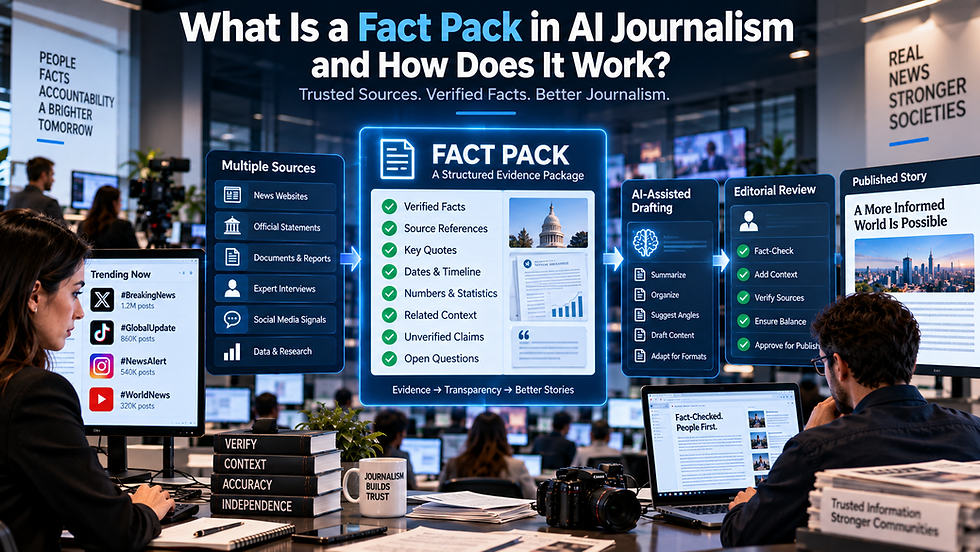
What Is A Fact Pack In Journalism?
A Fact Pack is an editorial research package containing the information a journalist or AI-assisted writing system is allowed to use when developing a story.
It can contain:
Verified facts
Primary-source documents
Source URLs
Official statements
Quotes
Dates and timestamps
Names and entities
Numbers and statistics
Relevant background
Previous coverage
Contradictory information
Unverified claims
Questions requiring further reporting
Editorial notes
Source confidence
Verification status
The purpose is not simply to collect information.
The purpose is to create a traceable evidence base for the story.
A well-designed Fact Pack should allow an editor to ask:
Where did this fact come from?
Has it been verified?
Can we trace it back to the original source?
What remains uncertain?
What should the AI not claim?
These questions become much harder to answer when a newsroom asks an AI model to conduct research, decide what matters, and produce a finished story in one step.
Why Fact Packs Matter In AI Journalism
Traditional journalism already involves research, source checking, note-taking, interviews, document review and editorial verification.
AI does not eliminate those activities.
Instead, AI changes the speed and scale at which information can be processed.
A newsroom might now have an AI system monitoring hundreds or thousands of documents, websites, transcripts, feeds or announcements.
That creates a new problem.
More information does not automatically mean better information.
An AI system can summarize a document quickly, but the newsroom still needs to know whether the summary is accurate.
It can extract a statistic, but the editor needs to know where that statistic originated.
It can generate a polished paragraph, but fluent writing does not establish factual accuracy.
A Fact Pack creates a controlled layer between source material and generated content.
The basic principle is:
Sources first. Structured facts second. AI generation third. Human approval last.
That is much safer than:
Prompt → AI research → AI article → publish.
How A Fact Pack Works
A practical Fact Pack workflow can be divided into several stages.
1. Story Discovery
The newsroom first identifies a potential story.
The signal might come from:
Breaking news
Social media
Search trends
Government announcements
Company statements
News feeds
News intelligence systems
Reporter observations
Reader tips
Existing newsroom coverage
At this stage, the story is only a lead.
It should not automatically become a verified fact.
This distinction is especially important when an AI system is monitoring large volumes of information.
The Reuters Institute's 2026 Journalism, Media, and Technology Trends report found that 97% of surveyed publisher respondents considered back-end automation important, while 82% considered newsgathering applications important. At the same time, publishers continue to report concerns about AI accuracy and misinformation.
The newsroom therefore needs a mechanism for turning large numbers of signals into controlled research.
The Fact Pack can provide that mechanism.
2. Source Collection
Once a story is identified, journalists or AI-assisted research tools collect relevant sources.
These might include:
Official documents
Government websites
Court records
Regulatory filings
Company announcements
Research papers
Interviews
Direct statements
Previous reporting
Public datasets
Original videos or photographs
The goal is to move closer to primary evidence.
For example, if a company announces a major business decision, the Fact Pack should not necessarily rely on an article repeating the announcement.
The newsroom should look for the company's original statement, relevant filings and independent evidence.
3. Source Evaluation
The next stage is deciding how much confidence each source deserves.
A Fact Pack can classify sources as:
Source Type | Typical Role | Editorial Treatment |
Primary document | Direct evidence | Highest-value source for the claim it directly establishes |
Official statement | Establishes an organization's position | Attribute and assess independently |
Independent reporting | Adds corroboration and context | Evaluate source quality and independence |
Expert source | Provides interpretation | Check expertise and potential conflicts |
Eyewitness account | Firsthand perspective | Corroborate where possible |
Social post | Discovery or firsthand lead | Verify before treating as fact |
AI-generated summary | Processing aid | Never treat as the original source |
This does not mean one source category is automatically correct in every situation.
The relevance of a source depends on the claim.
A government database may be authoritative for one fact.
A court filing may be authoritative for another.
A firsthand witness may provide information unavailable in official records.
The Fact Pack should preserve those distinctions.
4. Fact Extraction
After source collection, the newsroom can extract individual facts.
This is where AI can be particularly useful.
An AI system can help identify:
Names
Organizations
Locations
Dates
Numbers
Claims
Quotes
Events
Relationships
Relevant passages
Potential contradictions
But the extracted information should remain connected to its source.
For example, instead of simply storing:
Company announced acquisition
the Fact Pack should preserve:
Claim: Company announced acquisition Source: Original company announcement Date: Publication date Evidence: Relevant passage or document Status: Verified Notes: Acquisition terms require additional confirmation
This makes the information auditable.
5. Verification
Verification is the most important stage.
The newsroom should compare extracted facts against source material and, where appropriate, independent sources.
A useful verification status might include:
Unverified
Under Review
Partially Verified
Verified
Contradicted
Needs Update
This prevents a dangerous assumption:
AI extracted it, therefore it must be true.
The opposite should be the operating principle:
AI extracted it, therefore a journalist should be able to inspect the evidence.
NIST's AI Risk Management Framework emphasizes governing, mapping, measuring and managing AI risks, with human oversight processes explicitly included in the framework. It also recommends testing AI systems before deployment and regularly during operation.
For journalism, that translates into a practical rule:
Every important AI-assisted fact should have a traceable evidence path.
What Should Be Inside A Fact Pack?
There is no single mandatory format, but a publisher can create a standardized structure.
A useful Fact Pack can contain eight sections.
Story Summary
A short explanation of what the story is about.
Core Facts
The most important verified information.
Sources
The documents, URLs, statements, interviews and datasets supporting the facts.
Quotes
Verified quotations with source attribution and context.
Numbers
Statistics, financial figures, dates, measurements and other numerical information.
Context
Previous events, relevant background and historical information.
Unresolved Questions
Claims that still need confirmation.
Editorial Notes
Warnings, sensitivities, conflicts, legal considerations or other information an editor needs before publication.
This structure helps turn scattered research into an editorial asset.
Fact Packs And AI Hallucinations
One of the strongest reasons to use Fact Packs is to reduce the opportunity for unsupported AI generation.
A language model can generate plausible information that is not supported by the supplied evidence.
A Fact Pack does not eliminate that risk.
But it can create stronger controls.
For example, an AI drafting system can be instructed to:
Use only facts marked verified
Preserve source attribution
Avoid filling missing information
Flag unsupported claims
Ask for clarification when evidence conflicts
Distinguish facts from allegations
Preserve uncertainty
Avoid inventing quotations
This is much safer than allowing a model to fill gaps from its general knowledge.
A Fact Pack can therefore function as a controlled knowledge boundary for the drafting system.
Fact Pack Vs AI Research
These two concepts are related but different.
AI research is the process of using AI to find, summarize, classify or analyze information.
A Fact Pack is the structured output of the research and verification process that the newsroom is prepared to rely on.
AI research can produce raw findings.
The Fact Pack should contain the editorially reviewed findings.
That distinction is important.
An AI research assistant might return 50 pieces of information.
The Fact Pack may contain only 15 facts that the newsroom has actually verified.
The other 35 might be:
Irrelevant
Duplicates
Unverified
Contradictory
Outdated
Unsupported
This filtering process is where human editorial judgment matters.
Fact Pack Vs Article Brief
A Fact Pack is also different from an article brief.
An article brief explains what the journalist should produce.
It might contain:
Target audience
Search intent
Article angle
Headline direction
Key sections
Competitor coverage
Editorial objectives
Distribution requirements
A Fact Pack explains what the journalist can responsibly say.
The two can work together.
For example:
Article brief: Explain the impact of a new regulation on digital publishers.
Fact Pack: Contains the regulation, official statements, effective date, affected organizations, relevant figures, expert comments and verified background.
This creates a much stronger AI-assisted workflow.
The brief controls the purpose.
The Fact Pack controls the evidence.
The journalist controls the editorial judgment.
Fact Pack Vs Source List
A simple source list might contain ten URLs.
That is useful, but it is not a Fact Pack.
A Fact Pack connects sources to specific claims.
For example:
Fact | Source | Status | Notes |
Regulation was published | Official government document | Verified | Primary source |
Regulation takes effect on a specific date | Official document | Verified | Check jurisdiction |
Industry group criticized regulation | Organization statement | Verified | Opinion, not objective fact |
Economic impact will reach a specific amount | Industry estimate | Unverified | Requires independent assessment |
Consumer impact remains uncertain | Multiple sources | Needs context | Avoid definitive language |
This structure is much more valuable to an editor.
It shows not just what sources exist, but what those sources establish.
How AI Can Help Build A Fact Pack
AI can assist with much of the mechanical work.
Document Summarization
AI can summarize long documents before a journalist reviews the relevant sections.
Entity Extraction
AI can identify people, organizations, locations and products.
Date Extraction
AI can identify important dates and flag inconsistencies.
Number Extraction
AI can collect figures for manual verification.
Quote Detection
AI can locate potential quotations.
Duplicate Detection
AI can identify repeated claims across multiple sources.
Conflict Detection
AI can flag when two documents appear to provide different figures or dates.
Classification
AI can categorize sources and claims.
Research Organization
AI can transform scattered notes into a structured Fact Pack.
These applications align with the direction of newsroom AI adoption. AP's current standards explicitly allow AI for early-stage research and document summarization while requiring journalist review before publication.
What AI Should Not Decide Alone
The Fact Pack should not turn the AI into the final editor.
Human journalists should remain responsible for decisions such as:
Whether a source is credible
Whether two sources are truly independent
Whether a claim is sufficiently verified
Whether a quotation is fairly represented
Whether an allegation requires a response
Whether a story is sufficiently important to publish
Whether a claim could cause unnecessary harm
Whether uncertainty should be emphasized
Whether a correction is necessary
These decisions involve context, professional judgment and accountability.
AI can flag.
AI can organize.
AI can compare.
AI can summarize.
But the newsroom should decide.
The Fact Pack Can Become A “Single Source Of Editorial Truth”
One of the most useful applications is to make the Fact Pack the central evidence record for a story.
The journalist uses it to draft.
The editor uses it to fact-check.
The AI uses it to generate summaries and alternative formats.
The CMS can store it with the story.
The social team can use it to create distribution copy.
The video team can use it to prepare scripts.
The newsletter team can use it to create a summary.
This creates consistency across formats.
Instead of every department independently interpreting the source material, everyone works from the same verified evidence base.
That can reduce inconsistencies between:
Article
Newsletter
Social post
Video
Push notification
Podcast
Search snippet
Follow-up article
The Fact Pack therefore becomes more than a research document.
It becomes a story-level source of truth.
Fact Packs And Content Repurposing
Modern publishers increasingly turn one reporting package into multiple formats.
That makes evidence consistency especially important.
Imagine that a newsroom publishes a 1,500-word investigation.
The same reporting may later become:
A short video
A newsletter
A social post
A podcast segment
A visual explainer
A follow-up article
Without a shared evidence layer, different formats can gradually introduce different numbers, claims or interpretations.
A Fact Pack provides the verified foundation.
This is particularly valuable for content repurposing, because each new format can be generated from the same approved facts.
Fact Packs And Search Optimization
Fact Packs can also support SEO, GEO and AEO workflows.
The point is not to create content specifically for search engines.
Instead, structured evidence helps publishers create clearer, more complete and more trustworthy articles.
A Fact Pack can help editors identify:
Important entities
Core questions
Relevant dates
Supporting evidence
Missing context
Related internal coverage
Source references
Potential follow-up questions
Google's current guidance for generative AI search emphasizes valuable, unique, non-commodity content and says foundational SEO practices remain relevant to AI features. Google also warns against producing large volumes of content primarily to manipulate search rankings.
That makes the Fact Pack useful for a different reason.
It helps the newsroom produce evidence-rich original content, rather than simply more AI-generated pages.
Google's people-first guidance specifically encourages original information, reporting, research and analysis and warns against mass-producing content or mainly summarizing what others have said without adding substantial value.
Fact Packs Can Improve AI Search Visibility Indirectly
A Fact Pack is not an AI-search ranking trick.
There is no reason to assume that publishing a Fact Pack will directly cause Google AI features or other answer engines to cite a publisher.
The value is indirect.
A structured evidence process can help a newsroom create:
More accurate articles
Better attribution
Stronger original reporting
Clearer entities
Better context
More useful answers
Fewer unsupported claims
Those qualities align with the broader direction of search quality.
Google's 2026 guidance says its generative AI features rely on core Search systems and emphasizes unique, useful and reliable content rather than special AI-search formatting tricks.
A Fact Pack Should Preserve Uncertainty
This is one of the most important design principles.
Not every fact is equally certain.
A Fact Pack should not force every piece of information into a simple true-or-false category.
Consider a developing story.
The Fact Pack might contain:
Confirmed: Government agency issued a statement.
Confirmed: The statement contains a specific figure.
Reported: Two local outlets say additional incidents occurred.
Unverified: A social-media account claims a third incident.
Disputed: Two organizations provide different casualty numbers.
Unknown: Cause of the incident has not been established.
This is much more useful than flattening all of the information into one summary.
The AI can then generate copy that reflects the actual state of knowledge.
A Fact Pack Should Have A Time Dimension
News changes.
A fact can be accurate at 10 a.m. and outdated at 4 p.m.
Therefore, each important Fact Pack should ideally record:
When the fact was verified
When the source was published
Whether the source has changed
When the Fact Pack was last updated
Which facts are time-sensitive
This becomes especially important for:
Elections
Markets
Emergencies
Sports
Public safety
Government policy
Breaking news
The newsroom should be able to identify stale facts before they are reused.
Common Mistakes When Building Fact Packs
Treating Every Extracted Fact As Verified
Extraction and verification are different processes.
Saving Sources Without Connecting Them To Claims
A list of URLs is not enough.
The newsroom should know which source supports which fact.
Removing Uncertainty
Unconfirmed information should remain clearly labeled.
Letting AI Fill Missing Information
A missing fact should remain missing until it is verified.
Using Secondary Sources When Primary Evidence Exists
The original document should normally be reviewed when it is available and relevant.
Ignoring Conflicting Sources
Conflicts should be flagged rather than silently resolved by AI.
Creating A Fact Pack Once And Never Updating It
Developing stories require ongoing verification.
Treating The Fact Pack As An Article
The Fact Pack is an evidence layer, not the finished editorial product.
How Publishers Should Implement A Fact Pack Workflow
Publishers do not need to build a complicated system on day one.
Start with one newsroom workflow.
Step 1: Choose A Story Type
Begin with a repeatable category such as:
Breaking news
Government announcements
Corporate news
Technology stories
Explainers
Investigations
Step 2: Define Required Fields
Create a standard Fact Pack template.
At minimum, include:
Claim
Source
Evidence
Verification status
Date
Notes
Step 3: Separate Claims From Sources
Do not store research as one large block of text.
Connect each important claim to evidence.
Step 4: Add Human Review
An editor should approve important facts before they become eligible for AI-generated copy.
Step 5: Connect The Fact Pack To AI
The writing system should receive the approved evidence rather than unrestricted research access whenever practical.
Step 6: Connect It To The CMS
Store the Fact Pack alongside the story record.
Step 7: Reuse It Across Formats
Use the same verified evidence for articles, newsletters, social content and video scripts.
Step 8: Track Corrections
When a fact changes, identify every format that used the outdated information.
Measuring The Value Of Fact Packs
Publishers should measure whether Fact Packs actually improve newsroom performance.
Useful metrics include:
Metric | What It Measures |
Research time | How long it takes to prepare evidence |
Verification time | Time required to confirm important claims |
Correction rate | Errors discovered after publication |
Unsupported-claim rate | Claims without sufficient evidence |
Editorial intervention | How much human correction AI output requires |
Source traceability | Percentage of key facts linked to sources |
Repurposing consistency | Whether formats preserve approved facts |
Update time | How quickly changes propagate |
Journalist satisfaction | Whether reporters find the workflow useful |
A Fact Pack is successful if it improves the complete editorial workflow, not merely if it makes AI produce text faster.
Fact Pack Architecture For A Modern AI Newsroom
The Fact Pack can sit between research systems and the publishing workflow.
A modern implementation can connect:
News Intelligence → Source Collection → Fact Pack → Verification → AI Drafting → Human Editorial Review → CMS → Distribution → Analytics
This is an important distinction from an AI system that goes directly from news discovery to article generation.
The Fact Pack becomes the controlled middle layer.
It gives the newsroom a place to stop, inspect and correct information before it becomes content.
That makes it particularly relevant to an AI newsroom operating system.
How NewsBolts Can Use The Fact Pack Concept
For NewsBolts, the Fact Pack can become a core newsroom object rather than simply a document.
A story could have an associated Fact Pack containing:
Story: The event or topic being covered.
Claims: Individual factual statements.
Sources: Evidence supporting each claim.
Entities: People, companies, organizations and locations.
Timeline: Important dates and events.
Quotes: Verified statements with attribution.
Conflicts: Information that requires further review.
Status: Verified, unverified, disputed or outdated.
Editorial Notes: Context for reporters and editors.
Publishing Outputs: Article, newsletter, social, video and other formats derived from the evidence.
This structure can connect newsroom research with editorial governance.
It also supports the broader NewsBolts concept of a human-governed publishing workflow in which AI helps process information but humans retain control over publication.
NewsBolts Research Opportunity: The Fact Pack Benchmark
NewsBolts could develop a first-party Fact Pack Benchmark for AI Newsrooms.
Rather than claiming that Fact Packs improve journalism without evidence, NewsBolts could test the approach.
A controlled study could compare:
Workflow A: AI-assisted drafting from a general prompt.
Workflow B: AI-assisted drafting from a structured, human-reviewed Fact Pack.
The benchmark could measure:
Factual accuracy
Source attribution
Unsupported claims
Hallucinations
Editorial corrections
Time to publication
Verification time
Human intervention
Consistency across content formats
This would create original evidence around a newsroom workflow instead of another generic article about AI journalism.
Until such research is conducted, publishers should treat the Fact Pack as a practical workflow framework rather than a proven universal performance improvement.
What Publishers Should Do
Publishers should start by asking a simple question:
Before AI writes a story, what evidence should the newsroom require it to use?
That question can lead to a Fact Pack.
Start small.
Choose one repeatable story type.
Create a standard template.
Connect important claims to original sources.
Separate verified facts from developing information.
Require human review.
Then give the approved Fact Pack to the AI system for drafting, summarization or repurposing.
Over time, the Fact Pack can become part of the publisher's wider AI-assisted publishing workflow.
The goal is not to make journalism more automated at any cost.
The goal is to make AI-assisted journalism more traceable, more consistent and easier for humans to control.
Frequently Asked Questions
What Is A Fact Pack In AI Journalism?
A Fact Pack is a structured collection of verified facts, source references, quotations, dates, figures, context and unresolved questions prepared before AI-assisted drafting or publication. It gives journalists and AI systems a controlled evidence base.
Why Is A Fact Pack Important For AI Newsrooms?
A Fact Pack separates evidence from AI-generated language. It helps journalists trace claims back to sources, identify uncertainty, reduce unsupported statements and review the information used to create a story.
Is A Fact Pack The Same As A Research Brief?
No. A research brief usually explains the topic, audience, angle and objectives of a story. A Fact Pack focuses on the evidence, source relationships, verification status and factual material that can support the story.
Can AI Automatically Create A Fact Pack?
AI can help collect, extract, classify and organize information into a Fact Pack. However, important facts should be reviewed and verified by journalists before they are treated as approved evidence for publication.
Does A Fact Pack Prevent AI Hallucinations?
No. A Fact Pack cannot guarantee that an AI model will generate accurate output. It can, however, create a stronger evidence boundary and make it easier for journalists to identify unsupported claims and trace information back to sources.
What Should A Fact Pack Contain?
A useful Fact Pack can contain story summaries, verified facts, source references, quotes, dates, numbers, entities, context, unresolved questions, conflicting information, verification status and editorial notes.
Can Fact Packs Improve SEO?
Fact Packs do not provide a direct SEO shortcut. Their value is that they can help publishers produce more accurate, original and well-supported content. Google emphasizes useful, reliable and people-first content for both traditional and generative search experiences.
Can A Fact Pack Be Used For Newsletters And Video?
Yes. A verified Fact Pack can become the shared evidence base for articles, newsletters, social posts, video scripts, podcasts and other formats. This can help maintain factual consistency when one reporting package is repurposed.
Who Should Approve A Fact Pack?
The appropriate reviewer depends on the newsroom and story risk, but a journalist or editor should approve important claims before they become the basis for publication. High-risk stories should receive stronger editorial review.
Conclusion
A Fact Pack is a simple idea with significant potential for AI-assisted journalism.
It creates a structured evidence layer between research and writing.
Instead of asking an AI model to independently research a topic, decide what is true and write the story, the newsroom first gathers and verifies the important information.
The AI then works from that controlled evidence.
That approach does not eliminate hallucinations or guarantee accuracy. It does something more practical: it makes the editorial process more traceable, inspectable and governable.
For modern publishers, that distinction matters.
AI can help newsrooms process enormous amounts of information. It can summarize documents, extract facts, classify sources, identify relationships, prepare drafts and repurpose reporting.
But journalism still depends on evidence.
A Fact Pack gives that evidence a structured home.
The strongest AI newsroom is therefore not the one where AI makes the most editorial decisions.
It is the one where AI can do more useful work because the newsroom has clearly defined what is known, what is uncertain, where the information came from and who remains responsible for the final story.
That is the real value of a Fact Pack in AI journalism.



Comments