AI-Assisted Vs Fully Autonomous Newsrooms: What's The Difference?

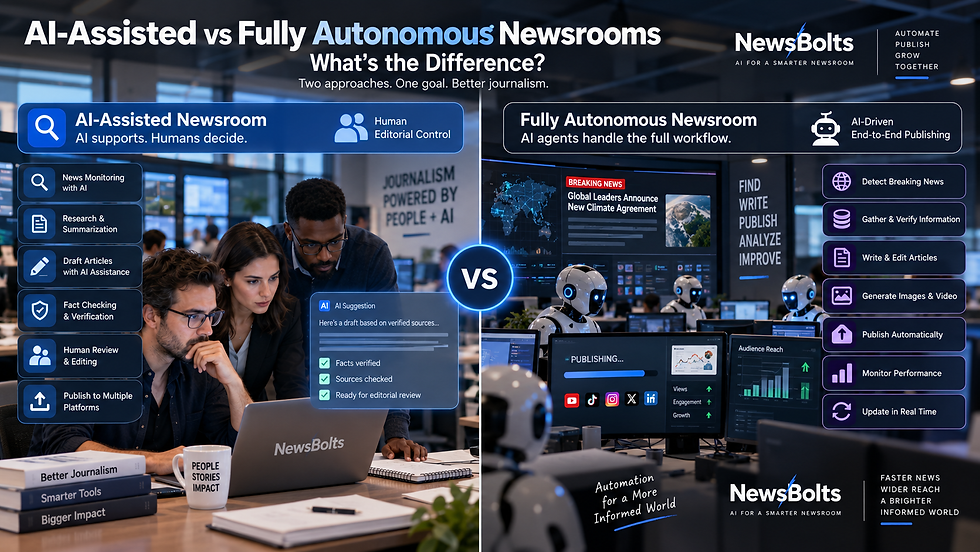
The difference between an AI-assisted newsroom and a fully autonomous newsroom comes down to who controls important editorial decisions. In an AI-assisted newsroom, AI performs tasks and supports journalists while humans retain responsibility for verification, judgment, and publication. In a fully autonomous newsroom, AI agents are designed to manage much more of the workflow with limited or no routine human approval.
For digital publishers, the choice is not simply about how much AI a newsroom can deploy. It is about risk, editorial control, operational efficiency, accountability, and the type of journalism the organization wants to produce.
What Is an AI-Assisted Newsroom?
An AI-assisted newsroom uses artificial intelligence to help journalists, editors, producers, and publishers perform specific tasks.
The human newsroom remains responsible for the important decisions.
AI may help with:
monitoring news sources
summarizing documents
extracting facts
transcribing interviews
translating material
identifying trends
generating article briefs
drafting headlines
producing first drafts
creating social posts
generating captions
repurposing articles into video scripts
optimizing metadata
analyzing audience data
The journalist or editor then reviews the output and decides what should happen next.
This model is already reflected in how major news organizations describe responsible AI use. In July 2026, the Associated Press updated its newsroom AI standards, allowing AI assistance for tasks such as early research, document summarization, transcription, translation, headline suggestions, story summaries, shot lists, grammar, and search optimization. AP explicitly states that journalists retain editorial judgment, verification, and accountability, with AI output reviewed and edited before publication.
That is the core principle of an AI-assisted newsroom:
AI assists the newsroom. Humans govern the journalism.
What Is a Fully Autonomous Newsroom?
A fully autonomous newsroom is a more ambitious model.
Instead of AI simply assisting individual tasks, AI agents can potentially coordinate an entire workflow.
For example, an autonomous system might:
Monitor hundreds of sources.
Identify a potential news event.
Determine whether the event is relevant.
Gather additional information.
Compare sources.
Generate a story.
Create headlines and metadata.
Produce social content.
Publish the article.
Monitor updates.
Revise the story when new information appears.
The key difference is decision authority.
In an assisted system, AI can recommend that a story should be published.
In an autonomous system, the AI may actually trigger publication.
That distinction creates significant implications for news publishers.
NIST's AI Risk Management Framework recognizes that human-AI configurations can range from fully manual to fully autonomous, and recommends clearly defining human roles and responsibilities for AI oversight.
A fully autonomous newsroom is therefore not simply "an AI newsroom with more automation."
It represents a different governance model.
AI-Assisted vs Fully Autonomous Newsrooms: The Key Difference
The simplest way to understand the difference is to look at who makes the final decision at each stage.
Area | AI-Assisted Newsroom | Fully Autonomous Newsroom |
Story discovery | AI assists | AI can independently discover |
Research | AI assists | AI can conduct multi-step research |
Verification | Human-led with AI support | AI-led or agent-managed |
Article drafting | AI-assisted | AI-generated |
Editorial judgment | Human | Potentially AI |
Sensitive stories | Human approval | Requires strong automated safeguards |
Publishing | Human-approved | Potentially automatic |
Updates | AI can recommend changes | AI may automatically update |
Corrections | Human-managed | Potentially agent-managed |
Accountability | Clearly human-led | More complex |
Speed | High | Potentially very high |
Risk | More controlled | Potentially much higher |
Best use | Most publisher workflows | Narrow, well-defined use cases |
The important point is that automation level and editorial autonomy are not the same thing.
A publisher can automate hundreds of repetitive tasks without creating a fully autonomous newsroom.
That is often the better approach.
Why AI-Assisted Newsrooms Are More Practical for Most Publishers
AI-assisted publishing offers a middle ground between traditional manual workflows and full automation.
A publisher can automate repetitive work while preserving human control over high-risk decisions.
Consider a breaking-news workflow.
AI can:
detect a developing story
collect relevant documents
identify entities
summarize available reports
compare information
create a Fact Pack
prepare an article brief
draft a story
suggest a headline
generate social copy
An editor can then:
evaluate the sources
verify important claims
contact sources when necessary
add original reporting
remove unsupported claims
assess legal and ethical risks
approve publication
This division allows the newsroom to gain speed without treating AI output as automatically trustworthy.
Reuters Institute's 2026 Journalism, Media, and Technology Trends report shows how widespread this approach has become. Among surveyed publisher leaders, 97% considered back-end automation important, 82% considered newsgathering important, and 81% highlighted faster coding and product development. At the same time, only 44% described their newsroom AI initiatives as promising, while 42% described their impact as limited.
That suggests an important lesson:
Adding AI tools is easier than redesigning the newsroom around them.
What Can an AI-Assisted Newsroom Automate?
A useful AI-assisted newsroom does not need to automate everything.
Instead, publishers should identify tasks according to their risk and value.
Low-Risk Repetitive Tasks
These are strong candidates for automation.
Examples include:
transcription
formatting
metadata generation
headline suggestions
basic tagging
caption generation
image alt-text suggestions
article summarization
content repurposing
publishing checklists
These tasks can consume significant editorial time without necessarily requiring final editorial authority.
Medium-Risk Analytical Tasks
These are better suited to AI assistance rather than unrestricted automation.
Examples include:
source comparison
trend detection
document analysis
story prioritization
data analysis
article outlining
SEO recommendations
audience analysis
identifying missing context
AI can accelerate the work, but editors should be able to inspect the underlying evidence.
High-Risk Editorial Decisions
These should generally remain human-led.
Examples include:
publishing allegations
identifying unreliable sources
deciding whether sensitive information is publishable
making accusations
handling vulnerable people
reporting potentially defamatory claims
deciding whether graphic material should be shown
determining whether an anonymous source is sufficient
final publication approval
This creates a practical three-level model:
Automated → AI-Assisted → Human-Led
Not every newsroom task belongs in the same category.
Where Fully Autonomous Newsrooms Could Make Sense
Fully autonomous workflows may have legitimate uses.
The strongest candidates are usually narrow, structured, predictable environments where:
inputs are reliable
outputs are clearly defined
errors have limited consequences
rules can be tested
humans can intervene when necessary
the system has strong monitoring
For example, a publisher might automate the creation of a structured weather update from trusted data.
A sports organization could potentially generate standardized score updates from verified feeds.
A financial publisher might automate certain market-data summaries under tightly defined rules.
A newsroom could automatically update a structured page when an official data feed changes.
These applications are very different from asking an autonomous agent to decide whether an unverified social-media claim deserves a breaking-news story.
The closer an AI system gets to independent editorial judgment, the greater the governance requirements become.
Why Fully Autonomous Newsrooms Are Riskier
The central problem is not that AI cannot generate content.
It can.
The problem is that journalism involves decisions that are difficult to reduce to simple production rules.
Source Credibility
Two sources can report the same event but have very different reliability.
An autonomous system needs to understand more than whether information appears multiple times.
It needs to consider:
source independence
provenance
incentives
original reporting
conflicts
corrections
context
Ambiguity
Breaking news is often incomplete.
An editor may decide:
"We know this much, but we should wait before publishing the rest."
An autonomous system optimized primarily for speed may have an incentive to fill the gaps.
That is dangerous.
Context
A technically accurate sentence can still create a misleading story if important context is removed.
Human editors routinely make judgments about what information readers need to understand an event.
Accountability
If an automated system publishes a false allegation, who is responsible?
The model?
The developer?
The publisher?
The editor who configured the system?
The answer must be defined before autonomous publishing is deployed.
Human Oversight Is Not the Same as Human Approval
There is an important distinction between human oversight and human approval.
Human approval means a person reviews the output before publication.
Human oversight can be broader.
It may include:
setting system rules
monitoring performance
reviewing exceptions
auditing decisions
testing models
investigating errors
changing risk thresholds
shutting down workflows
NIST's guidance emphasizes clearly defined human roles and responsibilities in AI systems, including policies for oversight and risk management.
This matters because simply placing an "Approve" button at the end of an automated workflow does not necessarily create meaningful editorial control.
If an editor is expected to approve 500 AI-generated stories per hour, the review process may become superficial.
Good governance therefore considers workload, review quality, escalation rules, and system transparency, not just whether a human technically exists somewhere in the workflow.
AI-Assisted Newsrooms and Editorial Quality
An AI-assisted newsroom can actually strengthen editorial quality when the workflow is designed correctly.
For example, AI can help an editor identify:
contradictory numbers
missing dates
duplicated claims
unsupported statements
inconsistent names
missing source attribution
potential updates
related documents
The editor then investigates the flagged issues.
This turns AI into a quality-control layer rather than a replacement for editorial judgment.
The approach also aligns with Google's guidance on generative AI. Google says generative AI can be useful for research and structuring original content, but producing many pages without adding value can violate its scaled content abuse policies.
For publishers, the broader lesson is important:
The value comes from the newsroom's reporting, verification, expertise, and original contribution not simply from generating more content.
Fully Autonomous Publishing Can Create Scale Without Quality
One of the biggest misconceptions about autonomous newsrooms is that more automation automatically creates a better business.
It does not.
Automation can increase output.
But output is not the same as:
audience trust
original reporting
authority
accuracy
subscriptions
engagement
revenue
A publisher could technically produce thousands of AI-generated stories.
That does not mean audiences will value them.
Reuters Institute has highlighted the growing concern around low-quality AI-generated content and "AI slop," while also noting that publishers are increasingly looking toward distinctive journalism and a more human face as AI-generated content expands.
This creates a strategic divide.
One publisher might compete on volume and automation.
Another might use AI to reduce operational work while investing the saved time into:
original reporting
interviews
investigations
local coverage
expert analysis
verification
community engagement
For many publishers, the second strategy offers a stronger editorial identity.
The Economics of AI-Assisted vs Autonomous Newsrooms
The economic question should not be reduced to "Which model requires fewer employees?"
A better question is:
Where can automation create the most value without weakening the publisher's competitive advantage?
An AI-assisted newsroom can reduce the time spent on repetitive tasks.
That may allow journalists to spend more time on work that machines cannot easily reproduce.
For example:
Before AI assistance
Reporter spends time monitoring sources → manually summarizes documents → creates article structure → writes draft → formats metadata → creates social copy.
With AI assistance
AI monitors and organizes information → prepares research → creates structured brief → drafts supporting material → generates metadata → reporter focuses on reporting, verification, and editorial decisions.
The goal is not necessarily fewer journalists.
It can be more journalism per journalist.
Reuters Institute's 2026 report found that 67% of surveyed publishers said they had not saved jobs as a result of AI efficiencies, while some reported small staff reductions and others added new roles.
That is another reason publishers should evaluate AI based on workflow outcomes rather than simplistic headcount assumptions.
How an AI-Assisted Newsroom Should Be Structured
A modern AI-assisted newsroom can be organized into several connected layers.
News Intelligence
The system monitors relevant sources and identifies potential stories.
Research
AI helps collect documents, summarize material, identify entities, and organize evidence.
Verification
Sources and claims are evaluated before important information reaches publication.
Editorial Planning
Editors decide which stories deserve resources and what angle the newsroom should pursue.
AI-Assisted Writing
AI helps create briefs, drafts, headlines, summaries, metadata, and other production assets.
Human Editorial Governance
Editors verify, rewrite, approve, reject, or escalate content.
CMS and Publishing
Approved content moves into the publisher's CMS and distribution systems.
Repurposing
The approved story can become:
social posts
newsletters
video scripts
reels
podcasts
graphics
explainers
Analytics
Performance data informs future editorial and business decisions.
This is the broader concept behind an AI newsroom operating system: connecting individual AI capabilities into a controlled publishing workflow.
How NewsBolts Fits the AI-Assisted Model
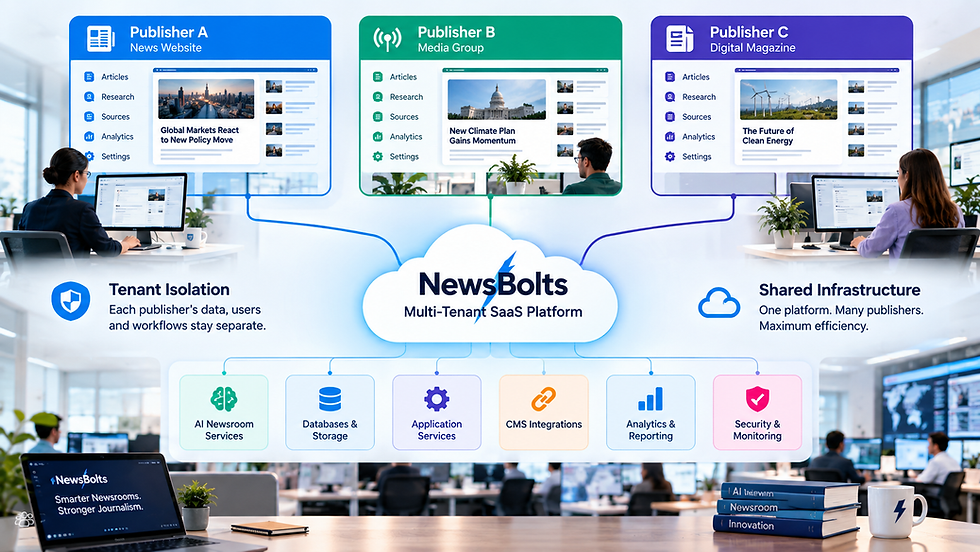
NewsBolts is better positioned as an infrastructure layer for human-governed AI newsroom workflows rather than as a system that simply replaces newsroom staff.
The practical opportunity is to connect:
news intelligence
research
source management
verification
Fact Packs
AI-assisted drafting
editorial review
CMS publishing
SEO
GEO
AEO
content repurposing
analytics
The important architectural principle is that AI does not need to own the entire process.
Instead, the system can assign different responsibilities to AI and humans.
For example:
Newsroom Function | AI Role | Human Role |
Story discovery | Monitor and rank signals | Set priorities |
Research | Summarize and organize | Evaluate evidence |
Fact extraction | Extract claims | Verify |
Article brief | Generate structure | Approve angle |
Drafting | Produce draft | Edit |
SEO | Suggest optimization | Approve strategy |
Reel creation | Generate script/assets | Review |
Publishing | Prepare workflow | Approve high-risk content |
Analytics | Identify patterns | Make decisions |
Corrections | Detect potential issues | Determine correction |
This creates a human-governed AI newsroom rather than an AI-only newsroom.
When Should Publishers Use AI Assistance Instead of Full Autonomy?
For most publishers, AI assistance should be the default starting point.
Use AI assistance when:
editorial risk is high
original reporting matters
sources vary in reliability
stories require context
legal or ethical judgment is involved
brand reputation is important
human expertise is a competitive advantage
Consider greater autonomy when:
the workflow is highly structured
inputs are reliable
the output can be validated automatically
errors have limited consequences
human escalation is available
the publisher can audit the system
there is a clear business reason for automation
The decision should be made workflow by workflow, not as a single newsroom-wide binary choice.
A publisher does not need to choose between "human newsroom" and "autonomous newsroom."
It can build a newsroom where different tasks operate at different levels of autonomy.
A Practical Autonomy Matrix for Publishers
A useful way to implement this is to score each workflow according to four factors:
Editorial risk
Input reliability
Output predictability
Need for human judgment
A low-risk workflow with reliable inputs and predictable outputs can move toward greater automation.
A high-risk workflow involving ambiguous evidence and significant editorial judgment should remain human-led.
For example:
Workflow | Recommended Autonomy |
Metadata generation | High |
Transcription | High |
Caption generation | High |
Article summarization | Medium |
Source monitoring | High |
Story prioritization | Medium |
Research assistance | Medium |
Breaking-news verification | Human-led |
Investigative reporting | Human-led |
Allegation publishing | Human-led |
Sensitive visual selection | Human-led |
Final publication of high-risk stories | Human-led |
This model allows publishers to automate intelligently without treating all newsroom work as equally safe.
Common Mistakes Publishers Should Avoid
Mistake 1: Measuring AI Success by Content Volume
Publishing more does not automatically create more value.
Measure quality, efficiency, audience outcomes, and editorial impact.
Mistake 2: Giving AI Editorial Authority Too Early
A newsroom should establish reliable workflows before granting autonomous publishing permissions.
Mistake 3: Treating AI Output as Verified
An AI-generated statement is not evidence simply because it sounds confident.
Mistake 4: Removing Humans From High-Risk Decisions
Sensitive journalism requires human judgment.
Mistake 5: Building Disconnected AI Tools
A newsroom with ten AI tools but no connected workflow can create more complexity rather than less.
Mistake 6: Ignoring Original Reporting
Automation should create more time for journalism, not simply more machine-generated content.
Mistake 7: Using Automation to Chase Search Traffic
Google's guidance makes clear that generating many pages without adding user value can create search-policy problems.
The goal should be useful publishing, not automated volume for its own sake.
What Publishers Should Do
Publishers evaluating newsroom autonomy should start with an inventory of their existing workflows.
For every major workflow, document:
input
AI task
human task
output
risk
approval point
escalation path
monitoring method
correction process
Then classify each workflow as:
Automated
AI-Assisted
Human-Led
Do not begin by asking:
"How much of our newsroom can AI replace?"
Ask:
"Which newsroom tasks can AI perform reliably, and where does human judgment create the most value?"
That question leads to a much more useful technology strategy.
The Future: From AI-Assisted to Selective Autonomy
The future of newsroom automation is unlikely to be a simple transition from human journalism to completely autonomous journalism.
A more realistic direction is selective autonomy.
Some workflows will become almost entirely automated.
Others will remain strongly human-led.
Reuters Institute's 2026 reporting points toward this more sophisticated model. It notes increasing interest in agentic AI and the embedding of AI into CMS and newsroom workflows, while also highlighting concerns around misinformation, AI-generated content, trust, and the limits of current newsroom AI initiatives.
This means the newsroom of the future may contain different levels of AI autonomy operating simultaneously.
A weather update might be automated.
A social caption might be AI-generated and lightly reviewed.
A business story might receive substantial AI research assistance.
An investigative story might remain almost entirely human-led.
The newsroom becomes a portfolio of human-AI workflows, rather than one universal automation model.
That is a more practical way to think about AI newsroom architecture.
Frequently Asked Questions
What Is the Difference Between an AI-Assisted and Fully Autonomous Newsroom?
An AI-assisted newsroom uses AI to help humans perform newsroom tasks while people retain editorial control. A fully autonomous newsroom gives AI agents authority to perform and potentially make decisions across larger parts of the publishing workflow with limited human intervention.
Is a Fully Autonomous Newsroom Better Than an AI-Assisted Newsroom?
Not necessarily. Full autonomy can increase speed and reduce manual work in suitable workflows, but it can also increase editorial, legal, reputational, and accuracy risks. For many publishers, selective automation combined with human editorial control is more practical.
What Tasks Should AI Automate in a Newsroom?
Low-risk repetitive tasks such as transcription, formatting, metadata generation, summarization, tagging, caption generation, and content repurposing are strong candidates. Higher-risk decisions involving source credibility, allegations, sensitive stories, and final editorial judgment should generally remain human-led.
Can AI Replace Journalists in a Fully Autonomous Newsroom?
AI can automate parts of journalism, but replacing the full role of journalists involves much more than generating text. Reporting, source relationships, interviews, field observation, verification, editorial judgment, accountability, and community understanding remain important human capabilities.
What Is Human-in-the-Loop Newsroom Automation?
Human-in-the-loop automation means an AI system performs one or more workflow tasks while a person retains responsibility for reviewing or approving defined decisions. The exact level of human involvement should depend on the risk and complexity of the workflow.
How Can Publishers Safely Introduce Autonomous AI?
Start with narrow, low-risk workflows. Define inputs and outputs, establish approval and escalation rules, test the system, monitor errors, document responsibilities, and expand autonomy only after the workflow demonstrates reliable performance.
Does AI Automation Create Better SEO for Publishers?
Automation itself does not create better SEO. Google says AI can assist with research and content creation, but generating many pages without adding user value may violate its scaled content abuse policies. Publishers should focus on original reporting, useful information, accuracy, and editorial value.
What Is Selective Autonomy in a Newsroom?
Selective autonomy means different newsroom workflows receive different levels of AI independence. Low-risk tasks may be automated, medium-risk tasks may be AI-assisted, and high-risk editorial decisions remain human-led.
Conclusion
AI-assisted vs fully autonomous newsrooms are not simply two versions of the same technology. They represent different levels of decision-making authority.
An AI-assisted newsroom keeps humans at the center of editorial judgment while using AI to accelerate research, production, optimization, repurposing, and operational work.
A fully autonomous newsroom pushes further by allowing AI agents to make and execute more decisions independently.
For most digital publishers, the strongest strategy is unlikely to be maximum autonomy everywhere.
It is controlled autonomy where it makes sense.
Automate repetitive work.
Assist with complex analysis.
Keep consequential editorial decisions human-led.
Create clear governance.
Measure the actual business and editorial impact.
And use the time saved by AI to invest in journalism that creates something machines cannot easily reproduce: original reporting, expert judgment, source relationships, context, credibility, and a strong connection with the audience.
That is the foundation of a scalable human-governed AI newsroom.


Comments