Bing SEO For News Publishers: Improve Discovery

Bing SEO for news publishers focuses on making articles easy for Bing to discover, crawl, understand, index, and surface. The most important foundations are crawlable pages, XML sitemaps, IndexNow, clear internal linking, strong article quality, accurate metadata, and a verified Bing Webmaster Tools setup. For AI discovery, the same foundations also support visibility in Microsoft Copilot and Bing's AI experiences.

What Is Bing SEO for News Publishers?
Bing SEO is the process of improving a website so Bing can discover, crawl, understand, index, and potentially rank its content.
For news publishers, there is an additional consideration: news discovery.
A publisher therefore needs to think about two connected systems:
Search discovery
→ Bing discovers and indexes the article.
News and AI discovery
→ Eligible content may also appear in Bing news experiences or be referenced in AI-generated answers.
Bing states that its core crawling, indexing, and ranking foundations also support eligibility for AI-generated experiences and grounding results.
This makes technical SEO, editorial quality, and content clarity important beyond traditional blue-link search.
Why Bing SEO Matters for News Publishers
News publishers work with a different publishing cycle from many other websites.
A normal evergreen article might remain useful for months or years.
A breaking-news article may be most valuable within hours.
That makes discovery speed important.
If Bing does not discover a newly published article efficiently, the publisher may miss opportunities to appear while the story is still relevant.
Bing's IndexNow protocol allows publishers to notify participating search engines when URLs are added, updated, or deleted. Bing says this can lead to faster crawling, although IndexNow does not guarantee indexing.
For newsrooms, that distinction is critical:
Notification is not the same as indexing.
How Bing Discovers a News Article
A simplified Bing discovery process looks like this:
Article Published
↓
Internal Links / Sitemap / IndexNow
↓
Bing Discovers URL
↓
Bing Crawls Page
↓
Bing Processes Content
↓
Bing Decides Whether to Index
↓
Bing May Rank or Surface Content
The publisher can improve several signals in this process, but cannot force Bing to index or rank every URL.
Bing's Webmaster Guidelines specifically recommend using IndexNow, XML sitemaps, crawlable internal links, and relevant external links to help discovery.
The First Technical Check: Can Bing Crawl the Article?
Before worrying about keywords, check whether Bing can actually access the page.
Look for problems involving:
robots.txt
noindex
Incorrect canonical URLs
Redirects
Server errors
Broken internal links
JavaScript-dependent content
Login restrictions
Incorrect HTTP responses
Bing's IndexNow documentation identifies issues such as noindex tags, robots restrictions, redirects, dead links, and pages that have not been crawled as possible indexing-related problems.
A beautifully optimized article cannot perform in search if the crawler cannot properly access it.
Use Bing Webmaster Tools
Bing Webmaster Tools should be one of the main tools in a publisher's SEO workflow.
It provides information about:
Indexed pages
Crawl requests
Crawl errors
Search impressions
Clicks
CTR
Average position
Search queries
News performance
AI-related visibility
Bing's Search Performance report includes crawl requests, crawl errors, and indexed pages alongside search performance data.
For a newsroom, this creates a useful distinction:
Editorial problem: The article is weak or lacks useful information.
Technical problem: Bing cannot properly discover, crawl, or process the article.
Visibility problem: The page is indexed but does not receive meaningful impressions.
These problems require different solutions.
Submit and Maintain XML Sitemaps
An XML sitemap gives Bing another way to discover URLs.
Bing supports several sitemap formats, including:
XML
RSS
Atom
Plain text URL lists
For publishers, the sitemap should be clean.
It should primarily contain URLs that are:
Canonical
Accessible
Intended for indexing
Not redirected
Not deleted
Bing's current Webmaster Guidelines recommend that sitemaps list canonical URLs and reflect the current site structure. They also recommend accurate freshness information such as lastmod where applicable.
Newsroom recommendation
Keep your publishing system responsible for updating the sitemap automatically whenever a new article is published.
Do not make editors manually add every article.
Use IndexNow for Fresh News Content
IndexNow is particularly relevant to frequently updated publishers.
It allows a site to notify participating search engines when URLs are:
Added
Updated
Deleted
Bing describes IndexNow as a protocol that can notify search engines about these changes and help them discover updates faster.
For a newsroom, the workflow can be:
Article Published
↓
CMS detects new URL
↓
IndexNow notification
↓
Bing receives URL
↓
Bing decides when to crawl
This is more efficient than expecting a crawler to discover every new article only through normal crawling.
But remember:
IndexNow improves notification, not guaranteed indexing.
Build Strong Internal Links
Internal links help search engines discover relationships between pages.
For a news publisher, internal linking should not be treated only as an SEO exercise.
It can also improve reader navigation.
For example:
New article
→ Previous article
→ Background explainer
→ Related investigation
→ Author page
→ Topic page
→ Latest coverage
This creates a connected editorial structure.
A new story should ideally be connected to relevant existing content rather than existing as an isolated URL.
Create Topic Hubs for News Coverage
Newsrooms often publish multiple articles around the same subject.
Instead of allowing those articles to become disconnected, create topic relationships.
For example:
AI Regulation
Latest news
Background explainer
Timeline
Key people
Policy analysis
Previous developments
This gives Bing stronger contextual information about the publisher's coverage.
It also helps readers move from a breaking story to deeper reporting.
Write Clear Headlines
A news headline should tell the reader what the article is actually about.
Avoid headlines that rely entirely on:
Mystery
Emotional exaggeration
Clickbait
Vague wording
Repeated keywords
A useful structure is:
Entity + Event + Important Context
For example:
Microsoft Announces New AI Search Features for Publishers
is clearer than:
This Major Search Change Could Transform Publishing
The second headline creates curiosity but provides less concrete information.
Clear headlines also help AI systems understand the subject of the page.
Make the First Paragraph Highly Informative
The opening paragraph should quickly establish:
What happened
Who is involved
Where it happened
When it happened
Why it matters
For breaking news, the first paragraph should not make readers search through several paragraphs for the main fact.
A strong opening also gives answer engines a concise piece of context that can be understood independently.
Use Clear Article Structure
News articles should be easy to scan.
Use:
What Happened?
Explain the main development.
Why It Matters
Give relevant context.
What We Know
Present confirmed information.
What Remains Unclear
Separate uncertainty from confirmed facts.
What Happens Next?
Explain confirmed next steps where available.
This structure is particularly useful for developing stories because it prevents speculation from being mixed with established facts.
Make Sources and Attribution Clear
News publishers should make it clear where important information comes from.
Depending on the story, this may include:
Official statements
Government documents
Court records
Company announcements
Research papers
Direct interviews
Other reputable reporting
Bing's publisher guidance has emphasized identifying sources, authors, and attribution as part of news quality.
This is not just an SEO technique.
It is good newsroom practice.
Originality Matters in Bing News
A publisher should not assume that rewriting an existing report is enough to create valuable news content.
Bing's publisher guidance has identified newsworthiness, originality, authority, and readability among the factors used to evaluate news publishers.
For example, ten publishers may report the same announcement.
A stronger article may add:
Original reporting
Local context
Expert analysis
Historical background
Primary-source evidence
New information
Clear explanation
The goal should be to give readers something useful beyond repeating the announcement.
Bing SEO vs Google SEO for News Publishers
Bing and Google share many fundamental SEO principles, but publishers should still monitor both systems separately.
Area | Bing | |
Crawlability | Important | Important |
XML sitemap | Important | Important |
Internal links | Important | Important |
Content quality | Important | Important |
Search intent | Important | Important |
Indexing controls | Important | Important |
IndexNow | Particularly relevant | Not a Google indexing mechanism |
Bing Webmaster Tools | Essential for Bing data | Not applicable |
Search Console | Not applicable | Essential for Google data |
AI visibility reporting | Bing provides AI Performance | Google provides different search reporting |
The important lesson is not to create completely separate content for each search engine.
Build a technically sound, useful article first.
Then use each search engine's webmaster tools to diagnose its own discovery and performance.
Bing News and Web Search Are Not Exactly the Same
Publishers should distinguish between being indexed in Bing's web search and eligibility for Bing news experiences.
Bing's publisher documentation has stated that news publishers are evaluated for news distribution using considerations such as newsworthiness, originality, authority, and readability.
The current PubHub documentation also notes that Bing PubHub is being retired, so publishers should avoid relying on older PubHub instructions without checking Microsoft's current documentation.
This is an important example of why publisher SEO documentation needs regular review.
AI Discovery Is Now Part of Bing Visibility
Bing's search ecosystem now includes AI-generated experiences.
Bing Webmaster Tools introduced AI Performance reporting in 2026, showing publishers how their content is cited across Microsoft Copilot, Bing AI-generated summaries, and selected partner experiences.
The report can show:
Total citations
Cited pages
Grounding queries
Citation activity over time
Bing explicitly warns that citation counts do not represent traditional rankings, authority, or page importance.
This creates a useful new measurement category for publishers:
Search visibility
and
AI citation visibility
They are related but not identical.
How to Structure Articles for Bing AI Discovery
Publishers should not create strange AI-specific text just to appear in generative answers.
Instead, make important information easy to understand.
Use:
Direct answers
Descriptive headings
Short factual paragraphs
Clear entity names
Evidence for important claims
Tables where comparisons are useful
FAQs for genuine reader questions
Clear relationships between facts
Bing's AI Performance guidance specifically recommends aligning content with user intent, improving clarity and structure, supporting claims with evidence, and keeping content fresh and accurate.
A Practical Newsroom Workflow for Bing SEO
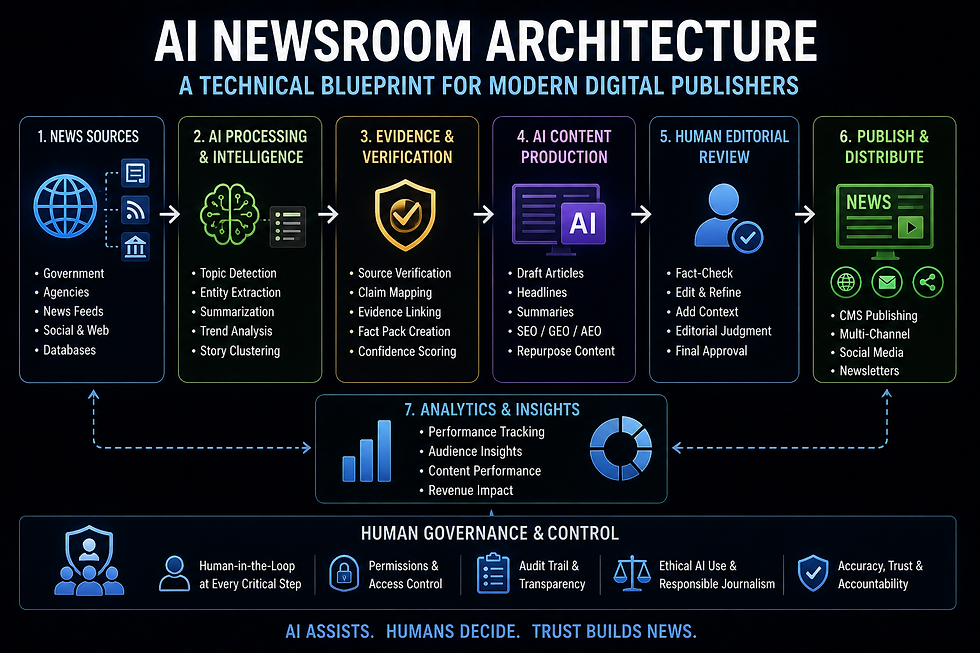
A useful workflow is:
1. Story Discovery
Identify a potentially important story.
↓
2. Source Verification
Check primary and reliable secondary sources.
↓
3. Fact Pack
Record confirmed claims, sources, dates, names, and uncertainties.
↓
4. Draft
Create the article with clear structure.
↓
5. Editorial Review
Verify facts and context.
↓
6. Bing SEO Check
Review crawlability, headline, metadata, internal links, sitemap, and IndexNow.
↓
7. Publish
Publish through the CMS.
↓
8. Notify
Send the URL through IndexNow where supported.
↓
9. Monitor
Review Bing Webmaster Tools.
↓
10. Update
Correct or update the article when facts change.
This is a much stronger process than treating Bing SEO as something added after publication.
The NewsBolts Bing Discovery Framework
For NewsBolts, a useful framework is:
DISCOVER → VERIFY → STRUCTURE → PUBLISH → NOTIFY → MEASURE → UPDATE
Discover
Find the story and identify the relevant search and audience intent.
Verify
Connect important claims to reliable sources.
Structure
Create a clear article with useful headings, context, attribution, and internal links.
Publish
Make sure the page is technically accessible and indexable.
Notify
Use appropriate discovery mechanisms such as XML sitemaps and IndexNow.
Measure
Use Bing Webmaster Tools to monitor crawling, indexing, search performance, and AI citation activity.
Update
News changes.
When important facts change, update the article and notify search engines of the change.
This approach fits NewsBolts' role as a Human-Governed AI Newsroom Operating System because AI can assist with monitoring and optimization while editors retain responsibility for verification and publication.
A Bing SEO Diagnostic Matrix
When an article is not appearing, diagnose the problem before changing the content.
Problem | What to check | Possible action |
URL not discovered | Sitemap, internal links, IndexNow | Improve discovery |
URL not crawled | Robots, server response | Fix crawl access |
URL not indexed | Canonical, noindex, quality | Investigate indexing |
Indexed but no impressions | Topic, intent, competition | Improve content |
Impressions but few clicks | Headline, snippet, intent | Improve SERP presentation |
News visibility weak | Originality, authority, newsworthiness | Improve editorial value |
AI citations weak | Clarity, evidence, structure | Improve answerability |
This prevents publishers from making random SEO changes.
Common Bing SEO Mistakes
Ignoring Bing Webmaster Tools
If Bing is an important traffic source, publishers should monitor its own data rather than relying exclusively on Google Search Console.
Assuming IndexNow Guarantees Indexing
It does not. IndexNow notifies search engines about changes; Bing explicitly says it does not guarantee crawling or indexing.
Publishing Isolated Articles
A newsroom that never connects related stories makes discovery and context harder.
Using Weak or Vague Headlines
Readers and search systems need to understand the subject quickly.
Copying Other Publishers
Rewriting the same information without adding meaningful value can produce weak editorial differentiation.
Mixing Confirmed Facts With Speculation
Clearly separate what is known from what is still developing.
Ignoring Updates
News articles often change as new facts emerge.
Publishers should have a process for reviewing important stories after publication.
Treating AI Visibility as Traditional Ranking
Bing's AI Performance data measures citation activity, not conventional rankings.
Bing SEO Checklist for News Publishers
Before publishing a news article, check:
Article URL is accessible
Page is not accidentally marked noindex
Robots.txt does not block important content
Canonical URL is correct
Article is included in the XML sitemap
Internal links point to the article
IndexNow is configured where appropriate
Headline clearly describes the story
Opening paragraph answers the main question
Important claims have sources
Author information is clear
Publication and update information is accurate
Article adds original value
Related articles are linked
Human editor has approved the article
Bing Webmaster Tools is monitored after publication
What Publishers Should Measure
Bing SEO should be measured at three levels.
1. Crawl and Indexing
Monitor:
Crawl requests
Crawl errors
Indexed pages
Indexing problems
Bing's Search Performance reporting provides these crawl and indexing metrics.
2. Search Performance
Monitor:
Impressions
Clicks
CTR
Average position
Search queries
News traffic
3. AI Visibility
Where available, monitor:
Cited pages
Total citations
Grounding queries
Citation trends
Bing's AI Performance report provides these insights across supported AI experiences.
The three layers answer different questions:
Can Bing find us?
Can Bing surface us?
Can AI systems cite us?
What Publishers Should Do First
If Bing traffic or indexing is weak, do not start by changing every article.
Start with the technical foundation.
Step 1
Verify the site in Bing Webmaster Tools.
Step 2
Submit and check the XML sitemap.
Step 3
Check crawl errors and indexed pages.
Step 4
Verify robots.txt, noindex, canonical URLs, and redirects.
Step 5
Implement IndexNow where appropriate.
Step 6
Improve internal linking between related stories.
Step 7
Review article quality, originality, attribution, and structure.
Step 8
Monitor search performance.
Step 9
Review AI Performance if available.
This gives the newsroom a measurable process rather than a collection of SEO guesses.
Conclusion
Bing SEO for news publishers is not about finding a secret ranking trick.
It is about building a reliable discovery and publishing system.
The foundation is:
Crawlable pages + XML sitemaps + internal links + IndexNow + strong editorial quality + clear structure + human verification.
For publishers, the workflow should go further:
Discover → Verify → Structure → Publish → Notify → Measure → Update
Bing's ecosystem is also expanding beyond traditional search. Its Webmaster Tools now provide AI Performance reporting that helps publishers understand when their pages are cited in Microsoft Copilot and other supported AI experiences.
For NewsBolts, this reinforces an important principle: AI can help a newsroom discover, organize, verify, optimize, and distribute information, but humans should remain responsible for editorial judgment and final approval.
FAQs
Does Bing SEO matter for news publishers?
Yes. Bing provides web search, news-related experiences, and AI-powered discovery surfaces. Bing Webmaster Tools also provides publishers with crawl, indexing, search, and AI citation data.
Does IndexNow guarantee that Bing will index my article?
No. IndexNow notifies participating search engines about URL changes, but Bing states that it does not guarantee crawling or indexing.
How can I help Bing discover new news articles?
Use crawlable internal links, an accurate XML sitemap, and IndexNow for newly published or updated URLs. Bing recommends these discovery mechanisms in its Webmaster Guidelines.
Why is my article indexed but not getting Bing traffic?
Indexing only means Bing has included the page in its index. Low impressions can result from search demand, competition, relevance, content quality, or other ranking factors.
Does Bing use the same SEO principles as Google?
Many fundamental principles overlap, including crawlability, clear content, internal linking, and useful pages. However, publishers should monitor Bing separately using Bing Webmaster Tools.
How can news publishers improve Bing News visibility?
Focus on newsworthiness, originality, authority, readability, clear attribution, and high-quality journalism. Bing's publisher guidance identifies these areas as important considerations for news publishers.
Does Bing AI Performance show rankings?
No. Bing says AI Performance measures citation activity and should not be interpreted as a ranking, authority, or page-importance metric.
Can AI-generated articles rank on Bing?
AI assistance does not automatically determine whether content will rank. Publishers should focus on useful, accurate, original content and follow Bing's Webmaster Guidelines. AI should assist newsroom workflows rather than replace editorial verification.


Comments