Human-In-The-Loop AI For Journalism: How Newsrooms Can Use AI Without Losing Editorial Control

Human-in-the-loop AI for journalism means using artificial intelligence to assist newsroom tasks while keeping humans responsible for important editorial decisions. AI can help with research, summarization, transcription, drafting, optimization, and workflow automation, but journalists and editors retain authority over sourcing, verification, context, accuracy, fairness, and publication. This approach makes AI part of the newsroom workflow without making it the newsroom's final decision-maker.

Introduction
The most useful question for publishers is not whether AI should be used in journalism.
It is where AI should be used, where humans must intervene, and how the two should work together.
AI can perform many newsroom tasks quickly. It can summarize documents, organize information, identify potential story signals, produce first drafts, suggest headlines, transform articles into other formats, and assist with search optimization.
But journalism involves decisions that go beyond producing text.
A newsroom must determine whether a source is credible, whether a claim is sufficiently supported, whether important context is missing, whether an allegation has been fairly presented, and whether an article is ready for publication.
That is where human-in-the-loop AI becomes important.
The Associated Press's current newsroom standards provide a useful real-world example. AP says AI can assist with activities including early-stage research, document summarization, transcription, translation, headlines, story summaries, grammar, and search optimization. It also states that AI-generated output is reviewed and edited by AP journalists before publication and that AI does not replace reporting, sourcing, editorial judgment, or verification.
For publishers, the lesson is straightforward:
AI can participate in the workflow without owning the editorial decision.
What Is Human-In-The-Loop AI For Journalism?
Human-in-the-loop AI is an operating model in which people remain involved in meaningful decisions within an AI-assisted process.
In journalism, that can mean a journalist:
Defines the story brief
Selects or evaluates sources
Reviews AI-generated research
Verifies important claims
Corrects AI output
Adds reporting and context
Determines editorial framing
Approves the final story
Decides whether publication should proceed
AI, meanwhile, can perform defined supporting tasks.
The important distinction is authority.
An AI system may generate a draft.
An editor decides whether the draft is publishable.
An AI system may identify a possible trend.
A journalist decides whether that signal represents a story worth reporting.
An AI system may summarize a source.
A human determines whether the summary accurately represents the source.
This division of responsibility is the foundation of a human-governed newsroom.
Why Human Oversight Matters In Journalism
Newsrooms work with information where errors can have consequences beyond a poor user experience.
An incorrect date in an entertainment article may be inconvenient.
An unsupported allegation involving an identifiable person can be much more serious.
A misleading financial claim can affect decisions.
A health-related error can create confusion or harm.
A fabricated quotation can undermine the credibility of the publication.
This is why human oversight should not be reduced to proofreading.
Editors need to evaluate evidence, meaning, context, and consequences.
NIST's AI Risk Management Framework is designed to help organizations manage AI risks and incorporate trustworthiness into the design, development, use, and evaluation of AI systems. Its Generative AI Profile specifically addresses risks associated with generative AI and provides suggested actions for governing, mapping, measuring, and managing those risks.
For newsrooms, that risk-management principle can be translated into a simple operational question:
What decision should require human authority?
What AI Can And Cannot Do In A Newsroom
AI capabilities vary by system, configuration, source access, and workflow. Publishers should therefore avoid assuming that every AI tool can safely perform every newsroom task.
A useful starting distinction is:
Newsroom Activity | AI Can Assist With | Human Authority |
Story discovery | Identifying signals and patterns | Decide whether the signal warrants reporting |
Research | Summarizing and organizing material | Evaluate source quality |
Transcription | Converting audio to text | Verify important quotations |
Drafting | Producing an initial draft | Edit and verify |
Headlines | Generating alternatives | Select accurate framing |
SEO | Suggesting titles and structures | Approve editorially appropriate optimization |
Repurposing | Creating social or newsletter drafts | Review accuracy and context |
Publishing | Moving approved content through workflow | Authorize publication |
This is not a universal division of labor.
A newsroom should define its own permitted uses based on its content, sources, risk tolerance, and editorial standards.
The NewsBolts Human-Governed Framework
A useful way to design a newsroom AI system is to divide the workflow into six layers.
1. Discover
Identify potential stories, trends, events, documents, or information gaps.
2. Verify
Collect and evaluate evidence before treating a signal as established fact.
3. Prepare
Create a structured evidence layer, such as a Fact Pack, editorial brief, or verified source set.
4. Assist
Use AI to summarize, draft, structure, optimize, or repurpose material.
5. Govern
Have humans review claims, context, framing, risk, and final content.
6. Publish And Learn
Publish approved content, monitor performance and corrections, and feed legitimate editorial lessons back into the workflow.
The model can be represented simply as:
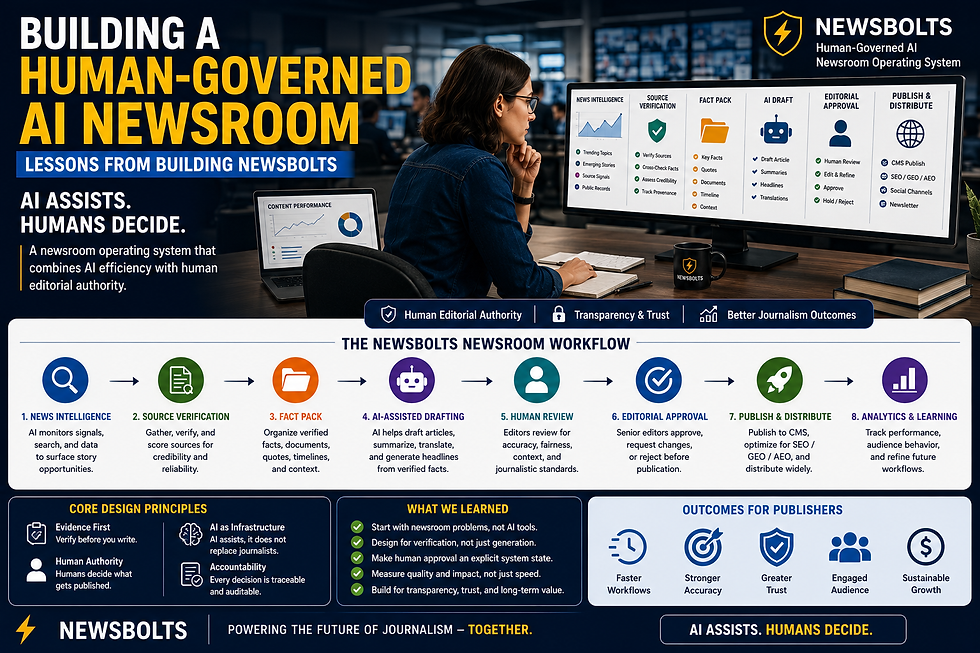
Discovery → Verification → Fact Pack → AI Assistance → Human Review → Approval → Publishing → Learning
The important feature is not the number of stages.
It is that AI assistance occurs inside an editorial system rather than outside it.
A Practical AI-Assisted Newsroom Workflow
A modern newsroom could structure an article workflow like this:
News Signal → Source Collection → Evidence Verification → Fact Pack → Editorial Brief → AI Draft → Human Review → Revision → Final Approval → CMS Publishing → Analytics
Each stage has a different purpose.
News Signal
A potential story is identified.
Source Collection
Relevant primary and secondary sources are gathered.
Evidence Verification
The newsroom determines which information is confirmed, disputed, incomplete, or still unknown.
Fact Pack
Verified information is organized into a structured reference for the reporting and writing process.
Editorial Brief
The newsroom defines the angle, audience, key questions, and boundaries of the story.
AI Draft
AI assists with the first version.
Human Review
An editor or journalist checks the output against the evidence.
Revision
Errors, omissions, unsupported claims, or weak framing are corrected.
Final Approval
An authorized person decides whether the final version can be published.
Publishing
The approved version moves to the CMS and distribution systems.
Analytics
The newsroom evaluates performance, engagement, corrections, and other relevant signals.
This workflow creates a critical separation between generation and publication.
Where Human Review Should Happen
Human involvement should not be restricted to the final stage.
There are several important intervention points.
Before AI Generation
A journalist or editor should define what the AI is being asked to do.
This reduces the risk of allowing a vague prompt to determine the story's framing.
After Source Collection
Someone should determine whether the evidence is appropriate for the task.
AI should not automatically treat every document, website, social post, or search result as equally authoritative.
After AI Drafting
The generated article should be compared with the approved evidence.
Editors should look for:
Unsupported claims
Missing context
Incorrect attribution
Incorrect numbers
Changed meanings
Invented quotations
Overconfident language
Conclusions that exceed the evidence
Before Publication
An authorized editor should approve the final version.
This final gate matters because changes may occur after the first review.
Risk-Based Human Oversight
Not every newsroom task requires identical levels of human involvement.
A risk-based system is usually more practical.
Risk | Example | Human Oversight |
Low | Formatting or metadata assistance | Quick review |
Moderate | Evergreen explainer | Factual and editorial review |
High | Breaking news | Detailed source and claim verification |
Very High | Allegations or sensitive reporting | Senior editorial review |
Critical | High-consequence public-interest story | Enhanced verification and approval |
These categories should be adapted to the publisher's own standards.
The key principle is:
More potential harm should generally mean stronger controls.
This also helps prevent another problem: making every editor manually review every low-risk AI operation with the same intensity.
AI Assistance Vs Automation Vs Autonomous Publishing
These terms are often used interchangeably, but they describe different operating models.
Model | AI Function | Human Role |
AI Assistance | Performs defined tasks | Makes editorial decisions |
Workflow Automation | Moves approved work between stages | Defines rules and handles exceptions |
Human-Governed AI | AI participates across workflow | Humans retain authority |
Autonomous Publishing | AI can potentially publish with limited intervention | Human involvement may be limited |
For most newsrooms, the most important distinction is between automation and authority.
A system can automatically move an article from “approved” to a CMS.
That does not mean the system should automatically decide whether the article deserves approval.
Automation can enforce a human decision without replacing it.
The Evidence Layer: Why Fact Packs Matter
A common weakness in AI-assisted journalism is asking a model to produce an article before establishing a reliable evidence base.
A stronger workflow creates an evidence layer first.
A Fact Pack might contain:
Verified facts
Source references
Dates
Names
Numbers
Quotes
Attribution
Conflicting claims
Open questions
Verification status
Editorial notes
The AI can then use that material to assist with drafting.
The editor can use the same evidence layer to review the output.
This creates a shared reference point between the machine and the newsroom.
Instead of asking:
“Does this article sound accurate?”
the editor can ask:
“Can this important claim be supported by the evidence we approved?”
That is a much stronger control.
A NewsBolts Editorial Control Model
For NewsBolts, a useful system design is to treat editorial control as a set of explicit states.
Draft
Content exists but is not approved.
Under Review
A journalist or editor is evaluating it.
Changes Requested
The content requires revision.
Approved
An authorized editor has approved the final version.
Published
The approved version has entered the publication workflow.
Updated
The published article has been materially revised.
Corrected
A published error has been identified and addressed.
This approach matters because a CMS should not interpret “AI draft completed” as “ready to publish.”
The publication permission should come from an explicit editorial state.
Editorial Review Checklist
Before approving AI-assisted journalism, an editor can use this checklist:
Important claims have supporting evidence.
Primary sources have been used where appropriate.
Quotations have been checked.
Dates and numbers are accurate.
Attribution is clear.
AI has not introduced unsupported facts.
AI has not changed the meaning of source material.
Important context is included.
The headline accurately reflects the story.
Analysis is distinguishable from factual reporting.
Sensitive claims receive appropriate scrutiny.
The final version, not an earlier draft, has been reviewed.
An authorized editor has approved publication.
Common Mistakes In Human-In-The-Loop AI Newsrooms
Treating Human Review As Proofreading
Editorial oversight involves judgment, not just grammar.
Reviewing The Output Without The Sources
An editor cannot meaningfully verify important claims without access to the supporting evidence.
Giving Every Story The Same Review Process
Risk varies by story.
Assuming AI Confidence Equals Accuracy
A confident answer is not evidence.
Allowing AI To Determine Publication Readiness
AI can flag problems, but publication authority should follow the newsroom's governance model.
Adding Too Many Human Gates
A workflow can become so cumbersome that editors spend their time managing process rather than improving journalism.
Failing To Track Changes
If AI or another system changes an approved article, the newsroom needs to know whether another review is required.
Benefits Of Human-In-The-Loop AI
Faster Routine Work
AI can assist with repetitive tasks such as summarization, transcription, formatting, and first-draft preparation.
More Consistent Workflows
A defined process can reduce ambiguity about who handles verification, review, and approval.
Better Allocation Of Editorial Time
Editors can spend more attention on high-risk decisions when routine tasks are structured effectively.
Stronger Traceability
A governed workflow can make it easier to determine how content moved from research to publication.
Controlled AI Adoption
Publishers can introduce AI into specific newsroom functions without handing the entire publishing process to an autonomous system.
AP's current guidance illustrates this controlled approach: AI may assist with several newsroom tasks, while AP journalists remain responsible for reviewing and editing AI output before publication.
Risks And Limitations
Human-in-the-loop AI is not a guarantee of accuracy.
Human reviewers can miss errors.
They can work with incomplete evidence.
They can become overloaded.
They can also develop excessive trust in automated systems.
There is another risk: automation bias.
If an AI system routinely produces acceptable drafts, reviewers may become less skeptical of its output.
That is why the workflow should make evidence and uncertainty visible rather than presenting AI output as inherently trustworthy.
Another limitation is cost.
Meaningful editorial review requires people, time, training, and clearly defined authority.
The objective should therefore not be maximum human intervention.
It should be appropriate human intervention.
How Publishers Should Implement Human-In-The-Loop AI
Publishers do not need to automate their entire newsroom at once.
A better starting point is a single workflow.
Step 1: Choose A Narrow Use Case
Start with something such as:
Document summarization
Article repurposing
Headline suggestions
Transcription
Research organization
Step 2: Define The Human Decision
Write down exactly what the journalist or editor must decide.
Step 3: Establish Evidence Requirements
Specify which sources are acceptable and which claims require verification.
Step 4: Create Risk Categories
Decide which stories require standard, enhanced, or senior review.
Step 5: Create Approval States
Make the difference between draft, review, approved, and published explicit.
Step 6: Measure The Workflow
Track both efficiency and editorial quality.
Step 7: Expand Gradually
Only extend automation after the workflow is understood and controlled.
NIST's AI RMF is similarly structured around managing AI risk across the lifecycle rather than treating risk as something considered only after deployment.
What Publishers Should Measure
A newsroom should not evaluate human-in-the-loop AI purely by the number of articles produced.
A better measurement framework includes:
Measurement | Question |
Review Time | How long does meaningful human review take? |
Revision Rate | How often does AI output require substantial editing? |
Rejection Rate | How often is AI output rejected? |
Verification Issues | How many material claims require correction? |
Post-Publication Corrections | What errors appear after publication? |
Workflow Delays | Where does content spend time waiting? |
Risk Routing | Are higher-risk stories receiving appropriate review? |
Output Quality | Is journalism maintaining editorial standards? |
Efficiency | Is AI reducing useful workload without reducing quality? |
These are measurement recommendations, not claims about NewsBolts performance.
Publishers should establish their own baseline before claiming improvement.
NewsBolts And The Human-Governed Newsroom
NewsBolts can be understood as infrastructure for connecting these stages into a Human-Governed AI Newsroom Operating System.
The important architecture is not simply “AI writes articles.”
It is:
News Intelligence → Source Verification → Fact Pack → AI-Assisted Drafting → Human Editorial Review → Approval → Publishing → Analytics → Repurposing
Each stage has a different responsibility.
AI can assist with production.
Workflow automation can move approved work between systems.
Analytics can provide feedback.
But humans remain responsible for editorial decisions.
This model also allows a publisher to connect newsroom processes with SEO, GEO, AEO, CMS publishing, analytics, and content repurposing without turning those systems into independent editorial authorities.
What Publishers Should Do
If your newsroom is beginning to use AI, establish these rules before increasing automation:
Define permitted AI uses.
Define prohibited or restricted uses.
Identify mandatory human review points.
Create an evidence layer before drafting.
Classify stories by risk.
Make approval an explicit system state.
Prevent unapproved content from reaching publication.
Record important review and approval actions.
Measure quality as well as production speed.
Review the workflow as AI capabilities change.
The strongest implementation is not necessarily the most automated.
It is the one where every automated action has a clear boundary.
NewsBolts Research Opportunity
NewsBolts could conduct a first-party study of human-in-the-loop newsroom workflows without assuming the results in advance.
A credible research design would define:
Participating publisher types
Story categories
AI tasks being evaluated
Human review requirements
Baseline production process
Review time
Revision rates
Rejection rates
Corrections
Editorial quality criteria
Sample size
Study period
Limitations
The results should be reported only after actual data is collected.
Until then, publishers should treat claims about AI productivity, accuracy, or editorial efficiency as claims requiring evidence rather than assumptions.
Conclusion
Human-in-the-loop AI for journalism is not simply a matter of putting an editor at the end of an AI content pipeline.
The stronger approach is to design the entire workflow around clear boundaries between machine assistance and human authority.
AI can discover signals, organize research, summarize documents, assist with drafts, suggest headlines, optimize content, and repurpose stories.
Humans should determine:
What is worth publishing
What the evidence supports
How the story should be framed
What requires additional reporting
Whether the final content meets editorial standards
Whether publication should proceed
The practical model is:
Discover → Verify → Fact Pack → Assist → Review → Approve → Publish → Learn
That is the core of a human-governed newsroom.
For NewsBolts, the objective is not to remove journalists from the workflow. It is to give newsroom teams an operating layer where AI can accelerate defined tasks while human editorial authority remains visible, enforceable, and accountable.
Frequently Asked Questions
What Does Human-In-The-Loop AI Mean In Journalism?
Human-in-the-loop AI means that people remain responsible for important decisions within an AI-assisted workflow. In journalism, this can include source evaluation, fact verification, editorial framing, revision, and publication approval.
Can AI Replace Journalists In A Human-In-The-Loop Newsroom?
A human-in-the-loop model does not require replacing journalists. Instead, it assigns AI specific supporting tasks while humans retain authority over reporting, verification, editorial judgment, and publication.
What Tasks Can AI Perform In A Newsroom?
Depending on the system and newsroom policy, AI can assist with tasks such as document summarization, transcription, translation, research organization, headline suggestions, drafting, grammar, search optimization, and content repurposing. AP currently permits several such uses while requiring journalist review before publication.
Does Every AI-Assisted Article Need The Same Human Review?
No. Review requirements can be based on editorial risk. Breaking news, allegations, sensitive reporting, and high-consequence subjects generally warrant stronger review than routine low-risk production tasks.
How Should Editors Review AI-Generated Journalism?
Editors should review the underlying evidence as well as the generated text. They should check factual claims, sources, quotations, numbers, dates, attribution, context, framing, and unsupported additions.
What Is The Difference Between AI Assistance And Autonomous Publishing?
AI assistance means AI performs defined tasks under human control. Autonomous publishing allows a system to make publication decisions with limited human intervention. Human-in-the-loop journalism emphasizes meaningful human authority over important editorial decisions.
Can A Human Review Process Guarantee Accurate AI Journalism?
No. Human review reduces risk but cannot guarantee accuracy. The quality of the evidence, review process, editor expertise, available time, and workflow design all influence the outcome.


Comments