Sustainable Revenue for Small Digital Publishers

A small digital publisher does not need millions of monthly visitors to build a sustainable business. The stronger approach is to build revenue around a clearly defined audience, valuable editorial products, and multiple income streams such as memberships, sponsorships, subscriptions, events, services, and carefully managed advertising. The goal is not maximum traffic alone; it is maximum business value from the right audience.

Search Intent and Editorial Strategy
Primary search intent: Informational and commercial investigation.
Main reader: Small digital publishers, independent news founders, niche media companies, editors, and newsroom operators.
Core problem: How to generate enough predictable revenue when traffic is too small to support a traditional advertising-first model.
Primary topic: Sustainable revenue for small digital publishers.
Related concepts:
Digital subscriptions
Memberships
Advertising
Sponsorships
Events
Donations
Reader revenue
Newsletter monetization
Publisher diversification
AI-assisted newsroom operations
Likely follow-up questions:
How many readers does a small publisher need to make money?
Are subscriptions better than advertising?
How can a niche publisher attract sponsors?
Can newsletters generate revenue?
Should a small publisher use a paywall?
What revenue streams work without huge traffic?
How can AI reduce newsroom operating costs?
How many revenue streams should a publisher have?
Unique value of this article: A practical Revenue Fit Framework and a simple publisher economics model that helps small publishers choose revenue streams based on audience relationship, editorial niche, operational capacity, and willingness to pay.
Why Traffic Alone Is a Weak Business Model
For years, digital publishing has often been associated with a simple equation:
More traffic → more advertising → more revenue
That model can work at large scale.
It is much harder for a small publisher.
A site with a highly specific audience may have strong editorial value but relatively modest traffic. If its entire business depends on display advertising, it may need a much larger audience before the economics become attractive.
The publishing industry is also dealing with changes in platform referrals, advertising, subscriptions, and AI-driven discovery. The Reuters Institute's 2026 trends report found that publishers continue to prioritize subscription and membership revenue while also pursuing advertising, events, platform funding, and other revenue sources.
That points to a different strategy for smaller publishers:
Build a valuable audience before trying to build a massive audience.
What Does Sustainable Revenue Mean for a Small Publisher?
Sustainable revenue means generating enough predictable income to support the publisher's editorial and operating costs without depending excessively on one unstable source.
It does not necessarily mean becoming highly profitable immediately.
A sustainable publisher should be able to answer three questions:
Who pays us?
Why do they pay us?
What happens if one revenue source falls?
This changes how publishers think about growth.
Instead of asking:
How can we get another 100,000 visitors?
Ask:
How can we create more value from the audience we already have?
The Small-Publisher Revenue Stack
A small publisher can consider several revenue categories:
Revenue Model | Best Fit | Traffic Requirement | Relationship Required |
Display advertising | Broad audiences | Higher | Low |
Direct sponsorship | Niche audiences | Low–Medium | Medium |
Membership | Loyal communities | Low–Medium | High |
Subscription | Premium information | Low–Medium | Very high |
Events | Local or professional audiences | Low–Medium | High |
Donations | Public-interest journalism | Low–Medium | Very high |
Newsletter sponsorship | Focused audiences | Low–Medium | Medium |
Services | Expert publishers | Low | High |
Affiliate revenue | Commercial-intent content | Low–Medium | Medium |
Grants/funding | Public-interest publishers | Low | High |
The important point is that traffic requirements vary dramatically between models.
A niche publisher with 20,000 highly relevant readers may have opportunities that a general publisher with much larger but less engaged traffic does not.
Start With the Audience, Not the Revenue Model
The biggest mistake is choosing a monetization method before understanding the audience.
Start by defining:
Audience → Problem → Value → Payment
For example:
A publisher covering local business news might have:
Audience: Local business owners
Problem: They need reliable information about regulations, competitors, local development, and opportunities.
Value: Timely, specialized reporting.
Possible revenue: Sponsorships, memberships, events, premium reports, and business subscriptions.
Another publisher covering technology policy could have:
Audience: Policy professionals and technology companies
Problem: They need specialized analysis and regulatory updates.
Value: Focused intelligence.
Possible revenue: Paid briefings, memberships, events, sponsorships, and research products.
The audience determines the economics.
The Revenue Fit Framework
NewsBolts can use a simple framework for evaluating revenue opportunities:
1. Audience Value
How important is your content to the audience?
2. Audience Loyalty
Do readers return regularly?
3. Commercial Intent
Does the audience make purchasing or professional decisions related to your coverage?
4. Exclusivity
Can your publisher provide information, access, analysis, or community that readers cannot easily get elsewhere?
5. Operational Capacity
Can your team actually deliver the proposed product?
Score each area from 1 to 5.
A revenue model with strong scores across these areas deserves more attention than one selected simply because another publisher uses it.
This is a strategic framework, not a claim about guaranteed revenue.
Build Around a Core Revenue Stream
Small publishers should generally avoid launching ten monetization products simultaneously.
Start with one strong core revenue stream.
For example:
Local publisher
→ Sponsorship
Specialized industry publication
→ Subscription
Community-focused publication
→ Membership
Investigative nonprofit
→ Donations and grants
Expert-led publication
→ Paid reports and services
Then add complementary revenue sources.
The objective is not maximum complexity.
It is revenue diversification without operational chaos.
Membership vs Subscription
These terms are often used interchangeably, but the business relationship can be different.
Subscription
The reader primarily pays for access to content or features.
Membership
The reader pays to support and participate in a publication or community, often receiving additional benefits.
A publisher might offer:
Free journalism
Member newsletter
Community access
Events
Ad-free experience
A subscription might instead focus on:
Premium reporting
Exclusive research
Paywalled articles
Premium data
The right choice depends on what the audience values.
Do Not Put Everything Behind a Paywall
A small publisher may be tempted to paywall its entire website.
That can create a problem.
If the publisher is still trying to grow recognition and audience relationships, restricting every article may reduce discovery opportunities.
A more selective approach can be:
Free content
→ Builds reach and trust
Premium content
→ Monetizes high-value information
This could include:
Specialized analysis
Industry intelligence
Data
Research
Investigations
Premium newsletters
Exclusive interviews
Member-only events
The premium product needs to provide a clear reason to pay.
Direct Sponsorship Can Work for Niche Publishers
Advertising networks typically reward scale.
Direct sponsorship can reward audience relevance.
Imagine a publisher has a relatively small audience of professionals in one industry.
A company that wants to reach those professionals may value the audience more than a much larger general audience.
Possible sponsorship products include:
Newsletter sponsorship
Sponsored sections
Event sponsorship
Podcast sponsorship
Research sponsorship
Topic sponsorship
The editorial boundary must remain clear.
A sponsor should not control independent editorial decisions.
That distinction is especially important for publishers building long-term trust.
Newsletter Revenue
A newsletter can become more than a distribution channel.
It can become a direct commercial product.
A publisher might use:
Website
→ Attracts readers
↓
Newsletter
→ Builds direct relationship
↓
Membership / Sponsorship / Subscription
→ Generates revenue
Newsletters can also help publishers reduce dependence on algorithmic distribution because the publisher has a direct communication channel with subscribers.
The revenue model could include:
Sponsorship
Paid newsletter
Membership
Subscription conversion
Premium research
Affiliate offers where appropriate
The important metric is not simply subscriber count.
Consider:
Open behavior + engagement + audience relevance + conversion
Events Can Become a Revenue Layer
Events are particularly relevant to publishers covering:
Local communities
Business
Technology
Politics
Industry sectors
Professional communities
Conferences
Roundtables
Webinars
Workshops
Community meetings
Executive briefings
Reuters Institute research has identified events as one of the revenue areas publishers are increasingly considering as part of diversified business models.
A small publisher does not necessarily need a large conference.
A focused event for a valuable niche audience may be more realistic.
Services Can Monetize Editorial Expertise
Some publishers have valuable knowledge that can be packaged into services.
Examples include:
Research
Industry briefings
Training
Data products
Custom reports
Professional newsletters
Workshops
This is particularly relevant when the publisher serves a specialized professional audience.
The key distinction is that services should not compromise editorial independence.
A newsroom can operate editorial content and commercial services with clear boundaries.
Donations and Grants
Donations and grants can be particularly relevant to nonprofit and public-interest journalism.
The Institute for Nonprofit News reported that its member outlets generated revenue from a mix of earned revenue, memberships, advertising, sponsorships, subscriptions, events, and charitable sources in 2025.
However, grants should not automatically be treated as permanent operating revenue.
A publisher should understand:
Funding duration
Eligibility
Reporting requirements
Renewal risk
Restrictions
Administrative cost
A grant can fund an important editorial project without necessarily solving the underlying business model.
A Simple Publisher Economics Model
Small publishers should model revenue before investing heavily in a monetization strategy.
Consider this hypothetical example:
A niche publisher has:
1,000 paying members at $5/month
2 direct sponsors at $750/month each
$500/month in advertising
One small event generating $1,000/month on average
The monthly revenue would be:
$5,000 + $1,500 + $500 + $1,000 = $8,000
Annualized:
$8,000 × 12 = $96,000
These are illustrative numbers, not industry benchmarks or NewsBolts results.
The important lesson is the structure.
The publisher does not need one source to generate the entire $8,000.
It builds a portfolio.
Revenue Diversification Does Not Mean Revenue Confusion
Adding revenue streams can make a business stronger.
But too many revenue streams can create operational problems.
For example, a small team could attempt:
Advertising
Paid newsletter
Membership
Podcast
Events
Merchandise
Consulting
Courses
Affiliate content
Research reports
That sounds diversified.
In practice, it could overwhelm a five-person newsroom.
A better approach is:
One core revenue stream
One complementary stream
One experimental stream
Then measure the results.
The 3-Layer Revenue Model
A practical structure for small publishers is:
Layer 1: Core Revenue
The primary source supporting the business.
Examples:
Subscription
or
Membership
or
Sponsorship
Layer 2: Complementary Revenue
A second source that fits the same audience.
Examples:
Events
Newsletter sponsorship
Advertising
Layer 3: Experimental Revenue
A controlled test.
Examples:
Premium research
Courses
Data products
New sponsorship package
This structure prevents the newsroom from turning every new idea into a full business line.
Use Content to Support Revenue, Not Just Traffic
A publisher should map content to business value.
For example:
Breaking news
→ Reach
Explainers
→ Search discovery
Investigations
→ Trust and differentiation
Expert analysis
→ Subscription value
Newsletters
→ Audience retention
Events
→ Community
Research
→ Premium revenue
This creates a more deliberate publishing portfolio.
Not every article needs to make money directly.
Some content exists to attract readers.
Other content exists to deepen the relationship.
The business becomes stronger when those roles are understood.
AI Can Improve the Economics Without Replacing Editorial Judgment
AI can also affect publisher economics by reducing repetitive operational work.
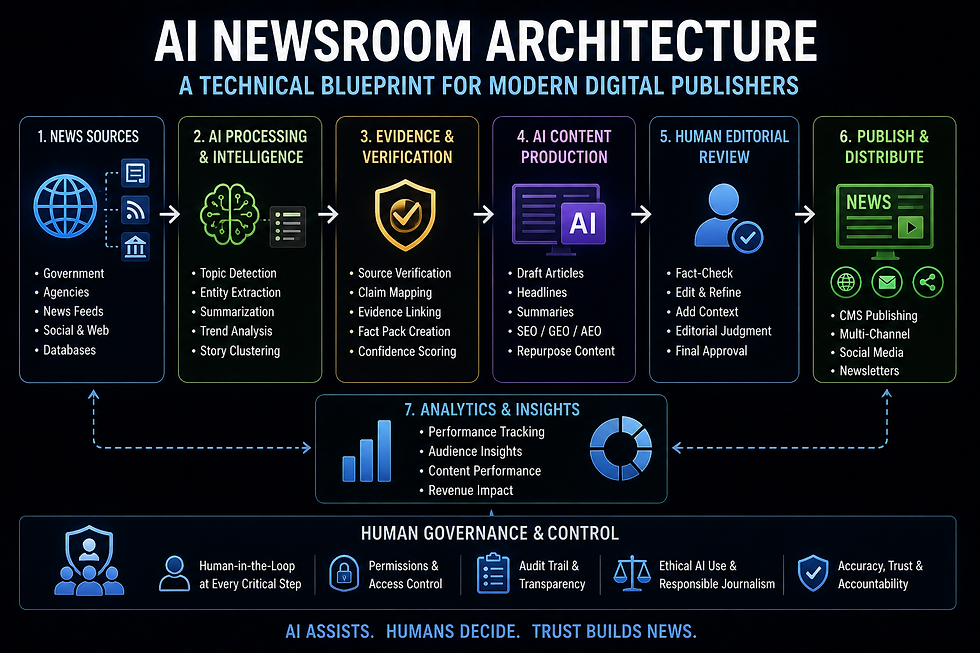
A Human-Governed AI Newsroom Operating System such as NewsBolts can be used to support workflows around:
News intelligence
Source organization
Fact Packs
Draft assistance
Editorial review
SEO/GEO/AEO optimization
Publishing workflows
Analytics
Content repurposing
The important distinction is between automation and editorial authority.
AI can assist with repetitive tasks.
Editors should remain responsible for:
Source verification
Accuracy
Context
Editorial judgment
Ethical decisions
Final publication
The economic opportunity is therefore not simply:
AI replaces journalists.
A more responsible model is:
AI reduces repetitive workflow overhead → newsroom capacity improves → humans spend more time on valuable journalism and products.
A Practical Revenue Workflow for Small Publishers
Use this process:
Step 1: Define the audience
Who is the publisher serving?
Step 2: Identify the strongest need
What information or community value does that audience need?
Step 3: Identify willingness to pay
Would the audience pay for access, convenience, expertise, community, or specialized information?
Step 4: Select one core model
Choose the revenue model with the strongest audience fit.
Step 5: Create the product
Define exactly what the customer receives.
Step 6: Test pricing
Run a controlled offer rather than guessing indefinitely.
Step 7: Measure conversion
Track visitors, registrations, paying customers, retention, and revenue.
Step 8: Add one complementary stream
Only after the core model is functioning.
What Small Publishers Should Measure
Traffic is still useful, but it should not be the only metric.
A better dashboard includes:
Audience
Returning visitors
Newsletter subscribers
Registered users
Engaged readers
Revenue
Monthly recurring revenue
Revenue per paying user
Advertising revenue
Sponsorship revenue
Event revenue
Conversion
Visitor-to-subscriber rate
Newsletter-to-member conversion
Trial-to-paid conversion
Retention
Subscription cancellations
Membership renewal
Repeat event participation
Editorial economics
Cost per content product
Production time
Revenue contribution
Staff capacity
The goal is to understand which editorial activities create sustainable business value.
Common Mistakes
Chasing Traffic Before Building Value
A larger audience is useful only if the publisher can convert that attention into a sustainable business.
Depending Entirely on Advertising
Advertising can be useful, but relying on one revenue source creates concentration risk.
Launching Too Many Products
A small newsroom cannot operate like a large media company.
Copying Large Publishers
A national newspaper's subscription strategy may not fit a niche publication.
Making the Paywall the Product
A paywall only controls access.
The actual product is the journalism, information, analysis, community, or service behind it.
Ignoring Retention
Getting a subscriber is only the beginning.
The publisher must continue providing enough value for that relationship to continue.
Mixing Commercial and Editorial Decisions
Sponsors and advertisers should not determine independent editorial conclusions.
Risks and Limitations
No revenue model works for every publisher.
Subscriptions can fail when the audience does not perceive enough exclusive value.
Advertising can be weak when traffic is limited.
Sponsorships require sales effort.
Events require planning and operational capacity.
Donations can be unpredictable.
Services can distract a newsroom from journalism.
AI can reduce repetitive work, but it also introduces risks around inaccurate information, source handling, and inappropriate automation.
That is why diversification should be selective.
More revenue streams do not automatically mean a healthier business.
NewsBolts Revenue Framework
For NewsBolts, a useful way to think about publisher sustainability is:
Audience → Editorial Value → Relationship → Product → Revenue → Retention
AI can support the workflow around this system.
For example:
News intelligence
→ Identify valuable topics
↓
Source verification
→ Build trustworthy information
↓
Fact Pack
→ Organize evidence
↓
Editorial production
→ Create useful journalism
↓
SEO/GEO/AEO
→ Improve discoverability
↓
Publishing
→ Reach the audience
↓
Analytics
→ Understand behavior
↓
Content repurposing
→ Extend the value of existing work
The purpose is not to automate editorial authority.
The purpose is to help a newsroom operate more efficiently while humans remain responsible for the journalism.
What Publishers Should Do First
If you run a small digital publication, start with a simple exercise.
Write down:
Our audience: Who exactly are we serving?
Our strongest editorial value: What can we provide better than general news sources?
Our most loyal audience behavior: What do readers repeatedly return for?
Our strongest commercial opportunity: What could this audience reasonably pay for or attract sponsors around?
Our core revenue model: Which model fits the answers?
Then build one product around that opportunity.
Do not start with a complicated monetization strategy.
Start with a clear audience and a valuable product.
Sustainable Revenue Is About Relationship, Not Just Reach
The strongest opportunity for many small publishers is not to imitate the economics of mass media.
It is to build a different relationship with a smaller but more relevant audience.
That might mean:
5,000 loyal readers
instead of
500,000 casual visitors.
The exact economics will vary by market, audience, pricing, costs, and product. There is no universal traffic threshold that guarantees sustainability.
But the strategic principle is consistent:
Audience quality can matter more than audience size when revenue depends on direct relationships.
Reuters Institute research continues to show publishers diversifying beyond advertising, with subscriptions, memberships, events, native advertising, platform funding, and other sources all forming part of the broader revenue picture.
Conclusion
Small digital publishers do not necessarily need massive traffic to build a sustainable business.
They need a valuable audience, a clear editorial proposition, and revenue models that fit the relationship they have with that audience.
A practical strategy is:
Find the right audience → create differentiated value → build a direct relationship → develop one core revenue product → add complementary revenue → measure retention and economics.
Advertising can remain part of the model, but publishers can also consider subscriptions, memberships, sponsorships, newsletters, events, services, donations, and premium information products.
For NewsBolts, the opportunity is to help publishers build the operational infrastructure behind that strategy while keeping editorial authority with humans.
The goal is not to publish more content simply to chase traffic.
The goal is to build a newsroom that produces useful journalism, develops audience relationships, and turns editorial value into sustainable revenue.
FAQs
Can a small digital publisher make money without millions of visitors?
Yes, but there is no universal traffic threshold for profitability. A smaller publisher can focus on higher-value revenue models such as subscriptions, memberships, sponsorships, events, services, or donations.
Is advertising a good revenue model for small publishers?
Advertising can work, particularly when the audience is large or commercially valuable. However, a small publisher may benefit from combining advertising with more direct revenue sources.
Are subscriptions better than advertising?
Neither is universally better. Subscriptions work when readers see enough exclusive value to pay. Advertising works when the publisher can attract valuable audience attention at sufficient scale.
How can niche publishers attract sponsors?
Start by defining the audience precisely. Sponsors may be interested in a smaller audience if it closely matches their target market. Publishers should offer clear sponsorship products while maintaining editorial independence.
Should a small publisher use a paywall?
Not necessarily. A paywall makes sense when the publisher has content or services that readers consider valuable enough to pay for. Some publishers may instead use memberships, donations, or premium products.
Can newsletters generate revenue?
Yes. Newsletters can support sponsorships, paid subscriptions, memberships, and conversion into other publisher products. The best model depends on the audience and the value of the newsletter.
How many revenue streams should a small publisher have?
There is no universal number. A practical approach is to establish one core revenue stream, add one complementary stream, and test additional ideas carefully.
Can AI help small publishers become more efficient?
AI can assist with research, organization, drafting, optimization, analytics, and repetitive workflow tasks. Human editors should retain responsibility for verification, editorial judgment, and final publication.


Comments