Generative Engine Optimization (GEO) For Publishers: How To Get Your News Cited In AI Overviews

The rules of digital discovery have fundamentally shifted. For over two decades, the publisher's playbook was simple: optimize for blue links, target high-volume keywords, build backlinks, and capture clicks from Google's search engine results page (SERP).
Today, that playbook is evolving rapidly. With the rise of Google AI Overviews, ChatGPT, Perplexity, and other answer engines, a growing percentage of user queries are answered directly on the search results page. Users get immediate summaries, synthesized insights, and direct answers without ever clicking through to a traditional website.
For digital publishers, this shift has sparked a major panic: If AI answers the query on the search page, how do our articles get traffic?
The answer doesn't lie in abandoning search optimization it lies in mastering Generative Engine Optimization (GEO). To survive and thrive, publishers must adapt their content architectures so that AI engines don't just read their news, but actively cite them as primary, authoritative sources.
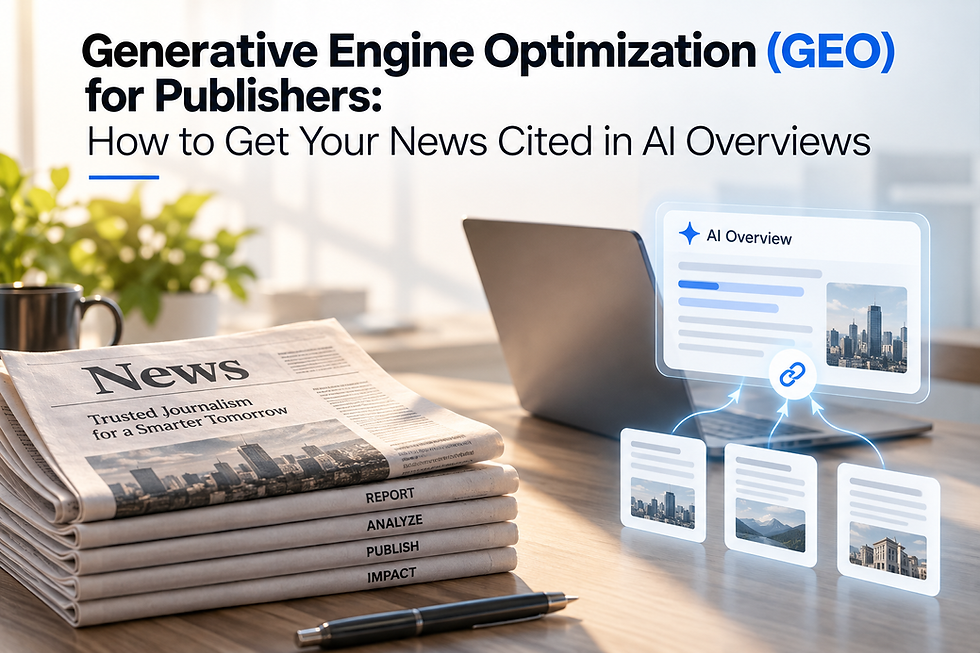
What is Generative Engine Optimization (GEO)?
While traditional Search Engine Optimization (SEO) focuses on ranking higher for keyword queries based on algorithms, Generative Engine Optimization (GEO) focuses on structuring content so that Large Language Models (LLMs) and generative search systems select, synthesize, and attribute your journalism in their responses.
When an AI engine generates an overview or answers a complex prompt, it relies heavily on specific structural markers:
Clear Attribution & E-E-A-T: AI models look for clear signs of institutional authority, expert author credentials, and verified primary sources.
Granular, Fact-Dense Formatting: LLMs prefer crisp, definitive data points, structured tables, and well-defined bulleted summaries that can be easily parsed.
Contextual Proximity: Answers that directly address user intent in the opening paragraphs are far more likely to be extracted and cited.
If your articles are buried in walls of unstructured text, vague generalizations, or unverified AI filler, generative engines will bypass you entirely or worse hallucinate information while crediting a competitor.
4 Strategies to Optimize News Content for AI Overviews and GEO
Getting your publication cited in generative search results requires a systematic upgrade to how you write, format, and verify your news.
1. Structure Articles with Answer-First Hierarchies
Generative engines scan content for precise definitions and direct answers to complex queries.
The Fix: Avoid buried leads or overly creative preamble. Use explicit H2 subheadings phrased as common reader questions (e.g., "What caused the shift in publishing workflows?"), followed immediately by a concise, data-driven 2-to-3 sentence summary paragraph. AI algorithms love to lift and cite text blocks structured this way.
2. Prioritize Verifiable Primary Sources and Data Points
AI engines are programmed to reduce hallucinations by cross-referencing claims. If your article contains sweeping statements without sources, generative tools will ignore it to avoid spreading misinformation.
The Fix: Embed direct references, clear statistics, primary document links, and expert attribution into your drafts. When an AI search engine crawls your page, it recognizes verifiable facts and is far more likely to include your publication in its citation list.
3. Implement Clear FAQs and Summary Blocks
Structured data and clear visual breakouts help LLMs parse the core takeaways of a long-form investigative piece or breaking news update.
The Fix: End your articles with a dedicated FAQ section targeting secondary search queries. Use clean bulleted lists for key takeaways. This gives generative models ready-made snippets they can cleanly extract and attribute back to your URL.
4. Guard Against AI Hallucinations in Your Own Stack
The greatest threat to a publisher's GEO performance is low-quality, automated content. If search engines or AI crawlers detect that your site publishes unverified, hallucinated AI drafts, your overall domain authority collapses meaning AI engines will stop crawling or citing you altogether. GEO requires absolute factual integrity.
How NewsBolts Helps Publishers Win at GEO
Adapting to Generative Engine Optimization manually can overwhelm an already stretched newsroom desk. Writing fast while embedding rigorous fact-checking and structured formatting requires a modern operational framework.
NewsBolts is a Human-Governed AI Newsroom Operating System designed to handle these exact demands. It provides digital publishers with an end-to-end workflow from automated news intelligence and verified source research to built-in SEO, GEO, and AEO optimization while ensuring human journalists retain strict control over editorial quality.
By integrating NewsBolts into your publishing pipeline, you can:
Automatically structure breaking stories with optimized headings and summary blocks tailored for AI search engines.
Enforce human-in-the-loop verification gates so every statistic and claim is bulletproof before publication.
Scale your output across traditional search and generative engines without compromising on editorial integrity or brand trust.
Frequently Asked Questions
What Is the Difference Between SEO and GEO for Publishers?
SEO (Search Engine Optimization) focuses on improving a website’s visibility in traditional search results, while GEO (Generative Engine Optimization) generally refers to creating and structuring content so that generative AI and answer engines can understand, summarize, and potentially cite it. For publishers, both approaches depend on useful, original, clearly structured, and trustworthy content.
How Can News Publishers Appear in Google AI Overviews?
News publishers can improve their chances of appearing in Google AI Overviews by publishing original and useful content, maintaining clear page structure, using descriptive titles and headings, providing accurate information, and following established SEO best practices. Google does not require special GEO markup or a separate optimization system for AI Overviews.
Does AI-Generated Content Hurt SEO and AI Search Visibility?
AI-generated content does not automatically hurt SEO or AI search visibility. The main concern is whether the content is useful, original, accurate, and created for people rather than primarily to manipulate search rankings. Publishers using AI for research, drafting, summarization, or optimization should maintain appropriate human review and editorial oversight.
How Can Publishers Optimize Content for AI Search?
Publishers can optimize content for AI search by answering important questions clearly, providing original information and analysis, using descriptive headings, maintaining accurate facts and sources, and creating strong internal links between related pages. Content should be written to satisfy the reader’s intent rather than trying to manipulate AI-generated answers.
What Makes Content More Likely to Be Cited by AI Search Engines?
There is no guaranteed formula for earning citations from AI search engines. Publishers can improve their chances by providing original information, clear explanations, reliable sources, specific facts, and content that directly addresses the user’s question. Strong editorial standards and transparent authorship can also help establish context and trust.
Does Human Review Improve AI-Assisted Content Quality?
Human review can improve the reliability and quality of AI-assisted content by allowing editors to check facts, sources, context, wording, and potential errors before publication. In a news publishing workflow, human editors can remain responsible for verification and final publishing decisions while AI handles repetitive or time-consuming tasks.
How Should News Publishers Use AI Without Losing Editorial Control?
News publishers can use AI for tasks such as research assistance, summarization, transcription, translation, drafting, metadata generation, and content repurposing while keeping important editorial decisions under human control. A human-governed workflow should define which tasks AI can perform and which decisions require journalist or editor approval.
Is FAQ Content Still Useful for SEO?
FAQ content can still be useful for SEO because it helps publishers address specific questions and cover related search intent. However, FAQs should primarily provide useful answers for readers rather than being created only to obtain a search-result feature. Clear, concise answers can also make important information easier for users and answer systems to understand.
Can Human-Governed AI Newsrooms Improve SEO and AI Search Visibility?
A human-governed AI newsroom can support SEO and AI search workflows by helping publishers research topics, verify information, create structured drafts, optimize metadata, build internal links, and repurpose content efficiently. However, AI-assisted workflows do not guarantee higher rankings or citations. Search visibility still depends on factors such as content quality, relevance, technical accessibility, authority, and competition.
What Is the Best Workflow for AI-Assisted News Publishing?
A practical AI-assisted news publishing workflow typically includes news discovery, source research, fact verification, AI-assisted drafting, human editorial review, SEO and metadata optimization, publication, and performance analysis. The exact workflow should depend on the publisher’s editorial standards, content type, risk level, and publishing requirements.



Comments