How To Prevent AI Hallucinations In Digital Publishing: A Human-in-the-Loop Guide

For digital publishers, generative AI is a double-edged sword. On one hand, it offers the speed required to keep up with a 24-hour news cycle, draft summaries, and scale content output. On the other hand, publishing a single AI-generated hallucination can permanently destroy a media brand's credibility, trigger severe legal risks, and cause search rankings to plummet.
As search engines and AI aggregators prioritize verified, authoritative journalism, managing editors are facing a critical question: How do you scale content production with AI without compromising accuracy? This is especially relevant given the rising concerns regarding AI Hallucinations in digital publishing, which can quickly erode audience trust.
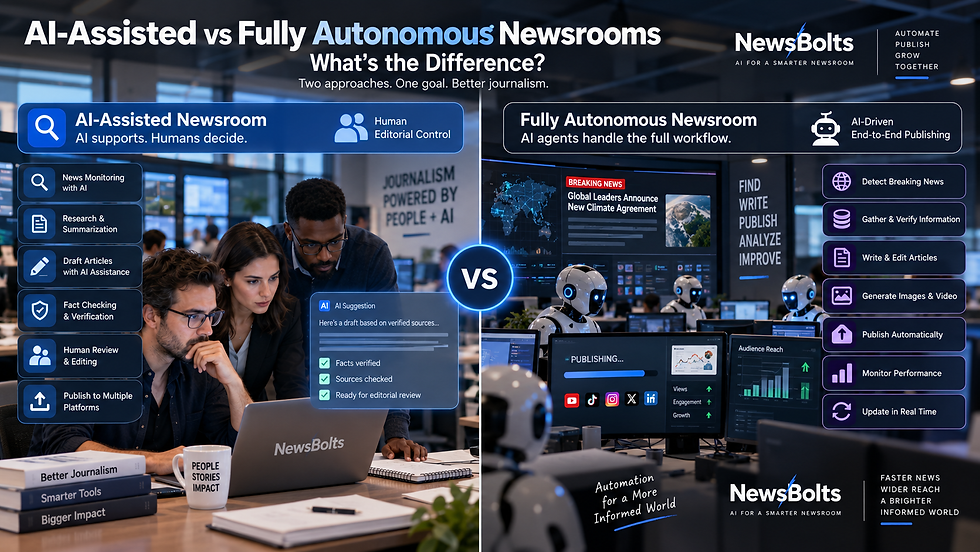
The answer lies in moving away from autonomous, "set-it-and-forget-it" content generation and implementing a Human-Governed AI Newsroom Operating System.

The Risk of Unsupervised AI in Newsrooms
When publishers rely on generic AI models to write or research stories entirely on their own, several failure points emerge:
Hallucinated Facts and Quotes: Large Language Models (LLMs) are predictive text engines; they predict the next likely word, not the objective truth. They frequently invent statistics, historical events, or expert quotes.
Lack of Contextual Judgment: AI struggles to weigh the nuance, ethical implications, or public interest value of a developing story.
SEO Penalties: Search engines actively demote low-quality, unverified programmatic content that provides no unique human insight.
To capture search traffic and build long-term trust, publishers must treat AI as a high-speed research and drafting assistant, never as a final decision-maker.
4 Steps to Build a Human-in-the-Loop Verification Workflow
Implementing a strict verification framework ensures your content remains accurate while still benefiting from AI efficiency.
1. Source-Backed Research Intelligence
Instead of asking an AI to "write an article about X from scratch," use AI to aggregate real-time news signals, monitor verified RSS feeds, and pull primary documentation.
The Rule: The AI must cite its source URLs or primary documents for every data point it suggests.
2. Structured Editorial Review Gates
An effective AI publishing workflow requires hard stops where human intervention is mandatory. Build a system with distinct operational gates:
Gate 1 (Drafting): AI generates the initial structural outline, headline variations, and a rough draft based on verified inputs.
Gate 2 (Fact-Checking): A human journalist or dedicated research editor cross-references every statistic, name, and claim against primary sources.
Gate 3 (Editorial Polish): The managing editor reviews the tone, voice, and alignment with brand guidelines before approval.
3. Automated Guardrails and Policy Checks
Integrate automated checks before a draft reaches the human editor. Your system should automatically flag risky phrasing, unverified statistics, or potential policy violations, cutting down the manual review burden.
4. Continuous Human Accountability
No matter how advanced the automation becomes, the final "Publish" button must belong to a human. This ensures full editorial accountability and satisfies E-E-A-T (Experience, Expertise, Authoritativeness, and Trustworthiness) standards required by modern search engines.
How NewsBolts Powers Safe, Scalable Newsrooms
Achieving this level of rigorous control requires more than standard writing tools it demands an operating system built specifically for the media industry.
NewsBolts is a Human-Governed AI Newsroom Operating System designed to bridge the gap between AI speed and editorial integrity. It handles the heavy lifting across your publishing workflow from news intelligence, source research, and automated fact-checking assistance to SEO optimization while keeping journalists firmly in control of verification and final publishing decisions.
By integrating NewsBolts into your publishing stack, you can:
Automate repetitive drafting and research without sacrificing accuracy.
Enforce human-in-the-loop review gates natively within your publishing pipeline.
Scale your digital publication faster while maintaining absolute brand trust.
Frequently Asked Questions
What is a human-governed AI newsroom?
A human-governed AI newsroom uses automation for repetitive tasks like research aggregation, drafting, and optimization, but mandates human oversight for fact-checking, editorial judgment, and final publishing decisions.
How do I prevent AI hallucinations in journalism?
You prevent hallucinations by implementing strict human-in-the-loop review workflows, requiring AI tools to reference verified source documents, and mandating human fact-checking before any content goes live.
Can AI-assisted content rank well on Google?
Yes, provided it meets high standards of originality, factual accuracy, and E-E-A-T. Search engines reward content that provides genuine value and verified insights, regardless of whether AI was used as a drafting tool.


Comments