How to Automate News Article Workflows Without Losing Editorial Control

The digital publishing industry is caught in a high-stakes balancing act. On one side, audience demand for real-time news is relentless, forcing newsrooms to produce more content across multiple channels than ever before. On the other side, shrinking profit margins and leaner newsroom staffs make scaling manual output nearly impossible.
Naturally, publishers have turned to generative AI to bridge the gap. Yet, full automation the "set-it-and-forget-it" approach often results in brand-damaging errors, unverified claims, and generic content that search engines actively demote.
For managing editors and executive publishers, the central challenge is no longer whether to adopt AI, but how to automate news article workflows without losing editorial control.

Why Full Newsroom Automation Fails
When media organizations attempt to fully automate their content pipelines using standard LLMs or generic content generation tools, they typically encounter three major roadblocks:
The Verification Bottleneck: Without structured oversight, AI-generated drafts often slip through with fabricated quotes, outdated statistics, or subtle factual errors that destroy audience trust.
Homogenized Voice: Unsupervised AI produces predictable, bland prose that lacks the investigative depth, unique perspective, and editorial voice that readers expect from established media brands.
Loss of Accountability: When an automated article faces backlash or legal scrutiny, pointing the finger at an algorithm does not protect a publication's reputation. Editorial accountability must remain human.
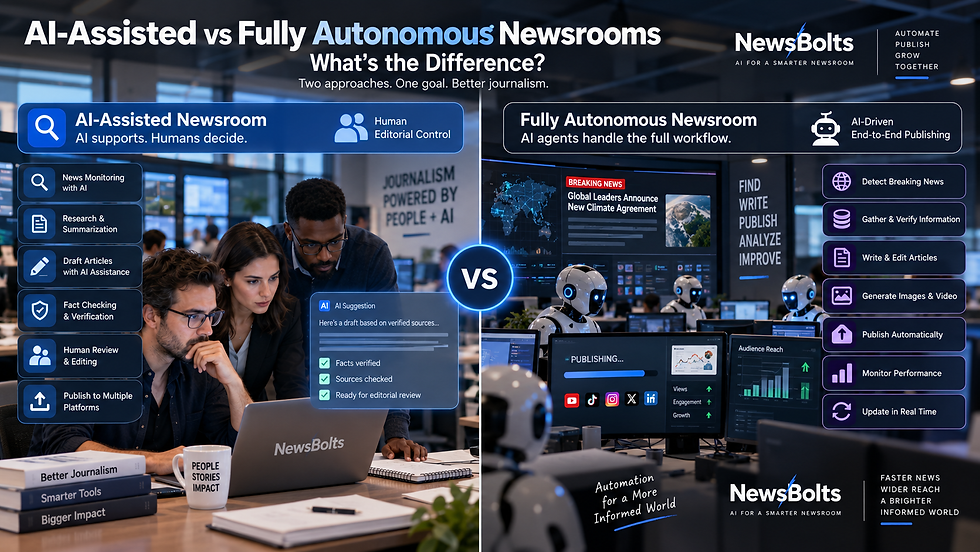
To capture the efficiency of automation while protecting brand integrity, publishers need a shift in architecture: moving from autonomous generation to human-governed workflows.
4 Pillars of a Human-Governed Publishing Workflow
Automating a newsroom successfully means building checkpoints where AI handles the heavy operational lifting, while human journalists retain veto power at every critical junction.
1. AI-Driven Intelligence, Human-Led Verification
AI excels at monitoring thousands of RSS feeds, aggregating real-time breaking news signals, and summarizing primary documentation.
The Workflow Shift: Let your AI intelligence layer surface the story angles and pull raw data sources. However, mandate that no draft can be compiled until a human researcher or reporter explicitly verifies the primary source links.
2. Structured Multi-Gate Editorial Review
Instead of a single "draft-to-publish" pipeline, a modern automated newsroom uses strict operational gates:
Gate 1 (Automated Outline & Draft): AI generates a structured draft, suggested SEO headings, and bulleted summaries based strictly on verified source materials.
Gate 2 (The Fact-Check Gate): A dedicated editor reviews data points, names, and statistics against primary references.
Gate 3 (The Editorial Polish Gate): The managing editor reviews tone, framing, and brand alignment before pushing content live.
3. Automated Guardrails and Compliance Checks
Before an article ever reaches an editor's desk, automated guardrails should scan the text for high-risk phrases, policy compliance issues, or structural inconsistencies. This reduces the manual review burden and catches potential errors before human eyes even review the piece.
4. Seamless Multi-Channel Repurposing
Automation shouldn't stop at the written article. Once a human-verified story is approved, the workflow should automatically adapt the core asset into social formats such as transforming key bullet points into article-to-reel scripts or newsletters without requiring redundant manual rewriting.
How NewsBolts Bridges the Gap Between Speed and Control
Achieving this level of rigorous, multi-gate automation requires more than piecing together generic writing tools. It demands a dedicated operating system built for modern publishers.
NewsBolts is a Human-Governed AI Newsroom Operating System designed specifically to solve this workflow dilemma. It manages the entire publishing lifecycle from automated news intelligence, source research, and AI-assisted drafting to SEO/GEO/AEO optimization while keeping journalists and editors firmly at the helm of verification and final publishing decisions.
By integrating NewsBolts into your digital publishing stack, you can:
Scale your daily output without compromising on E-E-A-T (Experience, Expertise, Authoritativeness, and Trustworthiness).
Eliminate hallucinations through built-in source-checking and structured editorial review gates.
Protect your brand’s editorial voice while leveraging cutting-edge newsroom automation.
Frequently Asked Questions
How Can Publishers Prevent AI Hallucinations in Digital Publishing?
Publishers can reduce AI hallucinations in digital publishing by grounding AI-generated content in verified sources and adding mandatory human review before publication. A reliable workflow should separate source collection, fact verification, AI drafting, editorial review, and final publishing so unsupported claims can be identified before they reach readers.
What Is a Human-in-the-Loop AI Newsroom?
A human-in-the-loop AI newsroom uses AI to assist with tasks such as research, summarization, drafting, content repurposing, and SEO while keeping important editorial decisions under human oversight. Journalists and editors remain responsible for checking sources, verifying claims, adding context, and approving content for publication.
How Does Human Review Reduce AI Hallucinations?
Human review provides an editorial checkpoint between AI generation and publication. Editors can compare AI-generated claims with source material, verify names and statistics, identify missing context, remove unsupported statements, and decide whether a story is ready to publish.
Can AI Be Used Safely for Newsroom Content Creation?
Yes. AI can be used as an AI-assisted newsroom tool when publishers establish clear controls around source verification, fact-checking, editorial review, and publication. The level of human involvement should increase for sensitive, complex, or high-risk stories.
How Should a Newsroom Verify AI-Generated Content?
A newsroom should verify important AI-generated claims against reliable source documents or original sources. Editors should pay particular attention to statistics, quotations, names, dates, allegations, and statements that could materially change the meaning of a story.
What Is the Best Workflow for Preventing AI Hallucinations in Journalism?
A practical workflow is Source Collection → Fact Verification → Structured Fact Pack → AI Drafting → Human Review → Final Approval → Publication. This separates evidence from generation and gives editors a defined opportunity to identify unsupported or incorrect information before publication.
Can AI-Assisted Newsroom Workflows Improve SEO?
AI-assisted workflows can help publishers produce and maintain content more efficiently, but automation itself does not guarantee better rankings or search visibility. SEO still depends on factors such as search intent, useful and original content, technical accessibility, internal linking, and the overall quality of the page.
Does Google Penalize AI-Generated Content?
Google does not say that content is automatically problematic simply because AI was used to create it. Its guidance focuses on whether content provides value to users and warns against scaled content created primarily to manipulate search rankings without adding sufficient value.
Why Is Human Oversight Important in an AI Newsroom?
Human oversight is important because AI can generate incorrect or unsupported information even when the output appears convincing. Editors provide source judgment, context, ethical review, and final accountability that cannot safely be reduced to automated content generation alone.


Comments