SEO vs GEO vs AEO: What Digital Publishers Need To Know

SEO vs GEO vs AEO are closely related but focus on different discovery experiences. SEO helps publishers improve visibility in traditional search results, GEO focuses on making content understandable and useful for generative AI systems, while AEO focuses on providing clear answers to specific questions. For digital publishers, the strongest strategy is usually to treat these approaches as complementary rather than separate channels.

Why Publishers Need To Understand SEO, GEO, And AEO
Search is no longer limited to a list of blue links.
A reader might search Google for a topic, receive an AI Overview, ask a follow-up question in AI Mode, use Bing Copilot, or ask another generative AI system to summarize an issue.
For publishers, that creates a more complicated visibility environment.
The important question is no longer simply:
“How do we rank this article?”
It is also:
“Can search and AI systems understand this article, retrieve the right information from it, and identify it as a useful source?”
Google's current documentation makes an important point: existing SEO practices remain relevant to AI Overviews and AI Mode. Google says there are no additional technical requirements or special markup required specifically for those AI features.
That means publishers should not abandon SEO and replace it with a completely separate “AI optimization” system.
Instead, the better approach is to build one strong editorial foundation and optimize different layers of that foundation for different discovery environments.
For NewsBolts, this distinction matters because a Human-Governed AI Newsroom Operating System should help publishers manage the entire chain:
Research → Verification → Reporting → Structure → Search Discovery → AI Retrieval → Human Review → Publication → Measurement
What Is SEO?
Search Engine Optimization (SEO) is the practice of making content easier for search engines to discover, crawl, understand, index, and serve to users.
For publishers, SEO covers much more than keywords.
It includes:
crawlability
indexing
internal linking
URL structure
page titles
headings
content relevance
technical accessibility
structured data
page experience
author and publication information
content quality
topical coverage
Google describes SEO as helping search engines understand content and helping users find a site through search.
For a news publisher, consider an article about a major election.
Traditional SEO questions include:
Can Google crawl the article?
Is the URL indexable?
Is the headline descriptive?
Does the article address the search intent?
Are related stories internally linked?
Is the page technically accessible?
Is the article original and useful?
Is the publication date clear?
Is the author identifiable?
These fundamentals remain important even when the eventual reader encounters the article through an AI-generated search experience.
SEO Is The Foundation
A useful way to think about SEO is:
SEO makes content discoverable and understandable to search systems.
Without that foundation, other optimization efforts have limited value.
Google's AI-search documentation specifically states that pages generally need to be indexed and eligible to appear in Google Search with a snippet to be eligible as supporting links in AI Overviews or AI Mode.
That makes technical SEO and content quality foundational rather than obsolete.
What Is AEO?
Answer Engine Optimization (AEO) is an industry term commonly used for structuring content so that systems answering questions can identify and present concise, useful answers.
Unlike traditional SEO, which often begins with a search query and a results page, AEO focuses more heavily on the question-and-answer relationship.
For example, instead of simply targeting:
“AI newsroom”
an AEO-oriented publisher might address questions such as:
What is an AI newsroom?
How does an AI newsroom work?
Can AI write news articles?
What should journalists verify before publishing AI-assisted content?
What is human-in-the-loop journalism?
The goal is not to manipulate an answer engine.
The goal is to make the answer clear, direct, complete, and supported by context.
What Makes Content AEO-Friendly?
A strong answer-oriented section usually has:
A clear question.
A direct answer.
Supporting explanation.
Evidence or sources where appropriate.
Context and limitations.
Related questions.
For example:
What Is Human-in-the-Loop Journalism?
Human-in-the-loop journalism is a workflow in which AI assists with tasks such as research organization, summarization, drafting, or classification while a human journalist or editor retains responsibility for verification, editorial judgment, and publication.
That answer can then be expanded with examples, workflow stages, risks, and editorial controls.
This structure helps human readers too.
AEO should therefore be treated as a clarity discipline, not merely a search tactic.
What Is GEO?
Generative Engine Optimization (GEO) is a broader industry term for improving the likelihood that content is understood, retrieved, referenced, or cited within generative AI and AI-powered search experiences.
The terminology is not as standardized as SEO.
Different companies, researchers, and practitioners may use “GEO” differently. Publishers should therefore avoid treating GEO as a universally defined technical specification.
The practical concept is easier to understand:
GEO focuses on making publisher content useful and identifiable as a source when AI systems generate answers.
Google's current guidance for generative AI search emphasizes valuable, original, non-commodity content and says that strong existing SEO practices continue to matter.
Bing has also introduced an AI Performance report showing publishers which pages are cited in AI-generated answers, along with associated grounding queries.
That gives publishers a more concrete way to think about AI visibility.
SEO Vs GEO Vs AEO
The easiest way to understand the three concepts is to compare their primary objectives.
Approach | Primary Goal | Typical Focus | Publisher Question |
SEO | Search visibility | Crawling, indexing, relevance, rankings | Can people find this article through search? |
AEO | Answer visibility | Questions, direct answers, structure, clarity | Can a system quickly identify the answer? |
GEO | Generative visibility | Retrieval, citations, context, authority, originality | Can AI systems understand and reference this content? |
These categories overlap.
A well-structured news article can simultaneously:
rank in conventional search,
answer a specific question,
and become a supporting source in an AI-generated response.
The mistake is treating them as three unrelated publishing departments.
The NewsBolts Model: One Article, Three Discovery Layers
A useful NewsBolts framework is to think about SEO, AEO, and GEO as three discovery layers around the same editorial asset.
Layer 1: Discoverability
This is the SEO layer.
The publisher ensures that the article can be:
crawled,
indexed,
understood,
internally discovered,
technically accessed,
and associated with the correct topic.
Layer 2: Answerability
This is the AEO layer.
The article makes important questions easy to identify and answer.
That means using:
descriptive headings,
direct explanations,
definitions,
concise summaries,
FAQs where genuinely useful,
comparisons,
step-by-step processes.
Layer 3: Citation-Worthiness
This is the GEO layer.
The publisher asks:
Does this article contain original reporting?
Does it provide evidence?
Are sources clearly identified?
Does it explain methodology?
Does it contain useful context?
Does it offer information that is not merely a rewrite of existing pages?
Are important claims easy to verify?
This final layer is particularly important for journalism.
A generic summary may be understandable without being particularly valuable as a source.
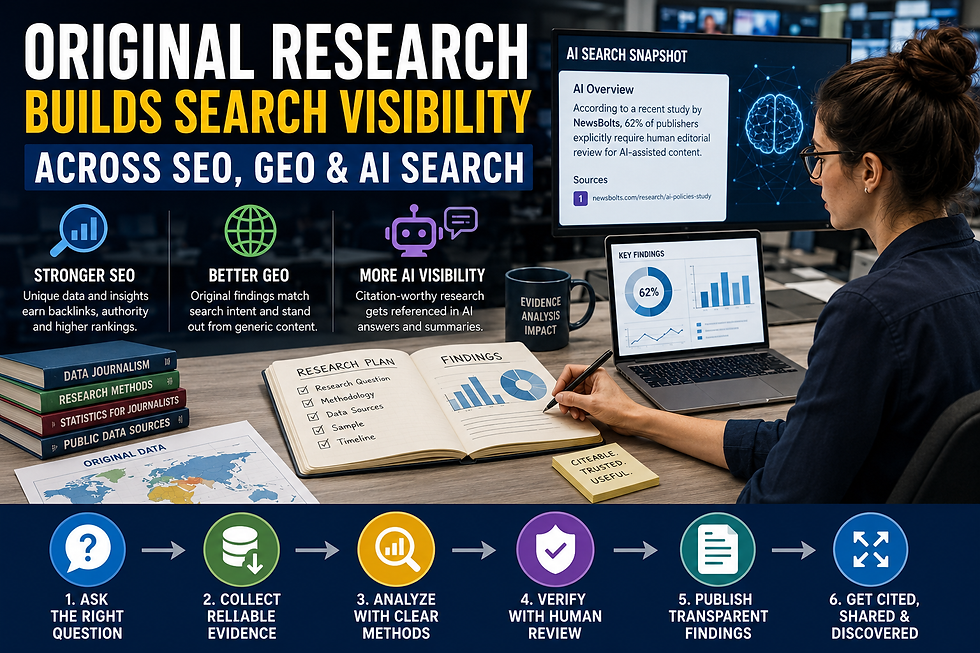
Original reporting, documented evidence, expert analysis, first-party data, and clearly attributed information provide stronger editorial value.
Google's people-first guidance explicitly encourages original information, reporting, research, or analysis and warns against simply rewriting other sources without substantial additional value.
Why Original Journalism Matters More Than Optimization Tricks
A publisher can optimize an article perfectly from a technical perspective and still produce something that nobody needs.
That is the central limitation of treating SEO, GEO, or AEO as purely mechanical systems.
Suppose ten websites publish articles explaining the same government announcement.
If every article simply rewrites the announcement, an AI system has little reason to prefer one version over another based solely on the wording.
Now consider a publisher that adds:
original reporting,
a timeline,
direct statements from relevant organizations,
primary documents,
data analysis,
historical context,
a comparison with previous announcements,
an explanation of what changes for readers.
The second article has more editorial substance.
That is the kind of differentiation publishers should pursue.
Google's generative-search guidance similarly emphasizes unique viewpoints and non-commodity content rather than content that could easily be reproduced by a generative model.
How A Newsroom Can Combine SEO, AEO, And GEO
Consider a newsroom covering a new AI regulation.
The workflow could look like this:
Story Discovery
Editors identify the announcement and determine whether it matters to the publication's audience.
↓
Source Collection
The newsroom gathers the original government announcement, legislation, official documents, company statements, and relevant expert commentary.
↓
Verification
Journalists confirm important claims against primary sources.
↓
Reporting
The newsroom adds original reporting, context, and analysis.
↓
SEO Structuring
The article receives a clear URL, descriptive title, useful internal links, appropriate metadata, and technically accessible page structure.
↓
AEO Structuring
The article directly answers questions readers are likely to ask.
↓
GEO Readiness
The article clearly identifies sources, dates, entities, evidence, methodology, and original contributions.
↓
Human Editorial Approval
An editor reviews accuracy, framing, sourcing, legal concerns, headline quality, and publication readiness.
↓
Measurement
The newsroom monitors search performance, engagement, citations, referrals, and other meaningful signals.
The important point is that SEO, AEO, and GEO happen inside the editorial workflow rather than after it.
What Publishers Should Optimize For
A common mistake is optimizing every article for the same objective.
A breaking-news article, investigative report, explainer, opinion piece, and evergreen guide do not have identical discovery requirements.
Consider this editorial decision matrix:
Content Type | SEO Priority | AEO Priority | GEO Priority |
Breaking News | High | Medium | High |
Explainer | High | High | High |
Investigation | High | Medium | Very High |
Opinion | Medium | Medium | Medium |
Data Report | High | High | Very High |
FAQ / Guide | High | Very High | High |
Live Updates | High | Medium | High |
This is not a ranking formula.
It is an editorial planning framework.
For example, an investigation may have fewer obvious question-based search opportunities than a guide, but its original reporting may make it particularly valuable as a source.
SEO, GEO, And AEO Require Different Measurements
Publishers should also avoid using one metric to judge all three.
SEO Metrics
Useful SEO measurements can include:
organic impressions
organic clicks
search queries
indexed pages
crawl issues
ranking visibility
click-through rate
organic conversions
Google Search Console remains an important source for measuring Google Search performance. Google's documentation says AI-feature traffic is included within the overall Search Console Web search reporting.
AEO Metrics
AEO is harder to measure directly because answer engines do not always expose comprehensive visibility data.
Publishers can instead monitor:
question-based queries
featured answer opportunities
impressions for question formats
engagement from informational searches
visibility of concise answer sections
referral patterns where available
These measurements should be treated as diagnostic signals rather than proof that a particular formatting change caused visibility.
GEO Metrics
Generative visibility can include:
cited URLs
AI referral traffic where identifiable
AI-generated answer appearances
citation frequency
grounding queries
pages referenced by AI systems
Bing's AI Performance reporting now explicitly exposes citation activity and grounding-query information for supported Microsoft AI experiences. Bing also warns that citation counts indicate visible references, not rankings, authority, traffic, or importance.
That distinction matters.
A citation is not automatically a business outcome.
The Most Important GEO Signal May Be Editorial Differentiation
Publishers sometimes ask:
“What schema should I add so AI cites my article?”
That question is understandable, but it can lead teams in the wrong direction.
Google explicitly says there is no special schema or AI-specific markup required for inclusion in AI Overviews or AI Mode. Existing SEO fundamentals remain important.
Structured data can still help search engines understand a page. For example, Google says Article structured data can help it understand article information such as the title, author, image, and dates.
But markup cannot manufacture original reporting.
A publisher should therefore prioritize:
Evidence before markup.
Useful reporting before keyword expansion.
Clear explanations before AI terminology.
Editorial authority before automation.
Common Mistakes Publishers Make
Treating GEO As A Replacement For SEO
This creates unnecessary complexity.
Google explicitly states that existing SEO best practices remain relevant to AI features.
Writing For AI Instead Of Readers
Content filled with unnatural phrases, repetitive definitions, and forced keywords can become worse for humans.
Google's guidance continues to emphasize people-first content rather than content created primarily to manipulate search systems.
Confusing Citations With Rankings
Being cited by an AI system does not necessarily mean the page ranks highly in traditional search.
Likewise, a citation does not automatically produce a click.
Publishing Generic Summaries
A newsroom that merely summarizes existing reporting may struggle to differentiate itself.
The stronger question is:
What did our newsroom add?
Assuming Every AI Search Engine Works The Same Way
Different systems can use different retrieval, ranking, indexing, and generation processes.
Google's AI Overviews and AI Mode can use query fan-out across related searches and sources, and Google notes that responses and links can vary across AI experiences.
That makes universal “GEO hacks” unreliable.
A Practical SEO, GEO, And AEO Checklist
Before publishing an important article, editors and SEO teams can use this checklist.
SEO Check
Is the page crawlable?
Is it indexable?
Is the URL clear?
Is the title descriptive?
Does the page satisfy the intended search?
Are important internal links present?
Is the main information available as text?
Does structured data accurately represent visible content?
Google recommends making important content available in textual form and ensuring structured data matches visible content.
AEO Check
What question does this article answer?
Is the answer immediately understandable?
Are important questions expressed as clear headings?
Are definitions concise?
Are complex explanations broken into logical sections?
Does the article address obvious follow-up questions?
GEO Check
Is the reporting original?
Are sources clearly identified?
Are important claims supported?
Are dates and entities unambiguous?
Does the article contain useful context?
Is the methodology explained where relevant?
Does the page offer information beyond a generic summary?
Is the content maintained when facts change?
Human Governance Still Matters
AI can help a newsroom discover patterns, summarize documents, classify sources, generate draft structures, identify unanswered questions, and prepare editorial material.
That does not make AI the final authority.
For journalism, the critical distinction is:
AI assistance is not editorial authority.
A human journalist or editor should remain responsible for decisions such as:
whether a claim is sufficiently verified,
whether a source is trustworthy,
whether a story should be published,
whether the headline accurately represents the reporting,
whether an allegation is fairly presented,
whether sensitive information should be included,
whether corrections are required.
This is where NewsBolts fits naturally.
A Human-Governed AI Newsroom Operating System can connect research, verification, drafting, SEO, GEO, AEO, publishing, and analytics while keeping editorial approval as a human-controlled stage.
The objective is not to remove the journalist from the workflow.
It is to give the journalist better information and better controls.
A Better Publishing Architecture
Instead of creating separate SEO, GEO, and AEO workflows, publishers can build a unified editorial architecture:
Source Intelligence
Collect relevant sources and signals.
↓
Fact Verification
Confirm important claims and identify uncertainty.
↓
Editorial Draft
Create the story or article.
↓
Search Layer
Improve discoverability, technical accessibility, metadata, and internal linking.
↓
Answer Layer
Clarify questions, definitions, summaries, and explanations.
↓
Citation Layer
Strengthen sourcing, originality, evidence, context, and entity clarity.
↓
Human Approval
Review the final publication.
↓
Distribution
Publish through the CMS and relevant channels.
↓
Measurement
Track search visibility, engagement, citations, referrals, and editorial outcomes.
This approach prevents optimization from becoming disconnected from journalism.
What Publishers Should Do
Publishers do not need three completely separate content teams for SEO, GEO, and AEO.
Instead, establish a common editorial standard.
Every important article should answer five questions:
Can search engines discover it?
Can readers understand it quickly?
Does it answer the questions people actually have?
Does it provide evidence and original value?
Would a journalist or editor stand behind every important claim?
If the answer to all five is yes, the article has a much stronger foundation for multiple discovery environments.
The NewsBolts perspective is simple:
Optimize the workflow, not just the webpage.
When source verification, editorial judgment, content structure, search optimization, AI visibility, and measurement are connected, publishers can treat search and generative discovery as parts of one publishing system.
The Future Is Not SEO Or GEO Or AEO
The distinction between SEO, GEO, and AEO is useful, but the boundaries will continue to overlap.
Search engines increasingly incorporate AI-generated answers.
AI systems increasingly retrieve information from the web.
Users increasingly ask conversational questions instead of entering short keyword phrases.
Publishers therefore need content that is:
technically accessible,
editorially trustworthy,
easy to understand,
directly useful,
well sourced,
original,
current,
and structured around real information needs.
That is not a completely new publishing philosophy.
It is an extension of good digital journalism.
The biggest strategic mistake would be to chase every new optimization acronym while neglecting the underlying asset: high-quality information that deserves to be discovered and cited.
For NewsBolts and other AI-enabled newsroom systems, the opportunity is to connect those requirements into one governed workflow where AI can accelerate research and production, but humans retain responsibility for what ultimately becomes journalism.
Conclusion
SEO, GEO, and AEO should not be treated as competing publishing strategies. SEO provides the technical and discovery foundation, AEO improves the clarity of answers, and GEO addresses visibility and citation within generative AI experiences. For digital publishers, the strongest approach is to combine all three inside a human-governed editorial workflow built around original reporting, verification, useful structure, and trustworthy information.
Frequently Asked Questions
Is GEO The Same As SEO?
No. SEO is the broader established discipline for improving discovery and visibility in search engines. GEO is an industry term generally used for improving visibility, retrieval, or citation within generative AI experiences. They overlap substantially, and strong SEO fundamentals remain relevant to Google's AI search features.
Is AEO The Same As GEO?
Not exactly. AEO generally emphasizes making content directly answer questions, while GEO usually emphasizes visibility and citation within generative AI systems. In practice, a well-written article can support both objectives.
Does Google Require Special GEO Optimization?
Google says there are no additional technical requirements or special AI-specific markup needed for inclusion in AI Overviews or AI Mode. Google recommends continuing to follow fundamental SEO practices and creating helpful, reliable, people-first content.
Can AI-Generated Content Rank In Search?
The fact that content was created with AI does not by itself determine its usefulness or visibility. Google emphasizes helpful, reliable, people-first content and warns against using automation primarily to manipulate search rankings.
How Can A News Publisher Become More Citation-Worthy?
Publish original reporting, clearly identify sources, support important claims with evidence, explain methodology when relevant, provide useful context, maintain accuracy, and add information beyond what can be obtained from a basic rewrite.
Should Publishers Create Separate GEO And SEO Articles?
Usually, no. Creating separate articles for each optimization label can create duplication and editorial inefficiency. A better approach is to build one strong article that satisfies users, search engines, and AI retrieval systems simultaneously.
How Should Publishers Measure GEO?
Where platform data is available, monitor cited URLs, citation activity, grounding queries, and AI referral traffic. Bing's AI Performance report provides citation and grounding-query information for supported Microsoft AI experiences, but Bing cautions that citation activity is not itself a measure of rankings, authority, or traffic.
What Is The Most Important Difference For Newsrooms?
SEO primarily addresses discoverability, AEO emphasizes answerability, and GEO emphasizes retrievability and citation within generative experiences. All three ultimately depend on a strong editorial foundation.


Comments