Sustainable Revenue For Small Digital Publishers

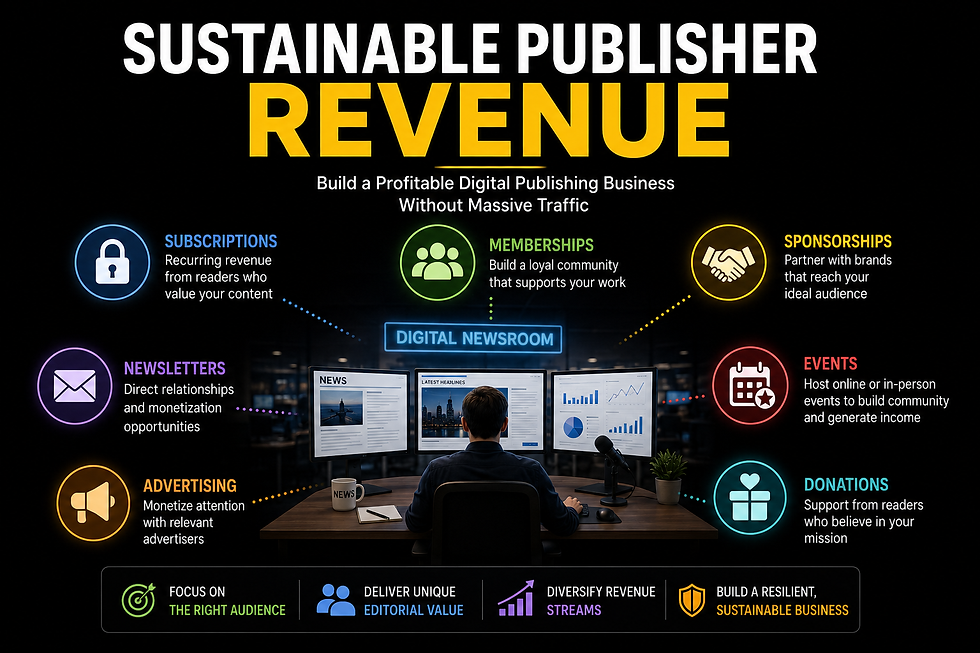
A small digital publisher can build sustainable revenue without millions of visitors by focusing on a valuable audience rather than maximum traffic. Subscriptions, memberships, sponsorships, newsletters, events, services, donations, and premium information products can complement advertising. The strongest strategy is usually to build one core revenue stream, add complementary income carefully, and measure retention, conversion, and revenue not traffic alone.
Search Intent and Editorial Direction
Primary search intent: Informational and commercial investigation.
Main reader: Small digital publishers, independent news founders, editors, newsroom operators, and media entrepreneurs.
Core problem: How to generate predictable revenue when traffic is too small for an advertising-first business model.
Primary topic: Sustainable revenue for small digital publishers.
Related concepts: Subscriptions, memberships, sponsorships, advertising, newsletters, events, donations, reader revenue, revenue diversification, publisher monetization.
What this article adds: A practical Revenue Fit Framework, a three-layer revenue model, and a simple way to connect editorial content with revenue without turning the newsroom into a collection of unrelated commercial products.
Why Traffic Alone Is Not Enough
Digital publishing often starts with a simple assumption:
More traffic = more revenue.
That can be useful at large scale, particularly for advertising businesses.
For a small publisher, however, chasing traffic without considering audience value can create an expensive growth cycle.
A publisher may spend more money creating content, marketing it, and maintaining the website while generating relatively little additional revenue.
The better question is:
How much business value can this publisher create from the audience it already serves?
This matters even more as search and social platforms change how people discover news.
The Reuters Institute's 2026 report found that publishers expect significant changes in search traffic and are placing greater emphasis on subscriptions, memberships, events, direct relationships, and new forms of distribution.
For a small publisher, this means building a business around audience value, not just audience volume.
What Does Sustainable Revenue Mean?
Sustainable revenue means generating enough dependable income to support the publisher's editorial and operating costs without relying excessively on one unstable source.
It does not mean that every article must make money.
Some content may exist primarily to attract new readers.
Other content may build trust.
Some products may generate direct revenue.
A sustainable publishing business connects these roles.
A useful model is:
Audience → Editorial Value → Relationship → Product → Revenue → Retention
If one part is missing, the business becomes harder to sustain.
For example, traffic without a relationship can be difficult to monetize directly.
A loyal audience without a valuable product may not generate revenue.
A paid product without strong editorial value will struggle with retention.
Start With the Audience, Not the Revenue Model
The biggest mistake small publishers can make is choosing a monetization model before understanding the audience.
Start with four questions:
Who is the audience?
Be specific.
For example:
Local business owners
Technology professionals
Policy researchers
Parents in a specific community
Investors
Healthcare professionals
Local residents
What problem does the audience have?
What information do they need regularly?
What makes your coverage valuable?
Is it speed, expertise, access, original reporting, analysis, local knowledge, or community?
What could the audience reasonably pay for?
The answer determines which revenue model deserves testing.
The Revenue Fit Framework
A simple NewsBolts perspective is to evaluate each potential revenue model using five factors.
1. Audience Value
How important is your content to the audience?
2. Audience Loyalty
Do people return regularly?
3. Commercial Intent
Does the audience make purchasing or professional decisions related to your coverage?
4. Differentiation
Can your publisher provide something readers cannot easily find elsewhere?
5. Operational Capacity
Can your team actually deliver the product?
Score each factor from 1 to 5.
A model that scores highly across these areas deserves more attention than a model chosen simply because another publisher uses it.
This is a strategic evaluation framework, not an industry benchmark.
The Main Revenue Options for Small Publishers
Revenue Model | Works Best When | Main Advantage | Main Challenge |
Advertising | Audience is relatively large | Easy to understand | Often requires scale |
Sponsorship | Audience is highly relevant | Can work with niche audiences | Requires sales |
Subscription | Content has strong paid value | Recurring revenue | Retention is difficult |
Membership | Community relationship is strong | Builds loyalty | Requires ongoing engagement |
Newsletter sponsorship | Audience is focused | Direct relationship | Requires engaged subscribers |
Events | Community or professional niche exists | Revenue + relationship | Operational workload |
Services | Publisher has specialist expertise | Can monetize knowledge | Can distract from journalism |
Donations | Public-interest mission is strong | Supports independent work | Revenue can be unpredictable |
Premium reports | Audience needs specialized intelligence | High-value product potential | Requires research capacity |
There is no universally best model.
The right choice depends on the publisher's audience and editorial proposition.
Advertising Should Not Be the Only Option
Advertising remains an important part of digital publishing.
But a small publisher should understand the difference between audience scale and audience value.
A general-interest publisher may need a large audience to make advertising meaningful.
A specialized publisher may have fewer readers but a more commercially valuable audience.
For example, a publication serving professionals in a specific industry could potentially attract sponsors that want to reach exactly those professionals.
This is why direct sponsorship can sometimes make more sense for a niche publisher than relying exclusively on programmatic advertising.
Direct Sponsorship for Niche Publishers
Sponsorship works best when a publisher can clearly explain its audience.
A sponsorship proposal should answer:
Who reads us?
Why does this audience matter?
What does the sponsor receive?
What editorial boundaries apply?
Possible products include:
Newsletter sponsorship
Event sponsorship
Podcast sponsorship
Sponsored sections
Research sponsorship
Topic sponsorship
The commercial relationship must remain separate from independent editorial judgment.
A sponsor can support a publication without deciding what the newsroom reports or concludes.
Subscriptions vs Memberships
Subscriptions and memberships can look similar, but the underlying relationship is different.
Subscription
The reader primarily pays for access to premium content, features, or services.
Membership
The reader pays to support the publication and may receive benefits such as community access, events, newsletters, or an enhanced experience.
For example:
Free journalism
→ Builds reach
Member relationship
→ Builds loyalty
Premium benefits
→ Create financial value
A publisher should not choose between the two simply because one is fashionable.
Ask what the audience is actually willing to pay for.
Should Small Publishers Use a Paywall?
Not necessarily.
A paywall is a mechanism for controlling access. It is not the product itself.
The product might be:
Exclusive reporting
Specialized analysis
Investigations
Data
Industry intelligence
Premium newsletters
Research
Expert commentary
If readers do not see enough value behind the paywall, simply restricting access will not create a sustainable business.
A small publisher should first identify the content or service that deserves payment.
Newsletters Can Become a Revenue Product
A newsletter should not be treated only as another way to send website links.
It can become a direct relationship with the audience.
A simple model is:
Website
→ Discovery
↓
Newsletter
→ Direct relationship
↓
Membership / Subscription / Sponsorship
→ Revenue
Possible newsletter revenue models include:
Sponsorship
Paid newsletters
Membership conversion
Subscription conversion
Premium research
Affiliate revenue where editorially appropriate
The important metric is not simply the number of subscribers.
Look at:
Engagement
Retention
Conversion
Revenue per subscriber
Audience relevance
Events Can Add Revenue and Community
Events can be particularly useful for publishers covering a defined community or professional sector.
They might include:
Roundtables
Webinars
Conferences
Workshops
Executive briefings
Community meetings
Events can create two types of value.
Financial value: Ticket sales and sponsorship.
Editorial value: Direct relationships with the audience.
Reuters Institute's 2026 research found that online and physical events were an important part of publishers' diversification strategies, with 54% of surveyed publishers identifying them as a revenue focus.
That figure describes surveyed publishers overall, not small publishers specifically, so it should not be treated as a benchmark for an individual business.
Services Can Monetize Publisher Expertise
Some publishers have specialist knowledge that can be packaged into services.
Examples include:
Research
Training
Professional briefings
Custom reports
Workshops
Data products
Industry intelligence
This can be particularly useful for specialist publications.
But there is a risk.
If commercial services consume too much editorial capacity, the publisher can lose focus.
A service should therefore pass a simple test:
Does this strengthen the publisher's expertise and business without weakening its journalism?
Donations and Grants
Donations and grants are particularly relevant to nonprofit and public-interest publishers.
The Institute for Nonprofit News' 2026 Index found that 49% of its members used at least four distinct revenue streams in 2025. It also reported that earned revenue including sponsorships, advertising, and events accounted for 17% of total revenue across its membership, while foundation funding remained a major source of support.
These figures apply to INN's nonprofit membership and should not be treated as a universal model for commercial publishers.
The broader lesson is useful, though:
Diversification can reduce dependence on a single source.
Do Not Launch Ten Revenue Streams at Once
Diversification sounds attractive.
But for a small newsroom, too many products can create another problem: operational complexity.
A five-person newsroom could theoretically launch:
Membership
Subscription
Podcast
Events
Merchandise
Consulting
Courses
Advertising
Newsletter sponsorship
Research reports
That does not necessarily create a stronger business.
It may create ten partially managed businesses.
A better approach is the 3-Layer Revenue Model.
The 3-Layer Revenue Model
Layer 1: Core Revenue
Choose the primary revenue source.
Examples:
Subscription
Membership
Sponsorship
Donations
Layer 2: Complementary Revenue
Choose a second model that fits the same audience.
Examples:
Newsletter sponsorship
Events
Advertising
Layer 3: Experimental Revenue
Test one new opportunity at a time.
Examples:
Premium report
Course
Data product
New sponsorship package
This approach gives the publisher diversification without unnecessary complexity.
Build Content Around Business Value
Not every article should have the same job.
A useful publishing portfolio might look like this:
Breaking news
→ Reach
Explainers
→ Search discovery
Investigations
→ Trust and differentiation
Analysis
→ Premium value
Newsletter
→ Retention
Events
→ Community
Research
→ Premium revenue
This allows editors to understand why different content types exist.
The goal is not to force every article to generate direct revenue.
The goal is to build a system where editorial work contributes to audience growth, trust, retention, or revenue.
A Simple Publisher Economics Model
Small publishers should calculate the economics of each revenue model before investing heavily.
Consider this hypothetical example:
1,000 members × $5/month = $5,000
2 sponsors × $750/month = $1,500
Advertising = $500/month
Events, averaged monthly = $1,000
Total:
$8,000/month
Annualized:
$96,000/year
These numbers are purely illustrative. They are not NewsBolts data or industry benchmarks.
The important lesson is the structure.
A publisher can build a revenue target from several manageable sources rather than expecting one source to provide everything.
Revenue Per Reader Is More Useful Than Traffic Alone
Suppose Publisher A has:
500,000 monthly visitors
but very little direct revenue.
Publisher B has:
25,000 monthly visitors
and a strong subscription, membership, or sponsorship business.
The second publisher may have a stronger business despite having less traffic.
This is why publishers should examine metrics such as:
Revenue per visitor
Revenue per subscriber
Revenue per member
Newsletter conversion
Retention
Traffic remains useful.
But it should be connected to economic outcomes.
AI Can Change the Cost Side of the Business
Revenue is only half of publisher economics.
The other half is cost.
AI can assist with repetitive newsroom operations such as:
News monitoring
Source organization
Fact Pack creation
Draft assistance
Metadata preparation
SEO/GEO/AEO optimization
Content repurposing
Workflow management
Analytics
The Reuters Institute's 2026 report found that 97% of surveyed publisher respondents considered back-end AI automation important, while 82% identified newsgathering as an important AI application.
That does not mean AI automatically makes a newsroom profitable.
It means publishers are increasingly exploring AI as part of their operating systems.
For NewsBolts, the appropriate model is:
AI assistance + workflow automation + human editorial authority
AI can help reduce repetitive work.
Editors remain responsible for:
Source verification
Accuracy
Context
Editorial judgment
Ethics
Final approval
A Practical Revenue Workflow
Small publishers can use this process:
Step 1: Define the Audience
Write down exactly who the publication serves.
Step 2: Identify the Core Value
What does the publisher provide that readers cannot easily get elsewhere?
Step 3: Identify the Strongest Relationship
Is the audience most engaged through the website, newsletter, community, events, or another channel?
Step 4: Select One Core Revenue Model
Choose the model with the strongest audience fit.
Step 5: Create a Clear Product
Define exactly what the paying customer receives.
Step 6: Test
Run a limited offer before building a complicated system.
Step 7: Measure
Track conversion, revenue, retention, and operating cost.
Step 8: Add One Complementary Revenue Stream
Only after the core model has enough evidence to justify expansion.
NewsBolts Revenue Framework
For NewsBolts, the broader publisher workflow can be viewed as:
Discover
↓
Verify
↓
Create
↓
Optimize
↓
Publish
↓
Distribute
↓
Measure
↓
Repurpose
↓
Monetize
AI can support multiple stages of this workflow.
For example, better news intelligence can help identify important stories.
Fact Packs can organize evidence.
AI-assisted drafting can reduce repetitive writing work.
SEO/GEO/AEO workflows can improve discoverability.
Analytics can identify which content attracts and retains the right audience.
Content repurposing can extend the value of existing editorial work.
But human editors remain responsible for the journalism.
This is where NewsBolts should be understood as a Human-Governed AI Newsroom Operating System, rather than simply an AI writing tool.
What Publishers Should Measure
A sustainable revenue dashboard should go beyond pageviews.
Audience Metrics
Returning visitors
Newsletter subscribers
Registered users
Engaged readers
Revenue Metrics
Monthly recurring revenue
Sponsorship revenue
Subscription revenue
Membership revenue
Event revenue
Conversion Metrics
Visitor-to-subscriber conversion
Newsletter-to-member conversion
Trial-to-paid conversion
Retention Metrics
Subscription cancellations
Membership renewal
Repeat purchases
Repeat event participation
Editorial Economics
Content production cost
Production time
Revenue contribution
Staff capacity
The key question is:
Which editorial activities create the most sustainable value for the business and audience?
Common Mistakes Small Publishers Make
Chasing Traffic Before Building Value
More visitors do not automatically mean more sustainable revenue.
Depending Entirely on Advertising
Advertising can be useful, but relying on one source creates concentration risk.
Copying Large Publishers
A national newspaper's business model may not work for a small specialist publication.
Launching Too Many Products
A small team needs focus.
Putting Everything Behind a Paywall
A paywall does not create value by itself.
Ignoring Retention
Acquiring a paying customer is only the beginning.
Mixing Commercial and Editorial Decisions
Sponsors should not determine independent editorial decisions.
Treating AI Efficiency as Guaranteed Savings
AI can reduce some repetitive work, but implementation, oversight, verification, and training also have costs.
Risks and Limitations
No revenue strategy works for every publisher.
Subscriptions require strong perceived value.
Memberships require community and ongoing engagement.
Sponsorships require sales capability.
Events require operational resources.
Donations can be unpredictable.
Services can distract from journalism.
Advertising can be vulnerable to changes in traffic and market conditions.
AI can reduce repetitive workload but can also introduce risks involving inaccurate information, source handling, and inappropriate automation.
The answer is not to eliminate these risks.
It is to understand them before choosing a model.
What Publishers Should Do
If you operate a small digital publication, start with one page.
Write down:
Our audience: Who exactly are we serving?
Our unique value: What do we provide better than general publishers?
Our strongest relationship: Where do our most engaged readers interact with us?
Our potential paying customer: Who has a reason to pay?
Our core revenue model: Which model fits the audience?
Then calculate a simple target.
For example:
Required monthly revenue
÷
Expected revenue per customer
=
Required paying customers
This is much more useful than setting a vague goal such as "we need more traffic."
Sustainable Revenue Is About Audience Quality
A small publisher should not automatically try to become a smaller version of a mass-market media company.
Its advantage may be specialization.
A publication serving a focused audience can build around:
Expertise
Trust
Community
Access
Original reporting
Professional usefulness
Local knowledge
That can create commercial opportunities that depend less on raw traffic volume.
The Reuters Institute's 2026 research found that subscription and membership remained the biggest revenue focus among surveyed publishers, while events and other diversified models also received significant attention.
The lesson for smaller publishers is not that subscriptions are automatically the answer.
The lesson is that direct audience relationships are increasingly important to publisher economics.
Conclusion
Small digital publishers do not need massive traffic to build a sustainable business.
They need a valuable audience, a clear editorial proposition, and revenue models that fit the relationship they have with that audience.
A practical strategy is:
Find the right audience → create differentiated value → build a direct relationship → develop one core revenue product → add complementary revenue → measure retention and economics.
Advertising can remain part of the mix.
But publishers can also consider:
Subscriptions + Memberships + Sponsorships + Newsletters + Events + Services + Donations + Premium Products
The objective is not to launch all of them.
The objective is to find the combination that fits the publisher's audience and operational capacity.
For NewsBolts, AI can support the operating layer behind this model—from news intelligence and verification through production, optimization, publishing, analytics, and repurposing—while humans retain editorial authority.
The sustainable newsroom is therefore not necessarily the one with the most traffic.
It can be the one that understands its audience best, produces information people value, and converts that value into a business model that can continue supporting the journalism.
FAQs
Can a small digital publisher make money without millions of visitors?
Yes. A publisher can build revenue around a smaller, highly relevant audience through subscriptions, memberships, sponsorships, events, services, newsletters, donations, or premium products. There is no universal traffic threshold that guarantees profitability.
Is advertising enough for a small publisher?
It can be part of the model, but an advertising-only strategy may be difficult when traffic is limited. Combining advertising with direct revenue can reduce dependence on one source.
Are subscriptions better than advertising?
Not necessarily. Subscriptions work when readers see enough value to pay. Advertising works when a publisher can attract sufficient valuable attention. The right model depends on the audience.
How can a niche publisher attract sponsors?
Define the audience precisely, explain why that audience matters, and create clear sponsorship products. Editorial independence should remain separate from the commercial relationship.
Should small publishers use a paywall?
Only when they have content or services that readers consider valuable enough to pay for. A paywall controls access; it does not create the underlying value.
Can newsletters generate revenue?
Yes. Newsletters can support sponsorships, paid subscriptions, memberships, and other publisher products. Their value depends more on audience relevance and engagement than subscriber count alone.
How many revenue streams should a small publisher have?
There is no universal number. A practical starting point is one core revenue stream, one complementary stream, and one carefully controlled experiment.
Can AI help small publishers improve profitability?
AI can assist with repetitive newsroom and publishing workflows, potentially freeing staff capacity for higher-value work. It does not guarantee profitability, and humans should retain responsibility for editorial verification and final decisions.



Comments